
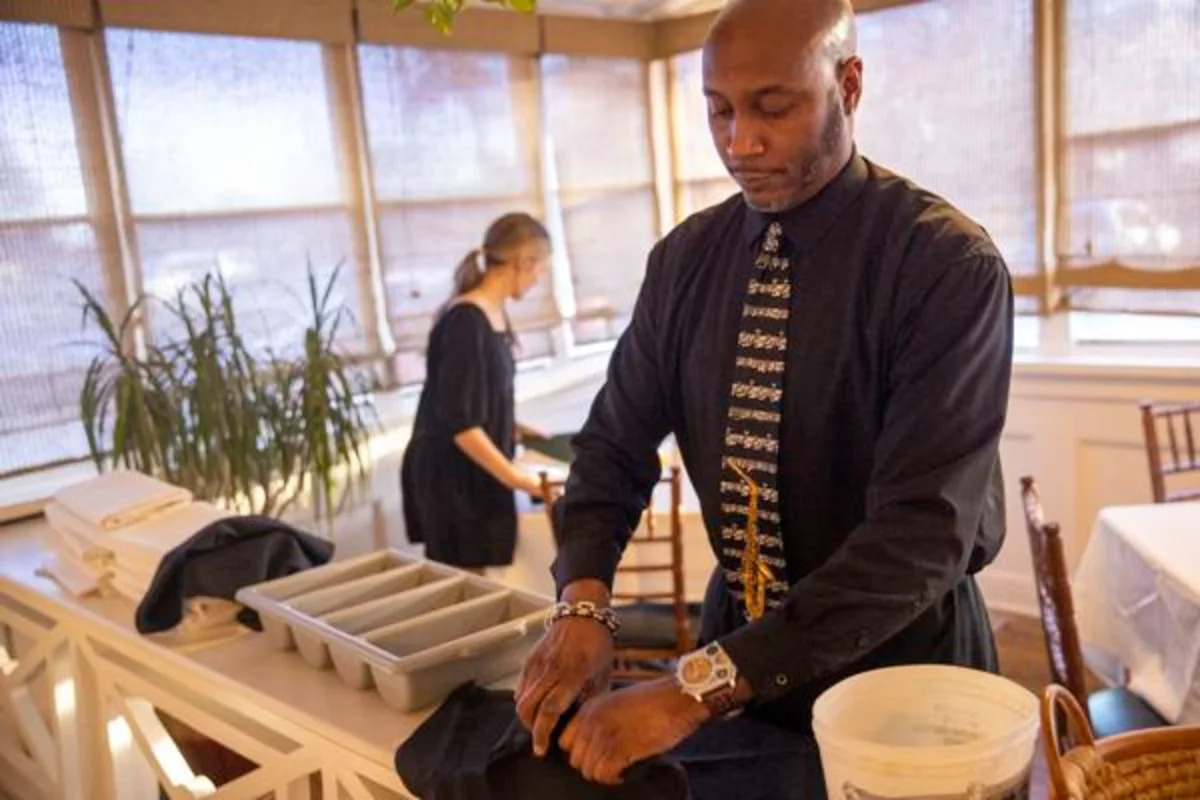

How much should Charleston diners be tipping these days? That’s one of the topics we’ll discuss in today’s Tip Jar. File/Staff
The other day, I placed an order for a latte at my favorite drive-thru coffee shop. After reaching the window, I was given a handheld terminal to insert my credit card. The attendant had another request after I scribbled my signature: “There’s just one more question for you to answer,” they said.
It was a not-so-subtle way of asking me to leave a tip.
Taking back the machine, I gave in to the pressure of the moment and added 20 percent to my $8-plus coffee. I drove away feeling a sense of regret for having spent so much money on my morning caffeine.

Tip Jar is a column from The Post and Courier where Food & Dining Editor Parker Milner answers readers’ questions about Charleston’s restaurants and dining scene. Matt Hill/Special to The Post and Courier
I know what you might be thinking: “Why don’t you just make coffee at home if you’re so concerned about the cost?” It’s a fair point, and exactly what I did the next day. But that hardly addresses the arguably out-of-control tipping culture facing diners across the country.
Like the reader who sent in our first Tip Jar inquiry of the day, I also want to support local hospitality workers. But with restaurant prices rising and tip screens showing up in more and more untraditional places — from airport kiosks to Hallmark stores — what’s a cost-conscious diner to do? That’s where we’ll start in today’s Tip Jar.
Submit your restaurant, dining and food questions, along with your first name and the neighborhood where you live, to tipjar@postandcourier.com.
Dear Tip Jar,
Tipping etiquette used to be simple. A solid 15 to 20 percent for sit-down service, a couple bucks for takeout. Now it feels like every screen is asking for 20 to 28 percent, whether I’m sitting down or just grabbing food or a drink off the counter. I want to support local hospitality workers, so I’m curious: What’s actually expected these days?
— Chris, Summerville
Hey Chris, you were one of several diners who asked about tipping after I answered a question about taxes and fees on Charleston restaurant bills in August. It’s taken me a while to get to it because, well, tipping is a complex topic.
You’re not the only one thinking about it, either. More than 80 percent of Americans think tipping has gotten out of control, according to a 2026 WalletHub survey. And more than half of respondents said they often leave a tip due to social pressure rather than good service.
Still, diner exasperation hasn’t truly impacted tipping at restaurants, according to a recent study by management platform Toast that was published in Food & Wine magazine.
Based on data from card and digital transactions at about 180,000 U.S. restaurant locations, tipping has remained stable over the last eight years, with full-service restaurant tips ranging from 19.1 percent to 19.9 percent and quick-service tips hovering between 15.8 percent and 16.8 percent.
As I noted above, digital point-of-sale machines that ask customers to choose a tip before tapping a credit card might be playing a role in the continued tip consistency.
Conscientious diners also know that, in South Carolina, employers can pay tipped employees as little as $2.13 per hour, more than $5 below the federal minimum wage. That means that, right or wrong, our system for compensating restaurant servers relies on diners’ willingness to make up the difference.
Given that landscape, the percentage you tip at full-service restaurants should not necessarily be a grade on the server. While the service at many dining destinations is far from perfect, at least 20 percent should still be the standard, with some basing the percentage off of the pre-tax amount and others taking it from the full bill.
Tipping, however, has spread to businesses that offer little in the way of traditional service, contributing to diner frustration. This is having an unintended consequence on Charleston-area restaurant servers, one of whom told me she’s recently experienced a decline in tips.
I’m not here to tell you who you should and shouldn’t tip, but I do think the style of the establishment you’re visiting can factor into the equation.
At counter-serve eateries, the decision can vary based on what you order and how much it costs. For instance, I don’t think it’s necessary to add a tip to the already high-priced $13 smoothie or $8 coffee, though I often find myself doing so if the person is friendly and remembers my name. Many will say that tipping at counter-serve spots and on takeout orders is optional, too, though restaurant owners may disagree with that sentiment.
Here’s the bottom line: Tipping in the U.S. is a broken system that many believe should go away, but that likely won’t happen any time soon. We shouldn’t punish the hard-working food-and-beverage workers for the structure they inherited.

Tipping etiquette isn’t as straightforward as it used to be, as tip screens show up in more and more places. So what’s actually expected these days? Food & Dining Editor Parker Milner shares some guidance. Send in your restaurant-related questions to tipjar@postandcourier.com, and we will answer them in a future column.
Hi Parker,
Enjoy your “tip jar” very much. My question is: Why do some restaurants serve shrimp with the heads on? To me, it is a waste, a mess trying to de-head while the rest of your meal gets cold, and it is not an attractive presentation. Thanks so much.
— Carol, downtown Charleston
This question reminded me of Stephen Colbert’s hilarious rant about restaurants leaving the tails on shrimp, which is just as off-putting to many diners as shrimp heads are to you, Carol. And I see your point: dishes in which temperature is a factor are best served ready to eat.
I imagine the heads are left on mostly for presentation purposes, as well as to add a more intense shrimp flavor. But, to your point, if dinner is cold by the time you deconstruct the dish, the exercise is all for naught.
Hi, could you possibly post something about the restaurants that have Thanksgiving dinners this year?
— Robin
Hey Robin, multiple restaurants in Charleston have announced they will open on Thanksgiving Day this year, including Pelato, which will offer its full menu plus holiday specials.
Sorelle is serving a family-style meal of seasonal selections, such as turkey confit arancini, chestnut agnolotti, heritage roasted turkey and festive desserts, while Oak Steakhouse’s full menu will be available alongside a separate prix fixe meal.
At Edmund’s Original, chef Bob Cook will serve his annual holiday buffet, and Post House in Mount Pleasant will offer a three-course prix fixe menu from noon-7 p.m. on Thanksgiving Day.
In addition, several restaurants and caterers have announced Thanksgiving to-go options. They include Rosemary & Rye, NICO Oysters + Seafood, Magnolias, Hank’s Seafood Restaurant and Lillian’s Petite Market & Eatery, among others.
Dining and Cooking