

An alum of notable New York City Persian restaurants like Sofreh and Eyval is opening up his own fast-casual restaurant dedicated to Persian wraps. Chef Soroosh Golbabae is opening Āzar in Williamsburg at 740 Driggs Avenue, at South Second Street, on Saturday, November 7.
Golbabae is focusing on the idea of loghmeh, a Persian word that means “morsel” or “perfect bite.” He explains, “Loghmeh is a super-easy homey concept that never made it out of the home,” and he’s doing something about that. To that end, Āzar is serving lavash flatbread wraps with Persian fillings that aren’t overly huge.
His version of the Iranian home dining staple ghormeh sabzi ($12) is made with beef cheeks instead of the typical lamb. “Beef cheeks are a favorite cut, and it’s really hot right now, so let’s try it,” he says. It’s cooked in a herby stew with kidney beans and black limes, “until the herbs are really incorporated with all that meat flavor,” he adds, and is garnished with fresh white onions.

The food spread at Āzar. Noah Fecks
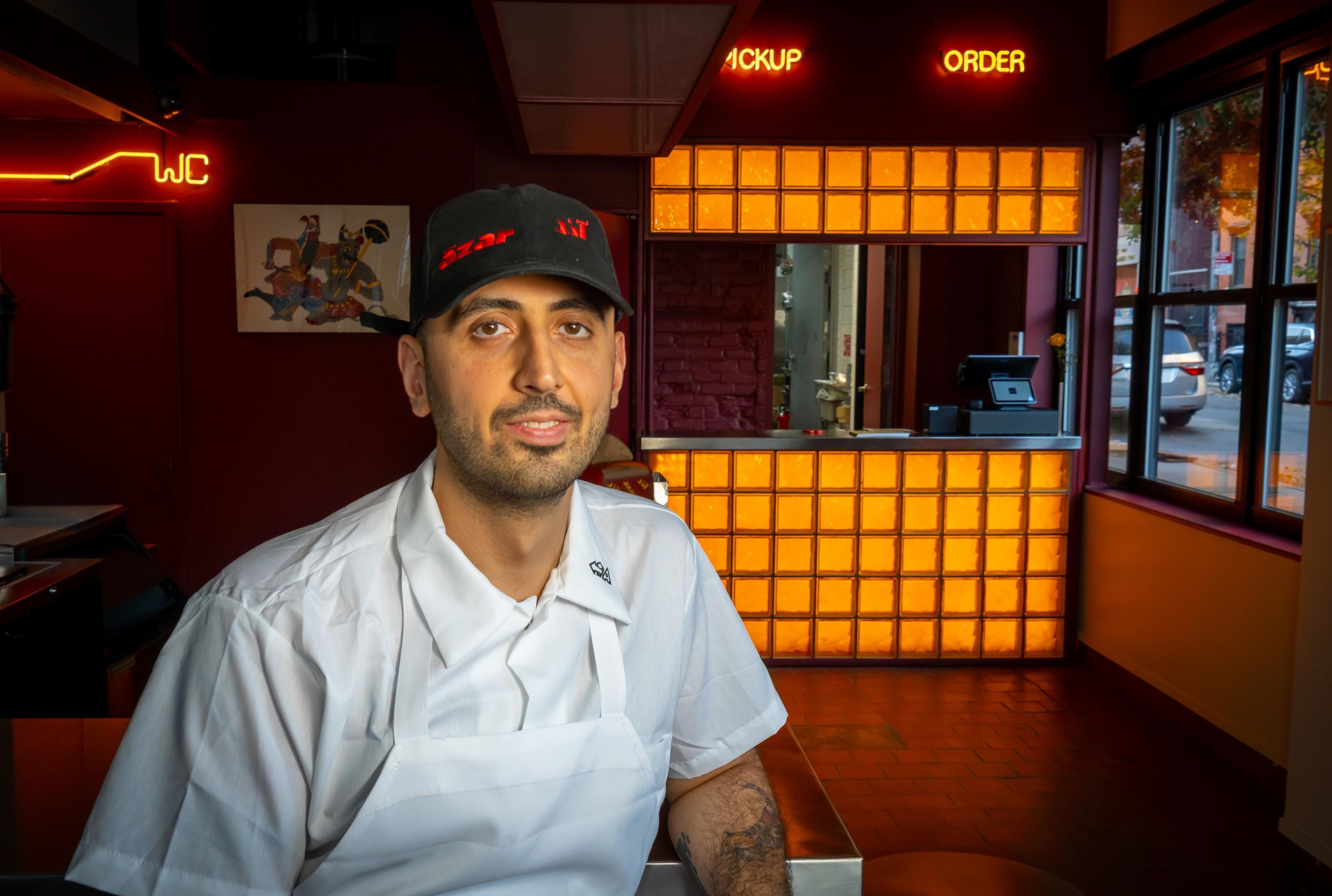
Soroosh Golbabae at Āzar. Noah Fecks
Then there’s the koobideh ($12), with a mixture of grilled ground lamb and beef made with saffron butter, plus sumac onions, grilled tomatoes, and fresh basil. The chicken fesenjoon ($9) will be on the menu through the spring; it’s a bright filling with a pomegranate-walnut sauce, grilled chicken thighs, and pickled red cabbage. The vegetarian option is the kashk bademjoon ($9) — a “super-comforting eggplant dish,” he says. “To me, it’s the umami of Persian cuisine.” It’s made with a slow-cooked eggplant, kashk (Persian whey), and crispy onions.
He made his own lavash recipe with some whole wheat flour to add structure, as well as butter “to make it more delicious, more aromatic, and, when it reheats or holds the food, it adds a little more strength.” It’s baked in the on-site pita oven.
Golbabae had been working on the idea for some time; “Āzar is on the back burner, cooking for a long time,” he tells Eater. He knew the name from the beginning, after his mother. He grew up in Tehran, watching his mother shop and cook. “I had that education growing up without even understanding it in the beginning,” he says.

The zereshk tanchin at Āzar. Noah Fecks
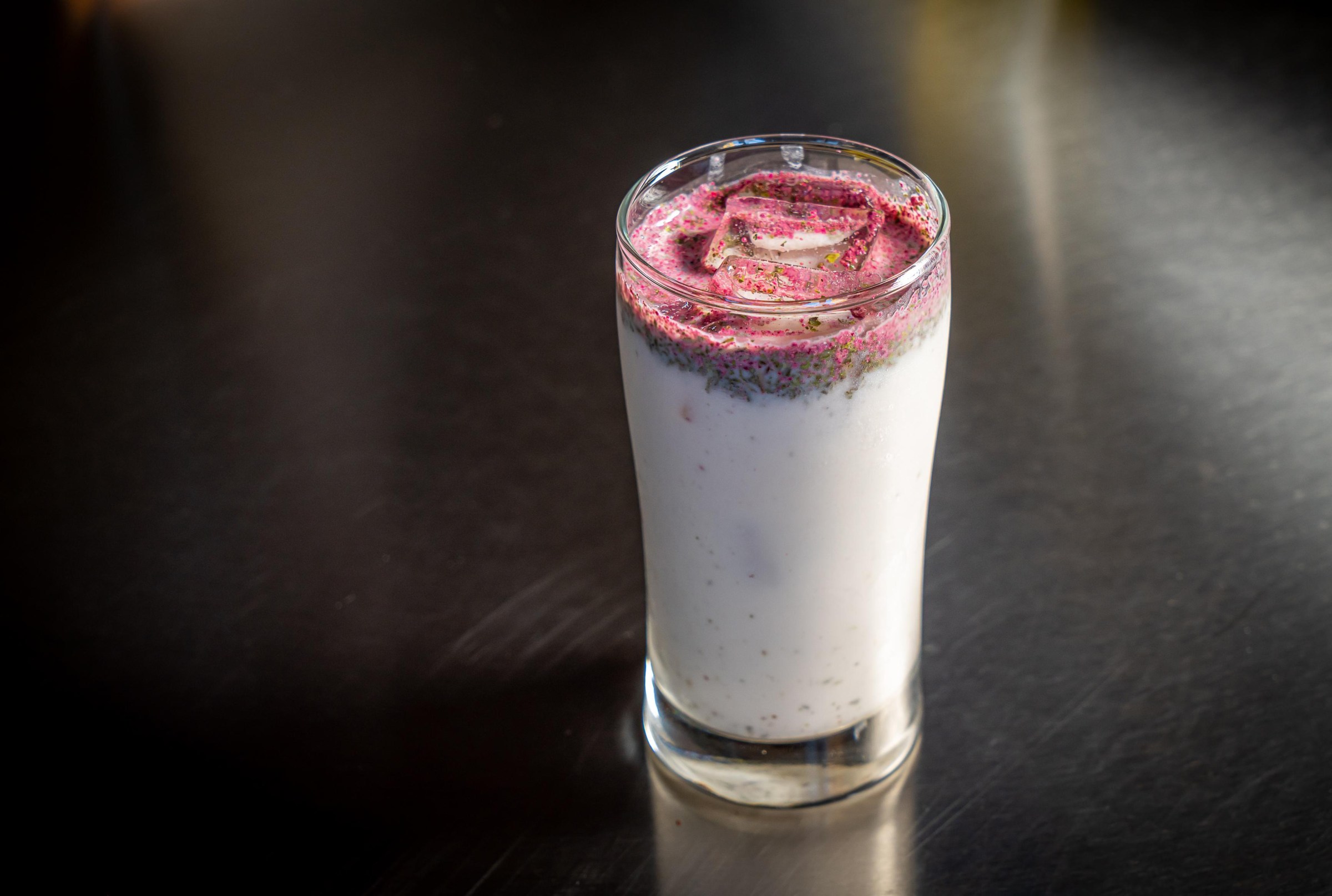
The doogh drink at Āzar. Noah Fecks
Look for sides like the tahchin ($8), a smaller take on the iconic Persian rice dish. He shares that he’s generally particular about tahchin. For this one, he went for a “softer, jasmine-like rice; we overcook it intentionally to get a little mushy,” he says. It gets seasoned with yogurt, egg yolks, saffron, and salt “so it becomes really nice and moist and fatty — kind of sticky.” While it’s typically stuffed with meat, vegetables, or barberries, he opted to serve it with the zereshk sauce (made with barberries and prunes) and pistachios for that cold-hot temperature combination. “Two things I really like to play with when I’m coming up with dishes are temperature and texture,” he says. “If you can get a few things in one bite, it’s just amazing; it’s a unique experience.”
Drinks include saffron sherbat ($5), made with basil seeds and lime (“super-refreshing, he describes); and doogh ($5), the yogurt drink with dry mint and rose that gets steeped overnight.
Growing up in Tehran, Golbabae frequented local street carts, kebab shops, and restaurants, and eventually worked at a few places. He worked there for a bit, and then moved to New York City to attend the Culinary Institute of America, but he wanted to go back to learning more about Persian cuisine. “I started digging [into all the old Persian recipes, thinking about how we can do that, how we can dress it in a different way that New York likes and also not lose the authenticity of it,” he says.
That’s when he ended up on the opening team of Prospect Heights restaurant Sofreh (which opened in 2018) and Bushwick’s Eyval; and then he was the opening chef and chef de cuisine of Park Slope Lebanese restaurant Sawa. He also ran Persian pop-ups and worked as a private chef.
All the while, he knew that the Persian community was looking for restaurants that were more accessible and affordable. “In a lot of restaurants nowadays, in many different cuisines, they are inspired by street food, but by the time the food goes on the table, to me, it’s not anymore because they played with it too much — I’m guilty myself — but I was like, maybe this is the time to take a little risk and come out of that comfort zone,” he explains.
He met Fardad Zabetian, who founded Kudo, a live-translation program, during a pop-up, and they teamed up to open Āzar.

Āzar’s dining room. Noah Fecks

Āzar’s exterior. Noah Fecks
The 350-square-foot counter-service space is small, with only 10 seats. It’s designed by architecture firm Roudiani.Harelson. Golbabae talks about how the firm’s co-founder, Bahar Roudiani, immediately understood his Iranian architectural references because she lived in Iran. He’d ask her about old houses in Iran and stainless steel details in the Albanian sandwich shops, and she knew them all. For Āzar, that means a stainless steel counter and amber glass blocks.
The walls feature artwork by fellow Iranians and Iranian Americans. Sina Choopani, who runs Tehran-based silk-screen print studio Garage.co, has some silk prints up. Zeynab Izadyar, the founder of Vvork Vvork Vvork, has patched-together quilts. The sound system is thoughtful too, not too loud, but still fun; it was built by the Bakery Studio’s Behrooz Afghahi and Nima Vakili.
“I want to show everyone we can do quick-service but with a little bit of vibe with a little bit of taste,” Golbabae says. Its name also works two-fold: it’s Farsi for “fire,” which Golbabae sees as an element that brings people together. “Wherever you see fire, you just go and look at it, or be around it,” he says.
Āzar’s hours will be from noon to 9 p.m. Wednesday through Sunday.
Dining and Cooking