

By Rachel Crumpler
Key Takeaways:
Thousands of North Carolinians with felony drug convictions may not be able to get SNAP benefits — sometimes for life.
Formerly incarcerated people affected by the permanent ban say it makes it harder to rebuild their lives in the community.
Bipartisan efforts to lift the restrictions stalled in the N.C. General Assembly last year.
Jennifer McCord, who became disabled in 2021 after a drunk driver crashed into her car, relies on $994 in Social Security disability income each month.
Nearly $700 goes toward rent for a studio apartment in Asheboro. Then she pays her phone, internet and car bills. Typically, she said, she has $30 to $50 left for food each month. Sometimes, there’s nothing.
That happened in August when she faced additional expenses for property taxes and a car inspection. A few weeks ago, she stood in a Food Lion parking lot asking strangers if they would buy her some food.
“I was like, ‘I’m not asking for cash. I truly need food. I have no food in my home,’” McCord said.
She said a pastor agreed and bought her about $100 worth of groceries.
Based on McCord’s income alone, she would qualify for the Supplemental Nutrition Assistance Program, or SNAP, which provides food benefits to more than 1.2 million low-income North Carolinians who struggle to afford food.
But she is permanently ineligible because of a 2009 drug trafficking conviction. She spent seven years in a North Carolina prison and was released in February 2016.
 Jennifer McCord faces food insecurity but is ineligible for SNAP benefits because of because of restrictions tied to her felony drug conviction.
McCord is one of thousands of North Carolinians affected by a policy that restricts SNAP eligibility for people with felony drug convictions. Some face temporary exclusions, while others, like McCord, are barred from receiving SNAP benefits for life.
“They take my food for the rest of my life because of a choice I made when I was 23, which I know I shouldn’t have done,” said McCord, now 42. “It really does affect me daily.”
McCord said the exclusion has contributed to a near-constant struggle to put food on her table — first after her release, when she had no savings and was trying to rebuild her life, and later when she lived out of her car for months after her divorce.
Now, her health has declined and the stakes are even higher.
McCord was diagnosed with breast cancer in February. Doctors are recommending a double mastectomy and several rounds of chemo and radiation, she said. But before treatment can begin, her doctor told her she needs to improve her nutrition. The prescription: protein drinks like Boost and Ensure — which cost about $2 for an eight-ounce bottle — to help build up her strength.
“I’m so small, and my body isn’t going to be able to take six rounds of chemo and six rounds of radiation without having proper nutrition,” she said.
McCord has relied on food pantries and food banks over the years and keeps a schedule for when she can visit local sites. But she said they don’t always provide enough food, particularly as some are increasingly strained from an influx of demand for assistance due to changes to federal food aid, including expanded work requirements.
Her nausea also makes some of the foods commonly available at food pantries — such as spaghetti sauce — difficult to eat.
“I’m literally sitting here hungry,” she said.
Targeting drug-related convictions
Thirty years ago, Congress passed the Personal Responsibility and Work Opportunity Reconciliation Act of 1996 as part of a Clinton-era welfare reform package. A provision, which received only two minutes of debate after it was introduced, created a federal lifetime ban on SNAP benefits for people convicted of drug-related felonies. The aim was to discourage drug crimes.
The language gave states the ability to set their own policies, and soon after implementation, some states began modifying the restrictions.
Just over half of states and Washington, D.C., have since passed legislation to fully opt out of the federal ban. Dozens of other states — including North Carolina — have modified the ban, including by adding drug testing or drug treatment as a condition of receiving SNAP payments.
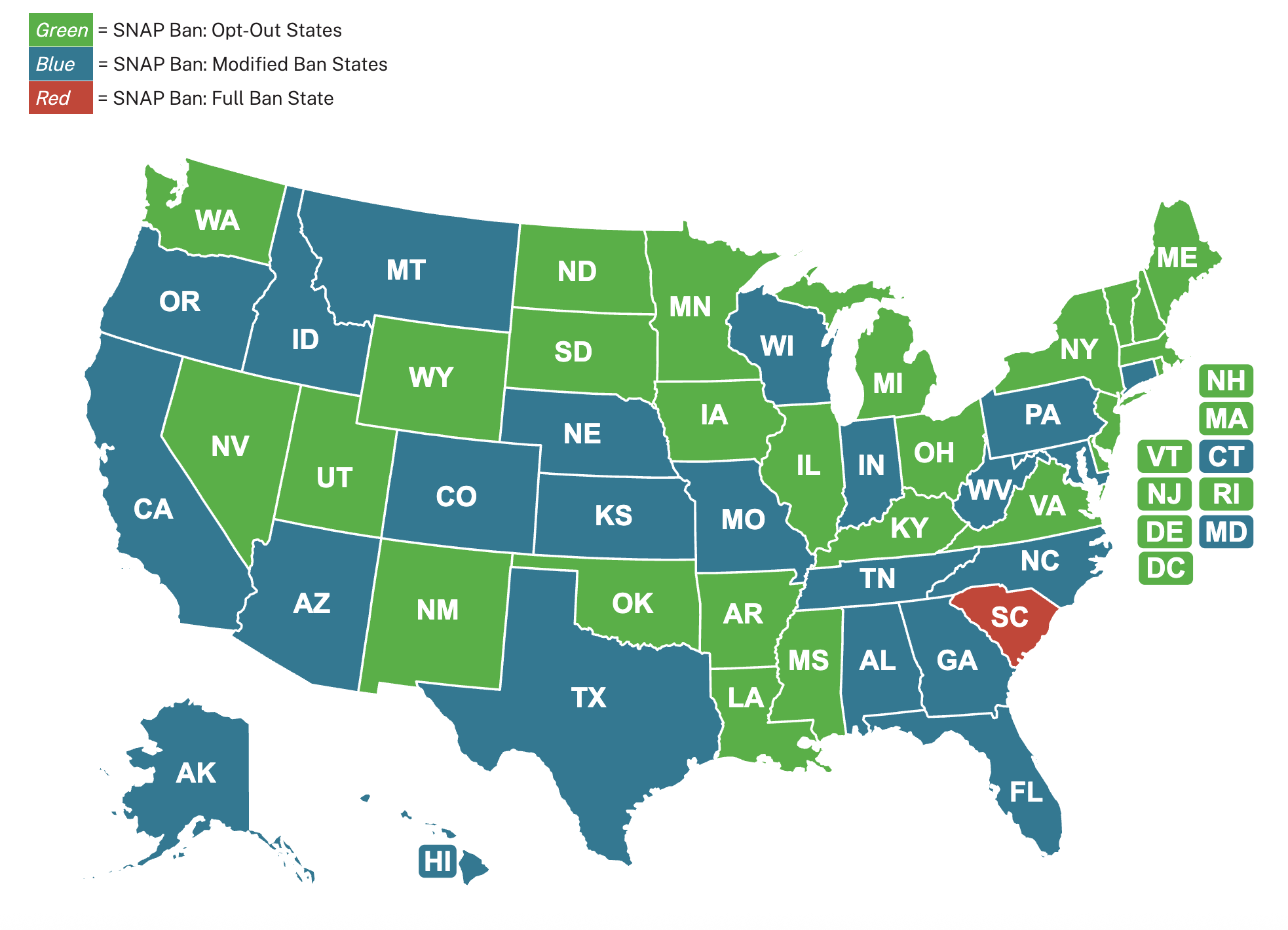 As of April 2026, just over half of U.S. states have opted out of a 1996 federal law banning people with drug-related felony convictions from receiving SNAP benefits for their lifetimes. Dozens of others — including North Carolina — have partial bans.
In North Carolina, people with low level felony convictions are barred from accessing SNAP benefits for at least six months after completing their sentence and must comply with certain requirements, such as drug treatment, to regain access. Those with more serious Class A through G felony drug convictions face a lifetime SNAP ban.
“From my assessment of the national landscape — outside of South Carolina — we have one of the harshest felony SNAP ban laws in our nation,” said Laura Webb, director of the Fair Chance Criminal Justice Project at the North Carolina Justice Center.
South Carolina is the only state that hasn’t modified the federal policy and enforces a lifetime SNAP ban for people with drug-related convictions. Webb said North Carolina is “just a step above” by allowing a select group of people to regain eligibility, while leaving many others subject to the lifetime ban.
About 16 percent of North Carolina’s state prison population of more than 33,000 are incarcerated for drug crimes, according to N.C. Department of Adult Correction data. In 2025 alone, 4,924 people were released to the community after serving time for drug offenses.
“For people who are coming back, particularly people who have felony convictions, who have a rough time finding employment, which they need to help them make income to buy food for themselves and their family, often SNAP is a lifeline for them,” Webb said. “To deny them [SNAP benefits] because of a past mistake is cutting off that lifeline, which undermines their ability to re-enter. It undermines health outcomes, and it also undermines public safety.”
‘Perpetual punishment’
When Brent Bailey was released from prison in 2004, one of the first things he did was apply for SNAP benefits as he tried to get back on his feet. But he was blindsided when he was denied benefits and told his 1999 drug felony conviction excluded him.
He thought SNAP could serve as a bridge helping to meet his needs while he rebuilt his life. Instead, he was left to scramble without it.
Now coordinator of the Buncombe County Reentry Council, Bailey said he repeatedly sees people encounter the same barrier after returning home from prison or jail.
“I have seen it time and time again, just the disappointment of people coming out with all of this hope and being inspired and then to get that denial where they go ‘It ain’t even no need of trying, cause I’ma just keep getting these no’s,’” Bailey said. “People are still getting out today who do not know that’s the law.”
In some cases, people like Gina Jacobs are initially approved to receive SNAP benefits before being told they are ineligible due to their conviction.
“We all have to eat — that’s the bottom line,” said Jacobs, who was released from state prison in 2018 after serving time for a drug trafficking conviction. “Eligibility for SNAP should just be about the financial need of somebody, not based on any conviction.”
For people returning from incarceration, the challenges stack up. Finding employment is often difficult: Only 37 percent of individuals exiting prison in 2024 found employment within a year after their release date, according to N.C. Department of Commerce data. Those who found work made an average of just $15,560.
Daquan Peters, who was released from federal prison in 2019 and returned to Wilmington, said being denied SNAP benefits because of his drug conviction felt like he was being set up to fail. He said he was determined not to revert to his old ways of selling drugs to make money, but said the lack of food aid made rebuilding his life harder.
He eventually found a job, but said he wasn’t making a living wage and finding enough to eat was a daily struggle.
McCord said at an especially low point about four years ago when she was homeless living out of her car, she stole some food from Walmart — the one time she has gotten into trouble since her release.
“It wasn’t the right choice, of course it wasn’t,” McCord said. “But at that point, I feel like it was a point of desperation. Thankfully it got dismissed, but that could have very well sent me back to prison.”
Bailey and Peters said the policy functions as a “perpetual punishment” long after a person has completed their sentence. While they now exceed the income threshold to qualify for SNAP, they said the ban based on their convictions prevents the safety net from being something they can turn to if their circumstances change.
“I do understand if I need [SNAP benefits], I can’t get it, and that’s relative to a conviction of 27 years ago,” Bailey said. “At some point people should complete their sentences. Right now, very technically, I’m still doing a sentence.”
Pushing to change the policy
For years, advocacy groups have pushed for North Carolina to join the majority of states that have fully opted out of the federal SNAP felony drug exclusion. They argue the restriction creates more obstacles for formerly incarcerated people trying to rebuild their lives, especially as they face high rates of food insecurity.
Research shows denying people food assistance worsens health outcomes and can increase recidivism.
Last year, a group of bipartisan state lawmakers in both chambers introduced House Bill 682 and Senate Bill 564 — both called the Public Safety Through Food Access Act — which sought to lift North Carolina’s SNAP restrictions for people with drug-related convictions.
“Just from an evidence based perspective it sort of is a no brainer that, if public benefits are going to exist, offering a person the ability to feed themselves and their family immediately after incarceration is pretty much what they exist for,” said Tarrah Callahan, executive director of Conservatives for Criminal Justice Reform.
Despite having bipartisan sponsorship, neither bill advanced out of committee.
“The singular obstacle, really, that I heard was timing,” Callahan said. She said some lawmakers had concerns about adding this additional group to the SNAP rolls at a time when the program is undergoing other changes and states and counties are being asked to shoulder more of its costs.
Webb said the lack of movement was a result of competing priorities.
“We don’t have strong opposition that I know of against it,” Webb said. “It’s about getting the word out and getting these bills prioritized.”
Advocates are also pushing at the federal level to repeal the policy nationwide.
Callahan said 2025 public polling commissioned by the NC Chamber found that about 80 percent of respondents supported providing food assistance to everyone who qualifies, regardless of whether they’ve been convicted of a drug offense.
“Being able to ensure that people have the ability to feed themselves is a critical component of the reentry package,” Callahan said.
In fiscal year 2026, SNAP recipients nationwide received an average of $189 per person each month. By comparison, it costs an average of $145 per day to house one person in a North Carolina prison — more than $4,300 per month.
Lives affected
Sybriea Lundy, who was released from state prison in July 2016, said it would be “an absolute game changer” if she were not excluded from SNAP eligibility due to her drug trafficking conviction. As a low-income single mother in Asheville supporting two daughters — one with Down syndrome — she said making ends meet is especially challenging, particularly as grocery prices have risen in recent months.
 Sybriea Lundy with her two children.
Her children are eligible for SNAP, but because Lundy is excluded, she does not count as a member of the household. That means her income is treated as supporting a family of two, not the family of three that they actually are. As a result, she said her family hasn’t qualified for food assistance.
“Throughout COVID and Helene and just all of the things that have been going on, it has been such a struggle just to make ends meet,” Lundy said. “Our home was destroyed in the flood. It’s just been an uphill struggle being displaced and having to pay for that and just all of the extra expenses from the damage. If we could have had any help with groceries, it would have made such a difference. Instead, I’m just digging myself deeper into debt.”
Evan Ashkin, a UNC family medicine physician, said he regularly sees the effects of the SNAP exclusion on his formerly incarcerated patients. He leads the NC Formerly Incarcerated Transition Program, which connects formerly incarcerated people who have chronic disease, mental illness and substance use disorder with health services and reentry resources.
“It comes up at least every month that we have someone who is struggling, who would not be struggling if their SNAP benefits were not withheld,” Ashkin said. “These are patients who have medical conditions where food insecurity really makes things worse.”
“I see them forgoing eating,” he added. “I see them having inadequate nutrition. This exclusion does not serve a public safety function. It’s counterproductive and not a crime deterrent. People aren’t aware of this punishment, and it just continues to make it hard for people to reintegrate and be successful.”
McCord, who has been ineligible for SNAP since her drug conviction nearly 20 years ago, says some days she doesn’t eat.
“I wouldn’t have had as much stress and anxiety that I do still carry today, which makes me have mental health problems,” she said.
Her food struggles, coupled with her cancer diagnosis, have put her in such a precarious position that she’s considering leaving North Carolina. Her co-defendant, who received the same drug charge, lives in Virginia and receives SNAP benefits.
“It may be getting to a point soon that I may just have to try to find somewhere to live in Virginia and move because at least I can access food there.”
This <a target=”_blank” href=”https://www.northcarolinahealthnews.org/2026/09/14/nc-snap-drug-felony-restrictions/”>article</a> first appeared on <a target=”_blank” href=”https://www.northcarolinahealthnews.org”>North Carolina Health News</a> and is republished here under a <a target=”_blank” href=”https://creativecommons.org/licenses/by-nd/4.0/”>Creative Commons Attribution-NoDerivatives 4.0 International License</a>.<img src=”https://i0.wp.com/www.northcarolinahealthnews.org/wp-content/uploads/2021/10/cropped-favicon02.jpg?fit=150%2C150&ssl=1″ style=”width:1em;height:1em;margin-left:10px;”>
<img id=”republication-tracker-tool-source” src=”https://www.northcarolinahealthnews.org/?republication-pixel=true&post=69715″ style=”width:1px;height:1px;”><script> PARSELY = { autotrack: false, onload: function() { PARSELY.beacon.trackPageView({ url: “https://www.northcarolinahealthnews.org/2026/09/14/nc-snap-drug-felony-restrictions/”, urlref: window.location.href }); } } </script> <script id=”parsely-cfg” src=”//cdn.parsely.com/keys/northcarolinahealthnews.org/p.js”></script>
Dining and Cooking