
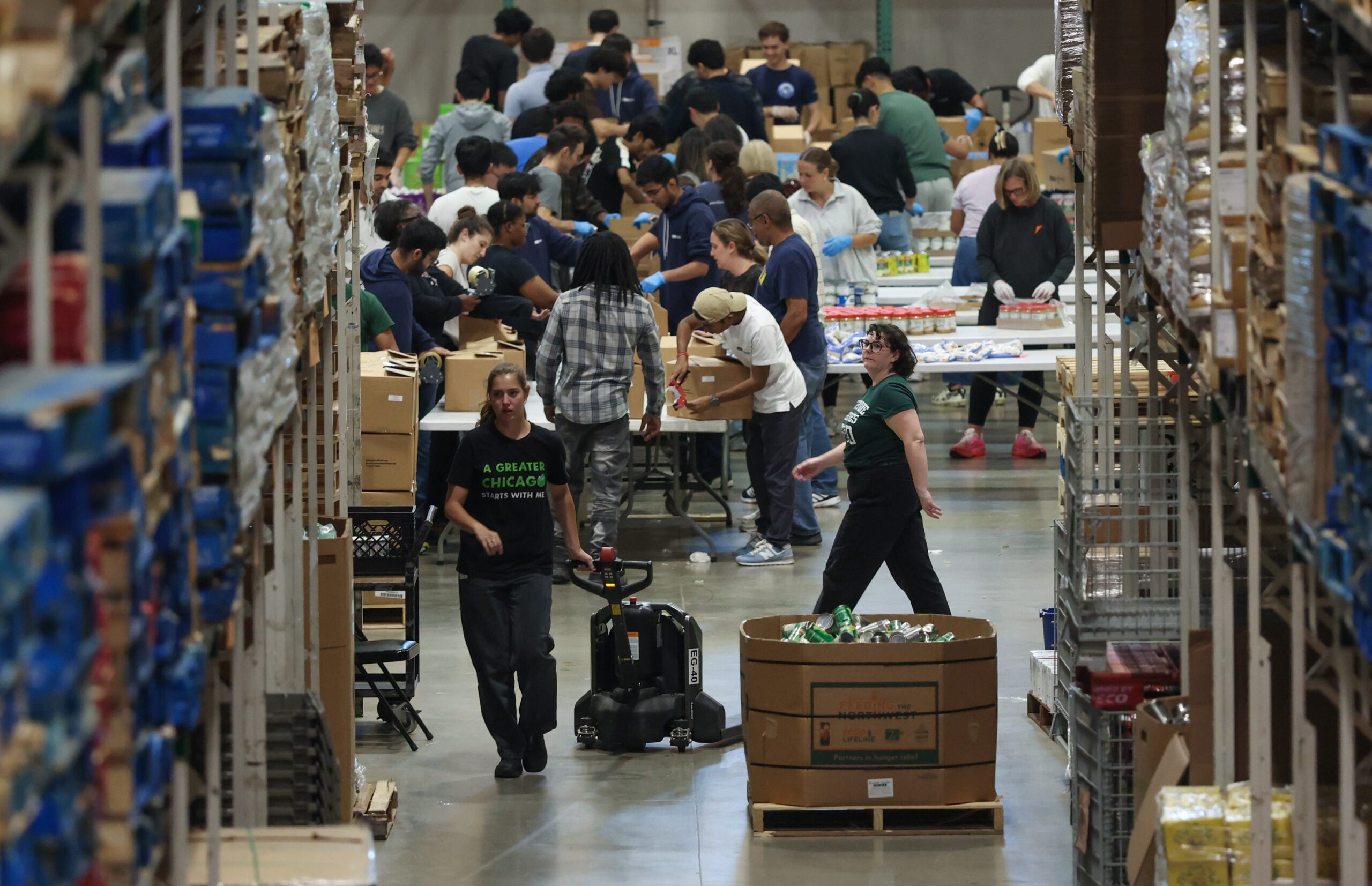
A new report released Monday by Chicago’s leading anti-hunger organization indicates a worsening hunger crisis across the city and its surrounding areas, exacerbated by affordability challenges, cuts to assistance programs and economic pressures that are making it harder for families to put food on the table.
Data compiled by the Greater Chicago Food Depository as of June 2026 reveals that approximately 417,000 Chicago households, representing about 1 in 3, are currently facing food insecurity — defined as a lack of consistent access to adequate food. In other words, 1 in 3 families in Chicago do not know where their next meal will come from, with the highest rates of food insecurity among communities in the South and West sides of the city.
“All of it is what we have experienced and what we see every day, somehow, seeing the numbers attached to it just gives it so much more weight,” said Kate Maehr, chief executive officer of the Greater Chicago Food Depository. “The statistic that has perhaps felt the heaviest is the one about children … to know that in our amazing city, almost half of the households with children are food insecure — it’s devastating, and it’s also distressing as we think about what is in front of us.”
Maehr warns that the implications extend far beyond this year or next.
“This is a problem that will last for decades because children in our great city are struggling with access to enough nutritious food to be able to live a healthy life,” she said in an interview with the Tribune.
It’s critical to note, Maehr explained, that food insecurity reflects broader economic instability and not a lack of effort. Most adults in food-insecure households are either working or are unable to work due to age, disability or other extenuating circumstances.
According to the data, more than half (56%) are employed, yet many still cannot afford food alongside housing, health care and other essentials. The report found that 12% of food-insecure adults are not working due to disability, while 11% of food-insecure older adults are not working due to retirement.
The survey reveals significant disparities across regions of Chicago, highlighting that the root causes of hunger and food insecurity are poverty, systemic inequity and structural racism, said Maehr.
According to the 17-page report, 41% of households on the city’s South Side and 45% of families on the West Side are food insecure.
Decades of public policies and persistent underinvestment have left both of these areas underresourced, a reality often marked by a scarcity of fresh food options in certain neighborhoods, said Saria Lofton, researcher and professor at the University of Illinois Chicago’s Department of Population Health Nursing Science.
Lofton uses the terms “food apartheid” and “historical disinvestment” to unpack the astonishing rates of food insecurity on Chicago’s South and West sides.
“These communities — West Garfield Park, Englewood, others — are often featured as ‘having no food,’ but it’s not addressed … and I think that is the most unfortunate thing,” Lofton said. “We have some of the most brilliant minds in this city, and we have an economy that could rival other countries, yet we cannot figure out how to support and build local food economies with people who want to do the work and I think that speaks to the historical disinvestment.”
Lofton said the current crisis is a threefold blow.
“Not only have people been put at risk of being food insecure, but having housing insecurity and job insecurity. … It’s something that is causing so much stress with people,” she said. “Folks are getting benefits reduced or losing them altogether, left and right, all at one time, and it’s a lot for anybody to handle.”
The disparity is staggering, but a sizable population of Chicago households (20%) in the north central area, including white households with higher incomes, is also experiencing food insecurity, the data shows.
The report shows that 44% of Hispanic households and 31% of Asian-Pacific Islander households are food insecure, and in homes with children, the rate is even higher. While only 14% of white households reported facing food insecurity, in Black households the figure climbed to 61%.
Researchers also note that national studies point to Indigenous populations and some multiracial households facing much higher rates of food insecurity than average.
Based on the report’s survey, 31% of Chicagoans overall and 70% of food-insecure households said they had to delay, reduce or skip payments on at least one other basic necessity, like utilities or medications, in the past month to pay for food.
Maehr said recent reductions to the Supplemental Nutrition Assistance Program, also known as SNAP, undoubtedly fueled the crisis, but growing economic inequality, rising inflation and unemployment had already driven many individuals to the edge of survival.
“We were already in a perfect storm coming out of a pandemic,” Maehr said. “If we would have been having this conversation 18 months ago, I would have said that families were struggling because rent has gone up 31% over the last five years, food prices have gone up 22% over the last five years. … It was against that backdrop that people in Washington, D.C., made the decision to take away food from these families.”
As of July 1, between 173,000 and 200,000 Illinoisans were kicked off SNAP after President Donald Trump’s sweeping domestic policy law, known as the One Big Beautiful Bill Act, added newer, stricter work requirements for the program’s recipients in February.
And that figure doesn’t include the thousands of individuals who are expected to lose benefits based on the federal changes to noncitizen SNAP eligibility.
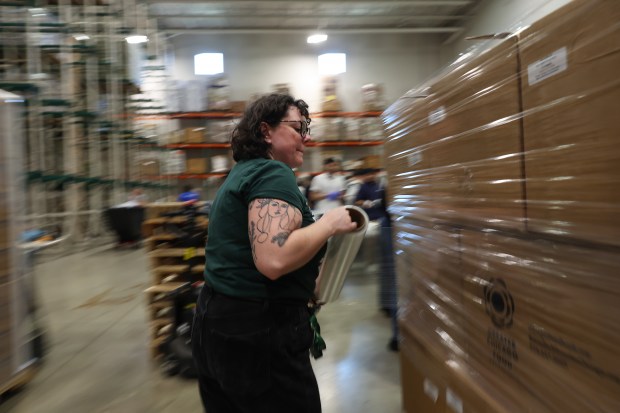 Sierra Helsing, senior manager of volunteer and guest experience, wraps boxes of repacked foods with plastic during an afternoon volunteer session at the Greater Chicago Food Depository on Sept. 11, 2026. (John J. Kim/Chicago Tribune)
In the Greater Chicago Food Depository’s survey of Chicago adults, 52% of food-insecure households and 10% of food-secure households said they receive SNAP benefits. Maehr said those findings demonstrate SNAP’s critical role in helping families attain the stability of food security, but also highlight the significant need that remains.
Illinois recently introduced an initiative called FRESH to help families buy groceries if they’ve experienced a loss or reduction of SNAP benefits on or after May 1. Individuals will automatically receive a one-time $400 cash deposit to their Link/EBT cards.
The domino effect of SNAP cuts has effectively strained an already vulnerable emergency food system, said Maehr, who emphasizes the critical role of local food pantries.
“These are community-based, often faith-led organizations, often with volunteers who are in retirement, who are on the front lines of making sure that their neighbors are fed,” she noted. “This is not a system that was designed to take the place of the nutrition safety net. And I want to be very clear: The work of food pantries and soup kitchens across this city, across this country is amazing, but it cannot fill the gap.”
New Life Centers operates food pantries in Little Village, Humboldt Park, Midway, Brighton Park and Pilsen, currently serving around 600 to 750 families per week. Verenice Martinez, director of food distribution services for New Life Centers, said the data aligns with her firsthand observations.
“Hunger does not discriminate right now,” Martinez said. “I have a good friend of mine who’s a dental assistant. She’s right here in Archer Heights and has called me a couple times to ask me when my food pantry is open, and she lets her staff come to the food pantry to get food too — I’ve seen construction workers in our lines. I’ve seen nurses. I’ve seen CTA bus operators. We see lots of really nice cars … really nice work trucks.”
Martinez said that even though she’s lucky to be in a dual-income household, she still shops around for sales and slips in a couple of meatless nights a week to hold off another grocery run. Lots of families who frequent the New Life Centers pantries likely do the same, she noted.
There is a stigma around food pantries that Martinez’s team has tried to break down by vocalizing that their pantry is for everyone — a safe place families can rely on for supplemental food.
In doing so, there has been a demographic shift in clientele, Martinez noted. Years ago, the core clientele might have been elderly neighbors and single moms, but now it’s also students, young adults and a wide mix of ethnic groups.
Earlier this year, the Greater Chicago Food Depository in partnership with City Colleges of Chicago launched the Statesman Market at Kennedy-King, where students and their families can grab free, healthy food and select household items. The market is an expansion of a former classroom-size food pantry on Kennedy-King’s campus and is playing a small part in addressing food insecurity among college students in the Englewood neighborhood.
Systemic gaps have also contributed to the current crisis, Martinez noted. Recently, a six-week strike involving food service contractors at Chicago Public Schools left children without lunch during summer camp.
“The entire first week of my kids’ summer camp, they didn’t have lunch. I am blessed to have the flexibility of being able to run out to grab them food, but what about all the parents who can’t do that?” Martinez said. “They were counting on those meals to come through as part of the service through the Park District.”
Martinez also noted the rising costs of summer camps meant a lot more parents couldn’t afford it. Many parents had to then figure out meals at home instead of having the support of summer camps, she said.
“It’s like when one little link in the chain breaks or separates just a little bit, it becomes catastrophic,” she said.
Surveys for the 2026 Hunger in Chicago report were conducted by NORC at the University of Chicago with funding from the Greater Chicago Food Depository. In total, 1,194 Chicago residents aged 18 and older participated in the probability-based panel designed to be representative of the Chicago household population.
“If this isn’t a wake-up call for the future of our city and our country, I don’t know what is,” Maehr said.
Chicago grocers are severely affected by reductions to SNAP: ‘We need to bail out this industry’
Dining and Cooking