
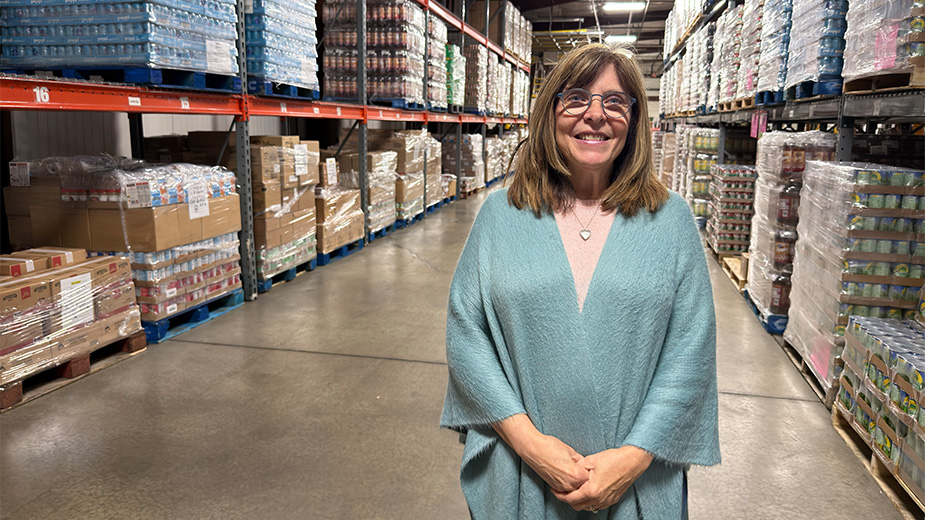
YOUNGSTOWN, Ohio – Food banks in the Mahoning and Shenango valleys are preparing for a busy holiday season after seeing unusually strong demand before Thanksgiving.
Renee Fuller, executive director of Second Harvest Food Bank of the Mahoning Valley, said the holiday rush started the last week in October, earlier than in prior years. People are trying to plan ahead.
“Sometimes other factors cause them to plan in advance,” she said. “The colder weather coming means more utility bills, higher heat, electricity.”
The time change means people are lighting their homes for more hours per day, plus gasoline and grocery prices remain high.
“So all of those factors have caused people, I believe, to try to plan a little more in advance and try to figure out how can I make all of this work and still have the food that I need for my family,” Fuller explained.
Food comes into Second Harvest’s 2805 Salt Springs Road warehouse from the U.S. Department of Agriculture, the state of Ohio, Ohio farmers’ programs, grocery stores, discounted suppliers through the Ohio Association of Foodbanks, individuals and food drives by companies and organizations.
Employees at Kisling, Nestico & Redick recently brought enough food for 20 meals to the warehouse and packed them to be delivered to an area school. Employees said it’s something the law offices have been doing for at least 10 years.
“We like to help the community,” said Shayna Koci, marketing assistant.
More Use
Officials at the Mercer County Food Bank in Sharon report similar trends.
“Historically, November and December are the food bank’s busiest time of year,” said Rebecca Page, executive director. “As you can imagine, with the winter months upon us, we have more and more neighbors making those difficult choices, especially regarding their utilities. Heating costs are going up. They make sometimes tough choices on whether they’re going to pay for their utility bills or purchase food. And with the added stressors of the holidays that bring to families who are already struggling, we always see a big increase in the need for food assistance.”
But it’s also the food bank’s busiest season of giving.
“Our community really does step up to answer the needs,” Page said.
Still, food bank sites have seen an uptick in visitors through 2026. This time of year is usually the busiest, but summer months this year were just as busy, said Alexis Spence-Locke, development director for Mercer County Food Bank.
“In September, we had over 19,000 individuals visit our network of member agencies, which is a lot more than we normally see,” Page added. “On average, every month we see about 14,000 folks. I anticipate that November and December are going to be well above those numbers. If they’re not higher than that 19,000 that we saw in September, I imagine they’re going to be very close to that.”
The Mercer food bank staffs eight employees, and its executive director credits its volunteers for the work it’s able to accomplish.
Getting Help
Spence-Locke said the food bank works to meet demand through a series of programs and through help from individuals and other organizations.
“Right now, we have something called Together We Can, so we have a lot of different agencies, businesses, organizations who have stepped up to host food drives, which helps a lot,” she said. “And honestly, it’s just neighbors coming around.”
Companies come together, particularly during the holiday season, to raise money or to host food drives knowing that the food bank’s numbers increase, Spence-Locke said. But this year, the need is greater and the numbers are higher.
“I would definitely say the more funds and food drives that could be hosted, especially right now, would definitely help to ease some of that burden on the food bank because it is a lot,” she said. “There are a lot more neighbors coming to us than ever before, but we do try to plan ahead and strategically.”
The Second Harvest and Mercer County food banks are part of the Feeding America network of food banks.
Both Page and Fuller said their respective organizations are seeing increases in the number of people seeking help for the first time.
“We’re hearing from a lot of first-time people,” Fuller said. “Sometimes it’s a family that’s working and they can’t qualify for benefits because they’re just a few dollars away, but it doesn’t mean that they’re not having a hard time, and they’re struggling to feed their family.”
Both food banks said increased demand includes families and seniors.
“Our highest number right now is teetering between children being higher or senior citizens within a percent of each other – like between a 25 to 26 to 27 percent range is made up of them,” Fuller said.
The increases may be linked to changes in SNAP or Medicare benefits.
“Usually the third week of every month is the busiest,” Fuller said. “But in November and December there is no busiest week. It’s busy, period.”
While distributing thousands of turkeys is cost prohibitive, other Thanksgiving staples including boxed instant mashed potatoes, canned yams and cranberry sauce and boxed stuffing are available at the food bank this time of year.
Programs by companies and other organizations help Second Harvest meet the increased need during the holiday season. Feed Our Valley is an annual food and fund drive by 21 WFMJ. And Greenwood Chevrolet conducts a food drive annually.
Second Harvest was also one of four Ohio food banks to share $600,000 raised by 52 northeastern Ohio Ford dealers. It’s part of Ford’s Global Dealer Food Drive involving 2,413 dealers across 39 countries this year, collecting more than 4.1 million pounds of food, about 3.6 million meals.
Partner Sites
Second Harvest distributes food to 160 partner sites across Mahoning, Trumbull and Columbiana counties, including churches, shelters, schools and senior programs.
One of those sites is the First Presbyterian Church of Warren, 256 Mahoning Ave NW. Kathie Trowbridge, the church’s administrative assistant, said the number of people using the church pantry fluctuates. If philanthropic giving is high and people are getting help from other agencies, they may not use the church’s pantry as much. Also, as holidays approach, some people opt to go to a larger pantry, and both the Warren Family Mission and Salvation Army are located near the church.
“It varies,” she said. “There’s different times of year that we do get more people.”
February, May, July and August saw more people, for example.
“If I look at last year, we had more people in October than we did in November and December,” she said.
In 2024 though, August and November saw more foot traffic. The church secured a grant to provide protein items through its pantry in addition to items from the food bank.
Volunteers planned to give out chickens this year before Thanksgiving.
Last year the church’s pantry served about 550 people, and as of mid-November this year, it had seen about 450.
The church has a pantry and pantry annex with freezers, refrigerators and shelving units, stocked with food and paper and personal hygiene products.
“We have groceries already bagged for everyone, along with a paper product and along with the frozen items,” Trowbridge explained. “The grocery bag is double bagged. It is heaping.”
The church also serves a hot meal the same day it hosts the pantry.
Minding the Budget
Sometimes Second Harvest buys items to make up for what it doesn’t get from other sources.
“And it works because we have a lot of sourcing options,” Fuller said. “But the cost of food right now for us has gone up because there’s a transportation fee.”
The food bank has always paid a fee based on the miles traveled by the truck driver delivering food. “Now you’re getting a fuel surcharge snuck in there, so it’s like double for a truck to come here,” she said.
That’s why it’s important to ensure each truck is full. Sometimes Second Harvest splits a load with another food bank with which it shares the fuel surcharge to keep costs lower.
“So you have to do all these things, like with your household budget,” Fuller said.
Pictured at top: Renee Fuller, executive director of Second Harvest Food Bank of the Mahoning Valley.
Dining and Cooking