

Chef Johanne Siy has spent the past year looking beyond the usual roster of ingredients. The Filipino-Chinese chef, who was the head chef at Lolla, has travelled to farms in the Philippines, France and Spain, seeking out ingredients that are little-known, underappreciated and steeped in craftsmanship.
The result is Aro, her highly-anticipated debut restaurant on Mohamed Sultan Road, which takes over the space vacated by the now-defunct one-Michelin-starred Japanese restaurant, Esora. Aro opens on September 25. The 26-seat restaurant serves, what she calls, “creators’ cuisine”, centred around around ingredients, craftsmanship and the food community.
A tasting menu costs $268. There will also be a shorter menu to encourage diners to visit the restaurant more regularly.

Photo: Aro
Aro, a long-time dream of Siy’s, is self-funded by Siy and her husband, and a close circle friends who have been supporting her ambitions. They include a Filipino man in his 90s, who was a regular at Lolla. It costs a low seven-figure sum to set up Aro, which resides in a heritage shophouse.
Siy, the winner of Asia’s Best Female Chef 2023 by 50 Best, has also assembled a team including Jhonel Faelnar, the former beverage director of two-Michelin-starred Atomix in New York and pastry chef, Elaine Ng, who used to work at La Dame de Pic at Raffles Hotel.
The world is her oyster
Over the past year since Siy left Lolla after a five-year stint, Siy has been travelling to farms around the world to source for products that farmers and producers have put considerable effort into making, but which have not received the same recognition.
There is deliberately no geographical label attached to the cuisine at Aro. The restaurant’s name makes reference to her “labour of love”. Aro means “to plough or cultivate” in Latin, and “love” in the hometown dialect of Johanne, who hails from the coastal town of Pangasinan in the Philippines.

Photo: Aro
The 45-year-old, who has worked at acclaimed restaurants including Le Bernardin, Restaurant André, Noma, Relæ and Fäviken, says: “I remember having a conversation with a chef in London last year about the elements in a restaurant—there was chainmail on the walls and ceiling, and we were talking about how it was reminiscent of a prison. As chefs, we kind of build our own prison by confining ourselves within a concept. I wanted to break out of that, but also for people to think about the food more deeply and be more curious about it.”
By leaving Aro’s cuisine less defined, she hopes diners will instead wonder what flavours and ingredients they might encounter.
Given that the restaurant is in Southeast Asia, there’s a focus on putting the spotlight on lesser-known Asian ingredients. “We know these ingredients, but the rest of the world doesn’t. I feel like it’s up to us to tell the world that these ingredients are just as worthy of being on the global pedestal as all the other luxury ingredients,” she says.

Photo: Aro
Over the past year, Siy has been visiting farms across Southeast Asia and Europe to meet farmers and food producers. Among her discoveries was Asin Tibuok, an artisanal salt from Bohol that takes almost a year to make, using coconut husks saturated with seawater, dried and burned into ash before being used to filter more seawater.
In France, she visited oyster farmers in Saint-Michel and Cancale and saw how oysters are cultivated and prepared for their journey to consumers. Near Lyon, she visited a cheese maker and became interested not only in the cheese itself but in what time does to the ingredient. That idea also informs Aro’s use of stingless-bee honey from the Philippines, which can be tasted in fresh and aged versions.
Another discovery was a seaweed from the Philippines that grows on rocky shores battered by violent waves. Gathering it can be dangerous, and fishermen may return without finding any. For Siy, that effort is part of the ingredient’s value — and part of the story she wants to bring to diners at Aro.
The cooking style at Aro will be a “composite of my culinary upbringing”, from Siy’s background in French cooking to exposure from her work stints in Scandinavia and New York City. There is also a desire to bring out more “Asian umami flavours through fermentation”.
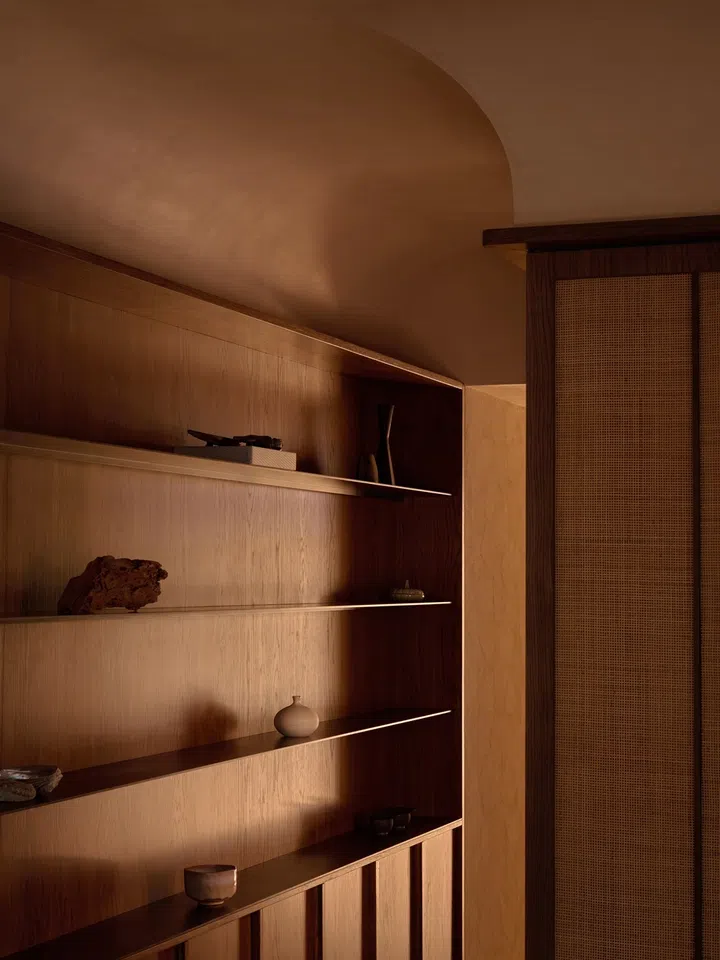
Photo: Aro
Setting up Aro solidified Siy’s value as a chef. She says: “At the end of the day, we are just like agents, and the produce is really the hero. It is also about stepping into the role of an educator and sharing my experiences with diners to build a deeper, more meaningful connection with them, instead of presenting the dishes.”
She plans to organise trips to visit farms in the region with her restaurant team to broaden their horizons when the restaurant is closed for breaks.
The inspiration behind Aro’s design
Photo: Aro
Design-wise, Aro, Siy’s brief to Japanese studio Keiji Ashizawa Design was to centre the restaurant’s interiors around natural materials that evolve the relaxed feeling of having friends over at home.
The restaurant’s darker wood tones were inspired by the pili nut. Siy cooked for the designers and showed them the nut itself, whose colours became the inspiration for the restaurant’s colour palette. This translated into different shades of brown from the walnut counters, oak chairs to the rattan-clad walls.

Photo: Aro
When Siy first saw the shophouse space, she liked its layout, particularly because it allowed her to tell stories directly and maintain a connection with guests.
Two existing elements were retained and became sources of inspiration: the fluted stairwell, which highlights craftsmanship and attention to detail, and the skylight, which creates a sense of airiness and openness. The area near the stairs was pushed back to make better use of the space, with a step, replaced by a stone, that diners need to step on — highlighting the point of intentionality.
“Devoting myself to doing something I love”
Photo: Aro
On what hopes diners can take away from a visit to Aro, she says: “I hope they feel enriched by the experience, knowing where the ingredients are from and the hands that put it together and grew them. They have a sense of connection with the overall food system—our role as chefs, producers, diners, that completes the whole ecosystem.”
Siy has also decided to dive into opening a fine-dining restaurant despite a challenging time in the industry. She shares candidly: “I want to devote my life to something that I love and can see myself doing until I’m old. What has also sustained me over the years is the connection I’ve built with diners.”
“When I didn’t have this concept yet and had just left Lolla, I constantly received messages from ex-customers who had become friends. They’d say, ‘When are you cooking again? Please let me know. We miss your food so much.’ That gave me a lot of fulfilment and satisfaction. So it’s really about getting back into that and seeing these people again.”
Dining and Cooking