

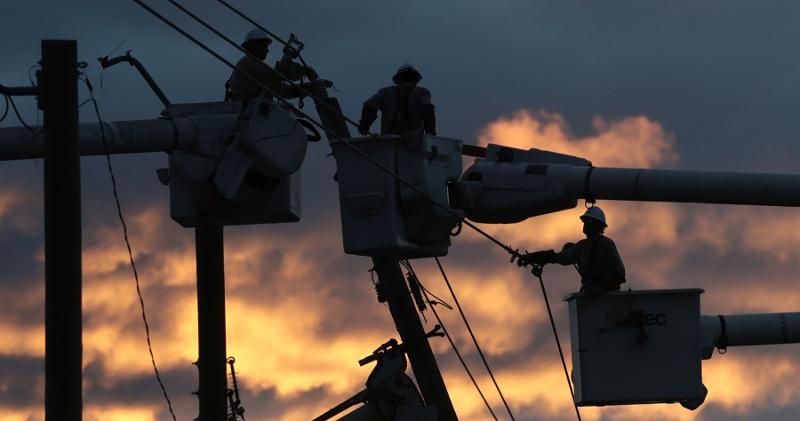
Power outages in the U.S. have increased by 60% in the past decade | Photo courtesy of Joe Raedle Getty Images
On August 11, 99 mile-per-hour winds tore through the heart of Gary, Indiana, spawning tornadoes and flooding, and knocking out power to nearly 400,000 homes and businesses.
It would be a full 14 days before that power was restored, creating nearly $5 billion in regional losses.
The two-week blackout is among the longest power outages in modern U.S. history, according to data from Electric Choice.
Gary’s Caribbean Roots, a Jamaican cuisine concept that opened about five years ago, experienced tens of thousands of dollars in losses, including from perished food. Johanna Flemming, who co-owns the restaurant with her husband Ryan, said she has never seen anything like it before.
“It was scary. There was water coming inside the building with customers inside. It really was something I’ve never seen,” she said. “Just chaos and devastation.”
If there is a silver lining to the Flemmings’ story, it’s that Ryan is a “storm fanatic who obsesses over the weather.” Because of this obsession, and their experience navigating damages from a prior storm, the restaurant operators had two generators on hand to help them through. But there were still losses, and significant ones at that.
“We were actually one of the lucky ones. Not only were we one of the first buildings to have our power turned back on after 11 days without it, we also invested in that second generator,” Johanna said.
“But I still get so nervous whenever it starts raining.”
It’s hard to imagine an independent restaurant losing tens of thousands of dollars in less than two weeks to be “lucky.” Other restaurants haven’t had the same fate. Boxer in Oregon, for example, cited power outages from a 2023 ice storm as the “final straw” in its bankruptcy filings. Just this week, a Florida operator said he fears for his own business after losing thousands of dollars from power outages caused by October’s Hurricane Isaias.
Indeed, Isaias knocked out power to hundreds of thousands of residents across Florida, Georgia, and Alabama. Predictive demand-intelligence company GhostCom Analytics estimates that the storm will disrupt $1.34 billion in sales across retail, restaurants, and hotels for a net loss of $517 million. Restaurant and bar sales are expected to fall $168 million, or 6.3% — the largest dollar loss of any sector from this specific storm.
These stories encapsulate what can happen when a single, uncontrollable event grinds a razor-thin-margin business to a halt. And, unfortunately, such storms are becoming not only far more common, but also far more severe.
Power outages in the past decade have increased by over 60% compared to the prior decade, according to data from the U.S. Energy Information Administration (EIA). Climate Central analyzed major U.S. power outages from 2000 through 2023 and found that weather-related outages occurred about twice as often from 2014 to 2023 as they did in 2000 to 2009.
This trend is expected to continue accelerating as climate change combined with growing electricity demand and aging infrastructure take their toll.
Fifty-plus years of navigating such incidents
Some restaurant operators have been around long enough that they’re now as prepared as they can be. Donnette Hansen has owned the Rainbow Lodge in Houston for nearly 50 years and, though her business endured through a destructive derecho in May 2024 followed by Hurricane Beryl just two months later, she said Hurricane Ike in 2008 was the worst.
“We were sitting around for weeks waiting for (the utility company) to get us power. We have had some short-term outages that have completely blown a shift, including a wedding once, but now the thought of an extended power outage makes my skin crawl,” she said.
Hansen estimates that the Rainbow Lodge lost about $150,000 in revenue from Ike. She had to pull from her savings account and take out an emergency short-term bank loan to recover.
Less than 10 miles away from Rainbow Lodge is The Original Ninfa’s, which first opened in 1973. Since then, the restaurant has weathered 10 hurricanes. During those 2024 back-to-back storms, Ninfa’s Navigation Boulevard location closed for two days and four days, respectively. Justin Solomon, vice president of operations, estimates that the combined loss was around $205,000.
“Without a doubt, the Hurricane Beryl outage had the largest negative impact on our business to date,” he said.
Responding to an outage
Amid such an event, he said an operator’s priorities must be minimizing losses and taking care of team members.
“We pull from every resource available to us. We utilize vendors for refrigerated trucks to store product, a generator rental company, electricians, plumbers, our general contractor, and our team,” Solomon said.
Ninfa’s has also created specific protocols to respond to a potentially threatening weather event, starting with an all-manager and supervisor huddle to discuss a plan of action and assign duties.
“We plan for different scenarios. Each manager heads a team of supervisors and employees that focus on different (tasks),” he said. “Mock schedules are made for the ‘storm crew.’ We get marketing involved to communicate with the community for adjusted hours or closures.”
Such communication, Solomon added, is critical, including team timelines and resources for monitoring weather, road closures, and public transportation notices. Ninfa’s even has a “crash kit” with step-by-step instructions for outages. It includes lighting sources and devices to illuminate the entire restaurant, including exits, as well as battery-powered handheld point-of-sale devices. If a vent hood is no longer accessible because of a power outage, employees snuff out and dampen wood-fired grills to avoid smoking out the entire restaurant. Kitchen supervisors and back-of-house teams are charged with putting food products on ice.
If a major storm is in the forecast, Solomon said it’s important to adjust purchasing and have a plan for refrigerated goods. Hansen said she not only lowers her inventory but also stocks up on ice so she can ice down the kitchen exhaust systems, air conditioning unit, and refrigerated items should the power go out.
“Also, if you can handle a generator, it’s a good idea because you might be the only place in the area with power. People like to get out, gather and talk about the outage. It could be a windfall,” she added.
Sometimes the “windfall” simply comes from the community pitching in to help. During Gary’s two-week outage, Caribbean Roots continued to pay its employees and they responded by delivering food to those in need as well as cleaning up debris in the restaurant after the flood waters receded.
“When the storm came in, we saved what food we could, we cooked in the dark, and then we helped as many people as we could,” Flemming said. “We are fortunate to have a big community that was willing to help. That storm showed us why it’s important to stay active and build relationships with our community.”
A legislative priority
Having resources and a community calvary may ease some of the pressure, but it certainly doesn’t provide visibility on relief or pay the bills that continue to come in while the power is out. Flemming expressed frustration with her utilities company, saying the restaurant didn’t receive any updates during August’s extended outage.
“We’ve had a lot of issues with them before, which is part of the reason we bought that second generator,” she said. “We didn’t hear from them, we didn’t hear from the government, from city officials — nothing. No updates on when the lights will be back. Not having any communication was the worst thing about the storm.”
Hansen added that after Hurricane Ike, “we were sitting around for weeks waiting for CenterPoint (Houston’s utility company) to get us power.”
Operators also have plenty of grievances about their insurance coverage.
“Business interruption insurance sounds great, but it has never covered our losses,” Hansen said. “There’s always some loophole and real disappointment.”
She recommends communicating with your insurance company to know what exactly is covered in the policy: “Know your options and fight for coverage.”
Solomon described dealing with insurance and utilities on top of facilitating a contingency plan for the restaurant creates a lot of “complex layers.”
“The business will take a loss and, unfortunately, it’s a nail in the coffin for some smaller restaurants,” he said.
Because of this complexity, several state associations and the National Restaurant Association have begun prioritizing more solutions for power outages. Emily Williams Knight, CEO and President of the Texas Restaurant Association, said her organization is focusing on things like utility accountability, business insurance, and a resiliency agenda, for example.
“We have a disaster relief program in place, but the fund has no money in it. We’re trying to get money in that fund so restaurants can apply for relief,” she said. “They need it during those times because outages have a major ripple effect — there’s no revenue coming in to get new inventory to reopen and employees aren’t getting paid, and so many restaurants just end up closing.”
Knight added that there is a “ton of work on infrastructure and framework” around the resiliency agenda because it includes emergency operations centers, streamlined communication and regulatory barriers, electric grid reliability, and more. There is also a push for utility accountability — ensuring that utilities companies provide updates and a dependable map so operators can see what’s working and where — and clearer insurance policies, so operators know in “plain, simpler language what is covered and what is not.”
Restaurant associations are also working to ease insurance costs, which are rising 20% to 30% annually, Knight said, because there are “so many claims from so many disasters.”
“This issue is getting worse everywhere. In a state like Texas, we can have hurricanes on the coast and fires in the panhandle, as well as crippling ice storms in the winter, so this is a key priority for us heading into our 90th legislative session (which begins in January),” she said. “It’s a key priority for a lot of us all over the country because it’s getting worse. We can’t control storms, but we don’t want restaurants to be put out of business because of unreliability or unaffordability from those storms.”
Contact Alicia Kelso at Alicia.Kelso@informa.com
Follow her on TikTok: @aliciakelso
Dining and Cooking