

New York City has long had a love affair with French restaurants. From luxurious temples of haute cuisine to bustling brasseries and farmhouse-chic dining rooms, French cooking has captivated New Yorkers for decades.
Despite it’s endurance, the French dining scene has been an ever-evolving one. The once formal white-tablecloth dining rooms of the 1930s have made way for the lively neighborhood spots of the 1990s. And in recent years, a new wave of casual neo-bistros has emerged, appealing to diners seeking a more laid-back yet refined vibe. These are the kinds of places that evoke a distinctly Parisian spirit — restaurants that could just as easily be nestled on a charming side street in the 9th or 11th arrondissement.
Here’s a look at how la cuisine française has changed over the years in New York, and where to find the city’s best French restaurants today.
New York’s embrace of French cuisine began in earnest in the 1930s and 1940s with restaurants that redefined fine dining in the city. Among them was Le Veau d’Or on the Upper East Side, followed by Le Pavillon, which first made waves at the 1939 World’s Fair as Le Restaurant du Pavillon de France. At the time, many considered it the ne plus ultra of dining.
By the late 1950s and early 1960s, grand restaurants such as La Côte Basque, La Grenouille, La Caravelle and Lutèce came to define the era. Formality prevailed.
“[It was] the Escoffier-modeled cuisine with the sauces and the table-side carving, red velvet banquettes, captains in tuxedos, waiters in white jackets with bow ties, and [male diners] in jackets,” says Rita Jammet, co-owner of La Caravelle from 1984 to 2004 and current Chief Bubbles Officer at La Caravelle Champagne & Wines.
The menus reflected that same sense of occasion: soufflés, sole meunière, roasted duck, roasted chicken, beef finished with Escoffier sauces and braised vegetables.
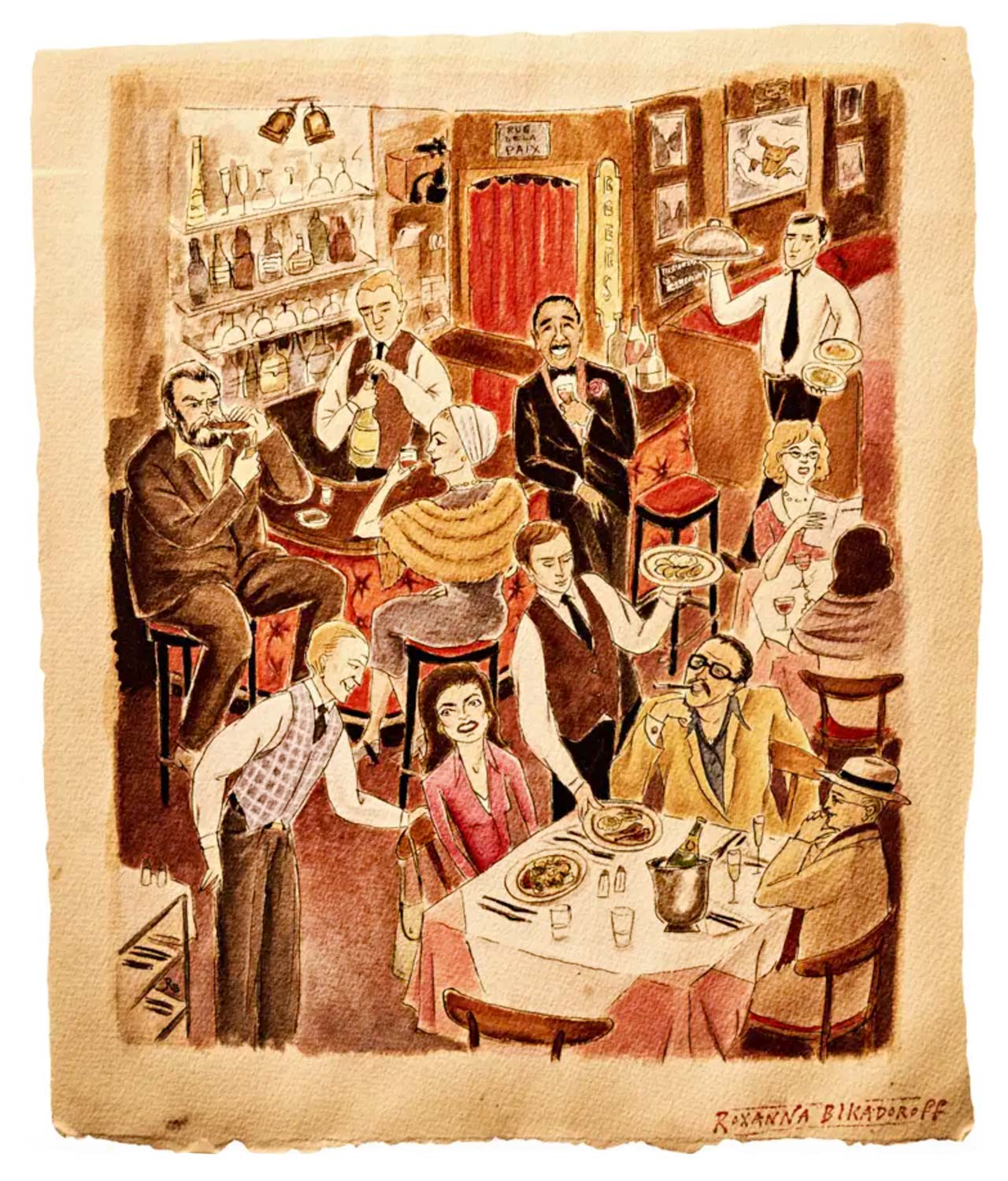
An old illustration of the Le Veau scene. © Le Veau d’Or
That model endured for decades before French dining began to evolve in the 1980s and 1990s. Technique remained paramount, but chefs started loosening the rules. Hospitality became more approachable, all-French menus gradually disappeared and global flavors found their way into French cooking.
Le Bernardin, Chef Eric Ripert’s Midtown temple of seafood, became known for globally inspired French cuisine, while Daniel balanced refined French classics with a contemporary sensibility. At Jean-Georges, dishes like egg toast with caviar shared menu space with spiced duck breast accented with mezcal and mustard. Around the same time, more non-French chefs and restaurateurs started opening French restaurants, broadening the cuisine’s identity beyond its traditional boundaries.
Another force was reshaping French dining as well. In Paris, the bistronomy movement emerged in the 1990s, blending the relaxed atmosphere of neighborhood bistros with the technique and ingredients of haute cuisine. There was an echo of this movement in New York, when buzzy brasseries such as Balthazar, Pastis and Anthony Bourdain’s Brasserie Les Halles proved diners were eager for French restaurants that felt lively rather than formal.

Salmon with Root Vegetables Parisienne and Leek-Truffle Marinière from Le Bernardin and the elegantly plated Binchotan Charred Scharbauer Ranch Wagyu from Daniel. © Nigel Parry/Le Bernardin | © Bill Milne /Daniel
Today, the definition of a French restaurant has broadened further — and in some instances, has become more personal. French technique remains the foundation, but chefs increasingly filter it through their own backgrounds and experiences, while still offering a rather fancy and chic environment.
At Maison Passerelle, Chef Gregory Gourdet blends French, African and Asian influences into dishes inspired by the French diaspora. At L’Abeille, Chef Mitsunobu Nagae draws on his years cooking at Joël Robuchon restaurants to fuse French technique with Japanese sensibilities. While in the West Village at Le B, Chef Angie Mar marries haute French cuisine with her Chinese heritage in dishes such as lobster blanquette, pork and duck terrine, and her signature salade “Chinoise.”

Pigeonneaux Paradis from Le B and colorful Smoked Beet Salad from Maison Passerelle. © Mike Vitelli/Le B | © Heather Willensky/Maison Passerelle
That same philosophy has also fueled a new generation of neighborhood restaurants that feel unmistakably Parisian while remaining rooted in New York. While the restaurants above have a more global flair, the cuisine at the neo-bistro leans more classic, evoking the time-honored flavors of authentic French regional cooking. This more casual style of dining appealed to diners after 9/11 and more recently, post-pandemic. The neo-bistro is also an affordable luxury and tends to be more profitable for restaurateurs, with more foot traffic and higher table turnover than very upscale restaurants.
At La Mercerie in SoHo, Chef Marie-Aude Rose serves elegant French comfort food in a stylish café setting, from chicken consommé with foie gras to classic profiteroles and tarte Tatin. At Le Coucou, American-born, French-trained chef Daniel Rose presents unapologetically French classics through his own lens, including tartare de bœuf, quenelle de brochet (a delicate fish dumpling) and tout le lapin (a rabbit dish prepared three ways).
“He cooks the most rustic and authentic French dishes that you can ask for, and you can feel a sense of nostalgia for the old days of French cuisine at Le Coucou,” says Jammet.
Le Chêne, from Alexia and Ronan Duchêne, offers another interpretation. The West Village restaurant celebrates French tradition with rich, robust dishes such as foie gras terrine, vin jaune sauces and a show-stopping pithivier (an elaborate filled pastry) layered with potato gratin, pork stuffing and smoked eel.
“We wanted to do a French restaurant that felt a bit more creative, not too rigid in terms of what people think of French food,” says Alexia Duchêne.
Even one of New York’s oldest French restaurants reflects that evolution. At the new iteration of Le Veau d’Or, Chefs Lee Hanson and Riad Nasr have ushered the storied restaurant into its next chapter with a menu that reveres classic French cooking — think pâté en croûte (pâte baked in pastry), poulet à l’estragon (tarragon chicken) and warm gratin au chocolat — with a lively, scene-y vibe that’s distinctly modern.

La Mercerie’s steamed tilefish with spring greens and the signature Pithiviers Terre & Mer from Le Chêne. © Gentl & Hyers/La Mercerie | © Colin Clark/Le Chêne
“If you want to play music, you need to learn the solfège, the basics of music. French cuisine is the solfège of cuisine in general.”
Elsewhere, arthur in Brooklyn channels the spirit of the modern Parisian bistro through Northeast ingredients and shareable plates like escargot, tuna crudo and warm buttery brioche. Nearby, Entre Nous could easily pass for a neighborhood wine bar in Paris, offering rustic small plates such as chicken liver parfait with cornichons and roasted carrots with lentils and chèvre alongside thoughtfully selected fromage and charcuterie.
On the Upper East Side, Cafe Commerce blends French technique with American and Italian influences, while nearby Marcel leans heavily into French café and brasserie classics, with dishes that channel the spirit of a Left Bank café, from roast beef tartine with cornichons to omelets, escargots and steak au poivre.
Together, these restaurants show just how much French dining in New York has evolved. Some preserve tradition almost intact, while others reinterpret it through different cultures, techniques and generations of chefs. What unites them isn’t a single style of cooking but a shared foundation in French technique.
For Jammet, that’s exactly why French cuisine continues to endure.
“If you want to play music, you need to learn the solfège, the basics of music. French cuisine is the solfège of cuisine in general,” she says. “There are so many options to enjoy the Frenchness in New York.”

Tender white fish fillet garnished with a fresh dice of tomatoes and herbs from Cafe Commerce and Highland Hollow Farm beef from arthur. © Alex Stein/Cafe Commerce | © Evan Sung/arthur

Hero image: The old school interior of Le Veau d’Or. © Gentl Hyers/Le Veau d’Or

Written by
Kate Heddings
Kate Heddings is a food editor and writer based in New York City. She also contributes to Food & Wine and BBC Travel.
Dining and Cooking