

There are fashion show locations, and then there are locations that become part of the story. On September 15, Consuelo Vanderbilt Costin staged Makers, Moguls, and Muses inside Vanderbilt Hall at Grand Central Terminal—the landmark her family helped bring into existence more than a century ago. For a New York Fashion Week presentation celebrating America’s 250th anniversary, it would be difficult to imagine a setting with more history embedded in its walls.

Consuelo Vanderbilt Costin
I loved this show.
Presented by Vanderbilt & Seewald Global Studio and Signet Fashion in collaboration with House of Vanderbilt, the evening brought together fashion, technology, art, history and commerce before approximately 300 fashion industry leaders, investors, buyers, media and VIP guests. Actor and Access Hollywood host Mario Lopez served as emcee, but the real host was Grand Central itself. There was something wonderfully full-circle about a Vanderbilt bringing a new generation of creators into Vanderbilt Hall—not simply to celebrate the past, but to ask what comes next.
That question is at the heart of Vanderbilt & Seewald Global Studio, co-founded by Vanderbilt Costin and media entrepreneur Michaela Seewald. The new venture combines fashion investment, media distribution, technology and commerce with the goal of helping designers grow without surrendering their creative identity or ownership. The studio grew from recognizing a very real problem in the creative world: enormously talented independent people can remain unseen, underfunded and sometimes unpaid simply because they don’t have the machinery of a major agency or corporation behind them.
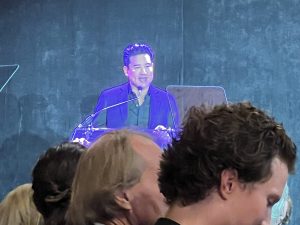
Mario Lopez
For its runway debut, the studio presented three designers with strikingly different aesthetics: Mexico City’s Lorena Saravia, Dustin Glickman’s Stockholm-based DSTN and French couturier Nabil Hayari of Hayari Paris.

The outfit I covet

For me, Lorena Saravia was irresistible. I would have bought practically every outfit that came down the runway. Working in earthy colors and fabrics that included crepe, jersey and beautifully light leather, Saravia played continually with structure and movement—dresses layered over fluid trousers, architectural draping floating over the body, fabrics that changed character as the models walked.
Still photographs don’t quite capture these clothes because movement is part of the design. They were chic, timeless and sensual, but also looked extraordinarily comfortable. Saravia understands something I increasingly want from fashion: clothes can be sophisticated without looking tortured. These were clothes designed for women to actually inhabit their lives in—and I wanted virtually every damn thing she sent down that runway.
Dustin Glickman’s DSTN took the room somewhere entirely different. At just 22, Glickman has developed a vocabulary rooted in sharp tailoring, leather and a rebellious rock-and-roll edge. Fringe, lacing and Gothic influences gave the collection its attitude, but there was discipline underneath the rebellion. It was darker, younger and deliberately tougher than Saravia’s effortless sensuality—a little rock star, a little dark cowboy, and very much aware of the power of a beautifully controlled silhouette.
Then came Nabil Hayari, and suddenly we were firmly in the world of couture. Hayari Paris brought glamour, workmanship and that particular French understanding that excess works beautifully when someone knows exactly when to stop. His made-to-measure work has long been associated with red-carpet dressing, and on this runway it provided the evening with its most unabashedly glamorous chapter.
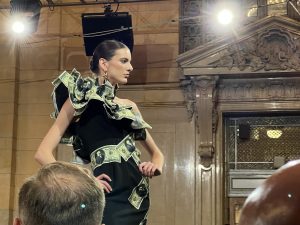
Hayari
Hayari’s presentation also connected fashion to art through a collaboration with photographer and visual artist Karen Bystedt, whose work includes her celebrated images of Andy Warhol. The evening incorporated a tribute to Warhol, adding another distinctly New York strand to a show already layered with the city’s history.

Hayari
But Makers, Moguls, and Muses wasn’t interested in nostalgia for nostalgia’s sake. The runway also served as the debut of Vanderbilt & Seewald’s Click-To-Buy technology, designed to allow people in the room and watching remotely to purchase looks directly from the runway. AEXA’s interactive AI hologram technology brought members of Vanderbilt history into the experience as well, creating an almost surreal collision between old New York and the increasingly technological future of fashion.

Famed Photographer Patrick McMullen
There was also a civic dimension to the evening. In recognition of America’s 250th anniversary, 25 members of the U.S. military, FDNY and NYPD were honored, with the presentation opening with the Color Guard and the national anthem. It gave the evening a sense of occasion beyond Fashion Week and connected the idea of American legacy not simply to wealth or famous names, but to service.

Hayari
That distinction matters because the Vanderbilt name inevitably arrives carrying history. Costin isn’t pretending otherwise. House of Vanderbilt and Vanderbilt & Seewald Global Studio are using that history as capital of another kind: access, visibility and the ability to put people into rooms they might otherwise struggle to enter.

Hayari
That is ultimately what made Makers, Moguls, and Muses so much fun. This wasn’t three collections being marched through an anonymous white box. The setting meant something. The clothes were genuinely worth seeing. The designers had distinct identities. Technology was being used to connect the runway directly to commerce, rather than being attached merely because somebody thought Fashion Week needed an AI gimmick.
Most importantly, I wanted the clothes.
After a week of seeing collections that ranged from inspired to inexplicable, there was enormous pleasure in watching Lorena Saravia send look after look down that runway and thinking, yes, I would wear that. And that. And definitely that.
Fashion can carry history, technology, cultural ambition and an entire family’s legacy on its shoulders. But eventually somebody still has to want the dress.
At Makers, Moguls, and Muses, I did.
Dining and Cooking