

Capybara Café, a new Fort Lauderdale indoor zoo where customers pay to pet and feed exotic rodents, is facing calls for an immediate shutdown following animal welfare complaints, zoning disputes, and state misdemeanor charges against its nonprofit parent company.
The controversy comes amid a surge in viral, social media-driven exotic animal attractions across Florida. In an open letter to a Fort Lauderdale city attorney last week, People for the Ethical Treatment of Animals (PETA) called for the facility’s shutdown and for an investigation into its owner, Stephanie Angel.
In a South Florida Sun Sentinel interview this week, Angel called PETA’s allegations “factually inaccurate” and rebutted the accusations, arguing her cafés and nonprofit have done nothing wrong.
“It’s one big lie,” Angel said. “PETA doesn’t care about truth or facts or about the good that we do. They just care about accusations and innuendo. They’re a loud minority, but most people in Fort Lauderdale support us.”
PETA’s Sept. 22 letter has sparked ire from animal-rights advocates, including Fort Lauderdale private investigator Ana Maria Campos and the New York charity World Animal Protection, which posted on Facebook last week that Capybara Café “is selling animal cruelty and calling it cute.”
The criticism comes as Capybara Cafés have risen across Florida in recent years, driven by the semi-aquatic rodent’s viral fame in TikTok and Instagram songs and memes. It also comes amid heightened scrutiny over exotic animal tourist attractions like Sloth World in Orlando.
Capybara Café, which offers no food or drink to humans, opened Sept. 17 in Fort Lauderdale’s Thrive District and is Angel’s third one, joining locations in St. Petersburg and St. Augustine. Its 5,000-square-foot lounge lets patrons book timed group or private “encounters” with the rodents and other exotic animals such as an African-crested porcupine, a three-banded armadillo, two Virginia opossums, six ferrets and two rabbits. A portion of profits benefits sanctuary operations, medical care and area animal-rehab clinics, Angel said.
In a Sun Sentinel interview, Cydnee Bence, a PETA attorney, alleged Noah’s Ark Sanctuary has a “history of noncompliance” with state and federal regulatory agencies.
Among PETA’s claims, which are refuted by Capybara Café’s owner:
• Four young capybaras “died without adequate veterinary care,” according to PETA, at Noah’s Ark Sanctuary, a nonprofit animal rehabilitation clinic in northern Florida that owns multiple Capybara Café locations.
• Fort Lauderdale’s Capybara Café was operating without a valid business tax receipt in an area not zoned for wild-animal petting zoos, PETA alleges.
• After hours, capybaras and other exotic creatures are daily moved to a house in the city not zoned for “an animal-oriented business.”
• The Florida Fish and Wildlife Conservation Commission (FWC) has filed misdemeanor charges against Angel for failure to report a lemur bite on an employee at a Capybara Café in St. Augustine.
“Animals shouldn’t be used as entertainment props in strange tourist traps,” Bence said. “We want the city to step in and see this business shut down and for the animals to be sent to a reputable facility to get the care they desperately need.”
‘I don’t see anything so serious’
Fort Lauderdale Commissioner Steve Glassman, a self-described “advocate” for Capybara Café, said there are no plans to investigate the business. Despite PETA’s letter claiming the opposite, Capybara Café has valid licenses and tax receipts to operate in the city, he said.
“They’re zoned as a retail use because they’re basically selling an experience, an activity center,” Glassman said. “If there’s evidence of problems, it will necessitate taking a look at that. But I don’t see anything so serious that it rises to that level.”
City records show Capybara Café’s business tax license was marked “pending” for two weeks after opening but was valid as of Sept. 30 — contradicting PETA’s claim that the business lacks proper tax receipts. Glassman suggested the delay is “probably some bureaucratic hold-up and nothing bad.”
However, the city has already issued two code violations against Angel’s properties.
One, on Sept. 8, states that a cage and pond was being built without a permit at the same Fort Lauderdale home PETA referenced in its letter. That property is registered to Noah’s Ark Sanctuary. It gave Angel an Oct. 13 reinspection deadline.
Angel confirmed that address is owned by her nonprofit, Noah’s Ark, but denied that capybaras and other exotic animals are being kept there overnight.
A second code violation for the same address, issued on Sept. 23, mentions keeping “prohibited wild animals including but not limited to, capybaras” and that code violation must be resolved by Oct. 8, according to city documents.
A still-active job listing for a “Live-In Animal Care & Transport Specialist” lists the same address and mentions caring “for our animals both at their residence and at our café” in the description.
“It’s one of our addresses but we don’t disclose where they go after the café closes because we’re afraid people will try to steal the animals,” Angel said. “I don’t know why [the city] gave us a violation, but we’re legally allowed to keep the animals where we keep them.”
Capybara deaths
Spokespeople for both the FWC and the U.S. Department of Agriculture (USDA) told the Sun Sentinel in mid-September that the nonprofit holds active state and federal wildlife exhibition permits.
Even so, Noah’s Ark Sanctuary has racked up multiple violations from both agencies.
A USDA inspection report from July 2025 states that four capybaras — two 5-month-old females (named Latte and Espresso), a 4-month-old male (Beans), and 9-month-old male (Reese) — died at Noah’s Ark Sanctuary between December 2024 and July 2025. Two capybaras died after showing injuries consistent with bites from other capybaras, while two others had symptoms including low body temperature and blood sugar.
“The circumstances of these deaths … demonstrate that this facility does not have a sufficient number of adequately trained employees to maintain the professionally acceptable level of husbandry practices,” the USDA inspector wrote in the report.
“They haven’t met the minimum standards of animal welfare, and it’s resulted in the deaths of animals,” said Bence, the PETA attorney. “All of their facilities should be closed, not just Fort Lauderdale.”
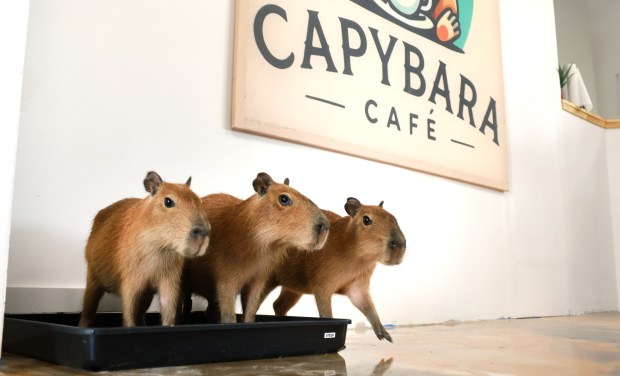
Carline Jean/South Florida Sun Sentinel
Capybaras roam around the Fort Lauderdale facility during an employee training session on Sept. 15, 2026. (Carline Jean/South Florida Sun Sentinel)
Angel, for her part, said she has filed an appeal against the USDA report and insisted no Capybara Cafés have been shut down. The Sun Sentinel could not confirm the existence of this appeal.
Part of the sanctuary’s mission is rehabilitating injured animals, Angel said, and three capybaras “came from another facility” and couldn’t be saved. A fourth “was prescribed the wrong medication by our veterinarian, which is toxic to capybaras,” she added.
“I was really upset about it,” Angel said. “We try to save all the animals we can, but they arrived in poor condition. It wasn’t my organization that caused their deaths. We have 33 capybaras now and have had zero problems with our animals.”
Meanwhile, a May 29 Florida Fish and Wildlife Commission citation said Angel “failed to notify [the FWC] of a bite to an employee caused by a tri-colored lemur” at the Capybara Café in St. Augustine on April 18. The employee was later treated at an emergency room.
For the violation, Angel faces a second-degree misdemeanor charge punishable by up to 60 days in jail or a $500 fine, according to state law. She is scheduled to appear at an Oct. 20 pretrial hearing in the Seventh Judicial Circuit Court of Florida in St. Johns County.
Angel said that because the lemur bite happened to an employee and not a member of the public, “staff are exempt from the law and this case should be dismissed.”
“Florida is great at assigning citations and blame without finding facts,” she said. “We didn’t have to report this to FWC.”
Glassman, unaware of the animal deaths and the state’s misdemeanor charge, said it doesn’t change his opinion about Capybara Café.
“I would hope there’s no mistreatment of animals in this facility, and I haven’t been led to believe there is,” he said.
Abraham Fish, Capybara Café’s landlord, said he spent weeks vetting Angel’s nonprofit and received letters of support from wildlife rescues before agreeing to a lease.
“I can tell you firsthand, Stephanie loves animals,” Fish added. “She’s teaching people how to rub capybara bellies. She’s giving money to rehab clinics. The place is packed every day and people love it. Look at her Google reviews. Bottom line: If USDA or FWC [haven’t] revoked her licenses, I don’t see anything wrong.”
Sun Sentinel senior features writer Phillip Valys can be reached at pvalys@sunsentinel.com or Twitter/X @philvalys.
Dining and Cooking