
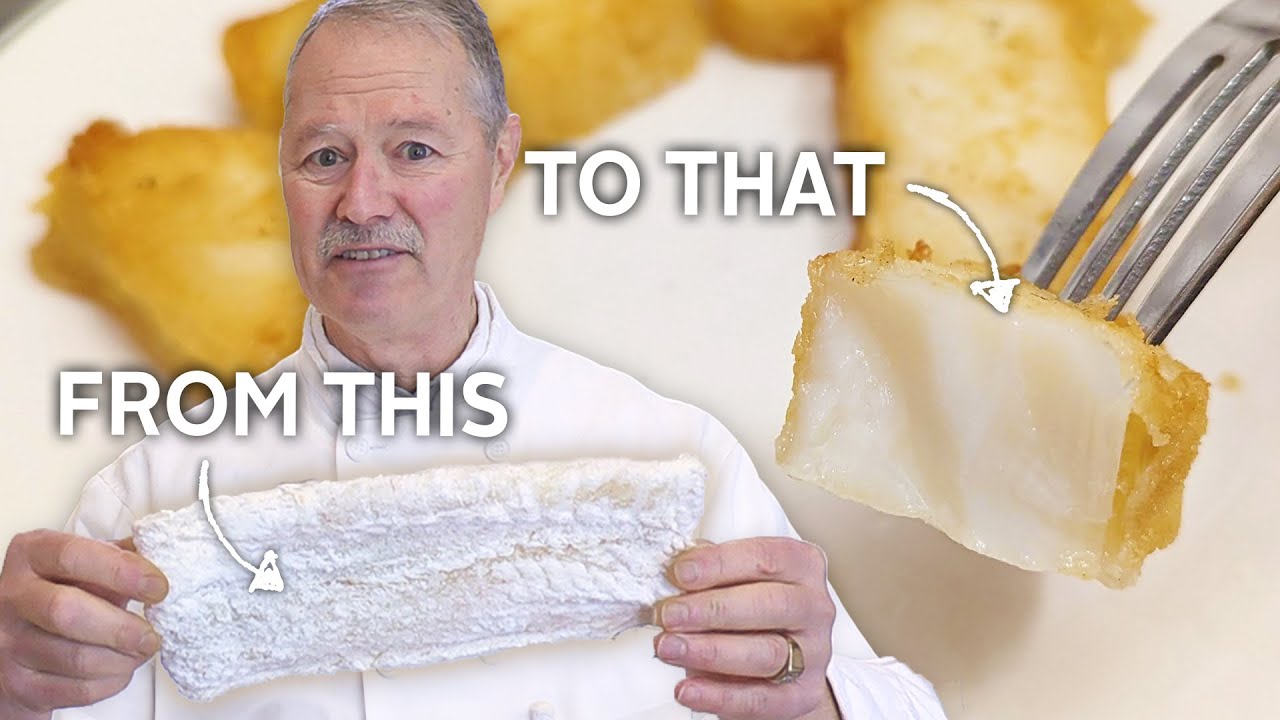
Bacala – it is cod that has been preserved in salt. I will show you how to prepare this delicious fish and then do a taste test. The taste is totally different than fresh or frozen cod – the meat is very white, firm, flakey and tasty!! My father’s favorite joke that he said often was, “Do you know why the ocean water is salty? It’s because there are too many Bacala” 🙂 🙂 🙂
00:00 INTRO
00:44 prepping the cod
05:42 3 days later, final rinse and dry, prep to fry
08:53 frying the cod
12:21 taste test
13:50 OUTRO
Bacala
What is it:
• It is cod fish that has been preserved in salt.
How to prepare it before cooking
Day 1:
• Rinse the Bacala thoroughly, using cold water from the tap (do not use hot water)
• Cut the Bacala into large sections and place in a large bowl.
• Fill the bowl with cool water and ensure the Bacala is completely covered in water.
• Cover the bowl and place it in the refrigerator.
• After a few hours, dump out all the water, and re-fill with new water – place back into fridge.
• After a few hours, dump out all the water, and re-fill with new water – place back into fridge.
• After a few hours, dump out all the water, and re-fill with new water – place back into fridge.
Day 2:
• In the morning, dump out all the water, and re-fill with new water – place back into fridge.
• In the afternoon, dump out all the water, and re-fill with new water – place back into fridge
• In the evening, dump out all the water, and re-fill with new water – place back into fridge
Day 3
• In the morning, dump out all the water, and re-fill with new water – place back into fridge.
• In the afternoon, dump out all the water, and re-fill with new water – place back into fridge
• In the evening, dump out all the water, and re-fill with new water – place back into fridge and cook tomorrow – or, you can cook it today
NOTES: in summary, the key is to wash the Bacala thoroughly and then let it soak, changing the water at least a minimum of 3 times per day for 3 days…you can also change the water more often if you like, say 4 – 5 times per day, for 3 days – this is fine also and preferred, but not essential.
Once you have finished and are at the end of day 3, you can cook the Bacala or put it in the fridge to cook the next day or even the day after that. Otherwise, you can also freeze the Bacala and then thaw/cook sometime later, at your convenience.
When you do cook the Bacala, there is no need to salt to it 😊
How to cook Bacala
• A simple/basic way is to just cut it into pieces and cover in flour – shake off excess flour and fry in vegetable oil till golden brown on both sides.
• Otherwise, Bacala is also delicious when baked or grilled. It can also be cooked on the stove top in many ways, as well as made into fish cakes. Very versatile and delicious.
My Kitchen Gear
Here are a few things I mentioned in the video. Please shop and support your local shops! If you cannot find them there, here are some links to help out.
“My Bread Book” by Jim Lahey
► USA https://amzn.to/2JLwbEe
► Canada https://amzn.to/3baKEF0
Lagostina Tuscan Collection Orange Oval Casserole Dish / Dutch Oven, 5 Quarts
► Canada https://amzn.to/3s0sU5a
► USA (similar) https://amzn.to/2XbpcYo
We are a participant in the Amazon Services LLC Associates Program, an affiliate advertising program designed to provide a means for us to earn fees by linking to Amazon.com and affiliated sites. The prices are not higher, this just makes it easier for you to find the product. Hope these links help.
Thank you!
Hello everyone! My name is Ivo and welcome to Cooking with the Coias. Today folks, I’m going to show you how to prepare. And of course we’re going to cook and do the taste test for Baccala. Now, Baccala is not to be confused with baccala, which is a dessert known in
Turkey and in Greece. Baccala is actually salted cod. It’s fish, that’s been preserved. And in Portugal they are the masters of baccala. In fact, they they pronounce it a little differently. Buccal bacalao is how they pronounce it in Portuguese, something like that. But in Italy it’s Bacala and Baccala. Is this here?
Salted cod. It doesn’t look too appetizing. But let me tell you folks, this is absolutely amazing. The salting preserves the cod. That’s what they did back in the day. They used to catch cod Newfoundland and bring it back to the homeland. To prevent it from going bad.
They salted it, but in doing so, they’ve created this amazing fish with fantastic texture and taste. It’s definitely different than fresh cod. It is codfish. It is definitely different than fresh cod. This salted cod, or baccala is amazing. So first thing we have to do, is get rid of all the salt. So.
Cool, cool water under the cold water. Just rinse it off and it’ll start to come back to life a little bit. The little more pliable, as you can see. Now you can buy baccala. You can buy a whole. This is one fillet, as you can see. It’s one fillet.
You can buy it bone in or boned. This one has been debone. And it is a fillet, as you can see. And. Once you’ve removed the salt now it’s also because it’s been sitting in salt. It’s basically salt impregnated. So what we have to do is we have to let this soak in
Water. Now, a very good way to do it is to cut it, cut it up into smaller sections so that it hydrates quicker. And it’s also easier to, to store. So I’m just going to it’s thinner here. And there’s a nice thick strip here. So what I’m going to do
And here’s the tail part which is thin as well. So let’s cut that thin section. It’s hard to cut because again it’s been salted and cured. So there’s one section there. This is thicker. This is thinner. So what I’ll do is I will cut cut that section. And then again I’m
Just cut this in half. You don’t have to. You can leave them whole. But again I’m going to put them in a bowl. And that’s where they’re going to have to soak. So two things. They’re going to sit much nicer in this bowl cut in pieces. And they’re also going to rehydrate
And dissolve much, much quicker because they’re smaller. So again just one quick rinse. Now I’m going to fill this bowl with water. Okay. And let’s cover it with a piece of plastic. Okay. With a piece of plastic, it gets covered. And that’s it. That’s step one.
So now I will put this in the refrigerator and we’ll keep it in the fridge. Today is Monday. The way to properly get all the salt, though, is now this water needs to be changed three times a day. So today is Monday. I’ve done it once already.
I’m going to put this in the refrigerator. Later today I will take it out of the fridge, dump the water out, put fresh water in, put it back in the fridge, and then before I go to bed tonight, I’ll do the same thing. I will take it out of the fridge,
Dump the water out fresh water in and leave it in the fridge overnight. So like I said, today is Monday. I will do it three times as well on Tuesday. So in the morning I’ll do it. I’ll do it later in the afternoon and before I go to bed on Tuesday
And then Wednesday, I’ll do it Wednesday morning, Wednesday afternoon and then Wednesday evening. I’m going to have a little bit for dinner. So that’s when we’re going to fry it up and do the taste test. So that’s it. So this can now go in the refrigerator. We change the water three times
Daily. And by day three we’re ready to cook and taste. Now as a side note, I just put it in the fridge. If you didn’t do that, if you just rinsed it and cooked it, you’d be eating salt. It would be completely salty. Not at all edible. So this is very important
To change the water three times a day. And like I say on day three, which is Wednesday, we’re going to do the taste test. And it will be not salty but flavorful. Okay. And one more point, in case I didn’t mention it, of course the baccala needs to be completely
Covered in water while it’s soaking. So here we are. Fast forward three days later. It’s Wednesday. Let’s take our baccala out of the refrigerator. And yes folks, I have been for the last three days. I have been draining the water, and replacing the water three times daily.
Okay, so here we are on Wednesday. We’re going to drain the water again. The bucket LA is now ready. It is the salted. So there’s a nice thin piece right there. These are the thicker ones. Look at this folks. This is the thicker one. This is nice. That’s a that’s a nice
Piece right there of baccala. These thinner ones I like to use them to make, like, cod cakes. The thicker ones, I like to fry them or cook them differently. But for today, folks, for today’s taste test, we’re just simply, going to do a fry. And you know what I’ll use?
And I do like the thicker one. I’m going to use this thicker one right here. We’re going to fry this one up okay. So now here’s the thing. I’ve got all this baccala. And you might be thinking, okay, I got to do this for three days.
I got a time for when I want baccala. You don’t. So what you can do by your baccala and quite simply, leave it in the fridge until you’re ready to do the three day thing with the with the water. Once you’ve done that and your three days are up again, there’s no pressure.
Take them out. Dry them like I did here. Put them in the freezer. Freeze it in sections that when you want them, you just take them out and. No, no. The salting required. Take them out and cook them. So it’s actually very, very easy to do. So here is a really,
Really nice piece that I’ve just dried these other ones. I will dry them and freeze them for later use because there are other recipes I would like to share with you already. So let me get a better knife and we’re going to cut this. I’m going to cut it in smaller
Pieces so that it cooks up better. Let’s say okay. Beautiful. Let’s say it’s a very it’s a nice firm texture to this, to this buckler because it’s been salted and cured. Okay. So now we have our baccala. I have a little bit of all purpose flour here.
So we’re going to do a very, very simple one. I’m going to say traditional. This is kind of how my mother always did it. very very simple. Fry. And all we’re going to do is coated in flour and shake off the shake off the excess flour.
And we’re going to make our way over to the frying pan. It’s that easy. And of course, the taste test. Baccala, folks. Delicious. Okay, there we go. Let’s make our way over to the stove. So let’s fire up our stove. And I’m going to use grapeseed oil today, folks.
But any vegetable oil will do just fine. Sunflower oil, vegetable oil, canola oil, whatever you prefer to use. All right, let’s bring that up to temperature. The bill 353, 6365. And then we’ll start frying. Let’s take a temperature check. Three 4350 we’re good, we’re good. Okay. So time to put our buckler.
Into the pan and the other the reason, one of the reasons why we drive these this buckle are before we flour coated it is you don’t want water to get in with your hot oil because it will really splash and make a mess. So you want your, for any
Fish that you fry, you want it relatively dry. Okay, now that I put the fish in. Yeah. 333 A little bit less there. 360 a little hotter here. Okay. So let’s just move that oil around. Oh, boy. Folks, there’s something about frying fish. The sound of fried fish. Beautiful.
Okay, we’re going to let this cook it till it’s, you know, golden brown, on the one side. And then we’ll flip it. So it’ll take a couple of minutes and remember, I mean, we cut them, but they’re still relatively thick. So we want to make sure it cooks right through.
It’s been about 2 to 3 minutes. Let’s take a look. Yeah yeah. There we go. That’s that’s quite nice. Yeah. Perfect okay. And we’re going to do another 2 to 3 minutes on the other side. Now I did put the heat back down to medium high.
I had it on high to begin with. To get the temperature up. And then once I got the temperature up, I dropped it to medium high so it doesn’t continue to burn and get really hot. So in fact. I see that’s only two and change, but it’s 355 there,
So that’s a good temp. It’s actually 379 here a little bit hot. So we’re going to give that another couple minutes folks and get that other side cooked up nicely. It’s been about two minutes. Oh that looks really really good. Folks I think we’ve got a winner right here. Oops. Wrong plate.
Wrong plate. Okay. Let’s shut that down. Let’s turn our oil off. Let’s take a look. Oh, yeah. That’s that’s what you’re looking for right there, folks. That one is really golden brown, a little bit thinner. See a little thinner. Very nice, very nice. Oh, yeah. Beautiful, beautiful. Baccala. Okay, so I’m not going
To let this cool very long. I’ll tell you that, folks, because I want to get into the taste test right away. But look at that beautiful buckle right there. Isn’t that nice? Just simple, simple fry right there. Very, very simple, simple fry. And we do not want to add salt to our baccala.
We are going to eat it just like this because it’s already salted due to the curing. Okay, taste test folks. Yes folks, the taste test. And you know what? I’m not even going to use a fork. We’re going to go in with our hands and we grab one piece right here. Beautiful, beautiful.
Baccala. Nice firm texture. Steaming. Delicious, folks. See the flakiness inside there? Oh my goodness. Just the right amount of saltiness you taste. Just a hint, just a hint of salt. Just as if you would have added your own salt. And that’s exactly what you’re after with lot. It’s firm. It’s got beautiful texture.
The taste is amazing. It’s not like eating fresh cod at all. This buck a lot, which is salted cod, taste totally different. And just this simple, simple fish fry. Like this. Amazing. Seriously, you have to give it a try. There’s a reason why in Portugal. Portugal is the number
One consumer of baccala in the world. In fact, when I went to Portugal, I’ve been a few times now. Each time I have baccala at least once daily. They’re the masters when it comes to cooking baccala and Italy is right behind them. It’s so good folks. And again, prep it. Freeze it.
Take it out. Cook it when you want. If you’ve never had baccala. By all means, here’s your opportunity. Give it a try. You’re going to absolutely love it. And down the road we’ll get into some different recipes. I’ll show you what you could do because it’s very, very tasty.
But anyway, you want to slice it. This is delicious. Thanks for joining me in the kitchen today on today’s episode of Cooking With decoys. And of course, it’ll make me very happy if you give this a try. Until next time. Putting the potato. Simple and delicious.
7 Comments
Pronunciation is Bacayaow
Once again you've shown me something I've never even heard of, nevermind tasted or cooked! Thank you, Ivo.
Interesting………
Awesome Ivo!!! I will certainly make your salt cod dish . I also make cod cakes with salt cod. Delicious….we love it.
I really like Bacala, have not had it for a while. What kind of counter top stoves do you use? I need to get a new one. Thanks.
That looks amazing
I’ve seen this in the grocery store and never new how to prepaid it . Thanks I’ll give it a try.