
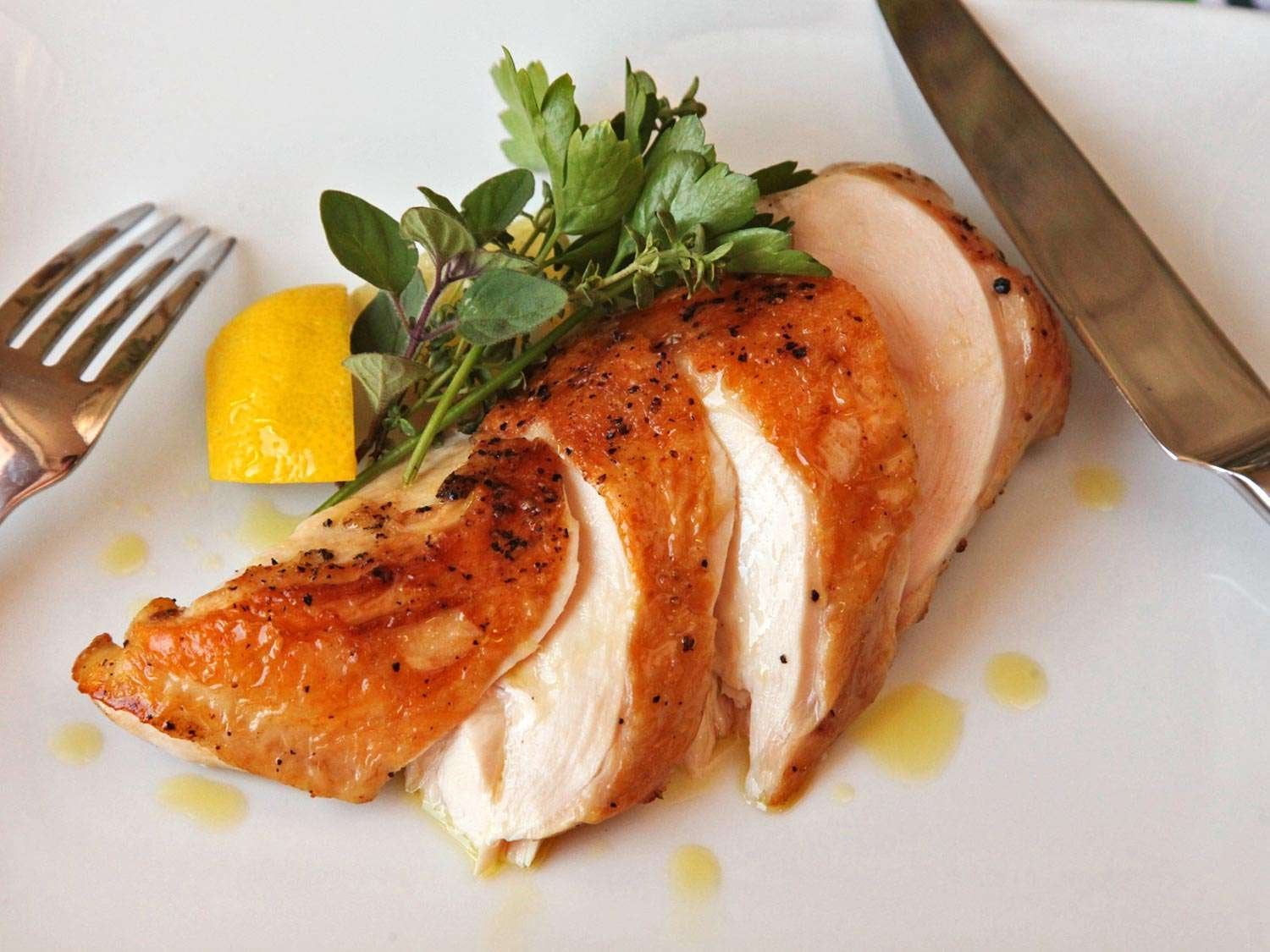
I just had my first attempt of suis vide. The results were mixed.
I cooked 2 pieces of chicken breast but one was clearly thicker than the other.
I've set it to:
- 65.5° (150 Fahrenheit)
- 90min duration
The thinner piece came out quite nice. Not as soft as I'd like (melting in your mouth) but still nice.
But the thicker pieces was very chewy in the middle part. It made me super paranoid about food poisoning and even if not, it was not edible.
But even this guide from serious eats does not discuss thickness at all. Why? In theory I followed his recommended time but the thick piece came out bad.
So my question is this:
Does the general rule "lower temp (within reason ofc.) = more softness" hold? So by that logic (and following this guide) I could go as low as 140°F (60°C) for 1.5 to 4 hours to get maximum softness correct?
However what about thickness? It is clear that 2 differently thick chicken breast will be completely different cooked if they have the same temp & duration.
So….how do you guys deal with that? Do you cut your chicken breast down to be always of (roughly) equal thickness?
Do you just add extra time if there is one particularly thick piece in your batch?
by sta6
11 Comments
Maybe the thicker piece was a case of woody chicken?
I often get weird, kind of stringy/rubbery texture from chicken breasts. Pieces are typically uniform size and i cook everything for the same time and temp. I believe it’s a chicken quality issue. There’s a problem becoming more prevalent in the market called “woody chicken” where some kind of genetic or developmental issue causes the meat to be extra tough. The chicken is always fully cooked, and I’ve never gotten sick, but the texture is so off-putting that I’ve started just throwing them out. I can’t tell how it will be until I bite into it, though.
Temperature is the level of doneness.
Time is set by how thick what you are cooking is…
Thickness should always be considered when deciding your cook time. Look for a time/ temperature/ thickness chart like this [chart](https://stefangourmet.com/2018/04/01/how-to-choose-time-and-temperature-to-cook-meat-sous-vide/). Sounds like you undercooked your chicken.
Probably more about the variability of the meat than the thickness. I usually cut a large breast into portions, usually at different thickness and the meat from the same breast comes out the same.
Because Reddit loves serious-eats a tad too much. Here is a more comprehensive guide:
https://douglasbaldwin.com/sous-vide.html#Table_2.3
Choose your temp and look at the pasteurization table.
Also, try 62.5 C, I don’t really feel like it’s got a weird texture but is a lot more moist.
Nobody is talking about thickness because it usually isn’t an issue worth talking about.
You really ought to have a read of Douglas Baldwin’s material in Sous Vide for the Home Cook. He discusses this topic to a level of detail that has never been surpassed. If you want to know about the interplay of temperature, thickness and cooking duration, and their implications for food safety, he’s your man. His information is extremely complete and extremely well organized, and it is much more reliable than the average advice you might expect to receive here.
This said, 65.5 C is more than warm enough to eliminate any concern about food poisoning, at least if you started with fresh, clean food and never had any power failure or other disruption. At this temperature, your chicken will have been pasteurized, and also cooked to a doneness that should be fairly similar in texture to conventionally prepared chicken.
Your perceived issue with texture is probably a result of poor quality in the chicken breast. Another commenter suggested woody breast, which is a pretty reasonable explanation.
There isn’t a chicken breast in the world that wouldn’t be finished cooking in 90 minutes. Huge chicken breasts are often tough. They are just inherently lower quality chickens weren’t meant to get to such freakish sizes as we see today
In restaurants, even when using sous vide, the proper way to deal with differing thickness of chicken breast is to flatten the thicker one with a mallet or sauce pan. Also “woody” chicken exists, and it’s not a great texture.
Now Dennis, I’ve heard speed has something to do with it
>Does the general rule “lower temp (within reason ofc.) = more softness” hold?
I think this is a bit simplicitic.
– This temp varies between meats (at beef vs chicken light meat be chicken dark meat).
– Underdone meat is going to be chewy, not soft.
And the phrase “within reason” is not helpful to the novice, who is trying to learn what “reasonable” is.
Here’s the simple rule that I saw in most beginner guides when I was starting with sous vide: one hour per inch of thickness.
Don’t forget: it is very difficult to overcook with sous vide. So just plan an extra hour. And — as a novice — check internal temps with your probe thermometer.