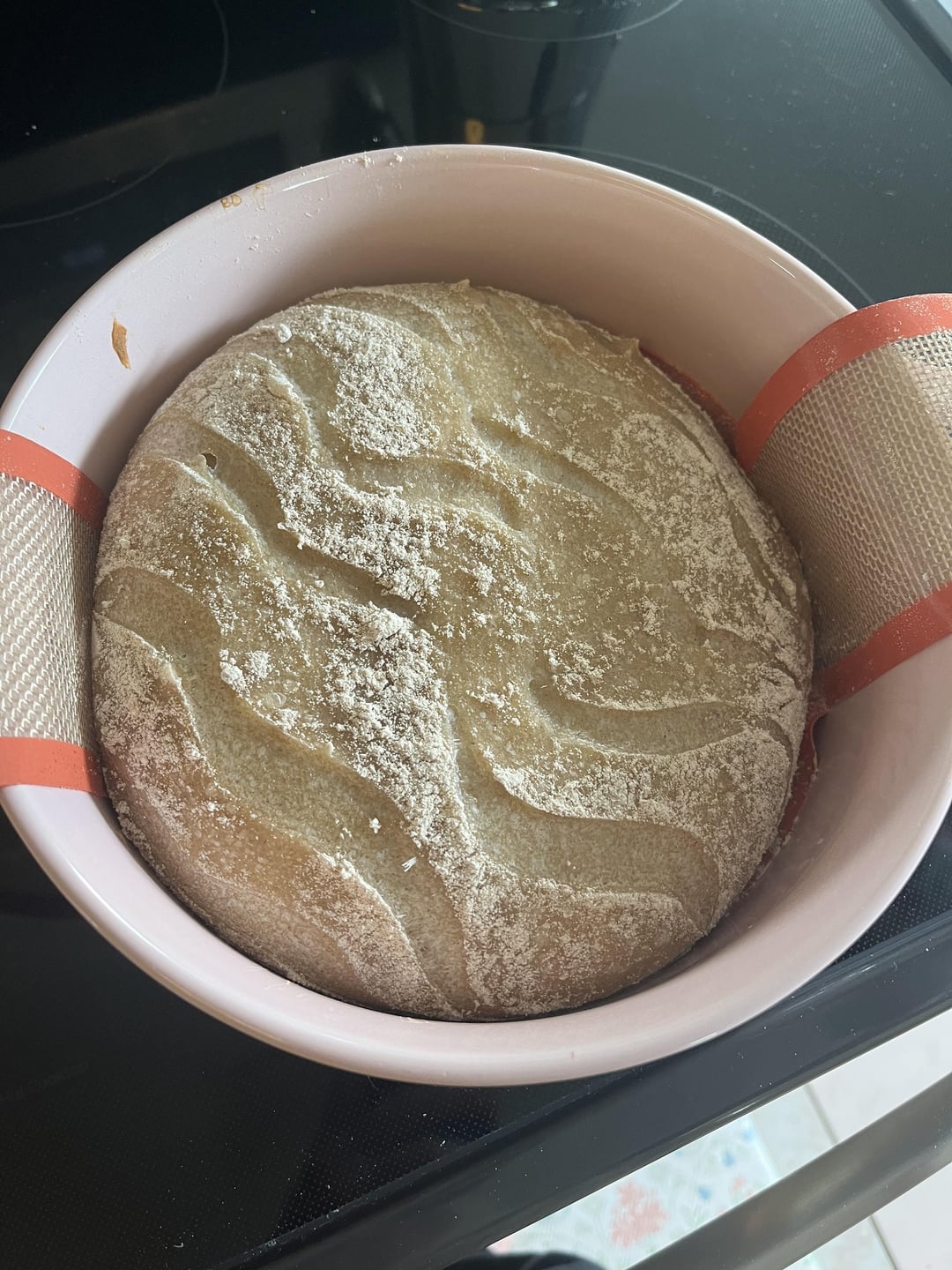
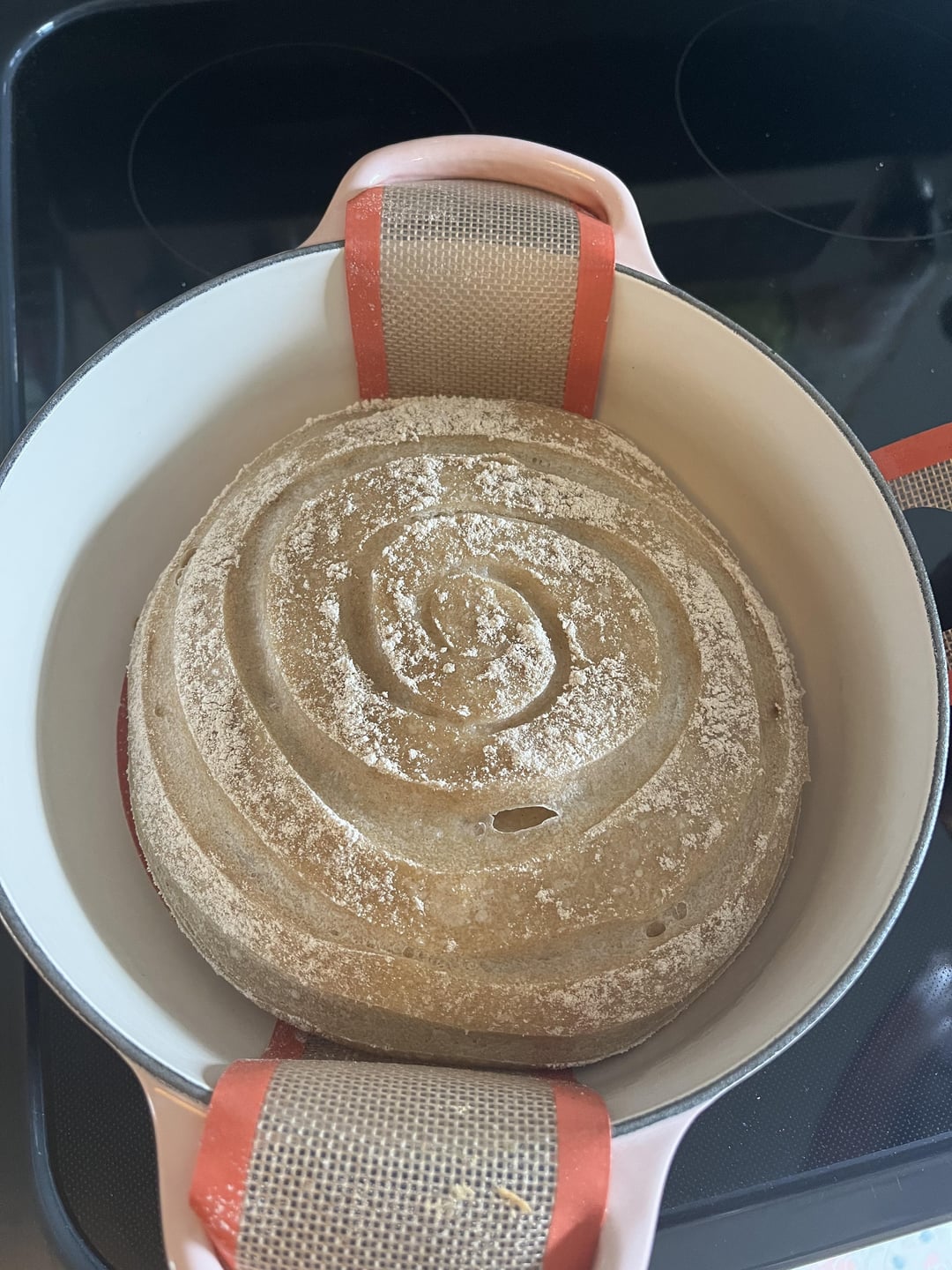
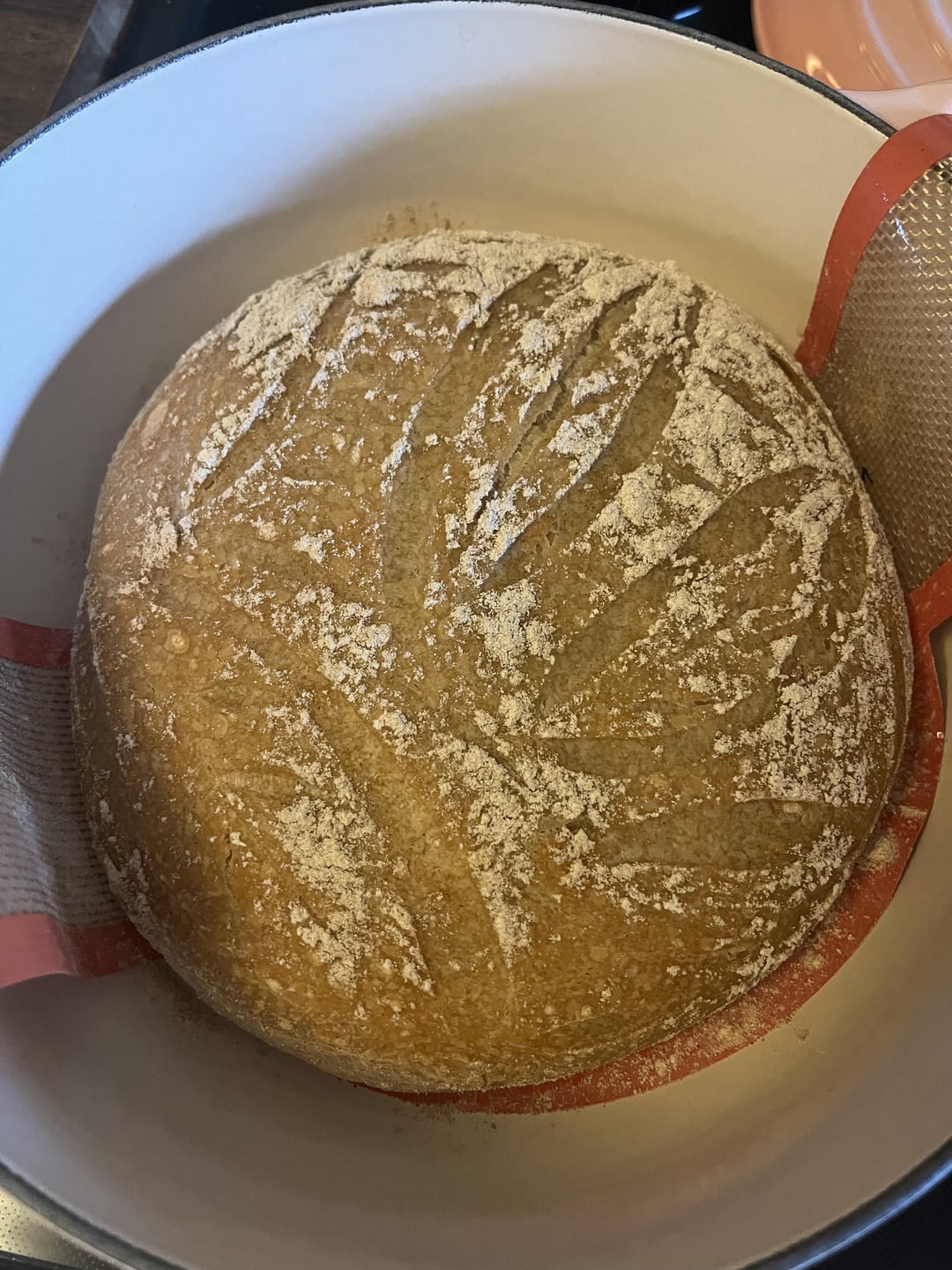
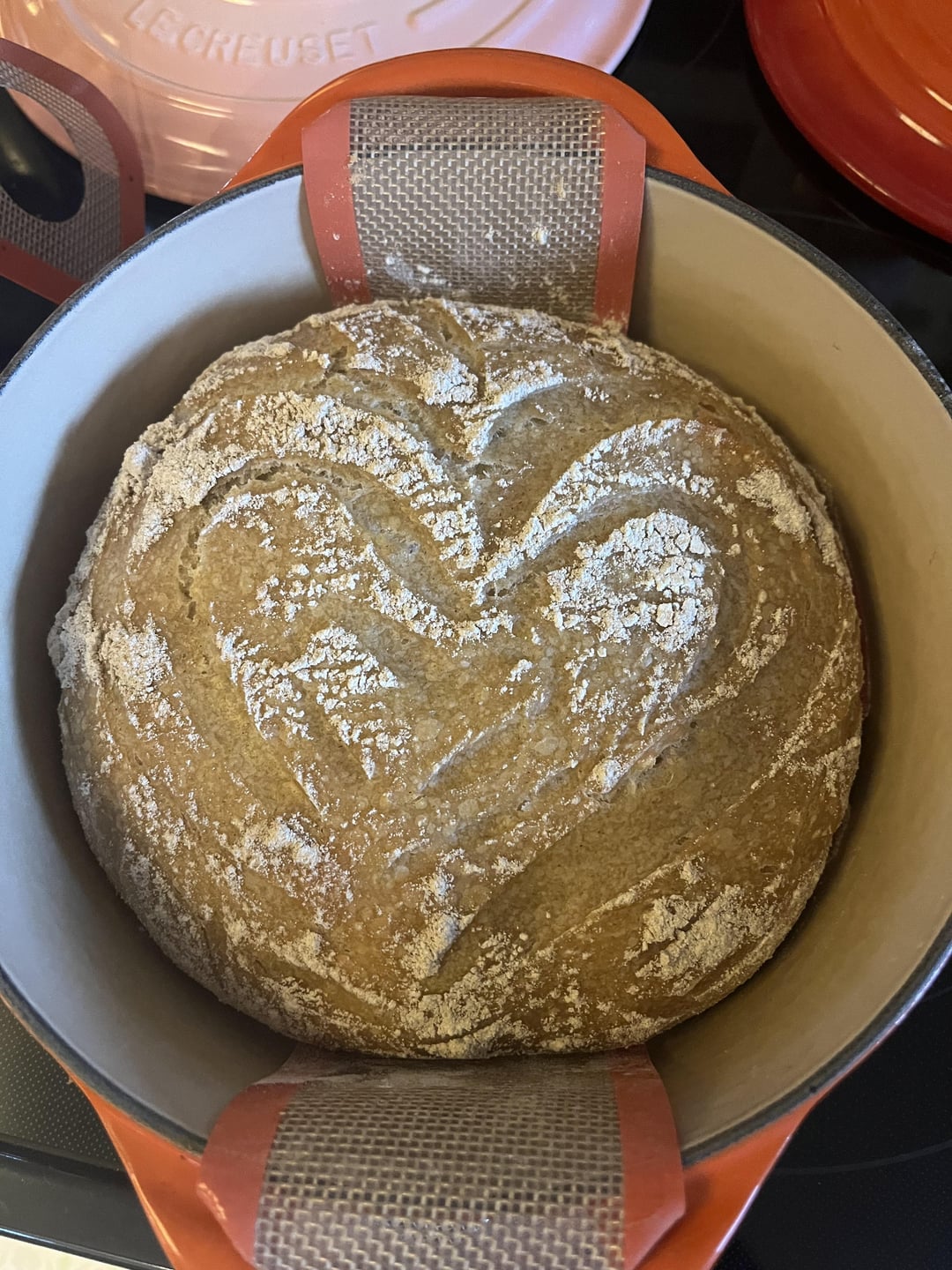
I just started about a month ago, it’s honestly a rocky road! Here’s my loaves the past few days. They’re at least starting to look nice!!
by SuccessfulSky3846
7 Comments
multisync
You just need to cook em! I bet they’d be wonderful. Try this: Crank that oven to 475, let it preheat an hour with vessel inside, add bread 30 min lid on / 25 lid off
imostmediumsuspect
Can you share your recipe/method?
They look severely underbaked and possibly underproofed.
For a loaf that size (I’m guessing 500g flour, 325g water?), you should have your cast iron in the oven while it preheats – heat it as HIGH as it goes (i have mine at 550F).
Bake for ~20-27 minutes.
Affectionate_Ant7442
I’ve been baking mine at 475 for 30 min lid on, 450 for 30 min lid off. I did not preheat my Dutch oven this most recent time.
galaxystarsmoon
These look underproved and underbaked. Can we see the inside of one of them? What is your ambient temp during bulk? How long are you bulking for?
jimbobobman
If you’re still experiencing burnt/hard bottoms after preheating your Dutch Oven, would highly recommend throwing a baking sheet, or better yet, pizza stone on the rack below your Dutch oven. I had very prevalent issues with burnt bottoms, which the baking sheet didn’t fix, but a stone worked wonders.
Also, as others have commented–make sure to bake at a high enough temperature! I start at 475 while I bake with the lid on, then drop to 450 when I take the lid off to help crisp it up.
Good luck!
Artistic-Traffic-112
Hi. Your loaves look pretty good they just need to cook more evenly and fully.
Your ceramic pot doesn’t want high thermal shock and probably isn’t safe to 450.
Your le creuset should be fine, but the enamelling may not like high thermal shock and craze.
I gather many ovens are bottom heated, so your DO and Le Creuset will heat up differentially bottom sides and top. The whole idea is that the thermal mass of your cookware stabilises the cooking temperature.
If you put your dough straight onto a bare DO base, it is going to sear and seal rapidly. The only way to avoid this is to create a thermal break between your dough and the base a d wall of your DO. Protecting you DO base from direct bottom heat is one way another is to insulate your dough from the vase with several layers parchment or a silicone sling yet another is ti place a trivet under you sling to create air flow.
All ovens are slightly different and do not necessarily reach the baking temperature you dialled in. So, check your oven.
Basic cooking for a DO is preheat and soak heat both oven and DO to 450, 500, 15 to 30 mins more than ready light. Remove DO and using a sling load loaf onto DO, slash, and cover. Put back in oven and reduce to 430 for approx 25 mins and a further 15 min lid off.
You can control the degree of colour with a reflective foil cover.
Your loaf is baked when the core temperature is 205 to 210
Your dough is still cooking when you pull it from the oven. It takes time for the superheated steam in your crumb to resorb and leave a nice soft crumb. If you cut before cold, the steam will condense and make your dough, doughy!
I use a different method to bake. A bread tin in a roasting pan. From cold in a pre heated oven. I allow 15 mins extra cooking time, but similar temperatures and controls
Happy baking
Edit:
Typo corrected
Capybarely
I’d be hesitant to use a silpat in bread baking. Their website says it’s good up to 428⁰F which is lower than your bread needs in the Dutch oven.

7 Comments
You just need to cook em! I bet they’d be wonderful. Try this: Crank that oven to 475, let it preheat an hour with vessel inside, add bread 30 min lid on / 25 lid off
Can you share your recipe/method?
They look severely underbaked and possibly underproofed.
For a loaf that size (I’m guessing 500g flour, 325g water?), you should have your cast iron in the oven while it preheats – heat it as HIGH as it goes (i have mine at 550F).
Bake for ~20-27 minutes.
I’ve been baking mine at 475 for 30 min lid on, 450 for 30 min lid off. I did not preheat my Dutch oven this most recent time.
These look underproved and underbaked. Can we see the inside of one of them? What is your ambient temp during bulk? How long are you bulking for?
If you’re still experiencing burnt/hard bottoms after preheating your Dutch Oven, would highly recommend throwing a baking sheet, or better yet, pizza stone on the rack below your Dutch oven. I had very prevalent issues with burnt bottoms, which the baking sheet didn’t fix, but a stone worked wonders.
Also, as others have commented–make sure to bake at a high enough temperature! I start at 475 while I bake with the lid on, then drop to 450 when I take the lid off to help crisp it up.
Good luck!
Hi. Your loaves look pretty good they just need to cook more evenly and fully.
Your ceramic pot doesn’t want high thermal shock and probably isn’t safe to 450.
Your le creuset should be fine, but the enamelling may not like high thermal shock and craze.
I gather many ovens are bottom heated, so your DO and Le Creuset will heat up differentially bottom sides and top. The whole idea is that the thermal mass of your cookware stabilises the cooking temperature.
If you put your dough straight onto a bare DO base, it is going to sear and seal rapidly. The only way to avoid this is to create a thermal break between your dough and the base a d wall of your DO. Protecting you DO base from direct bottom heat is one way another is to insulate your dough from the vase with several layers parchment or a silicone sling yet another is ti place a trivet under you sling to create air flow.
All ovens are slightly different and do not necessarily reach the baking temperature you dialled in. So, check your oven.
Basic cooking for a DO is preheat and soak heat both oven and DO to 450, 500, 15 to 30 mins more than ready light. Remove DO and using a sling load loaf onto DO, slash, and cover. Put back in oven and reduce to 430 for approx 25 mins and a further 15 min lid off.
You can control the degree of colour with a reflective foil cover.
Your loaf is baked when the core temperature is 205 to 210
Your dough is still cooking when you pull it from the oven. It takes time for the superheated steam in your crumb to resorb and leave a nice soft crumb. If you cut before cold, the steam will condense and make your dough, doughy!
I use a different method to bake. A bread tin in a roasting pan. From cold in a pre heated oven. I allow 15 mins extra cooking time, but similar temperatures and controls
Happy baking
Edit:
Typo corrected
I’d be hesitant to use a silpat in bread baking. Their website says it’s good up to 428⁰F which is lower than your bread needs in the Dutch oven.