
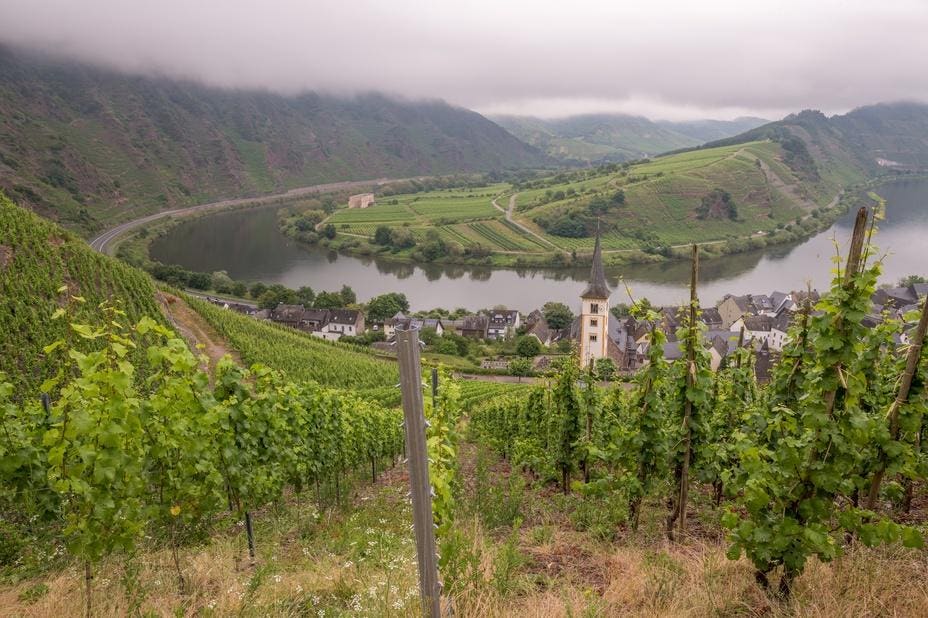
With iconic steep sloped vineyards, a mosaic of slate-driven soils, tapestry of microclimates resulting from the snaking Mosel River, families with twelve generations of winemaking, next generation passionate winemakers, and low-intervention, biodynamic winemakers, Mosel Valley is one of the world’s premier wine regions, producing some of the world’s best Riesling.
getty
It’s an unseasonably warm June day standing atop Weingut Carl Loewen’s block of vines in the Thörnicher Ritcher Vineyard. Looking down the 97º slope, one question comes to mind: Why would anyone plant vineyards here?
One of Germany’s largest forests begins at the base of the slope. A slight right turn of the head reveals the winding Mosel River. Grey slate mingles with quartzite underfoot. This isn’t just the second steepest slope in the Mosel, it’s an ideal cool microclimate, allowing golden Riesling grapes a long, consistent growing season, resulting in high-acid Rieslings with tension and verve. Simply put, one of the many reasons to fall in love with Mosel Riesling.
“The great wine writer Anne Krebiehl MW calls the Mosel ‘a cosmos unto itself’ and this is so true,” says Valerie Kathawala, journalist, co-editor of Trink Magazine, and author of the upcoming Wine Scholar Guild’s German Wine Scholar course. “The combination of a spectacularly twisting river that offers so many different exposures, angles, and degrees of steepness plus (mostly) slate soils, a relatively cool climate and a deep tradition of small growers working small plots are singular within Germany.”
Home to an array of grapes (its Pinot Noir acclaim continues to grow), the Mosel is known for Riesling. “Mosel Riesling is healthy anytime,” says Sophia Thanisch, fourth generation owner of Weingut Wwe. Dr. H. Thanisch Erben Thanisch.
An Abbreviated History of German Riesling
But the Riesling of today is not the same as the past, well at least not the recent past. History explains the first Riesling was made in the Mosel in 1435. By the 17th century it had become the region’s flagship and a century later it was being sought by English nobility—prized for its sweetness.
As a grape, Riesling has magic powers. “German Riesling can do something no other grape does so well: accumulate very high levels of natural sugars while holding onto very high levels of natural acidity,” Kathawala says. When carefully made the sugars and acidity provide a tantalizing tension, when not, resulting wines can be cloyingly sweet.
United States soldiers developed an appreciation for easy-drinking sweeter wines during World War II, and they brought that taste home with them. In the 1980’s “taste-maker importers” continued championing sweet wines in believing, along with Kathawala, that sweet wines are a “unique strength of German wine.”
Mosel Riesling Goes Back To The Future
Today, winemakers are going back to the future. While many wine drinkers are up to speed, some are still missing the magic of German Riesling. “The current generation of Riesling producers understands the mistakes that were made in the 1950s -80s,” she says. “Today’s growers are turning back the clock to adopt their grandfathers’ and great-grandfathers’ methods of farming and winemaking. Crucially, while German Riesling still shines as an off-dry or fruity sweet wine, it can now also triumph as a dry wine.” Thanisch, who’s two daughters, Juliane and Christina, are preparing to take over someday, admires the collaborative openness of the Mosel’s next generation seeking to adapt and grow together. “The collaboration is really important. In the past it didn’t happen.”
From large wineries to small, the focus remains on growing exceptional grapes, many through sustainable, organic, and biodynamic methods, that deliver site-specific terroir with limited winemaking intervention in the glass. Large wineries, such as Weingut Markus Molitor accomplish this by delivering the best possible wines representing each of their 25 vineyards. Weingut Carl Loewen, a small producer, sees themselves as growers focused on viticulture. “In viticulture, for me the biggest word is balance. My goal is to create that balance in the vineyard and glass,” says Christopher Loewen. Furthermore, the Mosel is poised to meet the lower alcohol trend. “We see the trend going to moderate alcohol and freshness. This plays in the Mosel because this is what we do here so well,” says Lara Haag, next generation of Weingut Schloss Lieser
How To Buy Mosel Riesling
Knowing how to select a high-quality Mosel Riesling at the desired sweetness level poses challenges, even for wine professionals. The good news is wine education can be fun and delicious. Read articles, like this one, seek out a locally owned, well-staffed wine retailer, get to know the staff and go on a Mosel Riesling adventure. Determine how the indicated sweetness levels match your perception and works with a variety of foods.
Weingut Markus Molitar utilizes color coded bottle capsules to signify sweetness levels. Some wineries employee the international Riesling scale on the back label for guidance. While others, such as Weingut Schloss Lieser consider it a matter of taste. “We are not big fans of communicating each wine’s sugar level. We think each person should taste for themselves,” says Haag.
German wine quality indicators—Qualitätswein, Prädikatswein, and VDP (Grosses Gewächs and Grosses Lage), are confusing hard to pronounce words. But, keep in mind knowledgeable wine professionals in a local wine retail shop love to talk German Riesling. Carve $20 or more dollars from the wine budget and explore. Keep in mind, most challenges are worth it. German, specifically Mosel, Riesling is the best wine you are not drinking; offering a style to pair with every food.
“Mosel Riesling would be my desert island wine if I had to pick one (and had a refrigerator to keep it all cold). This is because Mosel Riesling can be so many different things, all of them brisk, vibrant, and invigorating,” Kathawala says. “To me, Mosel Riesling contains infinite possibilities for exploration and zero chances of boredom. With a new generation of producers reviving forgotten sites, experimenting with lower intervention styles, or reviving traditional methods, the Mosel is also in a period of thrilling reinvention.”
Mosel Riesling Is Magic
With iconic steep sloped vineyards such as the legendary Berncasteler Doctor, Thörnicher Ritcher, and Ürziger Würzgarten, a mosaic of slate-driven soils, tapestry of microclimates resulting from the snaking Mosel River, families with twelve generations of winemaking, like Weingut Wwe. Dr. H. Thanisch Erben Thanisch, next generation passionate winemakers such as Christopher Loewen, Lara and Niklas Haag of Weingut Schloss Lieser, and low-intervention, biodynamic winemakers such as Clemens Busch, Mosel Valley is one of the world’s premier wine regions, producing some of the world’s best Riesling.
“It shouldn’t be any wonder that Mosel growers have perfected the art of wine-growing and making,” shares Kathawala. “It’s much more surprising that the world doesn’t assign far greater value to these treasures! But that’s an opportunity for all of us with open minds and palates.”
More From ForbesForbesMosel Winegrowers’ Focus On Soil Health Improves Wine QualityBy ForbesThe Dirty Truth Soil Health Plays In WineBy ForbesWhat If The Wine Industry Adopted A First Do No Harm Mentality?By