
Unlock the Editor’s Digest for free
Roula Khalaf, Editor of the FT, selects her favourite stories in this weekly newsletter.
This week’s recipe comes from Nick Bramham’s menu at Quality Wines in London, whose smash-hit sausage-and-chard ragu the magazine featured in August. I write this knowing I can only make such a grand claim once a year: it is the perfect dinner party recipe. It is French (read: sophisticated). It is easy to make well, with a bit of leeway on timings. It has an unusual flavour, and yet will please even fussy palates. And if I have learnt one thing from choosing recipes for the FT, it’s that all people really want is new ways to cook a chicken.
Drink
Champagne, Chenin Blanc, or off-dry Riesling. ‘If the wine has less acid than the food, it won’t really sing,’ explains Bramham.
Substitutions
Chervil or parsley would work well as herbs, but tarragon is the classic. Use good quality red wine vinegar if possible, eg Belazu’s. The basic stuff is a bit sharp and thin.
Tip
If you are not already in the habit, try adding vinegar to other stews and sauces. ‘It sharpens, brings things into focus, and balances fat and richness,’ says Nick. ‘Imagine a bag of chips without salt and vinegar.’
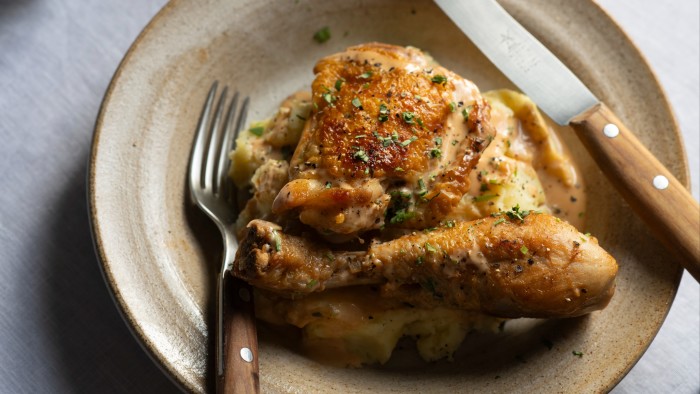
Vinegar chicken
To serve four
Season the chicken legs all over with salt and pepper, ideally the night before you intend to make it, at least one hour before. (Or in a pinch, fine, just season and go.)
In a large heavy-bottomed pan that can accommodate all the chicken in a single layer, heat the butter and oil over a medium heat and once the butter is foaming add the half the chicken, skin side down.
Cook relatively undisturbed until the skin is really crispy, around 15 minutes, then remove from the pan and rest on a plate skin side up, then repeat with the remaining chicken.
In the fat and juices left behind, gently cook the shallot until soft and translucent (about 15-20 minutes) then add the garlic and cook for a few minutes more.
Add the tomato purée and Dijon mustard, and cook for a few minutes then add the red wine vinegar and reduce until a syrupy consistency, around five minutes.
Add the chicken, skin side up, followed by the chicken stock, and simmer very gently for half an hour. Try to avoid the skin being covered by the stock — the chicken pieces should look like islands.
Remove the chicken and leave to rest on a plate while you finish the sauce. Strain it through a fine sieve then bring up to a boil.
Add the cream, reduce to a simmer, and cook until thickened to the consistency of single cream.
Add the chicken to warm through, sprinkle over the tarragon, and taste the sauce. Adjust the seasoning if necessary with salt and perhaps a splash of raw vinegar.
Serve with a big heap of coarsely mashed potatoes and maybe something green.
Coarse Mash
Chop the potatoes into equal chunks, each slightly larger than a golf ball.
Add to a pot and cover with water. Season lightly with the salt.
Bring up to a boil and simmer gently until tender. (It’s important to simmer very gently so the edges of the potato don’t overcook and break down or become waterlogged before the interior is thoroughly cooked.)
When tender, drain in a colander and allow the water to evaporate completely.
While still warm, slide back into the (now dry) pan in which they were cooked, and use a hand masher to make a coarse mash over a gentle heat. Carefully going around the pan, pressing the potato through the masher, ensuring the masher has total contact with the base of the pan each time. Don’t overmash! It should still have some texture, but no large lumps.
Tip the butter in the pan, allow it to melt/soften for a few minutes, then fold into the potato using a spatula.
To reheat, you might need to use a splash of milk, just to re-emulsify any butterfat that might split out.
Follow @FTMag on Twitter to find out about our latest stories first and subscribe to our podcast Life and Art wherever you listen