
00:01
“Journeys in Japan”
00:08
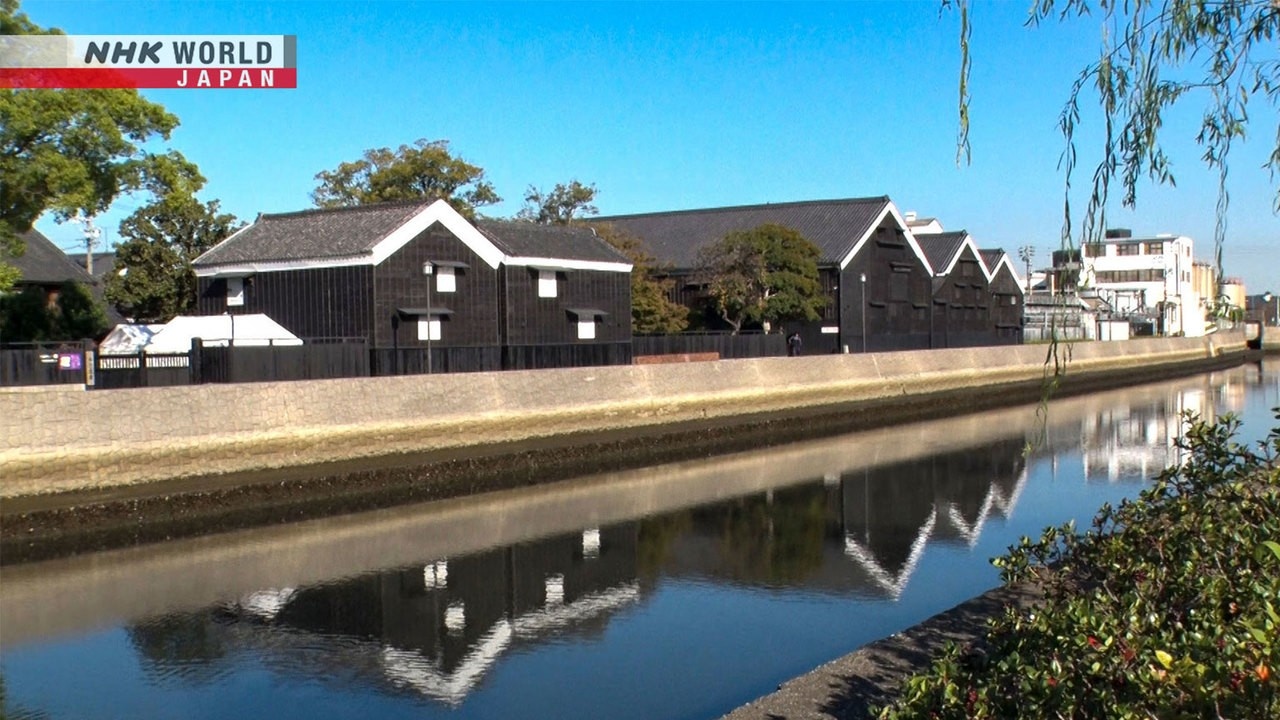
Wooden vessels once plied this canal…
00:13
carrying local specialties to Edo and other cities.
00:21
Handa, in Aichi, is known for its fine sake, vinegar, miso, and shoyu.
00:31
Jennifer Julien has come to savor this world…
00:38
as part of her thirst for culinary knowledge.
00:48
“Bonjour.” I’m a French from Bordeaux,
00:50
and I work in the food and wine business.
00:52
Today I’m in Handa, a town where I hear there is a fermented product
00:57
that is a must-have with food,
00:59
but also a lot of breweries.
01:01
So I’m very excited to go around.
01:10
The city also brews up fun with a dazzling float festival
01:14
held only once every five years.
01:22
On “Journeys in Japan,”
01:24
Jennifer enjoys the festivities and rich food culture of Handa.
01:37
Handa
Savoring a Canal City’s Delights
01:47
Located on the Chita Peninsula,
01:49
Handa is about 270 kilometers west of Tokyo.
02:02
Chubu Centrair International Airport is just on the other side of the peninsula.
02:15
So I’m on my way to Handa from the International Airport,
02:18
and it takes only 15 minutes to go there by car.
02:31
The city, with a population of over 100,000,
02:34
is within commuting distance of Nagoya.
02:50
Traces of times gone by can be discovered here
02:54
in the “district of warehouses.”
02:59
So this is the canal of Handa,
03:01
and I think that these black buildings really give a super nice vibe to the area.
03:07
And apparently, this is where they used to make vinegar.
03:12
Handa’s history of brewing goes back 200 years.
03:25
Thanks to the flourishing shipping industry,
03:28
its products took off in major cities.
03:35
So we’re at the back of those black buildings,
03:37
and it feels really like being in a time-slip tunnel.
03:48
In French, vinegar is “vinaigre.”
03:51
It means sour wine,
03:53
so there is a deep connection in between wine and vinegar.
04:30
This place recreates our vinegar brewery from the Edo period.
04:36
“Kasuzu” vinegar was produced here.
04:39
Kasuzu is made from “sake kasu” or sake lees.
04:43
Please come this way.
04:45
Our company started as a sake brewery.
04:48
In the brewing process, a huge amount of lees are left over.
05:03
Our founder made vinegar from them. It was a new invention.
05:17
First, sake kasu was aged in this big barrel to produce “umami” and sweetness.
05:24
– This is three-year aged sake kasu.
– The color is incredible.
05:46
– It’s an Edo period ship.
– What is it doing here?
05:54
Kasuzu was transported by this kind of ship all the way to Edo, now Tokyo.
06:07
It then encountered a certain food there.
06:12
– What was it?
– Let me show you.
06:18
This is “haya sushi,” the original form of “nigiri sushi.”
06:23
Kasuzu was inexpensive and rich in umami.
06:29
People found that sushi rice seasoned with kasuzu tasted better.
06:34
That’s how it became popular.
06:38
It’s no exaggeration to say that Handa created a sushi boom.
07:19
“Bisyu-hayasushi” is based on a 19th-century recipe.
07:26
The “nigiri” pieces are supersized compared to today’s.
07:33
Why are they so large?
07:36
So that you feel full by just eating one or two,
07:41
not like today’s style of eating many small pieces.
07:49
And the rice isn’t white.
07:53
It’s because we use this vinegar, made from sake kasu.
07:59
The dark color comes from its fermentation.
08:13
Wow, this is… Well, the size is, first of all, very impressive.
08:17
But also, indeed, it is salty.
08:20
But I think that this special vinegar
08:23
gives some kind of roundness, mildness to the sushi.
08:27
So the first bites are pretty well-balanced.
08:30
But maybe if I have too much, it will get saltier.
08:45
– This is the sake kasu vinegar.
– Thank you.
08:54
Yeah, it smells like round vinegar. Not too sharp.
09:11
This is not like super-vinegary vinegar.
09:14
It’s like round, mild vinegar.
09:17
And I think this is fruity also.
09:27
It makes me want to drink sake. Or even beer.
09:51
Wow, this building makes me feel like I’m in Europe.
09:59
This 19th-century structure was once a beer brewery.
10:03
(Handa Red Brick Building)
10:09
Hello, my name is Jennifer.
10:14
Baba Nobuo is the leader of a citizens’ group that conserves the building.
10:20
Please come this way.
10:25
The permanent exhibition showcases the brewery’s history.
10:35
This place was built in 1898.
10:41
German brewing equipment was installed and professionals came over
10:48
to start the production of authentic German beer, called Kabuto.
10:56
Japan was at the dawn of beer brewing at that time.
11:03
Why did beer brewing start in Handa?
11:07
Sake brewers in Handa had an entrepreneurial spirit.
11:14
Amid the declining popularity of sake,
11:18
they wanted to try something new for the future. And, it was beer.
11:24
Are the walls just as they were back then?
11:31
– So well preserved.
– It’s incredible.
11:37
Beer was stored in this space.
11:40
The walls were designed to accommodate tanks efficiently.
11:55
– What do you think made those holes?
– I have no idea.
12:03
They’re bullet holes from US fighters during the war.
12:10
One month before the war ended, Handa was air-raided.
12:18
Those holes were made in the attack.
12:28
The building had been used for storing military provisions during World War II.
12:33
And with that, Handa’s beer brewing came to a halt.
12:42
But in 2005, Baba and his group decided to change that.
12:54
– Okay, cheers!
– “Prost!”
13:06
Oh, my goodness. This is really like black beer with a very deep taste.
13:12
But it doesn’t have so much bitterness.
13:15
It has a pretty mild, deep and fruity taste.
13:23
Is this flavor the same as the original?
13:27
Yes. We faithfully re-created the beer using the original recipe.
13:33
Some said we should give it a modern twist. But we refused.
13:43
We wanted to pass on the value and appeal of this red brick building
13:48
and its brewing history.
13:50
We felt that we should simply recreate that old beer.
14:01
– And it resulted in a great flavor.
– Wonderful.
14:17
Kamezaki in northern Handa was once especially known for sake.
14:33
That’s a big sake brewery.
14:39
This brewery has a history of over 200 years.
14:58
Ito Masaru is the 9th-generation master here.
15:09
Sorry to interrupt you. What are you doing now?
15:13
I’m doing prep work.
15:16
I have blended the three main ingredients, rice, water, and “koji” mold,
15:21
in the tank for fermentation.
15:25
So milky. Once fermentation begins, we can see bubbles, right?
15:32
Yes. You can see that over there.
15:42
During the fermentation process, carbon dioxide and alcohol are produced.
15:47
The bubbles are carbon dioxide. It is breathing.
15:54
Oh my God, guys. It smells amazing.
15:56
It smells already like sake, “nihonshu.”
15:59
But it has kind of like a mild, round flavor, I think.
16:06
The aroma makes me happy.
16:12
– The sake is made with this water.
– Yes, from this well water.
16:25
It tastes different from ordinary water. It has a pure taste.
16:32
As Kamezaki was rich in groundwater like this, sake brewing flourished.
16:39
There were once about 40 breweries. I’m the 9th-generation head.
16:51
Until five years ago,
16:52
Masaru was working for a major telecom company
16:55
and had little background in the family trade.
17:00
When he was in high school, his father let the business go.
17:08
Then, two decades later,
17:10
Masaru decided to revive the old brewery
17:13
and resurrect his family’s sake flavors.
17:21
– This is my sake.
– What an honor.
17:35
Wow. It has a deep flavor.
17:39
It’s very deep in flavor and “karakuchi.” It’s a dry sake.
17:43
And I think it has a very pure taste.
17:47
It’s pure. Really nice. Like…
17:56
What made you decide to make sake?
17:58
We have many old buildings, like this.
18:04
I wanted to preserve them, but didn’t know how.
18:09
These days converting traditional structures into cafes is popular.
18:20
And I thought about doing that.
18:23
But would the business exist in 30 or 50 years, even after I die? I wasn’t so sure.
18:27
The buildings were created to be used as a sake brewery.
18:35
I thought brewing sake was the best way to preserve this complex.
18:44
So that made me consider making sake here again.
18:54
For him, it’s not just about honing his sake skills,
18:58
but also about using his brewery compound for cultural events
19:02
that bring community together.
19:18
This is such a nice view.
19:32
Oh, what do we have here?
19:34
I wonder what this building is? It has quite a unique shape.
19:42
Ah, and there’s another one!
19:49
“Saya” are garages for festival floats, called “dashi.”
19:59
Every district of Handa has held its own spring festival for over 200 years.
20:04
Residents pull towering floats
20:06
carrying the guardian gods of the community throughout their area.
20:22
And every five years, in autumn,
20:25
the floats see the light again.
20:48
The floats feature elaborate carvings,
20:51
large embroidered curtains,
20:53
and even mechanical dolls called “karakuri.”
21:00
Dozens are pulled into the city center from all 10 districts
21:04
for the Handa Dashi float festival.
21:17
The floats from each district are now heading here.
21:23
Today, all 31 one of them will come together.
21:29
This happens only once every five years.
22:03
Floats are paraded in one after another,
22:08
their grandeur a symbol of the wealth from the old trade in sake and vinegar.
22:19
I have never seen such a festival where there are so many different festival cars.
22:24
It’s so big and really…
22:26
You know, they’re all different in detail and,
22:30
you know, the colors for some of them. They’re really beautiful.
22:56
Look at all these festival cars.
22:59
This is quite a sight. I’ve never seen so many at once.
23:07
Unlike the spring float festival, this one is relatively new.
23:22
This story goes back 44 years.
23:25
We were part of a young entrepreneurs’ group.
23:28
We wanted to bring together the 31 floats,
23:32
as they were only seen in each district.
23:35
We thought it would galvanize the city.
23:41
Our proposal for the event met major opposition,
23:46
given the sacred quality of the festival.
23:50
But we patiently talked to all the parties and realized this event
23:56
that represents the whole city.
24:05
So, see? For example, this one has some dolls at the top.
24:11
Floats showcase karakuri dolls and their distinctive performances.
24:29
It’s so much fun. It’s a great chance for people in each district to get together.
24:39
It’s exciting. Each district has its own festival culture,
24:45
so we can learn from each other.
24:56
And, like all good festivals, there are food stalls with local delicacies.
25:10
Nice to see you again.
25:13
– What are you doing here?
– We are promoting sake.
25:26
You can taste from three Handa breweries.
25:31
It’s fascinating. You can enjoy their differences.
25:36
– Are you all good friends?
– We are.
25:40
Do you often collaborate like this?
25:45
Yes. We are confident about our local products.
25:49
We want to expose them to many people.
25:53
I’m from a brewery just down there. I was born and raised in Handa,
25:59
so I also would like many people to know about our sake.
26:13
The city of brewing’s two-day festival brought in over 500,000 people.
26:56
I had a wonderful trip in Handa.
26:59
The town’s brewing history is deep,
27:01
and its traditions have been passed from generation to generation.
27:05
I could also feel that the people are really protecting those traditions.
27:10
I also feel very lucky that I could attend the festival
27:14
that is held only once every five years.
27:17
And it was quite a sight to see so many car festivals at the same time.
27:22
I really do hope I can visit Handa again.
27:38
To reach Handa from Tokyo,
27:39
it takes one hour and 40 minutes
27:41
by Shinkansen to Nagoya.
27:44
From there, it’s about 35 minutes by local train.