

The Glancy Wine Education Foundation (GWEF) has announced its expansion to become a national scholarship organization through strategic partnerships with the International Wine Center in New York, the American Wine School in the Midwest, and the Association of African American Vintners (AAAV).
Combined with the foundation’s existing partnership with the San Francisco Wine School, these collaborations significantly extend GWEF’s geographic reach, enabling more aspiring wine professionals across the United States access to high-quality wine education.
The foundation’s new alliance with the International Wine Center brings GWEF scholarship opportunities to New York, while the partnership with American Wine School extends access to virtual and in-person classes across multiple Midwestern cities including Chicago, Detroit, Cleveland, and Cincinnati. Additionally, following the January launch of GWEF’s collaboration with the Association of African American Vintners (AAAV), its members now have enhanced access to professional wine education through GWEF scholarships.
“These partnerships mark a significant milestone in our mission to make wine education more accessible to underserved communities nationwide,” said Ana Keller, president of the Glancy Wine Education Foundation. “By expanding our reach from coast to coast, we can now help a much broader range of students develop their careers through professional wine certifications.”
Added Mary Ewing-Mulligan MW, president of International Wine Center and the first woman in America to earn the Master of Wine title: “As a woman-owned business, International Wine Center has always welcomed those in the wine industry who haven’t had an equal footing, by supporting scholarship opportunities when possible. The GWEF scholarship is yet another opportunity for IWC students, on top of the LDNY scholarships available to our existing women students. The GWEF scholarships, I suspect, will entice new individuals to begin formal wine education. Many people acquire wine knowledge informally by working low-wage positions at retail shops, and the possibility of reduced-cost courses can spur them into formalizing their learning. ”
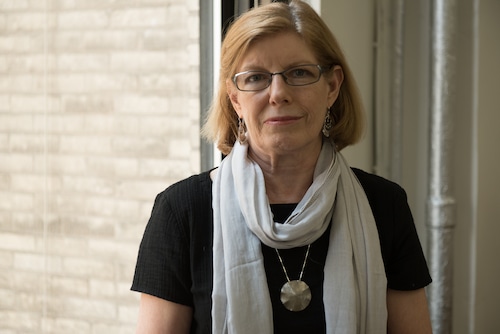
Says Mary Ewing-Mulligan MW, president of International Wine Center, ‘The GWEF scholarship is yet another opportunity for IWC students, on top of the LDNY scholarships available to our existing women students.’Gabi Porter
The expansion builds on GWEF’s strong foundation of educational support. Since it was established in 2020, inspired by the vision of San Francisco Wine School co-owners — Master Sommelier David Glancy and COO, Kristin Campbell — the foundation has focused on providing scholarships to underserved and minority communities to further their professional wine education, increasing diversity in the industry, and raising earning potential.
Alder Yarrow, vice president of the GWEF, retold the story to PennLive of Glancy coming to him and a few others back then, noting that “basically everybody in the hospitality industry just got laid off, and many of them would like to take the opportunity to beef up their wine education.” But having lost their jobs, they had no money. “We think we need to support them,” Yarrow recalled Glancy saying, “so would you consider starting a foundation to do that? And me and a bunch of other people said, yeah, that’s certainly a great idea. And we can also focus that effort on driving more diversity in the wine industry by focusing these scholarships on people of color, women and the underserved in the wine and hospitality industry, and so that’s what we did.”
Through 2024, the foundation focused on the Bay Area and raised money to provide scholarships for students to attend the San Francisco Wine School. Yarrow, who in 2004 founded and has been overseeing Vinography — a global wine community that features everything on the site from essays and news to reviews and editorials — said it became clear last year that there was a growing demand nationally for access to the kind of wine and hospitality education that the classes provided, especially for minorities and women.
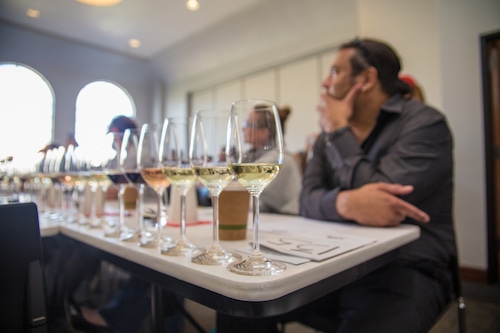
The San Francisco Wine School was founded in 2011 and strives to open the world of wine to serious students and enthusiasts everywhere, helping people of all levels break into the wine industry, advance their career or simply pursue their passions.San Francisco Wine School
Yarrow, as vice president of the foundation board, helped spearhead an effort that after research and discussions landed on new relationships with several schools and organizations nationally:
Founded in 2001 by Marianne Frantz, the American Wine School has educated more than 30,000 wine enthusiasts across seven states. The school offers internationally recognized programs through its affiliation with the Wine & Spirit Education Trust (WSET), including Levels 1-4 Awards in Wine. As the only Approved Program Provider for the WSET Level 4 Diploma in Wines in the Midwest, American Wine School operates in Chicago with satellite locations in Cincinnati, Cleveland, and Detroit. Founded in 1982, International Wine Center (IWC) is America’s oldest independent wine school and is located in the heart of New York City. Led by Mary Ewing-Mulligan MW, who introduced Wine & Spirit Education Trust (WSET) programs to the U.S., IWC was the country’s first WSET provider and remains one of the few offering the WSET Diploma in Wines, WSET’s highest qualification. Committed to independent-minded wine study for trade and consumers, IWC delivers a world-class education without promotional influence. Founded in 2002, the Association of African American Vintners stands as the go-to resource for advancing equity in the wine industry. AAAV’s mission is to provide comprehensive education, advocacy, and community support not only for Black vintners but also for wine brands and industry professionals.
They have joined the San Francisco Wine School, which was founded in 2011 and strives to open the world of wine to serious students and enthusiasts everywhere, helping people of all levels break into the wine industry, advance their career or simply pursue their passions. It was founded by Glancy, a master sommelier and certified wine educator, and as the largest wine school in the U.S. offers more than 25 certifications and educational series and over 75 individual classes, all taught in their state-of-the-art 4,000-square-foot Wine Education and Events Center and their cutting-edge hybrid classes.

Founded in 1982, International Wine Center (IWC) is America’s oldest independent wine school and is located in the heart of New York City.Gabi Porter
Finding accurate information on diversity in the industry isn’t quite searching for the needle in a haystack, but it’s close. Yes, there have been inroads made over the past couple of decades, but how much depends on who you talk to. Yarrow, whose Vinography site includes links to Global Black-Owned Wineries and Latinx-Owned Wineries in America, said quite succinctly that there are no official statistics. His lists, which he updates as he comes across new wineries, offer some data as does the work produced by Dr. Monique Bell, an associate professor of marketing at California State University, Fresno, who is known for her work on diversity and inclusion in the wine industry and the self-published “Terroir Noir: 2020 Study of Black Wine Entrepreneurs.”
What Yarrow will say with certainty is that the plans for this expansion are not a direct response to what’s happening politically around the country as Diversity, Equity, and Inclusion (DEI) programs are being scrapped and websites are being scrubbed of information.

Says Alder Yarrow of the wine industry’s diversification, ‘I can tell you, anecdotally, as a professional wine writer for the last 20 years following the industry, it is becoming more diverse. Is it becoming more diverse fast enough? No.’Alder Yarrow
As he noted, these plans were set in motion last year, well before the election and all the changes that have taken place since Jan. 20.
“But I can tell you, I am damn proud to be essentially tripling down on DEI focus in a moment where it seems like at least half the country’s opinions have swung in the other direction,” he said.
“I think we’re quite proud of the fact that roughly 60% of our [scholarship] recipients are non-Caucasian, close to 60% are female or female-identifying, and we feel like we’re making a tiny drop in the ocean toward pushing diversity and supporting that in the wine industry. You know, in a time where the wine industry is contracting, it’s a little bit difficult to sort of think about, OK, well, what kind of growth are we seeing in diversity in the wine industry? But I can just tell you, anecdotally, as a professional wine writer for the last 20 years following the industry, it is becoming more diverse. Is it becoming more diverse fast enough? No. Do we have an awful long way to go to get a reasonable and proportional representation of the melting pot that is America in the wine industry? Absolutely, a long way to go.
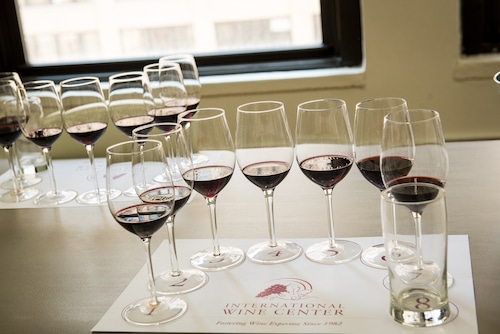
Led by Mary Ewing-Mulligan MW, who introduced Wine & Spirit Education Trust (WSET) programs to the U.S., International Wine Center was the country’s first WSET provider and remains one of the few offering the WSET Diploma in Wines, WSET’s highest qualification.Gabi Porter
“But whether it’s going to public wine tastings and looking at the diversity of the faces in those wine tastings in the public, whether it’s attending trade events and looking at who’s standing behind tables and representing wineries, we are absolutely seeing more diversity in the wine industry. It’s slow. It’s not fast enough, but it is steady, and it’s happening.”
Scholarship recipients will have access to prestigious wine education programs through GWEF’s educational partners, including Wine & Spirit Education Trust (WSET) qualifications, Society of Wine Educators certifications, Wine Scholar Guild programs, as well as other proprietary courses and certifications.
Professionals in need of financial aid are encouraged to apply for scholarships year-round on the foundation website. Awards are made monthly.