
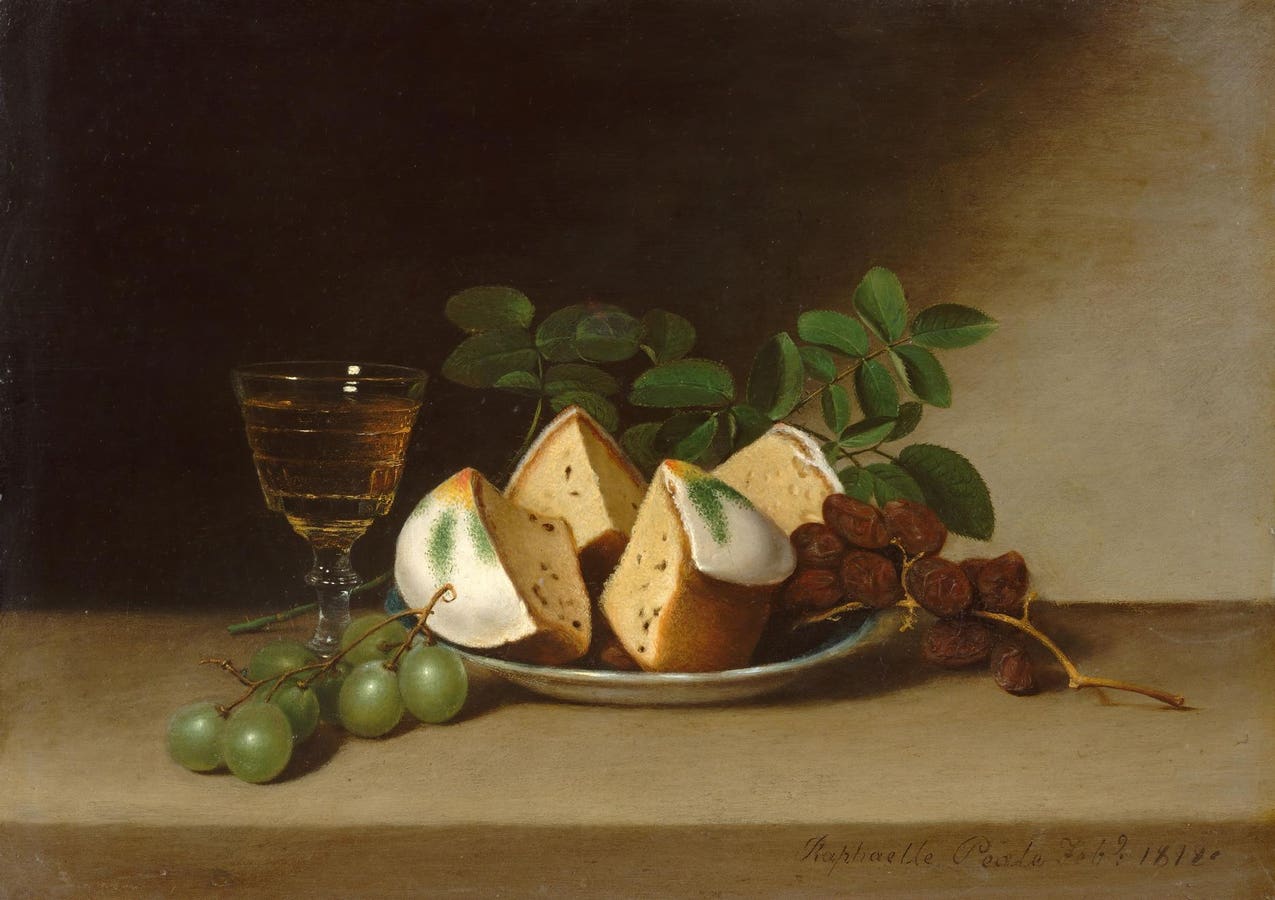
Still Life with Cake, 1818. Artist Raphaelle Peale. (Photo by Heritage Art/Heritage Images via Getty … More Images)
Heritage Images via Getty Images
The term “dessert wines” used for very sweet wines (also, to an extent, some sparkling wines) is actually a misnomer when you consider the excellent match-ups one can make beyond desserts. Indeed, it doesn’t even make much sense to serve some very expensive sweet wines with even sweeter desserts, like an intense chocolate cake with chocolate ganache and chocolate bon bons or an English toffee sticky pudding.
It is also worth considering if you want to drink any wine with dessert. I can’t imagine a butterscotch sundae with vanilla ice cream is going to be enhanced or complemented by serving it with a Sauternes.
FRANCE – Three different colorations for the Chateau Yquem from 1908 to 1970. (Photo by … More JNS/Gamma-Rapho via Getty Images)
Gamma-Rapho via Getty Images
Even if you love sweet wines after dinner, I know few people anymore who after a big meal really want to open a sweet wine, which is why they often come in half-bottles. Yet on their own, when a sweet wine is chosen to be the dessert, an accompaniment of, say, butter cookies will be an extra treat.
Let’s quickly go through the principal sweet wines of the world and discuss when they are best served. At the top of the pinnacle most connoisseurs place the Sauternes of Bordeaux, and may rank Château d’Yquem as the greatest of them all as a wine that can age for decades and, because of the residual sugar, acquire more and more levels of flavor. The happy truth about Sauternes is that, aside from very expensive d’Yquem ($500 for the 2020 vintage) and a handful of other bottlings, including Rieussec and Suduiraut, they are not particularly expensive, nor is their neighbor Barsac. Rieussec’s own second label, Les Carmes de Rieussec, costs only $40 and Suduiraut’s Lions de Suduiraut, $30.
3/13/2003 Roquefort sheepsmilk blue cheese. From France (Photo by George Wilhelm/Los Angeles … More Times via Getty Images)
Los Angeles Times via Getty Images
These are not wines to be wasted on tarte Tatin or crêpes Suzette; indeed, the classic match for Sauternes is a blue cheese like Roquefort, which is quite salty and marries voluptuously with the wine’s intense sweetness.
German wines have long been famous for their sweet wines, once enjoyed throughout a meal, but no longer as popular as they once were, which is why so much of the German wine industry has switched to making Trocken (dry) Rieslings that go better with food. But its Beerenauslese and Trockenbeerenauslese are as highly regarded as Sauternes, as are the Tokaji wines of Hungary, whose quality runs from three with 60 grams of sugar) to six puttonyos (stars) with 150 grams. Late Harvest Rieslings from California, Washington and Oregon, usually a bit lighter in body than German counterparts, are also easily found in the market. Then there is Eiswein, made from whatever little juice is left after the grapes have frozen, retaining a great deal of sugar. Both Germany and New York State may superb examples.
PORTO, PORTUGAL: Bottles of vintage port in racks at wine cellars of Graham’s Port Lodge in V|la … More Nova de Gaia in Porto, Portugal. (Photo by Tim Graham/Getty Images)
Tim Graham
The key to drinking such intensely sweet wines is that, while they may have a powerful flavor of caramel, they are also backed by enough acid so as not to be cloying or candy-like. So, too, Portugal’s Port and Spain’s Paolo Cortado and Oloroso Sherries have distinctive flavor profiles. Port, in particular, comes under so many iterations––White, Ruby, Tawny, Colheita, Crusted, Vintage, Late Bottled, and, increasingly, more names––that it doesn’t make it easy for any by a connoisseur to grapple with.
Italy makes a few sweet wines, usually fortified, including Marsala, Sweet Vermouth (used more as an apéritif), Picolit and Passito.
A picture shows a Brie de Meaux cheese displayed in a light box during a Wikicheese photo shoot, on … More May 15, 2015 in Paris. AFP PHOTO / FRANCOIS GUILLOT (Photo by FRANCOIS GUILLOT / AFP) (Photo credit should read FRANCOIS GUILLOT/AFP via Getty Images)
AFP via Getty Images
Key to matching them with what might follow after the main course of a meal, when the palate may already be fatigued by so many flavors in the meal, is to consider the wine itself. As noted, Sauternes goes splendidly with blue cheeses, but then, so would many sweet wines named above, not least Port, which has long been considered requisite with English Stilton. Very creamy soft cheeses like Brie and Camembert are delightful with French Vouvray, which is made demi-sweet, as would Champagnes so designated.
With mild cheeses a lighter Ruby or Tawny Port will work wonders, as would Oloroso or Paolo Cortado from Spain. The less sweet German Rieslings in the Spätlese or Auslese classifications go very well with cheese like Gouda, Cheddar and fresh goat’s cheese.
Roasted chestnut are seen in Rome, Italy on March 25, 2024. (Photo by Jakub Porzycki/NurPhoto via … More Getty Images)
NurPhoto via Getty Images
And one of my favorite marriages is with hot chestnuts and a glass of sweet wine. A lighted fireplace helps measurably. (Other nuts work but not if they’ve been salted.)
As I mentioned, if you enjoy a sweet wine as dessert, a nibble of cookies makes good sense, and I can readily imagine drinking a Ruby Port, Marsala or Tokaji with fruit pies.
REGGIO EMILIA, ITALY – MARCH 24: Lambrusco, a dry red wine originating from the Italian province of … More Emilia-Romagna, is served with Crescentina at Antica Salumeria Giorgio Pancaldi, a delicatessen which traces its history back to the 15th century, on March 24, 2017 in Reggio Emilia, Italy. The region, which encompasses the Po River valley, is considered the breadbasket of Italy. With its lightly effervescent full body and high acidity Lambrusco is well suited to balance the rich foods of the region including Parma Ham, Prosciutto di Parma, Culatello and Parmesan cheese and Crescentina, a fried pastry also known as Gnocco Fritto. (Photo by David Silverman/Getty Images)
Getty Images
I have had experiences with producers and chefs who think it a bright idea to serve sweet wines with meat and fish, but I’ve found most matches ghastly––think of oysters Rockefeller with Sauternes or a ribeye steak with a Tokaji. The exceptions might be a very highly spiced, chile-packed Indian or Thai dish that would blunt any and all dry reds and whites. A demi-sec Champagne works nicely, not least because of how the acid and bubbles cut the heat. I’ve also had semi-sweet, sparkling Lambrusco that goes remarkably well with some of the rich pasta of its origin, Emilia Romagna.
So, next time you are tempted to pull that sweet wine off the back of the shelf, consider its possibilities as more than an accompaniment to dessert. It might well be the dessert.