


Content creator goes viral for creating disability-friendly recipes
A content creator cooks up easy-to-follow meals that are tasty and disability-friendly.
I am ashamed to say that when I first became a food writer I knew very little about Julia Child other than she wrote one of the most important cookbooks in the history of civilization, hosted a show I once watched on PBS with my mother and, well, that famous “Saturday Night Live” skit with all the blood.
Over time I came to learn more about her by talking to other food writers, food historians and chefs. I even had the opportunity to meet her editor, Judith Jones, at an event the 92nd Street Y, in Manhattan.
My interest in Child grew immensely after Nora Ephron’s adaptation of Julia Powell’s book, Julie & Julia, an account of Powell cooking her way through Child’s “Mastering the Art of French Cooking,” came out in 2009. The movie led to Child’s book return to the bestseller list 48 years after its release.
In the past five years, Julia-mania has continued, starting with the release of “Julia,” an excellent documentary film, followed, in 2022, by the HBO Max series of the same name, starring Sarah Lancashire, which covered Julia and her husband Paul Child’s time living in Cambridge, MA, where her immensely popular cooking show, “The French Chef,” first premiered on PBS.
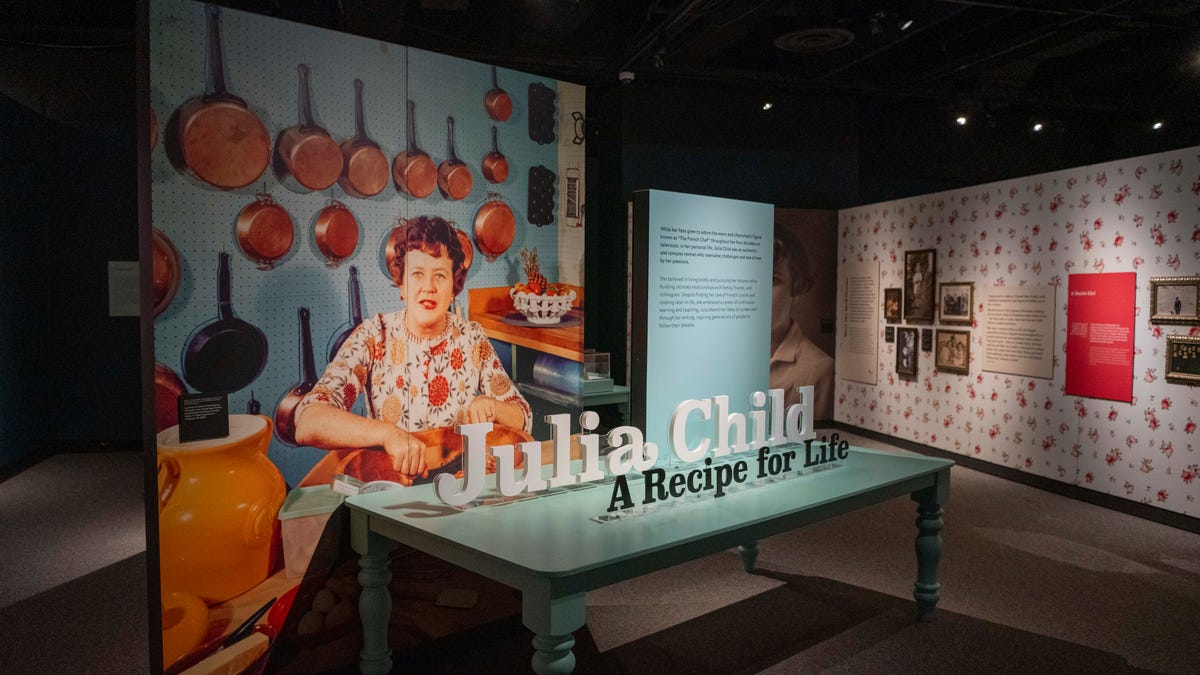
So it’s safe to say I knew quite a bit about Child when I took my daughter to see the traveling exhibit, “Julia Child: A Recipe for Life,” at the Cincinnati Museum Center. It’s an enjoyable, cozy exhibit, with its floral wallpapered walls displaying old photographs and text panels detailing Child’s incredible life story. There are replicas of her most beloved pots and utensils, handwritten and typed letters, and other ephemera.
The exhibit is especially engaging for children, who can play around on a replica of the set of “The French Chef” and use a 1960s-era TV camera to film the show themselves. My daughter also loved getting her picture taken in a clawfoot bathtub, where attendees are encouraged to recreate the iconic photo from Julia and Paul’s famous Valentine’s Day card. She also loved writing a personal letter to Child in a digital guestbook and gazing at a stack of old-fashioned televisions displaying Child’s cooking shows and interviews.
For me, the best part of the exhibit was an exploration of how French cooking changed the Cincinnati culinary landscape, particularly at restaurants such as the Maisonette, Pigall’s and the Gourmet Room. There are photographs of the late Jean-Robert de Cavel alongside many of his protegees. The exhibit also honors de Cavel’s predecessor, Pierre Adrian (father of La Soupe founder Suzy DeYoung) who, like Child, helped teach Cincinnatians how to cook French food at home via appearances on Cincinnati television stations and columns in local newspapers.
The exhibit also includes a tribute to Edith Hern Faucet, who learned French culinary techniques as an enslaved cook for Thomas Jefferson at both the White House and Monticello. Once Jefferson died, she and her family (who were also enslaved by Jefferson) moved to Cincinnati and introduced French cuisine at a catering company she opened with her sons William and Peter Fossett. (The Enquirer’s Jeff Suess wrote an excellent article on them in February.) Like Child’s story, the Fossetts’ is one we should learn−and never forget.
Julia Child: A Recipe for Life runs through May 18, 2025, at the Cincinnati Museum Center, 1301 Western Ave., Queensgate, cincymuseum.org