

Already in 2025, Australia’s wine industry along with the global wine producing sector more broadly have been faced with a diverse mix of challenges, ranging from the established conversation of a winegrape oversupply and decrease in consumption, to the newer, emerging threat of tariffs on wine and liquor imports into the US.
In this interview article, Drinks Trade speaks to Justin Taylor, Company Director and Export Manager at Taylors Wines and third generation family member, about the current positioning of Australia’s wine industry, along with the ways Taylors is looking to evolve in the future.
Drinks Trade: Trump’s ‘Liberation Day’ tomorrow may change things, but how big of a threat do you think Trump’s tariffs pose to Australian wine?
Justin Taylor: Now that’s a question for one man, and he certainly does begin with T but it’s not T-A-Y-L-O-R … There’s definitely some markets where it’s going to be an advantage – like in Canada where I was last week, there’s a lot of product coming off shelves – and there could be opportunities for Australian wine, there’s no doubt about it.
But if big tariffs are put upon European wines and it slows the sale of European wines into the US, those wines will have to find other markets around the world, and that could be a disadvantage.
DT: As Taylors’ Export Manager, how do you see the current positioning of Australian wine in/compared to other key wine markets globally?
JT: Some great recent data: the wine category is up 2.5% MAT in Australia; that’s fantastic news!
I work for the business in the international markets and a few of those [aren’t doing as well], [and] that’s broader category stuff. I look at short term trends and then longer term trends, [and] the Australian short-term MAT is definitely positive. Then I saw the Australian category in Canada has been tough for the last handful of years. There was a trend in New Zealand that had wine consumption overall down 20% in the last decade. That’s a big number, but that’s broader category stuff, it’s not Australia and it’s definitely not Taylors or Wakefield.
What they always say about wine is wine does well in recessions, and it does well in boom times as well: people drink more. In tough times, they drink more too. It just seems pretty flat at the moment would be my broad take of the recent Australian trends.
DT: How is Taylors adapting its offer to suit these trends/changes?
JT: We’ve definitely got an innovation pipeline and innovation model – one of our core values as a business is innovation – and I think we’ve got some really exciting stuff coming down the chute. We look at trends: People drinking lighter style reds, people drinking aromatic whites (and we happen to have a range called the Aromantiques), but I think a lot of our innovation pipeline is fed by brilliant consumer trend research work.
I don’t want to let the cat out of the bag, but I’ve seen some really fun lighter style red stuff that I think could be coming down the chute from us.
I’ve tasted some product and I’ve seen some labels and they’re fun. It could be younger demographic stuff, but they’re not trivial wines, they’re good wines, but they’re on trend.
They’re all things we’re looking at all the time and trying to match our forward innovation withthe consumer trends we’re picking up on. Some of them are fun.
DT: We recently did a tasting of new wine innovations (that didn’t feature Aromantiques but should have), and it was evident that, in many ways, most of these new-age wine styles are not targeted at established wine consumers, nor to most of the people selling these wines… A) is this something you agree with, and if so, B) how does Taylors approach this divide?
JT: I think you’ve got to be true to your values. You’ve got to know what you’re good at. We’ve got a few examples, like orange wine, where we were probably never going to go there (and others did and good on them, but I used to drink them and they always just felt like unfinished wines to me).
Then there’s been other pieces of innovation, like cans. We looked at it and have gone, I can see there’s a future for that. I can see why the consumer might like that. But it’s just not deep enough in our DNA to pull it off.
It’s got to be that combination of innovation that consumers are after, but innovation that we can deliver on; and I think we’re pretty good at it. If the trend is just outside of the space that we’re in and it’s fun because it’s going to push us to go to that space, I think we often learn a lot through that process.
DT: This reflects what your brother Mitchell told Drinks Trade last year. He also said Taylors will keep an eye on the many assets currently on the market “trying to find something that suits our needs.” Is this still the case? If so, would this be to help broaden Taylors’ focus areas?
JT: It’s definitely never off the agenda with us. We definitely run the numbers on a lot of brands. We run the numbers on brands that may be for sale that may fit in with where we want to go.
I think we’re on a long-term luxury path, and if a brand came up in those price segments that was complimentary to us and we thought we could expand upon it, I’m sure we would look at it.
DT: How about spritzers?
JT: This is where we encourage our wine [innovation team] to come back to us with ideas, and they’ve come back with some really fun spritzer ideas … I never want to say never, but I don’t think we’re immediately going into that space, but it’s certainly a space we’ve looked at.
DT: Taylors recently partnered with LeCavist wine storage experts to further encourage education around the importance of wine service temperature. What role do you believe wine education will play in the future longevity of wine?
JT: We’ve got to keep educating. We’ve got to keep our story out there. I mean, we’ve always been supportive of the consumption of wine, and we will always support that.
Education is an ongoing thing [and] the work we’re doing on temperature at the moment is fantastic. We’ve been talking temperature for a decade and what we’re finding at the moment is we’re getting a lot of interest in our temperature sensitive labels; we’ve done some fantastic events lately.
The fact that red wines go into the fridge and white wines out of the fridge, that’s got people thinking.
DT: Is there a concern that wine’s seeming complexity/pretentiousness might be one of the factors reducing consumption globally in younger LDA demographics?
JT: We’re only trying to give them one more fun thing to think about. People make those occasion decisions based on what they see in front of them, what they’re going to eat, and what the price point is.
Consumers are getting so much more educated, and this is just one piece of education that seems to be resonating [as consumers are] taking their wine journey seriously.
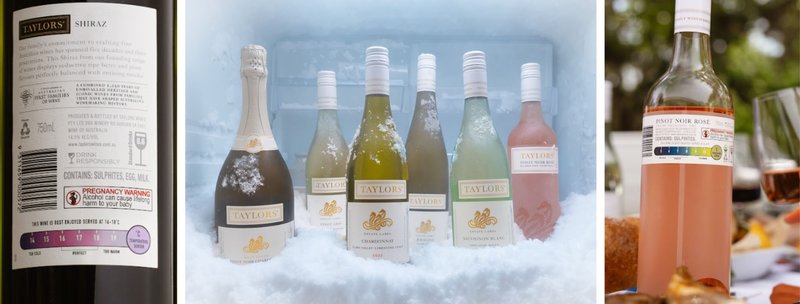
Temperature-sensitive labels can now be found on every Taylors Estate bottle
//
Taylors unveils Estate Label Grenache
Taylors unveils first label refresh for Taylor Made collection