
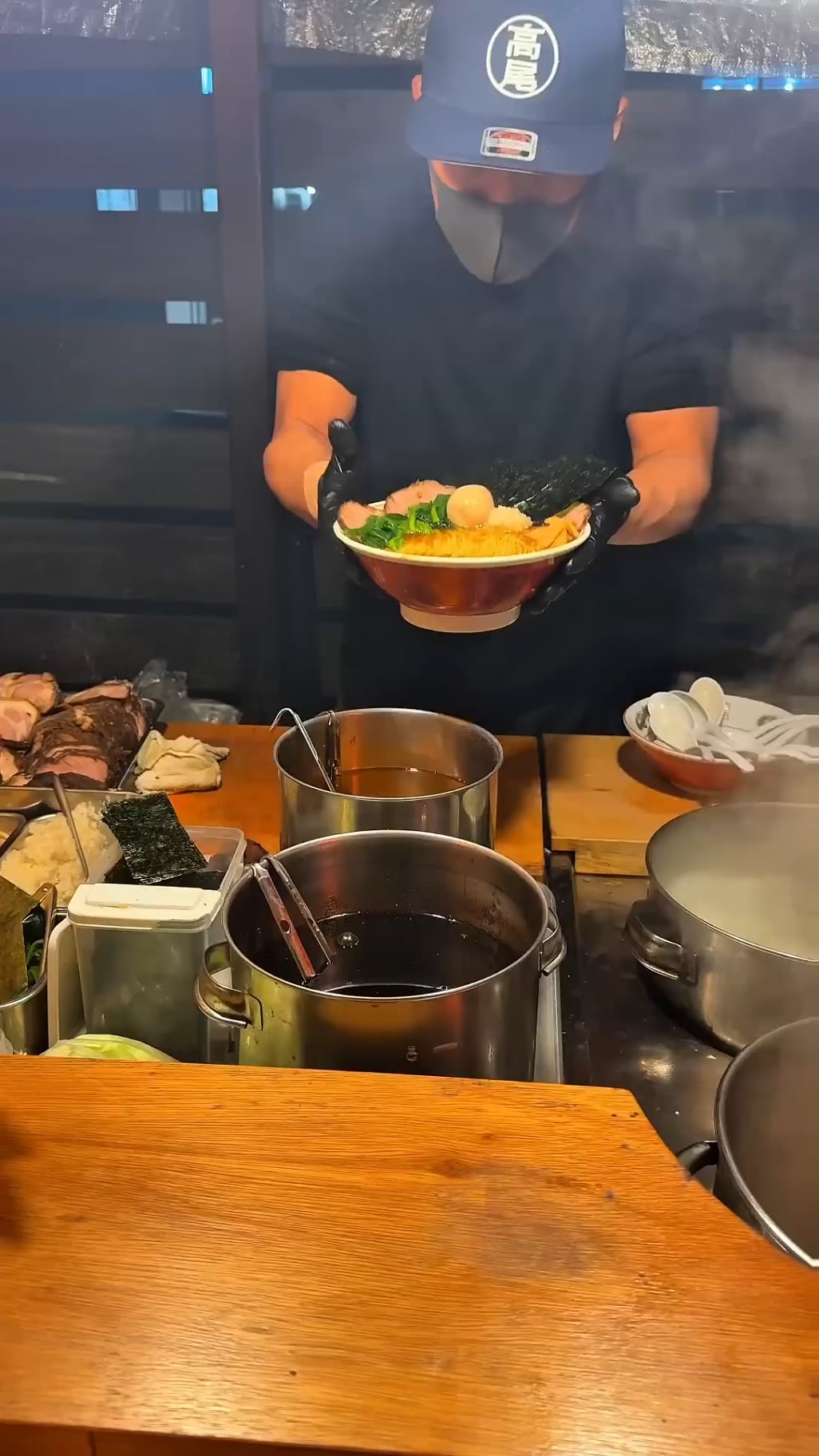
What is the general recipe of the soup of this kinda ramen? (I believe this is Shoyu Ramen).
What is that black liquid, and the yellowish liquid added after it? I know the last third one is stock.
But I'm not sure what the first two are. Is the black one pure soy sauce or a mix of soy with some other sauces?
How I have tried to make ramen is by mixing soy sauce, rice vinegar, fish sauce, oyester sauce (coz I don't have Kombu), MSG, and sesame oil, and then chicken stock…….. but I can't seem to get it right at all…
Somebody please help me?
I am from India, and I can only access the ingredients I have mentioned. Kombu is just too expensive, and I can't make dashi stock, coz Tuna flakes are unavailable in our markets.
by LUCIFER_3A2T7G1
19 Comments
The first thing he adds is shoyu tare – tare is the seasoning added to broth to give it its flavor. It’s
most likely a blend of soy sauces simmered with sake, mirin, sugar, and some ingredients that might be harder to find for you like niboshi, kombu, bonito flakes.
The second thing he adds is aroma oil – this is the layer of oil that is usually on top of a bowl of ramen. Most likely chicken fat or oil that has been seasoned and infused with scallions or garlic.
You should read ramen lord’s free ebook. It is linked in the sidebar and can easily be found via Google as well. It answers all of your questions and gives you a ton of recipes to recreate.
Damn it.. just had dinner and now hungry again.
More importantly what ramen shop is this? I want to go there. Looks super good
Just a suggestion from the ingredients you listed in another comment, you could instead try Ramen_Lord’s simple Shio tare. All you need for that is Salt, MSG and Water.
[https://adamliaw.com/recipe/ramen-school-007-garlic-shoyu-ramen](https://adamliaw.com/recipe/ramen-school-007-garlic-shoyu-ramen)
^ This explains the first two things he pours: tare, then aromatic oil. I would not substitute anything unless specified in the recipe since the flavours can change quite drastically.
[https://adamliaw.com/recipe/ramen-school-006-rich-double-soup-for-ramen](https://adamliaw.com/recipe/ramen-school-006-rich-double-soup-for-ramen)
[https://adamliaw.com/recipe/ramen-school-001-basic-clear-ramen-broth](https://adamliaw.com/recipe/ramen-school-001-basic-clear-ramen-broth)
^ These two explain the third thing he pours which is the broth.
[https://adamliaw.com/recipe/ramen-school-003-ajitama-ramen-eggs](https://adamliaw.com/recipe/ramen-school-003-ajitama-ramen-eggs)
[https://adamliaw.com/recipe/ramen-school-002-three-styles-of-chashu](https://adamliaw.com/recipe/ramen-school-002-three-styles-of-chashu)
^ These are two types of topping you can add.
There are many recipes for ramen online. Once you figure out how to assemble the dish, understanding the recipes becomes a lot easier and you can play around with different combinations.
You could try using roasted dry bombil as a substitute for the bonito.
So you’re facing a really interesting challenge here, and you’re going to need to experiment with local ingredients to stay within your budget constraints. You’re not going to replicate this bowl, because you don’t have the ingredients for it, but you can make your own spin!
First things first: With Ramen, the name of the game is ***umami*** everything in the dish is full of umami, or umami enhancers. You’ll find lots of resources online on how that works. Almost all the ingredients you’ll add will be in service to increasing the experience of umami.
Ramen has a few components: Broth, Noodles, Tare, Fat, and Toppings. Most speak for themselves, but the ones that don’t: **Broth** is the stock/soup that’s obtained by extracting flavour and texture from either protein or vegetables and forms the base of the soup, in ramen it is not seasoned; **Tare** is the seasoning for the soup and provides a large flavour boost to the soup, it can be made of many bases, but in this case you’re working with a soy-sauce base (and soy sauce on its own would be the simplest tare); **Fat** is added as an aromatic and for flavour, it can be a protein fat like chicken, or an aromatic oil like scallion oil, the fat in the video kinda looks like chicken fat, but it’s hard to tell.
Start by creating a chicken stock as your base. You’ll want to mix it with your own version of dashi. I know you can’t make dashi because of the price, but the goal of dashi is to be light and packed with umami enhancers. It’s traditionally made from kombu and fish flakes, but you can make it from any umami enhancing ingredients.
Next will be your tare, with soy sauce as your base, to which you can add ingredients for sweetness or to add a bit of an edge. After that, you can create an aromatic oil that suits your dish.
Don’t worry about replicating what you had in this video, you’re not going to be able to, use what’s locally available and knowledge of the principles of ramen and food science (specifically around umami) to make your own version. Ramen Lord’s e-book is a great start.
The Indian cuisine is full of high quality ingredients and aromatics. Use the ingredients you already know and love! Things like sun-dried tomatoes pack lots of umami enhancing compounds and may be a great addition. Maybe mirin is out of the question, but you can use kardemom for some spiced sweetness in your tare. Make it your own, and show us what you come up with!
Everyone here is going to say you need all these special types of ingredients. The only special ingredient you need is miso.
I am Japanese and live in Japan.
If you want to make something like that:
1: Soy sauce
2: Oil
3: Miso
If you can’t get miso, you won’t be making that ramen.
Get the miso and you’ll get the ramen taste you’re looking for.
I can’t cause I didn’t watch the video.
Hi friend. You can also make a simple dashi stock by boiling fishbones and seafood, shells etc 🙂
Black liquid is tare, a concentrated seasoning. For this ramen it wood be sou sauce based.
The yellow liquid is aroma oil.
Fak that looks good.
I need Ramen like this in my life, it looks delicious and presentation is great
* Fluid with water soluble flavours
* Fluid with fat soluble flavours
* Broth which contributes most of the fluid
* Solids

It’s giving Ponyo ramen.
OP. Asking for advice is not wrong. You are well within your right to ask for advice, and as you can tell, plenty of people are here answering your questions. However, go about it better next time. These are communication and social skills that im talking about.
You’re asking people to precisely tell you how to do everything, and then when they say something that contradicts what you have read online, even though you’ve never made a bowl of raman before, you’re just saying “well google says this, not what you said”, instead of doing a deeper dive into the techniques and ingredients that comprise the components of raman. I guarantee most of us here learned mostly from the internet, but not just google search. Go watch videos and read more extensively instead of asking for help than just being combative with the people you asked help from.
https://i.redd.it/jfpjgacf08te1.gif
Any details in the noodles in this video? Are they commercial, or resturaunt made?
In Southern California it seemed like many places advertise that they make their own noodles, but less so in some other areas I’ve been.