
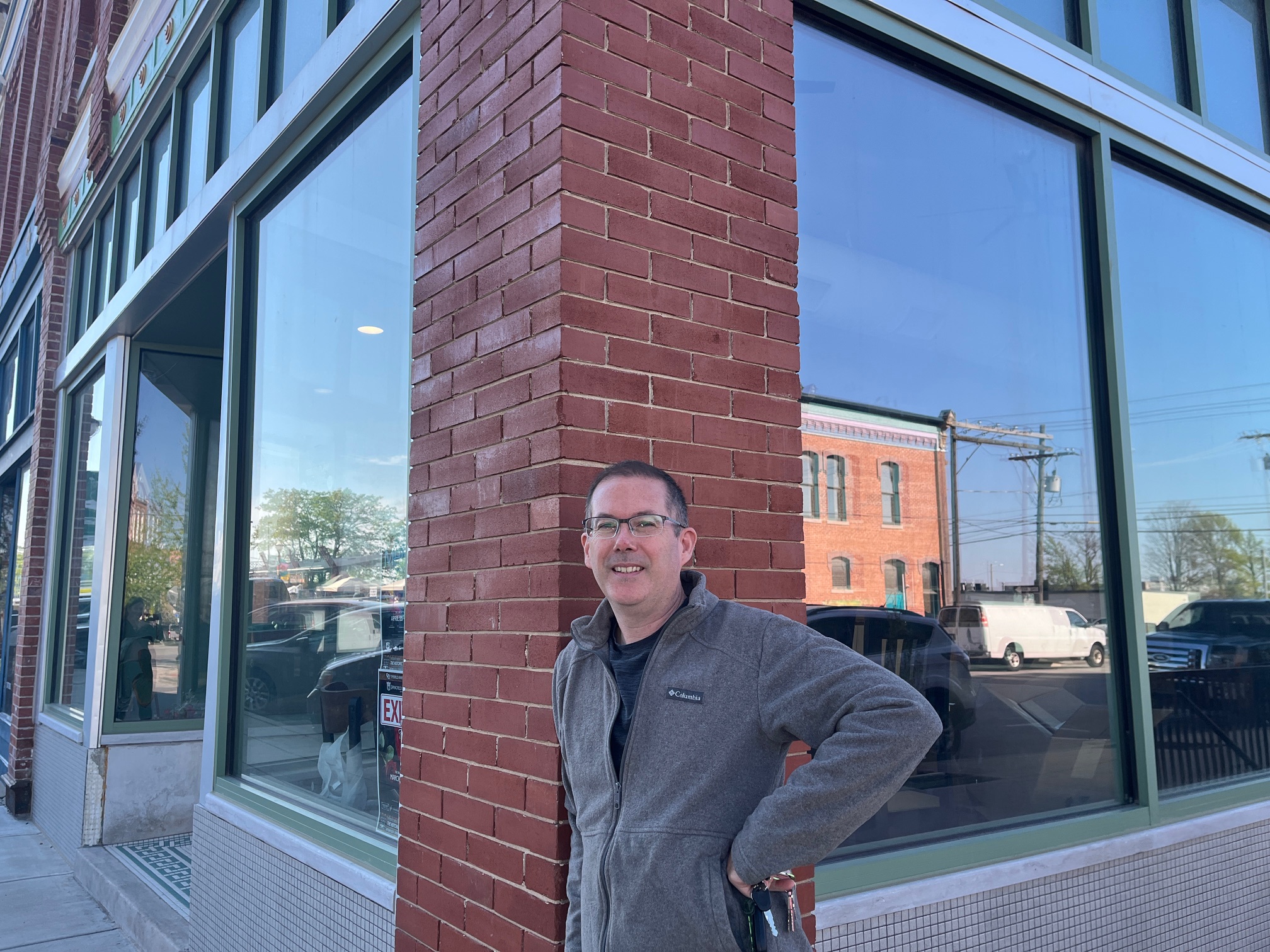
When you take a bite of Joe Gidman’s food, he wants you to enjoy it, but there is something equally important.
This avid traveler wants to pique your interest in the world.
“I want to create something here that makes people curious and makes them think maybe the rest of the world is exciting. Whether I get it right or not, I am trying to give people experiences. If there are foods I fell in love with, maybe they will, too,” he said.
With his mother Claire, Gidman owns Peruvian Cafe Cusco (2013), Chabom Teas + Spices (2015) and Van Gogh’s Eeterie (2018) — all located on Commercial Street.
Now he’s opening his third ethnic restaurant, La Roux Bistro, at 300 E. Commercial Street, with two new business partners. They hope to open this summer.
La Roux Bistro brings French, New Orleans and Ozarks influences to C-Street
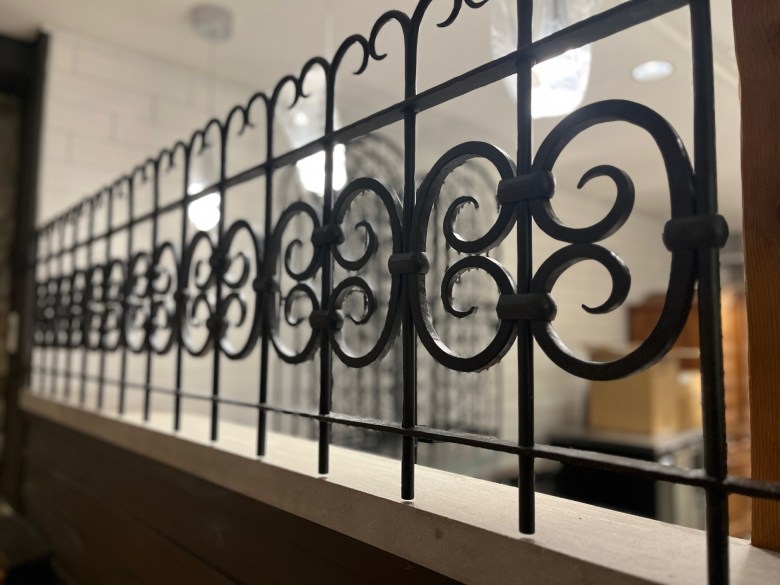 This iron detail is on the second floor of La Roux. It separates the kitchen and dining area, adding to the ambiance. (Photo by Juliana Goodwin)
This three-story, French-inspired venue will be unlike anything Springfield has seen and is quite an undertaking. Located in a historic building from 1883, each level is themed. Gidman wants to share how the French influence moved from France to Louisiana and the Ozarks.
On the first floor, you’ll feel New Orleans vibes. There’s a vibrant mural inspired by Chappell Roan on the wall. The drinks will be reminiscent of the Big Easy. Sip on a Sazerac or Hurricane. Savor fried oysters, alligator or bite into a crunchy po’ boy.
Take the stairs down to the second level, and you’re transported to a classic French bistro, serving countryside staples like beef bourguignon. There’s an open kitchen, wine racks, iron work by a local artist and stone walls that make the space feel warm and intimate. The menu will rotate a bit. Fresh baguettes will be baked in-house, and there will be two styles: classic French and New Orleans, which is more crumbly and not as dense.
The third underground level of this establishment is a treasure. In fact, they didn’t even know it existed when the facility was being renovated. Joe Hosmer owns the building and is one of Gidman’s business partners. During excavation, a passage was unearthed, revealing a third level. It was flooded because there’s a natural spring under the room. They had to pump it out and redirect the water.
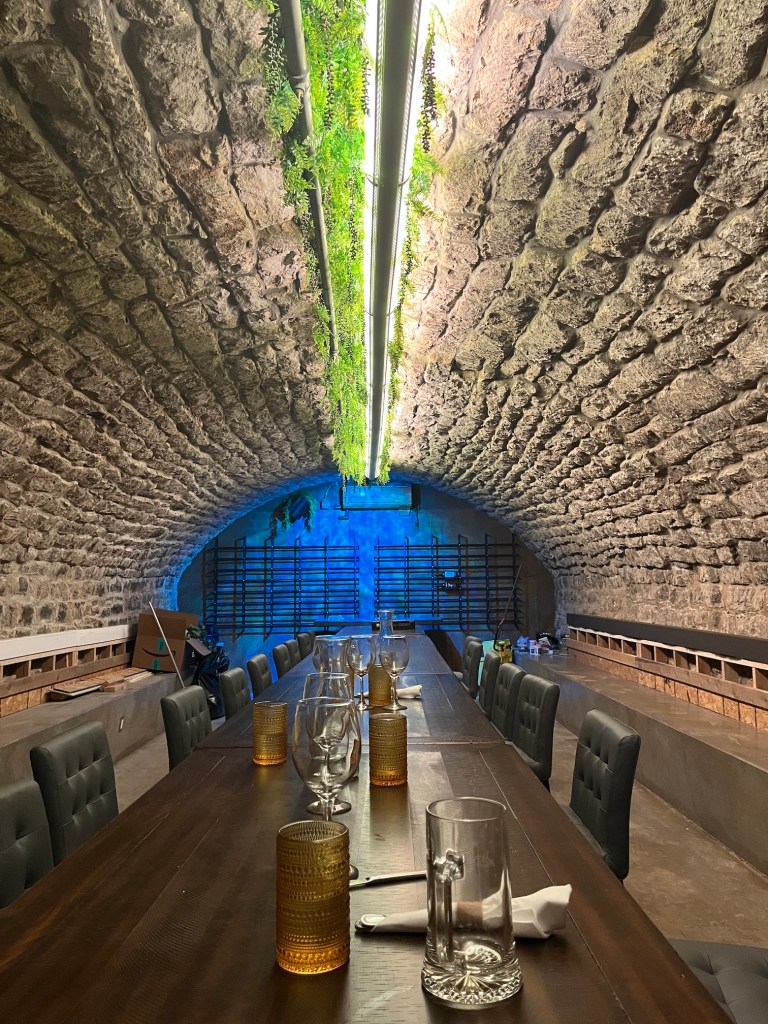 This is the Phenix Vault, an underground room discovered during building renovations. It will be a speakeasy-style spot with moonshine cocktails and small plates. Dating back to the 1800s, he hopes it will be a tourist attraction and selfie spot. (Photo by Juliana Goodwin)
What was uncovered was an arched stone room that they have dubbed the “Phenix Vault,” named for the Phenix quarry. The sides are lined with built-in seating and there are tables. The cocktails will be more moonshine-focused to give a nod to this region. Faux green ferns dangle from the ceiling, and the back wall has a projector that paints dancing green and blue colors on the wall. Gidman wants this to be a selfie spot, a place where tourists and locals pop in to see even if they aren’t staying for a drink.
“We don’t know who built the room or why,” Gidman said.
Joe grew up in Connecticut and didn’t expect to own restaurants
Gidman attended College of the Ozarks to earn a degree in studio art. He also studied Spanish at a language school in Spain and did an exchange program at an international business school in the Netherlands. His time in the Netherlands is what inspired him to open Van Gogh’s Eeterie.
During college, he met his best friend, Rodrigo Cabrejos, his other partner at the new restaurant.
After graduation, they traveled to Peru, where Cabrejos is from. For several months, they beach-hopped the country and hiked the Inca Trail.
“While we were there, we were sitting there eating one day, and he said, ‘This is the best day of our lives. I wonder what it’s going to be like in 10 years?’ and I said ‘I don’t know but I’m going to open a restaurant and call it Café Cusco,’” Gidman said.
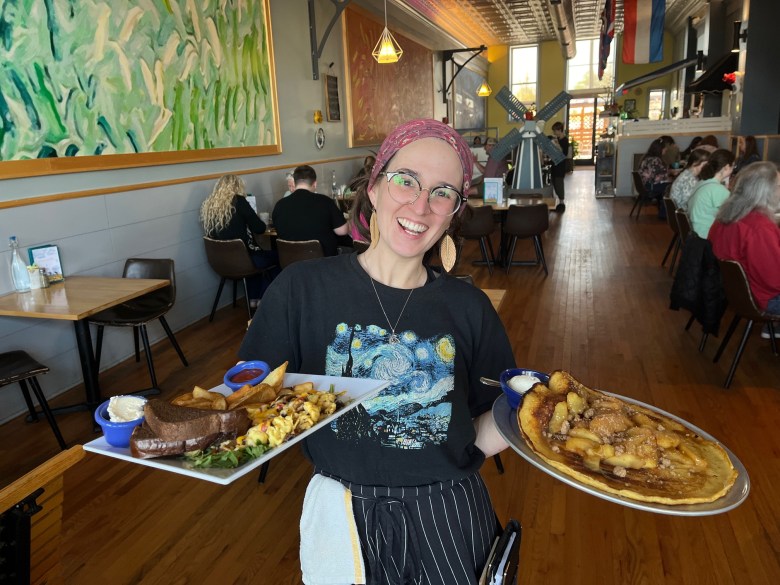 Sumar Foster carries two plates of food to customers on a recent Saturday morning at Van Gogh’s Eeterie. (Photo by Juliana Goodwin)
Two terrible occurrences paved the way for a brighter future
When Gidman returned to the U.S. in his early 20s, there weren’t a lot of art studio jobs, so he managed a restaurant in Branson. Gidman had worked in the industry since he was a teen.
Cooking is his passion, a skill he learned from his grandmother.
Next, he opened a Fair-Trade gift shop in Branson.
“But then in 2007, the economy collapsed and I ended up filing bankruptcy and lost my house. So I moved to Springfield and started working at Kai and Haruno and went back into the restaurant industry,” he said.
The dream of that Peruvian joint gnawed at him. One day, on his way to a downtown restaurant, he was in a terrible car accident.
“I was on my back for six months and started writing a business plan,” he said.
When Gidman recovered from the accident, he received a small settlement and used it to buy a fryer, grill and flattop and turned his kitchen into a version of a restaurant. He’d invite Rodrigo Cabrejos over and play around with different recipes. Cabrejos was excited to share his culture.
When he was ready to make his pitch, Gidman planned to apply for a bank loan and that day, his mom called and asked him to stop by before he went to the loan officer. She had received an unexpected inheritance.
“She opens the letter and hands it to me and it was the amount I was going to the bank for. She asked if I would be a business partner with her. At first, I was like, ‘No, pay off your home or go on vacation.’ She decided if she lost it all, she never expected to receive it anyway, so it was worth the risk,” Gidman said.
Both parents quit their jobs and mom became his partner. Dad pitched in but never took a paycheck. They helped their son fulfill his vision to introduce Springfield diners to different global flavors.
“I wanted to make something that was memorable,” Gidman said. “This is my art form. That is why I opened Van Gogh’s and why I am opening La Roux.”
In the Kitchen: Q&A with Joe Gidman
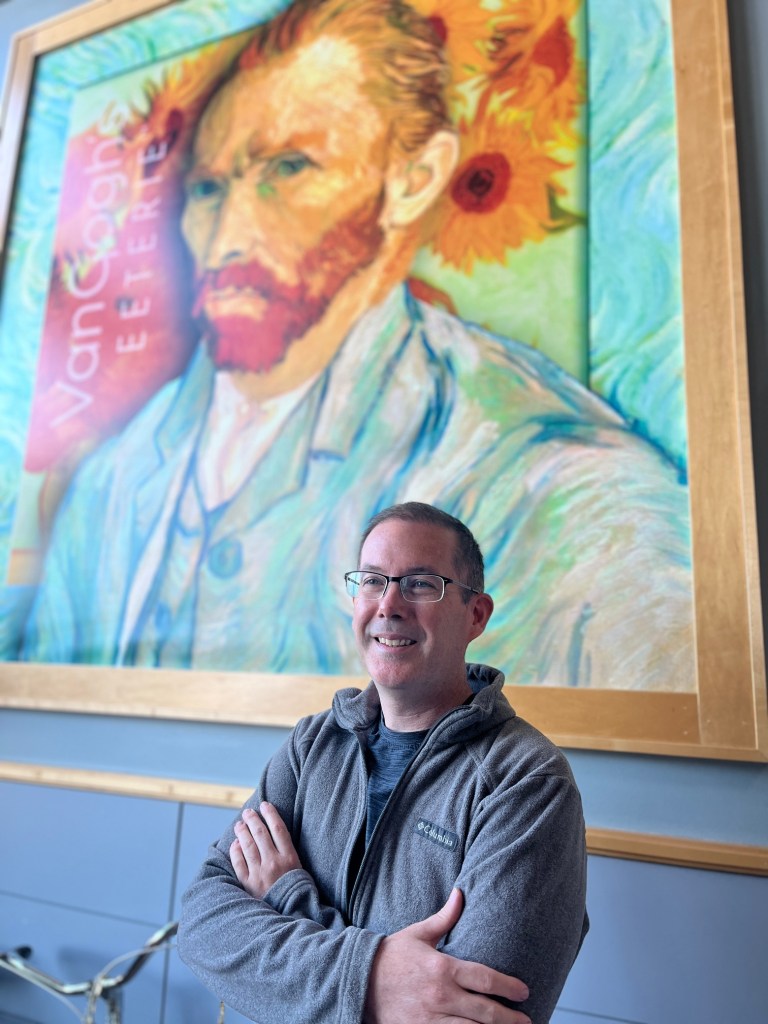 Joe Gidman poses inside his Van Gogh’s Eeterie, one of four businesses he owns on Commercial Street. (Photo by Juliana Goodwin)
Q. When you opened Café Cusco in 2013, what was the reaction?
It was really good. Commercial Street was kind of a forgotten area. There were a lot of neighborhood people who embraced us. They were happy to have a restaurant in their neighborhood. We had time to tweak and build on things and build our reputation. It was like every day the feeling of being discovered. People were nervous to come to this side of town back then, so the ones that did were more adventurous. It was outside the box.
Q. Was it hard to get Peruvian spices when you opened?
Yes. That is a big reason we opened the tea shop. I couldn’t get the right price point without the volume and I didn’t have anywhere to store it. By buying in bulk the discounted price covered the cost of the lease of this building and I had more storage space. The savings alone covers the cost. I speak Spanish decently well, but I am not a native speaker and when I called companies, they gave me a discount but it wasn’t as good. So I talked to the owners of Latino Market and said, ‘Can you contact them and source the product for me?’ They get a better deal, put an upcharge and make money. When people need certain products, I send them their way, so we help each other.
Q. When you opened Van Gogh, what made you think it would be well received?
It was a risk. When I was an art student, it was you make art from what you know. I was an exchange student in the Netherlands, and I have a love for that country and culture and it was something I knew.
Q. Does it offend you if someone tries your food and says it’s not authentic?
They do it all the time. It doesn’t offend me. It is fusion. This is how I view it from my perspective. Every chef puts their own twist, and maybe my twist is more American because that is where I’m from. It is what it is. I have Peruvians come in and say this isn’t exactly authentic, but I like it.
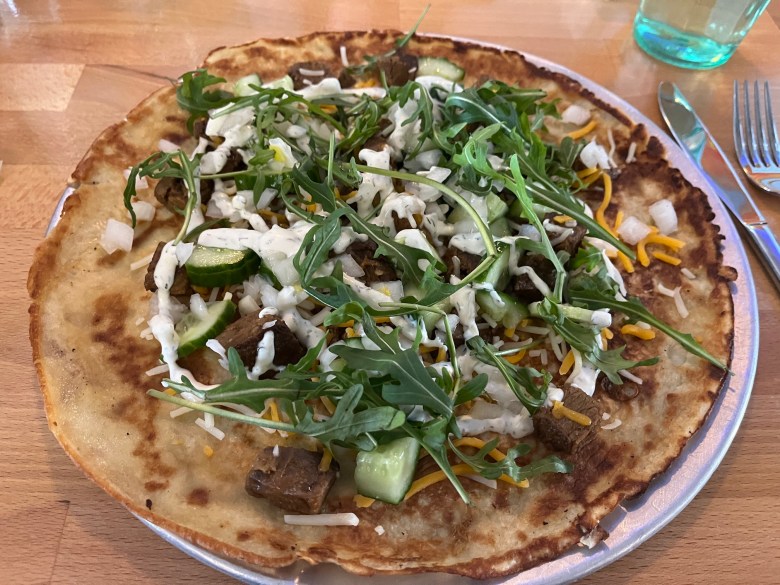 Rotterdam is a popular Dutch pancake at Van Gogh’s Eeterie. The restaurant was inspired by Gidman’s time in the Netherlands as a student. (Photo by Juliana Goodwin)
Q. Why French?
Joe Hosmer has bounced around and traveled and that is his ancestry. I obsessively love New Orleans. I love the food. Roux is the foundation of the cuisine. Hosmer’s vision was the French restaurant. I started to think about how the European settlers were French and what if we use this to show French influences and how it got from there to here. Not just think about a country far away, but how that culture influences where we are right now.
Q. All your businesses are on Commercial Street? Why not try another side of town?
The street is like a canvas, when I came up here there wasn’t much here. I love Commercial Street. It has its own vibe, its own energy. It has a deeply rooted neighborhood. If we had opened anywhere else, we would have been a restaurant in a location, and here we opened in a neighborhood. In Springfield, I would probably never open anything that is not on C Street.
Q. Of the three businesses you have so far, which one has been the most successful?
Café Cusco has been the most successful for years. The tea shop took a while, but it is sustainable. Van Gogh turned a corner. The last six months to a year, it has exploded.
Q. You are known for accommodating food allergies. How did that happen?
Our emphasis of accommodating dietary needs was from day one. I have been the main cook for my family for 40 years and made dinners for members who are diabetic or have gluten allergies. I always learned how to make food adaptable. At LaRoux, we will look at, ‘How can I make this roux more allergy-friendly or vegan?’ Use coconut oil instead of butter or gluten-free flour. I am always curious how to adapt food so you don’t lose the flavor. Everyone deserves to eat good food.

Juliana Goodwin
Juliana Goodwin is a freelance journalist with experience covering business, travel and tourism, health, food and history. She is a former Food and Travel Columnist for the Springfield News-Leader, a former business reporter for The Joplin Globe, and has written for USA Today and Arkansas Living Magazine, among others. More by Juliana Goodwin