
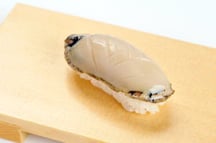
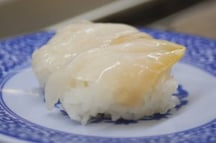
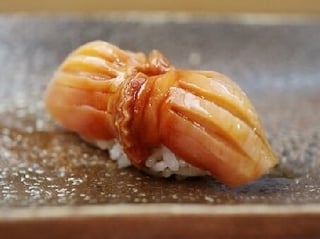
Growing up in Tokyo, my favorite nigiri were these shellfish – Awabi (abalone), Aka-gai, and Miru-gai. While not cheap, it wasn't hard to find these. In the US, sometime around the early 2000's, these disappeared off sushi restaurants' menus – even as "premium" items (except the Miru-gai – sometimes referred to as giant clam or geoduck). Now, in the 2020's, they're nowhere to be found. Why?? For some reason, the popularity of shellfish sushi (including the 'ika' (squid) seems to have declined. What happened?? I think the last place I had all of these was in the Pacific NW….around 2005. Anyone miss these nigiris as much as I do?? Anyone know where they have these??
by CanAny1DoItRight
12 Comments
Mostly conservation. Abalone have had a bad run with changing water temperatures, algae blooms and invasive sea urchins. I don’t know about this season or the last few, but (at least in California) they were approving fewer and fewer licenses and then closing down harvests entirely.
Got to try abalone and welk in Japan recently. I wasn’t super impressed with the abalone but the welk was great. It’s not something I’ve seen on a US menu before or since.
Just a guess here, but it might just be economy optimization.
For a restaurant, having to many different product makes stock management more complex and more expensive. If you buy more of one resource, you buy less of another one, then you might have an as good discount by buying many different products.
Then, the popularity: if a product isn’t that popular, then the cost mentioned above are not worth it. Even if you loose customers by doing so, but if all restaurants in a region drop it from the menu, then you won’t have your customers leave because of that (~).
Also, all prices have increased. In my country, sushi are really expensive. If less people can afford them, then even the basic sushi become kind of “premium” food.
There is possibly other reasons more specific to your region (e.g. less supply of some resources)
From what I understand, a lot of bivalves had restrictions for import into the United States.
For stuff like muki hotate which is consumed in large quantities, it’s not a problem as much (though I know a few high end restaurants that use high end local scallops). But for stuff like akagai or torigai, it’s much harder, you need to have a relationship with a supplier who will shuck them and ship them in a good condition overnight.
> In the US, sometime around the early 2000’s, these disappeared off sushi restaurants’ menus
I’m amazed they were there at all at that point in time. 20+ years ago I feel like the popularity of sushi, broadly in the US, isn’t nearly what it is today. Same with general availability of product.
I love myself squid and giant clams. I’m with you on shellfish. Done right they’re amazing.
It depends on where you live in the U.S.—you’ll have the best luck in places like New York, Los Angeles, or Honolulu. Old school, mom-and-pop Japanese-owned spots, especially the kind where you can order okonomi or set a price for omakase, will often carry things like akagai and mirugai.
On the other hand, higher-end sushi restaurants with Tokyo branches usually *don’t* serve akagai or awabi. I’ve asked before, and they’ve said they can’t import them at the quality they’d want to serve. You’ll sometimes see mirugai or torigai on the menu depending on the season.
I’ve had better luck finding mirugai at high end Chinese restaurants.
Honolulu, Hawai’i resident here. Abalalone and Mirugai can be found here on a regular basis in the high end sushi restaurants.
My local HMart frequently had live abalone. I might wamt to purge it before peparing it but it should be good to go.
I got whelk from a freezer pack at the local Japanese market, but it was cooked and tough as whelk tends to be, so it was a little too chewy for nigiri/sashimi. I’m sure there are ways to mitigate this but I haven’t tried. Mught also try that live as I see it occasionally.
Jiro in Seattle had them, before they started accepting reservations at least. Not sure about now
You can still get this for a few more days.
The abalone farm just south of KOA airport is closing on June 9. I bought 15 pounds last week.