
Several hundred years ago, Genoa was one of the richest cities in the world, and you can see it right away in the colonnaded walkways and Renaissance opulence of Via XX Settembre, or the almost impossibly ornate Baroque palazzos of Via Garibaldi. Its subsequent decline as a major maritime power has only served to make it more mesmerising though, with its faded grandeur, industrial port and hotchpotch of architectural styles giving it a chaotic charm I just can’t resist. Think frescoes above phone shops, keyring stands nestled beside statues of the Virgin Mary and ancient streets overlooked by Mickey Mouse grinning from the Disney cruise ship in the port. A love affair with trompe-l’oeil gives the architecture a trippy, nothing-is-quite-as-it seems effect, whilst the network of twisting streets means that you rarely stumble upon the same place twice.
The tiny, medieval alleys that meander across much of Genoa’s UNESCO World Heritage Site centre have their own name, carruggi. Google Maps was no match for their labyrinthine ways, and we frequently found ourselves lost as the blue dot struggled to navigate streets no wider than an adult armspan. Between the narrowness of the walkways and the height of the buildings, many streets were in full shade for most of the day, making them perfect for a gelato out of the sun’s glare. At Cremeria Buonafede, we fell in love with pànera, a cloud-like, coffee-laced confection somewhere between cream and semifreddo. At Profumo di Rosa, it was a strawberry sorbetto and rose gelato that made me swoon.
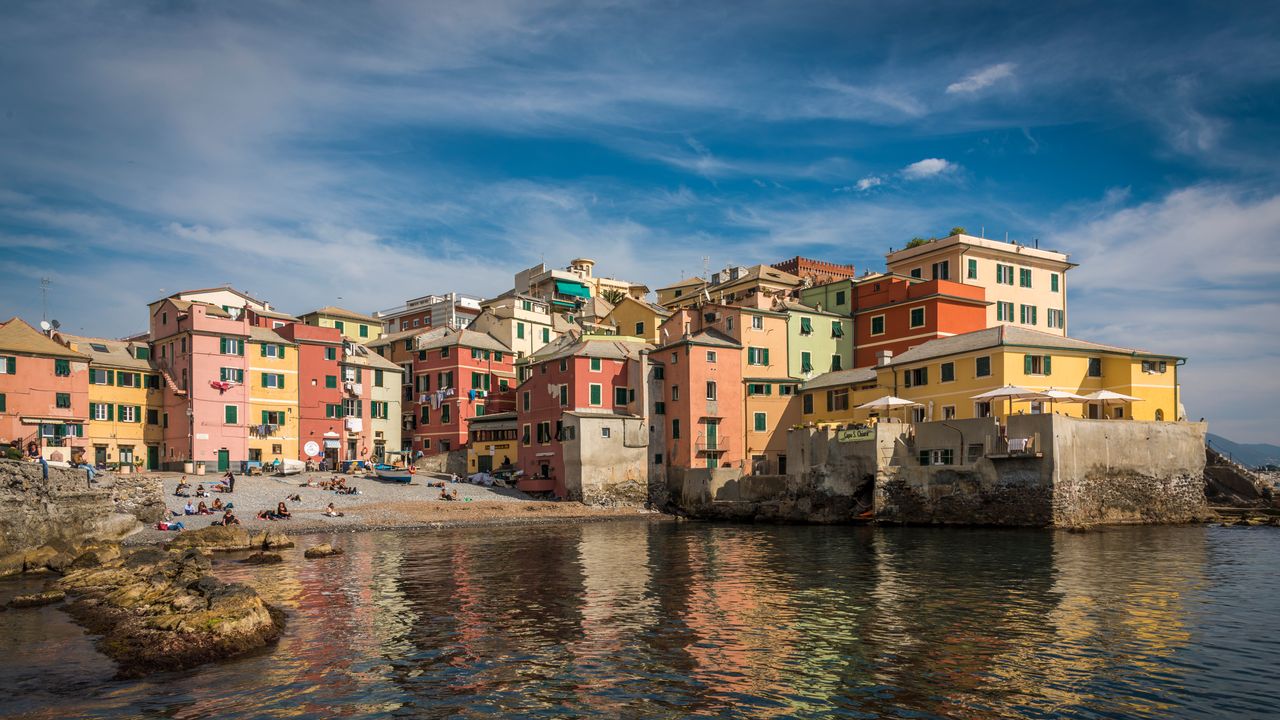
A street overlooking the sea in Boccadasse.
Chiara Salvadori
Palazzo Angelo Giovanni Spinola.
Simona Sirio
And in fact, much of the city’s best food is eaten on the go. Genoa is renowned for its ultra-thin focaccia, doused in local olive oil and best procured at tiny focaccerie where the staff would crowd round to coo over my toddler, despite their long queues. The city’s other famous foodie export is pesto alla Genovese, which has you pledging never to eat pesto from a jar again. We bought this, and a sublime pansotti con salsa di noci (a sort of greens-filled ravioli in a creamy walnut and marjoram sauce) from Pastificio Artigianale di Canneto, and went back the next day for a repeat order.
When full, we spent our days taking in the exquisite interiors and impressive art collection of the Palazzo Rosso, exploring the city’s hidden parks – the Villetta di Negro’s steep paths reward you with incredible views and a huge waterfall – and riding the scarlet funicolari into the peaceful, green neighbourhoods that top the city’s many hills. In fact, thanks to the city’s topography there are also several lifts that act as public transportation to the higher regions, and we loved riding the Art Nouveau elevator up to the panoramic Spianata Castelletto, where we felt almost drunk on the heady scent of jasmine all around us.