
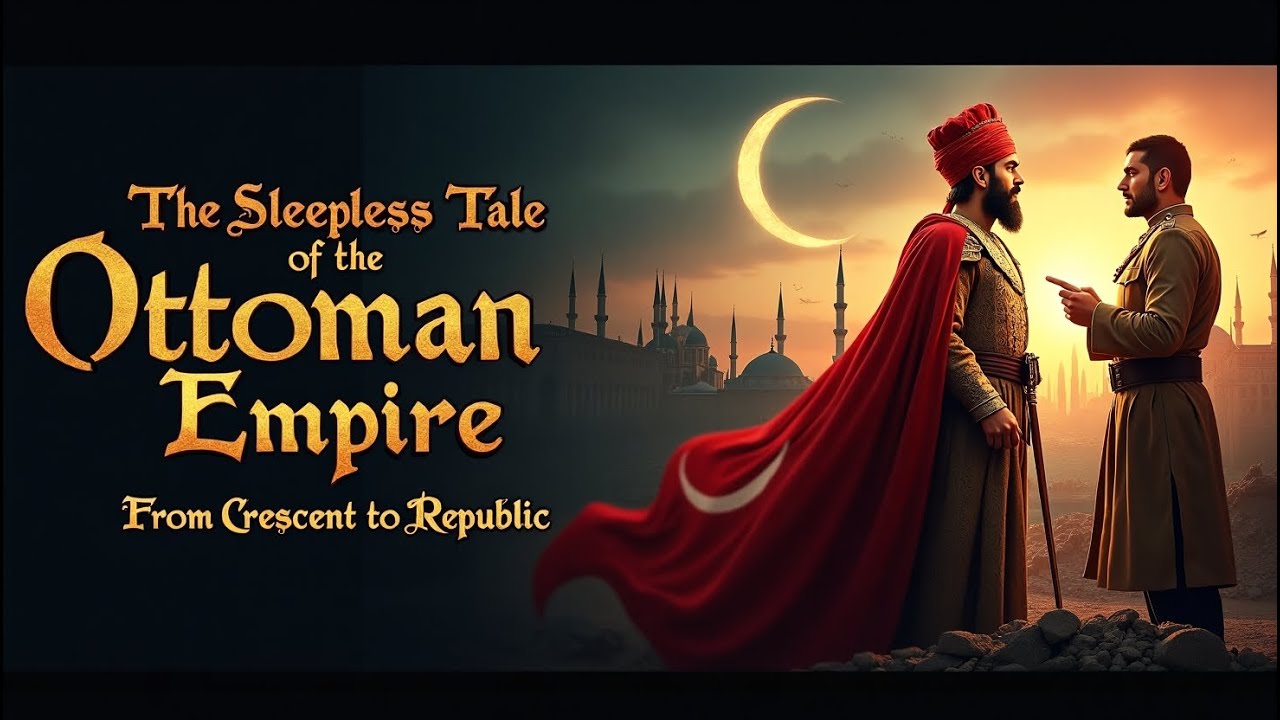
The Sleepless Tale of the Ottoman Empire — From Crescent to Republic
The empire that once cast its shadow across three continents… How did it rise — and why did it fall?
In this sleepless tale, journey through the soul of the Ottoman Empire: from the humble crescent-bannered beginnings of Osman I to the defiant last stand of the Republic under Mustafa Kemal Atatürk.
Witness the triumphs, betrayals, glories, and ghosts that shaped over 600 years of history — as the sultans dreamed, the world turned, and empires crumbled.
⚔️ From the conquest of Constantinople to the trenches of Gallipoli.
🕌 From the golden domes of Topkapı to the whispers inside secret chambers.
🇹🇷 From crescent moon to republic sun — the end was not silence, but reinvention.
🎙️ Narrated in a calm, immersive tone to help you drift into history, this episode is perfect for late-night reflection or deep historical discovery.
—
🔔 Subscribe for more sleepless journeys through forgotten empires and human epics.
#OttomanEmpire #HistoryForSleep #TheSleeplessTale #FallOfEmpires #MustafaKemal #FromCrescentToRepublic
as the final echoes of empire dissolve into memory we arrive at the end of a story as sweeping and symmetrical as legend a tale that began with a small band of Turkish horsemen on the frontiers of Anatolia and rose to become one of the most enduring empires in human history from the muddy paths of Esti to the luminous halls of Topkapi the Ottoman Empire stretched its wings across six centuries touching three continents and countless lives but as with all things vast and human it too came undone the collapse of the Ottoman Empire at the close of World War 1 marked more than just the end of a political structure it left a silence where a system had once thrived at silence that still murmurs beneath the surface of modern nations so what remains when an empire vanishes more than you might expect the lines drawn in the wake of its fall still carve up our modern world they separated provinces into nations divided neighbors into strangers and left behind wounds that in many places still ache the ghosts of the Ottoman past are not confined to dusty archives or ancient palaces they live in languages still spoken in flavors still savored in customs still passed down.in Istanbul the empire’s final aching capital you can feel it still minarets pierce the skyline like memories made of stone domes shimmer in golden light rising above streets once walked by poets and pashas at the Grand Bazaar merchants sell wares in corridors built under men the conqueror along the Bosphorus 18th and 19th century wooden mansions Hansel and Gretel proud catching the same sea breezes that once cooled Ottoman viziers but the Ottoman spirit drifts far beyond Turkish shores dot insabieavo stone bridges arch across the Miljaska River bridges built under Ottoman rule that watched as a shot there sparked a World War in Jerusalem the walls erected by Suleiman the magnificent still embrace the Sacred Heart of the Old City in Cairo Ottoman mosques rise above the crowded lanes of the modern city in Athens Thessaloniki and towns across the Balkans you’ll find Ottoman arches and fountains peeking from beneath layers of nationalism and time perhaps most intimately the legacy lives in taste Turkish kebabs Greek moussaka Bosnian brek Lebanese kibbeh these dishes born in imperial kitchens and refined over generations still Grace tables across former Ottoman lands they ignore borders drawn in ink they travel by memory by scent by the rhythm of family tradition even the ritual of coffee so central to daily life in the region was shaped during Ottoman rule the act of boiling pouring sipping sharing in coffee houses from Damascus to Belgrade this ritual remains a social anchor a relic of the past that never needed to be revived because it never disappeared but perhaps the most subtle and profound legacy lies not in buildings or dishes but in ways of thinking in the structures of governance in the strategies of coexistence in the invisible systems that shape how states interact with faith ethnicity and identity dot the Ottomans for all their flaws left behind administrative tools that still inform many successor states bureaucracy a delicate balancing act between religious and secular power the need to manage diversity in vast multilingual multi faith societies their millet system which allowed religious communities a degree of offered an early form of pluralism flawed certainly and hierarchical but also far ahead of its time this model would echo in later experiments with multicultural governance from Lebanon to Bosnia the empire’s long and uneasy interaction with Europe also left its Mark it was enemy partner and curiosity all at once Europe defined itself in part by its contrast to the Ottoman sand yet adopted much from coffee to tulips in turn Ottoman reforms drew heavily from European models filtered through the lens of imperial pragmatism that complex dance continues today in Turkey’s ongoing debates about its place between east and west is it part of Europe the Middle East or is it something else entirely a bridge a mirror a hybrid born of empires for historians the Ottoman Empire offers a rare case study in long lived adaptability how did it hold together such diverse peoples for so long how did it negotiate change without always losing cohesion and why despite all its reforms did it finally collapse these questions remain relevant not just to scholars but to any of us trying to understand how complex societies endure evolve or fall apart for everyday people living in lands once ruled by the Ottomans the legacy is often felt not in monuments but in muscle memory in the way a wedding is celebrated in the lullabies sung to children in family recipes turns of phrase or surnames some of these echoes are embraced others are ignored or resisted genetic studies now confirm what oral histories long suggested the empire mixed peoples and cultures over centuries the nationalisms that came later often tried to untangle this web to purify what was never meant to be separate archaeology two continues to uncover Ottoman foundations beneath newer facades in cities that once sought to erase the past the past quietly persists in brick in tile in layout but perhaps nowhere is the Ottoman shadow longer than in the modern Middle East the empire’s collapse left power vacuums and the colonial lines that replaced it drawn with rulers not roots created modern states still struggling for stability from Iraq to Syria from Palestine to Lebanon these borders ignored geography history and community dot and so movements rose to fill the void Arab nationalism political Islam secular republics each claimed to offer a more authentic vision but all operated in the shadow of what came before some look back with longing not for sultans or sultanas but for a time when multiple identities could exist within a larger whole a world before passports before census boxes before the great flattening of nationalism dot Ottoman cities were mosaics not monoliths markets where Turkish Arabic Greek Armenian Ladino and Persian all mingled neighborhoods where churches stood beside mosques and synagogues governments that didn’t pretend everyone was the same but tried however imperfectly to manage the differences that world is gone but its memory lingers as the call to prayer floats across the old quarters of Istanbul as hands shape copper into trays using centuries old techniques as families gather around tables to eat dishes whose origins are older than nations the past is not gone it is simply quieter it is not fully embraced it is not fully rejected it is lived The Ottoman Empire now rests in the pages of history books in curated exhibits and televised dramas its sultans soldiers and scribes are long buried and yet something breathes on in the dust in the spice in the syllables of daily speech the empire may be gone but its pulse lingers even today the nation states that replaced it fly different flags tell different stories and teach different histories but beneath those narratives the Ottoman rhythms still beat sometimes faintly sometimes defiantly and so we conclude not with certainty but with humility The Ottoman Empire was not a fantasy not a darkness not a Utopia it was a human creation vast flawed beautiful brutal resilient it contained brilliance and cruelty coexistence and violence elegance and exploitation it cannot be reduced to cliche it must be understood in full and it must be remembered so as the sun slips beneath the Bosphorus where Europe and Asia nearly touch where Constantine once raised his Christian Rome and memmed claimed it for Islam we might pause we might listen to the whispers of water carrying six centuries of stories from the Black Sea to the Mediterranean dot and we might understand that this empire like all great human endeavors has not truly vanished it has only changed shape it lives in us now in the waning days of Byzantine power Anatolia had become a fractured mosaic of rival principalities once dominated by the mighty Seljuk sultanate of Rome the region was now crumbling under the strain of internal conflicts and the lingering shock of Mongol invasions though the Mongol Ilkhanates still claimed overlordship over these lands their grip was tenuous a distant shadow of true control in this void opportunity beckoned for the bold the shrewd and the ruthless on the Northwestern frontier of the collapsing Seljuk realm where forested mountains slowly give way to fertile plains a volatile borderland stretched between the Islamic world and the crumbling Byzantine Empire here power belonged to tribal leaders known as baes frontier lords who commanded fierce bands of mounted warriors called ghazis these fighters driven by religious fervour and the lure of plunder roamed the edges of empire with blades in hand and conquest in mind among them was a man named Archi Grau a chieftain of a small nomadic Turkish tribe that had fled westward from Central Asia to escape the Mongol storm for his loyalty to the Seljuks Urgiraw was granted land near the town of Sentai on the fringes of Byzantine territory here his people began to transition from wandering herders to settled farmers and from raiders to rulers when Urjagrow died around 1281 his modest dominion passed to his son Osman Bey at first glance Osman seemed no more powerful than the other local bays but he possessed something rarer magnetic charisma political vision and an instinct for leadership that transcended the age he forged alliances through marriage welcomed skilled refugees from Mongol held lands and even integrated defectors from the Byzantines into his growing ranks where others sought only loot Osman built something greater a nascent state unlike many of his contemporaries Osman adopted a policy of relative tolerance Christian villagers who submitted peacefully to his rule were protected and taxed not slaughtered and many did to Greek Armenian and Turkish peasants the Byzantine landlords and rival Turkish beys often seemed more burdensome than the pragmatic and steady rule of Osman this model of military expansion paired with administrative inclusion would become a defining feature of the Ottoman state according to tradition a dream came to Osman in the early days of his rise a dream that would be etched into the mythic foundations of an empire in his vision a vast tree sprouted from his chest growing so large that its branches spread across the entire world beneath its shades stood the mighty mountain ranges the Caucasus the Taurus the Atlas and the Balkans from its roots flowed four great rivers the Tigris the Euphrates the Nile and the Danube cities bloomed along their banks ships sailed their waters and the crescent moon rose above them all when Osman recounted this dream to Sheikh Edebalia revered Sufi mystic and the father of the woman Osman wished to marry the elder interpreted it as divine prophecy the dream he said foretold a destiny of empire whether this tale is legend or truth its impact is undeniable it gave spiritual legitimacy to Osman’s rise and positioned his descendants as rulers ordained by divine will in the centuries to come the dream would be invoked again and again to affirm the dynasty’s right to lead the Islamic world Osman’s early conquests were modest but shrewd he focused on Byzantine strongholds around ST and gradually expanded his territory as word of his leadership spread warriors flocked to his banner by 1299 Osman felt powerful enough to declare independence from the waning Seljuk Sultanita date later recognized as the official birth of the Ottoman state his followers began to call themselves osmanlilar the people of Osman the fledgling Ottoman realm took on the shape of a frontier warrior society it retained much of its Turkic nomadic character while incorporating elements of Byzantine and Seljuk governance Ghazi warriors formed the military backbone receiving land in newly conquered areas in exchange for their service these grants created a cavalry class that could be summoned in times of war markets soon emerged near frontier forts and a primitive bureaucracy began to grow religion played a vital role in legitimizing and unifying this expanding realm Osman forged close ties with Sufi brotherhoods whose mystic and inclusive approach to Islam appealed to both Turks and converts dervish lodges sprang up in conquered lands serving as spiritual centers and tools of cultural integration Islamic law while present was applied with flexibility and political sense as the Byzantine Empire continued to weaken Osman pressed deeper into their lands in 1301 his forces defeated a Byzantine army at the battle of baphios securing control over much of Bithynia it was a pivotal moment the Ottomans had moved beyond frontier raiders and become a real military power capable of challenging empires Osman’s son Orhan an ambitious and able commander joined him in the field together father and son dismantled the Byzantine presence in Northwestern Anatolia fort by fort town by town their greatest prize was the city of Bursa a wealthy and strategically placed urban center Osman began the siege but his health soon declined by 1323 or 1324 as his forces continued their assault the founder of the Ottoman dynasty lay dying summoning Orin to his side Osman offered his final counsel according to the Ottoman chronicles he urged his son to rule with justice to spread the faith by the sword and to honor men of learning then in a modest wooden home in Saint the man who had turned a tribal holding into a rising principality took his final breath in 1326 Orhan captured Bursa making it the first capital of the Ottoman state legend tells that he brought the news to his father’s tomb fulfilling Osman’s dying wish what had begun with a single bay a dream and a handful of warriors had now become something far greater in the green hills of Bursa surrounded by tombs and rising mosques the Ottoman state had found its first home from the roots planted by Osman his descendants would forge a dynasty that would last 600 years the sword of Osman worn by each new Sultan at his coronation would come to symbolize the divine and historical continuity of their rule passed from hand to hand across the centuries from conquerors to reformers from poets to emperors from poets to emperors sword and the legacy it carried began here this was only the beginning with the conquest of Bursa in 1326 the Ottomans took their first true steps from tribal principality to emerging empire Bursa nestled among the fertile hills of Northwestern Anatolia became not only the administrative heart of Osman’s legacy but a symbol of what the Ottomans could become a bridge between worlds a city where tradition met transformation under the rule of Orhan Bey Osman’s eldest son the Ottoman state began to evolve from a military frontier society into a more structured political entity though still rooted in the warrior ethos of the Ghazi Orhan understood that the future of the dynasty depended as much on law economy and infrastructure as it did on the sword one of his earliest and most decisive reforms was to formalize the institutions of governance Orhan established a mint in Bursa issuing coins in his name a traditional sign of sovereignty he developed administrative offices and expanded judicial oversight under Islamic law mosques schools and markets began to flourish across the newly claimed territories the city of Bursa in particular became a hub for religious scholarship and trade with dervish lodges charitable foundations and caravanserais dotting its streets but Orhan was not only a builder he was a conqueror his reign marked a period of rapid territorial expansion in 1329 the Ottomans scored a significant victory over the Byzantines at the battle of Pelagonium this triumph cemented Ottoman dominance in Northwestern Anatolia and discouraged further Byzantine attempts to reclaim their lost lands following this the Ottomans captured the important cities of Iznik ancient Nicea in 1331 and Izmit ancient Nicomedia in 1337 these cities had once been strongholds of Christian orthodoxy and imperial Byzantine culture therefore marked not only a territorial gain but also a symbolic rupture with the fading grandeur of Byzantium Orhan approached these new conquests not with indiscriminate destruction but with incorporation he preserved churches and welcomed local Christians into Ottoman administration and society many Christian nobles recognizing the stability of Oran’s rule pledged loyalty to him some even entered into military service or intermarried with Turkish elites this policy of inclusion coupled with strategic marriage alliances proved critical Orhan himself married Theodora the daughter of Byzantine Emperor John the 6th Kontos Kazinos in a move that shocked Christian and Muslim observers alike but this marriage wasn’t about love it was about leverage through this alliance Orhan secured military and political advantage at a time when the Byzantine throne was mired in civil war and it was in the shadow of that war that the Ottomans crossed into Europe for the first time in 1352 Byzantine Emperor John the 6th requested military aid from his son in law to support his position during a succession conflict Orhan sent a contingent of Ottoman soldiers to the European side of the Bosphorus in return the Byzantines granted the Ottomans control of the fortress of tissimp near Gallipoli then in 1354 a natural disaster changed history a powerful earthquake devastated the Gallipoli Peninsula weakening its defenses and causing many of its Greek inhabitants to flee seizing the moment the Ottomans occupied the vacated fortress town of Gallipoli without resistance what began as a small foothold quickly turned into a strategic springboard the European continent long thought unreachable by Turkish powers was now open and the road into the Balkans stretched ahead like a promise this incursion alarmed the Christian kingdoms of Europe for the first time they recognized the Ottomans not as distant frontier raiders but as a rising power with imperial ambition yet Orhan ever pragmatic did not overextend instead he consolidated his rule fortified Gallipoli and ensured that the passage across the Dardanelles would remain under Ottoman control internally Orhan continued to strengthen the foundations of the state he expanded the Timar system a feudal arrangement where cavalrymen were granted land in exchange for military service this both incentivized loyalty and tied the warrior elite to the state’s success but perhaps Orhan’s most enduring legacy came not from the battlefield but from an institution he helped establish the J a N I s s a R I E s as the empire expanded and relied increasingly on non Turkish populations Orhan and his advisors saw the need for a new kind of army one loyal only to the Sultan drawing from Christian boys taken through a practice known as devshirme these youths were converted to Islam rigorously trained and formed into a standing army unlike any the Islamic world had ever seen these Janissaries would eventually become the most feared and disciplined military force in the empire though their full development came under later rulers Orhan laid the groundwork through them the Ottoman state transcended its tribal origins and began its transformation into an imperial machine by the time Orhan died in 1360 the Ottoman state had grown from a regional principality into a transcontinental power he was buried in Bursa alongside his father the city he had helped turn into a capital now stood as a testament to his vision from Osman’s dream to Orhan’s designs the Ottomans had risen from obscurity to dominance their banners flew over Anatolia and now fluttered on the edges of Europe and yet this was still only the beginning when the green banners of the Ottomans rose over the minarets of Bursa it marked not only the fulfilment of Osman’s dream but the threshold of a new chapter in history what had begun as a frontier principality was now taking shape as a sovereign state under the thoughtful and ambitious rule of Orhan Ghazi son of Osman the Ottoman realm transitioned from a loose tribal alliance into a structured and ambitious political entity Orhan reigned from 1326 to 1362 and with a steady hand he guided the Ottomans through a period of foundational transformation with Bursa as the new capital Orhan turned his attention not just to conquest but to governance he minted the first Ottoman coins a declaration of sovereignty stamped into silver he founded a chancellery borrowing administrative traditions from the Persians and Byzantines and he built religious and public institutions schools markets mosques among them rose the elegant Yesil Cami the Green Mosque which still testifies to the dynasty’s early to architectural ambition but it was in the realm of military innovation that Orhan made his most lasting contributions while the Gazi cavalry still formed the Ottoman spear point Orhan recognized the limitations of a purely tribal and raiding army Around 1330 he created the Yaya Corps the first regular infantry in Ottoman history these salaried soldiers laid the groundwork for a professional military tradition even more consequential was Orhan’s development of what would become the Janissary Corps though still in its nascent form during his reign the concept was clear an elite army loyal only to the Sultan composed of boys taken from Christian families converted to Islam and trained for war and governance this practice known as devshirme may seem harsh to modern eyes but in its time it offered social mobility and power to otherwise marginalized youth the Janissaries would go on to become the iron spine of the Ottoman military machine for centuries dot as Orhan consolidated control in Anatolia events across the narrow waters of the Dardanelles opened unexpected doors The Byzantine Empire a shadow of its former grandeur was plagued by internal strife in 1346 Emperor John’s Sextokantakouzenos desperate to shore up his throne during a civil war offered his daughter Theodora to Orhan in marriage in exchange for military support the Ottomans accepted then came the earthquake of 1354 a devastating tremor struck the Gallipoli Peninsula reducing its Byzantine fortresses to rubble and causing mass panic among the local population the opportunity was to right to ignore Orhan’s son Suleyman Pasha swiftly seized the fortress of the Zimp then moved on to take Gallipoli itself with scarcely a sword drawn the Ottomans had gained their first permanent foothold in Europe this moment was seismic not just geologically but historically it marked the beginning of Ottoman expansion into the Balkans though Suleyman died soon after in a hunting accident the conquest he began would set the course for the empire’s European destiny in 1362 Orhan passed away and the mantle of leadership fell to his son Murad I if Orhan had been the architect Murad was the builder of empire Murat ruled for 27 years from 1362 to 1389 and under his direction the Ottomans grew from a regional power into a transcontinental empire one of his first acts was symbolic yet profound moving the capital from Bursa to Edirne formerly Adrianople in Thrace this signaled a shift in focus from Anatolia to Europe from consolidation to conquest from Edirne Murad launched a relentless campaign through Thrace Bulgaria and Macedonia the Christian kingdoms of the Balkans alarmed by Ottoman advances rallied under the banner of Serbian Prince Lazare on June 15th, 1389 their forces met Murad’s army at Kosovo Polje the field of blackbirds what happened at Kosovo became the stuff of legend dot accounts are shrouded in myth and contradictory detail but what is certain is this both leaders perished Murad was assassinated in the aftermath of victory reportedly stabbed by a Serbian noble feigning defection Prince Lazar was captured and executed though it cost the life of a Sultan the battle of Kosovo broke organized resistance in the Balkans for generations Mirad’s son Baezid already present on the battlefield swiftly assumed control in a ruthless move he executed his own brother to eliminate any rival claim to the throne thus initiating a grim Ottoman custom fratricide as state policy it was brutal but effective in preventing civil war Baezid would come to be known as Yildirim the Thunderbolt dot and his reign would see the Ottomans move faster strike harder and reach further than ever before the battle of Kosovo had left the Balkans shaken though Murad the first fell in the field his death was not the end but the turning of a page his son Baezid known to history as Yildirim the Thunderbolt ascended the throne with lightning in his veins on the battlefield soaked in blood and shadow Baezid asserted his rule the Ottoman way swift brutal and absolute he executed his own brother to prevent civil war a grim practice that would echo through the dynasty for centuries preserving empire at the cost of kinship the message was clear unity over sentiment power above all from 1389 to 14:02 Bazid ruled with dazzling aggression his conquests came like storms fast furious and seemingly unstoppable Serbia and Bulgaria were reduced to vassal his armies surged into Wallachia clashed with Bosnian lords and laid siege to the last outposts of Christian Defiance in the west kings watched nervously Bayezid’s shadow stretched across Europe in 1396 a crusading army of French German and Hungarian knights rich in pride poor in unity marched to confront the Ottomans at Nikopolis but their armour could not save them Baezid crushed them the flower of western chivalry was shattered in a single day survivors were paraded then slaughtered his reputation in Christendom turned from rumour to terror but while Europe trembled Anatolia burned with a different fire baezid unlike his predecessors abandoned the cautious strategy of diplomacy and slow encroachment he moved swiftly against the remaining Turkish Balkans in Anatolia former allies distant cousins ancient rivals one by one he broke them by 1390 the Ottomans ruled most of western and central Anatolia but these victories sowed resentment the frontier lords who once ruled semi independently now bowed to central authority bitterly dot and far to the east a storm was gathering Timor known in the west as Tamalane was no ordinary conqueror a descendant or so he claimed of Genghis Khan he had carved a massive empire from India to Persia where he went cities fell and rivers ran red Baezid’s rapid expansion and his harsh treatment treatment of rival Turkish principalities provoked Timur’s ire when Timur’s envoys were insulted and his allies overrun war became inevitable in 14:02 the two titans met at the battle of Ankara Bizid’s army was strong veterans from a dozen victorious campaigns but pride can blind even the sharpest sword Timur’s forces were larger better organized and included war elephants from India were still discontent brewed within Bazid’s ranks many of the Anatolian princes forced into submission years earlier now saw a chance for revenge on that fateful day they turned betrayed from within surrounded from without the Ottoman army crumbled Bazi’d was captured a shock to the Muslim world a triumph for Timur legends say he was kept in a gilded cage paraded as a prize before Timur’s court whether truth or poetic cruelty his fall marked a catastrophic rupture in Ottoman continuity the empire he had built with such fury now lay broken timour ever the puppet master restored the independent Beyliks Baezid had crushed he divided Ottoman Anatolia among Bazid’s sons each now a rival and in Europe he installed a ruler of his choosing then as swiftly as he had come Timur departed leaving the Ottomans to devour each other this was the interregnum or fetrat deverie a time of chaos brother against brother from 14:02 to 14:13 the Ottoman world hung by a thread but from the dust rose Mehmed I one of Bazzard’s sons patient calculating and politically gifted he outmaneuvered his brothers not just on the battlefield but in diplomacy and statecraft one by one he brought Anatolia and the Balkans back under Ottoman control his rule was not flashy but it was foundational though some Turkish beyliks regained temporary independence and Timur’s influence lingered like smoke after fire Mehmed began rebuilding the bones of the state he revived institutions stabilized taxation and reestablished diplomatic channels when he died in 1421 the empire was no longer broken it was healing his son Murad the second took the mantle inheriting not chaos but a fragile hope for three decades Murad labored in the shadow of great ancestors and future giants his reign was a test of endurance in Europe he faced two formidable enemies Janos Huniadi the Hungarian general who fought with brilliant resolve and Skanderbeg the Albanian rebel who defied the Sultan with unmatched tenacity Murad held the line he reconquered rebellious territories reasserted authority over wayward vassals and patiently absorbed the bailiffs that had splintered after Ankara he was no romantic hero but he was a craftsman shaping the foundations of what would soon become empire again in 1444 the Christian kingdoms made one final push a crusading army marched once more to repel the Ottomans at Varna but Mur now a seasoned veteran met them with brutal efficiency the crusade ended in flames the Balkans remained Ottoman for good Murad died in 1451 his throne passed to his 19 year old son a boy whose ambition burned like a beacon in the dark memmed the second twice before the young prince had ruled briefly when Murad abdicated both times he was forced to step aside amid political pressures but now he returned as a man ruthless brilliant and destined to change the world he had his eyes set on a single prize a city that stood like a ghost of ancient glory Constantinople the Red Apple it was more than a city it was a symbol of the Roman world of Christianity’s eastern heart and of a dream the Ottomans had chased for generations others had tried Bazid had failed but Mem had was patient he would not storm the city with pride he would surround it with preparation in the wake of Murad’s long reign the Ottoman state was stable centralized and militarized its armies were professional its bureaucracy sophisticated and its Sultan obsessed the groundwork was laid the empire had weathered its darkest night now with the fall of Byzantium just over the horizon the dawn of the Ottoman Golden Age was near the sword of Osman had passed through fire and shadow from the green hills of Bithinia to the bloodied fields of Ankara now it gleamed anew in the hands of Memdi the conqueror the last page of an old world was about to be turned and a new empire one that would stand for nearly five centuries was ready to rise for more than a millennium Constantinople the grand city founded by Constantine the great in 330 C E had stood invincible its massive fortifications loomed over the mingling of Europe and Asia guarding the last splendor of the Roman world through Crusades plagues revolts and sieges it had endured when the Western Empire crumbled yet in spring 1453 the unshakable finally trembled within the city’s immense walls Emperor Constantine the 11th Palaiologos marshalled a mere 7,000 survivors soldiers citizens and foreign volunteers to defend an empire reduced to a single Metropolis the surrounding countryside lay in Ottoman hands outside Sultan Mehmed the second only 19 but already hardened by rule gazed across the water what my ancestors strove for in many campaigns I shall achieve with one blow he declared Constantinople’s fall would Mark the transformation of the Ottoman state into a true empire dot m e H m E d meticulously prepared in 1452 he ordered to fortresses Rumeli Hisari on the European shore and Anadolu Hisari on the Asian side built to choke off the vital Bosphorus Strait this iron grip on maritime access was signaled brutally one Venetian ship defying the blockade was captured its captain impaled dot within the walls Constantine responded by appealing to the west he even accepted a union of Orthodox and Catholic churches and unpopular measure invoking painful memories of the 12:04 sack of Constantinople though a few Genoese and Venetian soldiers came and an engineer named Giovanni Giustiniani Longo arrived help fell far short faith alone would face the might of the Ottoman war machine Mendy assembled a force of nearly 80,000 Janissaries Turkish cavalry conscripts from Europe’s vassal states and summoned urban from Hungary to build a monstrous cannon this behemoth could hurl 1,500 pound stone balls demanded 60 oxen to move and roared across the plains like thunder accompanied by dozens of smaller cannons this artillery pounded walls built for a previous era of bows and catapults on April 6th, 1453 the guns opened fire for weeks Ottoman metal collided with Byzantine stone each night defenders frantically filled breaches rubble wood barrels earth even cloth working under the weight of despair infantry charges faltered under rain and blood resistance was fierce but dwindling realizing that the walls alone would not fall Mehmed hatched a bold plan a steel across Galata in a single night hundreds of small ships were rolled over greased logs from the Bosphorus into the Golden Horn a feat of ingenuity that shattered the Defender’s last hope of naval defense docked by late may walls were weakened defenders drained on May 28th Mehmed met privately with his commanders he promised three days of looting at Oman military law permitted it to stoke bravery and issued personal rewards for troops the first to breach the walls inside Constantine walked his commanders urging them to hold the line to protect what remained of their world that night Christians and Catholics gathered in Hagia Sophia side by side they prayed for God’s mercy then at dawn on May 29th, 1453 the assault began first came the irregulars then Turkish infantry but it was the Janissaries hardened and disciplined who pushed forward at Saint Romana’s Gate where breach had opened they surged Giovanni was wounded confusion spread Aposton Gate was left unguarded Ottomans flooded in others scaled the walls near the Blushony Palace inside the city’s heart Constantine removed his imperial regalia it was time to stand as a soldier he LED a final charge fighting to his death his body was lost to legend but Mustafa Kelly later claimed he arranged a respectful burial by midday the city was Ottoman dot m e H m E d entered on horseback riding straight to Hagia Sophia noticing a soldier prying up marble he commanded let the plunder suffice the buildings belong to me the church was converted into a mosque a potent symbol of conquest for three days soldiers took what they could emperor’s gold manuscripts relics some destroyed some carried away captives were enslaved some buildings damaged yet behind the destruction came Memer’s deeper purpose transformation after looting ended memmed implemented a grand vision he invited survivors Muslims Christians Jews to repopulate the devastated city even offering tax breaks he appointed janadius to the Orthodox patriarch granting religious autonomy under Ottoman rule markets reopened merchants flourished construction began anew gradually Constantinople adopted a new name Istanbulers a living legacy where east met west where imperial grandeur touched everyday markets across Europe panic and awe stirred Pope Nicholas the 5th appealed for a crusade none answered Europe had its own turning tides religious schisms dynastic conflicts and the lure of the Atlantic frontier meanwhile the Islamic world celebrated the conquest fulfilled a hadith one day Muslims will conquer Constantinople for the Ottomans the city’s fall was not the end it was a beginning no longer a frontier dynasty now an imperial power mem claimed the title Kaiserai Rum Caesar of Rome his conquest of Constantinople marked the end of the Byzantine Empire and the dawning of the Ottoman Golden Age the city’s domes would echo calls to prayer its courts would host poets scientists and diplomats from here Memdi continued expanding across the Balkans Anatolia and the Black Sea but the story unfolds in next chapters when the echo of conquest faded meant to now Sultan and Kaiserai Rumsted amidst the ruins of Constantinople the city was wounded its population scattered its grandeur tarnished yet in his mind stirred a Phoenix within months mend enacted a transformation more remarkable than its fall he invited former residents Muslims Christians and Jews to return offering land tax exemptions and legal protections Hagia Sophia was reborn as a mosque but the Orthodox Patriarch Janadius too remained in his ancient setam unmistakable symbol of coexistence markets reopened crafts and commerce flourished artisans scholars and merchants flocked in from distant lands building bazaars and baths mosques and madrassas in this rebirth memmed claimed a secular vision spanning beyond conquest Renaissance painters were brought from Italy architects infused Byzantine domes with Ottoman elegance the city became Istanbul a cultural crucible where arteries of trade pulsed day and night took to govern such a cosmopolitan capital meant innovated ruthlessly yet wisely he expanded the Divan of Sultans Council to include ulema scholars military officers and diplomats Islamic law was codified nationally while local traditions were respected reinforcing unity and justice critically he professionalized the military the Janissaries became a standing army disciplined loyal modern Memed initiated the Timar land grant system rewarding soldiers with land revenues in exchange for service this stabilized power and boosted loyalty the once nomadic Ottomans now had structure and permanence Bursa Edirne and Istanbul connected by roads lighthouses bridges and ships formed a network of imperial resilience and mobility across continents not for long would Istanbul remain the empire’s soul jewel Mehmed’s ambitions stretched west.in 1454 he launched campaigns into Thrace Macedonia and Bulgaria city after city fell drama Serres Philipopolis until 1463 when his armies moved deep into Bosnia capturing King Steven Tomasevic leading to Bosnia’s final fall.in 1468 Muslim communities flourished in the Balkans churches remained standing but converted to mosques or granted protected status reinforcing Ottoman sovereignty without alienation a mix of coercion and tolerance ensured compliance and culture endured the Venetians uneasy neighbours struck back in 1463 capturing islands in the Aegean MEMD responded in kind laying siege to Eidon reconquering territories and securing sea routes to Cyprus and the levant.in 1475 he claimed the strategic Crimean Conate bringing the Black Sea under Ottoman dominance and seeding Protection over Christian Genoese ports there in that same stroke Ottoman power reached Istanbul Bridge between the Mediterranean and the Russian steps turning his eyes to the Mediterranean’s jewels and threats memmed launched a massive siege on Rhodes the bastion of the Knights’hospital though he failed to capture it in 1480 the campaign showcased Ottoman maritime power and his strategic boldness even at the twilight of his reign dot home memmed commissioned architectural wonders the Fateh Mosque and complex in Istanbul schools hospitals markets a pattern replicated across the empire education and public welfare became statecraft libraries filled with books in Arabic Persian Greek Latin ink flowing and domes rising marking the empire’s ideological as much as material expansion yet not all was grand Mem’s reign was also marked by ruthless absolutism scholars plotting reform were executed powerful families purged even loyal generals executed on suspicion his family life too was turbulent constant paranoia LED to brutal punishments even so his vision an enduring multi ethnic empire under the Ottoman banner dash endured when Mehmed the second died in 1481 he left an empire vastly greater than he’d inherited spanning Anatolia Thrace the Balkans and parts of the Black Sea region Constantinople once Byzantine glory now stood as Istanbul the beating heart of an empire dominated by Turkish Muslim rule but alive with Christian and Jewish voices education and architecture had flourished legal reforms had taken root the military stood strong and trade routes prospered he had fulfilled prophecy not just the medieval Muslim legend of conquering Constantinople but an Ottoman promise empire synthesis endurance Mem’s conquest anchored the empire his successors Bayezid Du’as Alima I s lemon would build on this foundation from Istanbul law and art spread culture blended politics rippled across continents but it was memed who lit the imperial flame he made Istanbul the cultural pivot connecting Mediterranean to Silk Road church to mosque classical antiquity to Ottoman Renaissance it was a spring morning in May 1453 when the skyline of Constantinople ancient capital of emperors and saints was shattered by the thunder of Ottoman cannons for over a thousand years the city had stood as a bastion of eastern Christendom a jewel of civilization perched between two worlds now its mighty walls cracked under fire smoke curled above its domes and on the 29th day its gates finally broke memt the second just 21 years old rode through the breach behind him came thousands janissaries engineers scholars administrators administrators part of a vision much larger than mere conquest this was not the end of a city it was the beginning of something greater with the fall of Constantinople the Ottoman Empire crossed an invisible threshold the age of ambitious raids and frontier skirmishes was over now began an era of imperial statecraft cultural synthesis and calculated majesty historians would one day call it the Golden Age but first the ashes had to be swept away when men the conqueror entered the shattered Byzantine capital he didn’t gloat he stood quietly among its ruined relics pausing in the Hagia Sophia once a church now a hushed shell there in the half light beneath its massive dome he reportedly whispered what a city we have given over to ruin but the young Sultan had not come to destroy he had come to build almost immediately orders were issued to restore the broken infrastructure roads were repaired aqueducts cleaned the Hagia Sophia its echoes still trembling with the chants of centuries was transformed into a mosque but Mehmed didn’t erase the city’s Christian legacy he preserved it Greek churches remained open Jewish quarters were protected Armenian merchants were invited in then came the people thousands of families Turkish Greek Armenian Jewish Slavic were resettled into the capital many by force others by promise craftsmen were given tools merchants were granted privileges entire districts were assigned to scholars artisans and court officials like veins feeding a beating heart these communities revived the city memed declared Constantinople the empire’s capital but it was not the Byzantine capital reborn it was now Istanbul the heart of a new world that fused east and west tradition and transformation atop the old Acropolis Memed began construction of the Topkapi Palace sprawling complex of courtyards tiled pavilions and shaded gardens that would serve not only as his residence but as the nerve center of the empire unlike European castles Topkapi wasn’t designed for isolation it was open flowing almost contemplative each courtyard stepped deeper into privacy from the outer court where ambassadors waited to the inner chamber where only the closest advisors could pass this was the geometry of control of hierarchy of balance it was here that the Sultan met with his viziers read poetry wrote laws listened to scientists and astrologers and watched the sun rise over two continents men thirst for conquest was matched only by his appetite for knowledge he spoke Turkish Arabic Persian Greek Latin and even some Slavic dialects his personal library included both the Quran and texts on Roman history and classical philosophy he was a patron of scholars both Muslim and Christian he invited astronomers from Samarkand theologians from Cairo and artists from Italy the famed painter Gentile Bellini journeyed from Venice to paint Mem’s portrait one that still survives with the Sultan peering out beneath an arch expression austere but curious as though quietly challenging the world to understand him under his orders schools and madrassas were built hospitals libraries law academies the message was clear the sword may conquer but the pen would preserve asterisk but to govern an empire that stretched from the Danube to Mesopotamia Mehmed needed more than buildings and books he needed order so he issued the kanunname sweeping codification of Ottoman civil law it did not replace Sharia but worked beside it offering rules for taxation military service trade land ownership and administration for the first time the empire had a coherent legal framework that could be applied uniformly across distant provinces and wildly diverse populations frontier lords once powerful and semi independent were stripped of hereditary privilege power was centralized in Istanbul the empire was no longer a patchwork of tribes and provinces it was now a machine of state humming with discipline ambition and hierarchy it’s no exaggeration to say that Mehmed reshaped not only a city but the very structure of the Ottoman Empire yet his ambition did not stop at the city walls from 1453 until his death in 1481 mend the second remained on the move he crushed the last Byzantine enclaves along the Black Sea took control of Serbia and pushed into Greece and Albania when Venice resisted Ottoman expansion into the Aegean mend ordered the construction of a new navy one that would seize dozens of islands and tip the naval balance in the eastern Mediterranean dot in Anatolia he shattered the remnants of the old Turkish beyliks consolidating them into a unified Turkish states something unseen since the fall of the Seljuks centuries earlier by the time of his death at the age of 49 the Ottoman Empire had more than doubled in size mend the second died on campaign in 1481 likely of illness though rumors swirled of poison or betrayal his body was carried back to Istanbul and interred in a grand mausoleum near the Fatih Mosque monumental complex he had personally commissioned complete with school hospital soup kitchen and library dot the man who had taken Constantinople rewritten imperial law and sparked a cultural renaissance now rested in the city he had revived but his story was far from over his son Bazid too stood next in line a ruler more cautious more introspective he would not expand the empire as his father had but he would preserve its foundations and prepare it for a new kind of conquest one of minds faith and diplomacy that golden age had begun not with fanfare but with vision with firelight on stone with a young man in a ruined basilica whispering to ghosts and from those ashes a civilization began to rise the echoes of Mehmed the Second’s cannons still reverberated through the Ottoman realm when his son Bayezid the second ascended the throne but where his father had been a tempest conquering reforming rebuilding Bazid was a river calm contemplative deliberate his reign would not be one of thunderous expansion but of quiet consolidation it was an age of introspection the swords were sheathed the palaces flourished and in the hush between wars the empire breathed Bazarid’s path to the throne was not without blood the death of Menvi to ignite it a power struggle between Baazid and his younger brother Sam Sultan a brilliant and ambitious rival who had his own vision for the empire as factions split and soldiers chose sides the battle for succession turned into a civil conflict in the end Bazzid prevailed sem fled eventually falling into the hands of European powers first the Knights Hospitaller then the pope himself for years the captured prince was paraded as a diplomatic pawn a royal hostage used to pressure the Ottoman court Beyazit ever the pragmatist paid handsomely to keep his brother in European custody fearing that Sem’s return could ignite another civil war it was a cold decision but a necessary one with the throne secure Baezid turned his gaze inward where Mem had forged new frontiers Baezid strengthened the ones he inherited for over three decades from 1481 to 1512 the empire remained largely at peace it was a rare pause in a violent century and one that Baezid used to quietly refine what his father had built he expanded the Ottoman fleet turning it into a formidable naval power that could challenge Venice Genoa and the maritime states of Europe Ottoman ships now patrolled the Aegean and eastern Mediterranean projecting power overseas once dominated by Christian powers at the same time he improved the internal workings of the empire taxation systems were rebalanced provincial governors were held more accountable trade flourished under his steady hand and the empire’s coffers swelled with wealth from ports markets and silk routes but Baezid’s greatest strength lay not in administration or arms but in empathy in 1492 far to the west a different kind of conquest was unfolding the Catholic monarchs of Spain Ferdinand and Isabella had completed the Reconquista driving out Muslim rule from the Iberian Peninsula but their victory came with tragedy the expulsion of tens of thousands of Jews from Spain they were scholars physicians merchants poets communities whose families had lived in Spain for centuries now they were hunted uprooted and cast into exile Bezzid saw what others did not not refugees but opportunity he sent the Ottoman navy to rescue many of the expelled Jews and bring them to his empire you call Ferdinand a wise king he is reported to have said but he impoverishes his own kingdom and enriches mine the Jews found a new home in Ottoman lands in cities like Istanbul Salonika and Ismir they revived their lives building synagogues opening schools trading spices and silks and contributing to Ottoman society in ways that would last for generations Baysid’s decision was not just humane it was visionary unlike his father Baysid was no conqueror poet he was a Sufi deeply spiritual quietly devout and drawn to the inner dimensions of Islam his court was filled not with warriors but mystics scholars and philosophers he sponsored religious institutions endowed mosques and supported the production of theological literature under his guidance Istanbul grew not only in size but in soul Bezeid saw the empire not as a tool of conquest but as a sanctuary for order and piety his rule was one of stillness of balance between law and mercy and yet this very stillness would so unrest in his later years as Bazid aged new winds began to stir far to the east a religious and political storm was rising the Safavid dynasty in Persia founded by Shah Ismail the Safavids were Shia Muslims in sharp contrast to the Sunni orthodoxy of the Ottomans but more than that they were revolutionary fiery charismatic and determined to reshape the Islamic world their message found deep resonance among the Turkish tribes of eastern Anatolia threatening to fracture Ottoman unity Bazzid cautious and reluctant to provoke war chose containment over confrontation but this policy of restraint did not sit well with everyone one man in particular grew restless Bazid’s own son Selim Selim known to history as Yavuz the grim was the governor of Trabzon a frontier province on the empire’s eastern edge he was everything his father was not fiery ambitious and mercilessly decisive to Selim the Safavid threat demanded action not caution he watched fumed and waited by the early 15 Selim had begun building support among the Janissaries and military elites he portrayed his father’s inaction as dangerous his leadership as passive whispers of rebellion turned to open confrontation.in 1512 with the backing of the army Selim marched on the capital Baezid now an old man weakened and weary was forced to abdicate the quiet Sultan was escorted away from power and died in relative obscurity soon after Bayezid’s reign though overshadowed by the brilliance of his father and the fury of his son remains one of the most stable and humane chapters in Ottoman history he preserved the empire he deepened its institutions he turned it into a sanctuary for the persecuted his rule was not one of expansion but of refinement and interlude of calm before the storm that was Esel as the sun set on Bazi’s era the empire stood at a crossroads one path LED to cautious diplomacy and cultural synthesis the other lit by fire and driven by zeal to war dot s e l I m chose the latter and history would follow when Bazzit too stepped down from the throne he left behind an empire that was peaceful prosperous and in the eyes of his son dangerously complacent dot s e l I m the son who would become known as Yavuz the grim saw in his father’s quiet restraint not wisdom but weakness and as he seized power in 1512 Selim did not come to preserve what had been built he came to reshape the world not through poetry nor patience but with fire and steel Selim’s first act as Sultan was brutal and swift in the shadows of the palace he eliminated all potential rivals his brothers their sons anyone whose blood might one day claim the throne the executions were not acts of vengeance they were cold calculations each one a preemptive strike to prevent future civil war in the Ottoman tradition such fratricide was grimly legal and accepted method of securing succession but Selim took it to terrifying new depths the empire had known many sultans it had never known one quite like him he was not a builder he was not a dreamer he was a warrior and war was coming dot to the east a different empire had risen from the mists of Persia the Safavid under the young and charismatic Shah Ismail they were forging a sheer theocracy militant mystic and revolutionary dot in a world largely sunny the Safavid message cut like a blade and it found eager followers among the Turkic tribes of Eastern Anatolia tribes who though part of the Ottoman Empire began turning their loyalty toward the rising sun of Persia for Salim this wasn’t just heresy it was sedition it threatened to rip apart the religious and political unity of the empire and in typical Selim fashion he would not wait for that rupture he would crush it first in the summer of 1514 Selim LED a massive army eastward across the Anatolian plateau his target Shah Ismail dot Ismail confident in his divine charisma and his cavalry’s speed believed he could overwhelm the Ottomans but he misjudged his opponent Salim’s army marched not only with Janissaries the elite Ottoman infantry but with something far more devastating artillery when the two empires collided at Chaldiran near the Iranian border the battlefield became a furnace the horsemen fearless and fast charged wave after wave but they met Ottoman cannon fire and musket lines tearing through men and horses alike the Ottomans stood firm the Safavids shattered dot Shah Ismail fled the field wounded and humiliated his mystique once seen as untouchable was gone dot s e l I m had not only won a battle he had drawn a line from that day on the borders between the Ottoman and Persian worlds between Sunni and Shia spheres would be etched in blood that line still exists today but Salim’s ambition did not stop at Chaldiran in fact it had only begun now he turned south his eyes fixed on the ancient lands of Syria and Egypt territories ruled for centuries by the proud Mameluk sultanate more than just provinces they held within them the beating heart of the Islamic world Mecca and Medina whoever ruled the Hijaz ruled the soul of Islam dot c l I m wanted that authority and he would take it by force his army crossed into Syria in 1,516 defeating the Mamluks at the battle of March Dabeek within months the Ottomans swept into Damascus then continued south in 1517 they reached Cairo dot the Mamluks fell like dust before the storm it was not just a military conquest it was a spiritual one in Cairo the last shadow of the Abbasid Caliphate ceremonial figurehead preserved by the Mamluks formally handed over the relics of the Prophet Muhammad his sword his robe his banner to s E L I m dot 2 the Ottomans though the legal legitimacy of this transfer was debated by scholars the symbolism was undeniable the Ottoman sultans were now not only emperors they were caliphs spiritual leaders of the Sunni Muslim world with a single campaign Salim had tripled the empire’s size annexed the holy cities of Islam and cemented the Ottoman’s claim to global religious authority by the end of his reign Selim’s conquests had transformed the Ottoman state from a regional powerhouse into a truly transcontinental empire from the Balkans to Baghdad from the Danube to the Red Sea the empire was now a patchwork of peoples cultures and faiths held together by a centralized system and the threat of overwhelming force dot s e l I m reorganized the empire’s bureaucracy to manage this expansion placing trusted commanders in key posts and integrating Arab territories into the imperial fold he maintained the devshirme system but also expanded the use of local elites balancing Turkish power with regional administrators and he enriched the empire through war spoils and control of trade Egypt’s fertile lands brought a flood of tax revenues control of the Red Sea opened maritime access to Indian Ocean trade routes the Ottomans now stood at the crossroads of east and west and yet despite his immense achievements Suleiman’s reign lasted only eight years in 1520 at the age of 49 the grim Sultan died possibly of cancer or a sudden illness while preparing another campaign his rule had been short but it burned white hot what he left behind was not merely a larger empire it was a different empire stronger harder sharper he had redrawn the borders of Islam reshaped the map of three continents crowned the Ottomans as protectors of Mecca and Medina he had turned the house of Osman from a dynasty into a Caliphate and now into this empire of fire and steel stepped his son a young Sultan educated thoughtful and as history would soon learn every bit his father’s equal in ambition his name was Suleiman and the Golden Age was about to begin in the summer of 1520 the imperial tent stood quiet on the plains of Thrace the air was heavy with the scent of military leather and Parchment and in the hush that followed the sudden death of Selim the first a new figure stepped forward from the shadow of conquest he was 25 years old slim composed with a gaze sharpened by discipline and the quiet conviction of destiny his name was Suleiman and the world would come to know him as the magnificent where others inherited a throne Sulaiman inherited an empire carved by fire and steel stretched from Cairo to the Carpathians from the gates of Vienna to the sands of Mecca yet what he envisioned was more than dominance he dreamed of civilization dot from the very start he showed he was no ordinary ruler trained in the palace school seasoned by provincial governance Suleiman possessed the rare duality of a soldier’s grit and a scholar’s mind and he would wield both with unprecedented force within a year of his coronation the young Sultan marched north to confront the unyielding Hungarian bastion of Belgrade the fortress had defied Ottoman armies for decades but in 1521 under Suleiman’s command it fell not long after he turned his gaze to the island of Rhodes stronghold of the Knights Hospitaller for six harrowing months siege engines groaned and cannons roared then in 1522 the final breach was made the cross was driven from the eastern Mediterranean and Suleiman’s name rang across Christendom with awe and dread but it was in 1526 at the battle of Mohacs where destiny cast its longest shadow the fields of southern Hungary became a graveyard the mighty Hungarian army collapsed before the precision of Ottoman firepower and cavalry King Louis the second was thrown from his horse and drowned in the marshes nobles were cut down without mercy by sundown the political map of Central Europe was shattered and in its place Suleiman planted the banner of the crescent yet power only beckoned him deeper in 1529 he launched his most ambitious campaign yet the siege of Vienna the glittering capital of the Habsburg dynasty the city stood as the final threshold to Western Europe had the siege succeeded the road to the heart of the continent might have opened but nature intervened rains flooded the Danube early snows fell and supply lines withered the siege failed still the Ottomans had struck fear into the very soul of Europe but Suleiman’s vision extended far beyond battles to the east he LED multiple campaigns into the rugged lands of Persia clashing with the Safavids his Shia rivals and eventually capturing Baghdad the ancient heart of Mesopotamia southward he dispatched his navy to challenge the Portuguese grip on the Indian Ocean and in the Mediterranean he found a seafaring genius to match his land conquests here Odin Barbarossa the legendary pirate turned admiral Barbarossa and storm hearted transformed the Ottoman fleet into a juggernaut from Algiers to Tunis the crescent moon flew over the waves coastal cities trembled merchant ships vanished and in 1538 at the battle of Proveza he shattered a combined Christian fleet securing Ottoman dominance of the Mediterranean for decades and as the empire expanded outward Suleiman turned inward to the law to architecture to the soul of the state he became known as Kanuni the lawgiver not merely because he created law but because he balanced it he summoned his chief jurist Ebuzor a Fendi and together they wove Islamic Sharia with imperial edict binding the empires swirling mosaic of languages religions and customs into a coherent legal tapestry this code refined and just would endure not for years but for centuries his court once military in nature now became a theatre of philosophy diplomacy and magnificence the top copy palace gleamed with intellectual energy treaties were signed with kings and emperors French envoys shared wine with Ottoman scribes through capitulations European merchants were granted privileged trade rights cementing Istanbul as the crossroads of the world the machinery of the state too reached its peak at the empire’s core stood the Imperial council guided by the Grand Vizier but always in the shadow of the Sultan its members from military leaders to financial ministers were not nobles by birth but servants of the Devshirme loyal elite and highly trained aristocracy was not inherited it was earned and in that meritocratic system the Ottoman state thrived across the provinces Ottoman governance relied on balance governors Bey’s administered regions judges upheld the law and soldiers bound by the Timar system farmed lands they were sworn to defend it was a mosaic of loyalty responsibility and mutual oversight a design as elegant as it was resilient dot and the empire vast as it was remained fed clothed and connected agriculture sustained growing cities peasants farmed lands not as serfs but as tax paying freemen grain reserves guarded against famine trade flourished not only from Istanbul but through Aleppo Cairo Sarajevo from these cities flowed silk spices glass and knowledge Jews Greeks Arabs Armenians merchants of every Creed shaped the Ottoman bazaar the wealth that poured into the empire was not hoarded it was transformed Suleiman became the patron of a cultural golden age mosques rose like prayers cast in stone calligraphy sang on Parchment poets sculpted language like marble and presiding over it all was one of the greatest architects in human history Mimar Sinan Sinan a convert from Christianity a soldier turned architect became the empire’s builder of dreams for five decades he reshaped Ottoman skylines with domes that soared like thoughts and minarets that sliced the heavens his masterpieces the Fezid Mosque the Imperial Sulimani Mosque in Istanbul and the awe inspiring Selimiye Mosque in Edirne stand today as testaments not just to faith but to human imagination and in the heart of Sulaiman’s empire one woman would challenge tradition and history itself she was born Alexandra Lizauska captured from Ukraine and brought to the harem but she rose not through beauty alone but intellect charisma and ambition the world would know her as Hurrem Sultan or roxolana against centuries of Ottoman custom Suleiman made her his legal wife the first in generations he brought her out of the harem and into the palace where she became his confidant his political partner and the mother of his children charitable diplomatic and shrewd Hurrem corresponded with rulers advised on state affairs and built schools and hospitals in her name where others saw scandal Suleiman saw strength but within the golden splendor shadows began to stir the final decade of Suleiman’s reign would be marked not by conquest but by grief and betrayal the succession always a dangerous affair in the Ottoman court turned deadly his eldest son Mustafa beloved by the army and seen as the empire’s brightest hope was accused of plotting rebellion whether through court intrigue or manipulation some say at the urging of Hurrem Suleyman ordered his execution in 1553 the empire mourned and something inside the Sultan dimmed Hurrem died in 1558 the sons she left behind Salim and Baezid soon turned against each other Baezid lost and by 1561 Salim stood alone by the time Suleiman LED his final campaign in 1566 against the fortress of sigetvar in Hungary he was old and weary his body frail his heart burdened yet still he donned his armor mounted his horse and rode with his men there in his tent beneath the pounding cannons of his final siege Suleyman the magnificent died but his death was hidden Grand Vizier Sakalu Mehmed Pasha concealed the news fearing chaos orders were issued in the Sultan’s name the campaign continued only when Selim had secured the succession did they announce the passing of the greatest ruler the Ottoman world had ever known dot as his body was returned to Istanbul buried in a tomb beside the Sulimani Mosque a Monument he had dreamed designed and seen built an era ended an era of law and conquest of poetry and war of domes and death and though history would move on Solomon’s shadow would never truly fade for in his time the Ottoman Empire became not just a state but a civilization fierce flawed and radiant as the crescent it bore at its height the Ottoman Empire was not just a state it was a living mosaic an empire of empires woven together by the hands of warriors scholars artisans and believers from the golden dunes of North Africa to the windswept plains of Crimea from the jagged peaks of the Balkans to the fertile Crescent of Mesopotamia the Ottomans ruled over a world of dazzling diversity Turks Arabs Greeks Armenians Muslims Christians Jews each bore their own tongues rights and stories and yet beneath the crescent moon of the Ottomans they became part of something larger a civilization that rather than erase difference sought to arrange it into harmony how did a single imperial system manage such a task how did it govern a world so large so different and so full of competing truths the answer was not brute force it was something far more enduring a philosophy of rule based on flexibility layered power and cultural fluency at the heart of the empire stood the Sultan not merely a king but an idea in human form he was the shadow of god on earth the guardian of Mecca and Medina the heir of Rome and the caliph of the faithful his power in theory knew no limit in practice it was hemmed in by law by custom and by the sheer scale of the world he ruled he governed from Istanbul a city reborn from the ashes of Byzantium from the soaring domes of Topkapi Palace the Sultan reigned not alone but through a machine of governance as intricate as a mechanical clock beneath him the divan or imperial council met in hushed chambers the grand vizier his right hand acted with delegated authority managing the rhythm of statecraft other viziers treasurers scribes and generals formed the circle of power that turned the empire’s gears and sometimes behind a delicate lattice screen the Sultan listened in silence invisible but present judging all yet this council of lords and scholars was not a European style nobility most owed nothing to birthright they had been chosen from the villages of Christian Anatolia and the Balkans came the devshirme boys young bright and taken from their families not as slaves but as seed for empire they were converted to Islam trained in palace schools educated in war and poetry alike from this elite crop came the Janissaries the empire’s steel boned infantry and the bureaucrats who would pen its decrees their loyalty was not to tribe or kin but to the Sultan alone this was not cruelty it was a kind of brutal Equality no noble house could rival the state no bloodline could rise beyond the Sultan’s shadow in this meritocratic hierarchy the most brilliant rose regardless of name dot to rule such a massive realm required balance while the Janissaries policed the cities and fought foreign foes the cavalry the sipahiyed the countryside they were granted land under the Timar system in exchange for military service where Janissaries brought discipline the Sepahi brought reach together they stitched the cities and fields into a single imperial quilt and above them all like a spine running through the empire stood religion Islam was the soul of Ottoman civilization its scholars the ulema formed a vast hierarchy of legal minds and spiritual guides at its head stood the Sheikh al Islam a position of immense influence he could interpret the Quran define justice and if necessary stand firm even against the Sultan through works charitable foundations funded by the wealthy mosques hospitals schools and soup kitchens operated across the empire these institutions did more than serve they bound the provinces to Istanbul through networks of mercy education and faith yet the Ottomans did something radical for their time they embraced the religious other rather than demand conversion or crush dissent the Ottomans crafted a delicate system the millet dot each major religious community Greek Orthodox Christians Armenian Apostolics Jews and others was organized as a semi autonomous nation within nation LED by their own patriarchs or rabbis these militants governed marriage inheritance education and worship according to their own laws it was a hierarchy to be sure Muslims stood above non Muslims Turkish above non Turkish men above women but within those lines there was space to breathe space to thrive when Spain expelled its Jews in 1492 the Ottoman Sultan Beyazid the second welcomed them with a sly rebuke of Christian kings you call Ferdinand wise he said yet he impoverishes his realm while we gain its riches the Ottomans had no illusions of Equality but they knew that strength lay in managing difference not erasing it a 16th century Ottoman official once described his empire as a garden of many flowers each rooted in its own soil yet blooming in harmony the Ottomans didn’t merely govern diversity they enriched it their empire sat astride the greatest trade routes of the Old World after conquering Syria and Egypt they controlled the arteries connecting Asia Africa and Europe through deserts and oceans caravans and ships goods flowed into Istanbul like blood into a heart from Cairo came spices from Persia silk from the Balkans grain and timber Ottoman markets buzzed with colour carpets ceramics precious metals olive oil and perfumes the smell of cinnamon mingled with the clang of copper in every port and bazaar tongues mingled Turkish Arabic Greek Ladino Armenian dot guilds dash ease N a F dash regulated production protected quality trained apprentices and insured fair prices these were not merely economic units but social ones each guild was a community a brotherhood often mixing Muslims Christians and Jews under the same roof and at the foundation of it all stood the peasant tiller of the soil the Ottoman state protected small scale farming discouraged large estates and taxed predictably grain stores insured cities could survive famine farmers in turn fed an empire asterisk Ottoman cities weren’t just markets they were worlds built around mosque complexes each funded by sultans or statesmen they combined the sacred and the civic a single complex might house a mosque school soup kitchen bathhouse and caravanserai cities were designed not for show but for life neighborhoods mahallas clustered around shared faiths Greek Christians in one Armenian artisans in another Jews in a third but in the marketplace in the bathhouse in the coffee shop they mingled this was coexistence born of routine not theory nowhere was this more vivid than in Istanbul dot after the conquest of Constantinople in 1453 Mehmed the Conqueror had reimagined the broken Byzantine capital as a shining Islamic Metropolis churches were preserved or transformed mosques sprang up like forest trees Topkapi Palace perched above the confluence of sea and sky became the empire’s beating heart by the late 16th century Istanbul swelled with more than half a million souls one of the largest cities on earth its markets rang with dozens of languages its streets smelled of rosewater and roasting meat its silhouette shimmered with minarets and domes it was the very image of Empire grand diverse alive if the sword built the Ottoman Empire the pen refined it within the gardens of Topkapi and the shadowed halls of Medreses the Ottomans cultivated a civilization of deep learning and wide curiosity their scholars did not merely preserve knowledge they expanded it their poets did not simply imitate they transformed this was an empire where a Sultan could wield both scimitar and sonnet where court historians documented the thunder of battle and the silence of stars where a single library might contain scrolls in Arabic Turkish Persian and Greek the intellectual world of the Ottomans was a triad Arabic for law and religion Persian for poetry and culture and Turkish for governance and empire a refined statesman might write legal codes by day and ghazals by night drawing from traditions that stretched from Andalusia to Samarkand dot poetry was not a luxury it was a language of power sultans like Suleiman the magnificent under the pen name Mohibi composed verses of aching love and divine longing poets such as Bakhud and Fuzulu crafted intricate couplets that could break hearts and dazzle minds filled with metaphor double meanings and spiritual yearning these were not just aesthetic games in Ottoman court culture beauty was seen as a reflection of divine order to master words was to approach god but even poetry bowed before the sacred religion was not just the soul of the state it was its conscience Orthodox Sunni Islam remained the imperial standard but it was never a monolith across the empire a living mosaic of interpretations flourished jurists in black robes mystics in whirling skirts theologians in candlelit chambers the madrasas trained the elite in Quranic exegesis jurisprudence and logic students argued over obscure legal points with the same intensity that generals debated battle plans these debates formed the bedrock of Islamic legitimacy for the empire and yet alongside the letter of the law there was the ecstasy of the mystics dot s U f I orders especially the Mevlevi known in the west as whirling dervishes and the bektashi wove their way through towns villages and palaces they offered a spirituality of music dance and devotion their lodges became sanctuaries for the poor schools for the orphan and beacons for the spiritually hungry this coexistence between law and love text and trance created a religious ecosystem that was surprisingly flexible one could argue with a khadi by day and dance with the dervishes by night it was a dynamic that made Ottoman Islam more resilient more human the same synthesis extended to medicine and science Ottoman doctors inherited the knowledge of earlier Islamic civilizations which in turn had preserved and enriched the wisdom of ancient Greece but they did not simply copy they observed recorded and experimented astronomers built observatories that tracked the stars with astonishing accuracy they charted planetary movements compiled almanacs and debated the geometry of the cosmos in Defiance of religion but as a means of understanding divine creation.in hospitals from Edon to Damascus surgeons developed procedures for cataracts bone fractures and infectious disease illustrated medical manuals displayed detailed anatomy treatments blended herbal remedies prayer music therapy and hygiene long before these ideas took root in the west healing was not just a science it was a trust between doctor and patient under the gaze of god what the Ottomans could not express with image they rendered informed.in religious contexts Islamic tradition discouraged human figuration but far from being a limitation this sparked a revolution in abstraction calligraphy became the empire’s highest art to transcribe the Quran with elegance was an act of devotion lines of Arabic flowed across walls books and ceramics like liquid Grace the stroke of the pen became a visual prayer architectural ornamentation reached sublime heights through geometry and floral patterns designs that echoed endlessly in mosques baths and palaces light tile and symmetry spoke where statues could not dot in secular art however figures danced into view miniature painters illustrated manuscripts of history science and literature with precision and colour cities battles and ceremonies came to life in gold framed details more windows into a vast world sound too had its language from the marching rhythms of the meta military bands whose drums echoed across battlefields to the plaintive melodies of Sufi ceremonies Ottoman music spoke to the soul of a people.com ensembles played intricate compositions built on makam’s modal systems capable of expressing subtle emotional states instruments like the Ney a reed flute tanbur a long necked lute and Kudam a type of kettle drum wove together melodies that carried listeners from Celebration to melancholy and back music was taught orally master to pupil note by note feeling by feeling for the vast majority of Ottomans life unfolded not in palaces but in gardens courtyards and market places most were farmers living by the rhythm of the seasons and the laws of the land but even they participated in a civilization far larger than themselves whether Christian or Muslim man or woman peasant or artisan everyone had a place in the tapestry the city meanwhile was a theatre of layers coffee houses first introduced in the 16th century from Yemen became vibrant centres of public life here men gathered to drink the empire’s new favourite beverage black bitter stimulating and debate poetry politics and philosophy authorities both feared and tolerated them too beloved to ban too powerful to ignore hamams or public baths served as social hubs bazaars brought together every craft and Creed in these spaces people crossed boundaries without erasing them family remained central patriarchal households often included grandparents siblings and even enslaved workers women though largely confined to gendered spaces maintained powerful networks of influences especially in elite circles many managed estates endowed schools and shaped court politics from behind silk screens children received early education at neighborhood religious schools regardless of faith Muslim boys pursued more advanced learning in madrassas while girls often Learned through family crafts and religious practice the Ottomans loved spectacle shadow puppet theatres portrayed satirical dramas with cardboard characters while street storytellers recited epics that stirred the blood feasts weddings and military victories were celebrated with fireworks parades and public charity.in Istanbul the circumcision of a prince could prompt week long festivals lanterns glowing on the Bosphorus fireworks cracking above domes thousands fed in public squares the Sultan was not just a ruler he was a symbol of stability and benevolence and these displays cemented the emotional bond between ruler and ruled beneath the culture and splendor lay the bones of governance Ottoman law was dual Sharia for religious matters and canon imperial law for administration the kadi or judge held immense power in local courts Muslims went to Sharia courts for most disputes but non Muslims could choose between their own courts and Ottoman ones this legal pluralism gave the system both flexibility and legitimacy where Sharia could not address emerging problems taxation military organisation urban regulation the Sultan’s decrees filled the gap this balance allowed the empire to remain both rooted in faith and responsive to change. by the mid 16th century the Ottoman system had reached full bloom it was not a Utopia there was inequality coercion and hierarchy but within its bounds millions found a measure of peace Protection and participation unmatched by most empires of the time the empire’s genius lay not in suppressing difference but in managing it through institutions culture and imagination it bound peoples not by sameness but by shared benefit its strength came from adaptability its beauty from synthesis yet these very strengths carried seeds of future fragility the delicate equilibrium between centre and province between law and mysticism between stability and innovation would prove difficult to maintain in the centuries to come but that is another story here at its zenith the Ottoman Empire stood as one of history’s great civilizational achievements a world of domes and stars of books and bazaars of prayers in many tongues all echoing beneath the same sky and though time would move on its legacy would remain in stone in law in memory dot still whispering still alive it began not with a collapse but with a whisper when Sultan Suleyman the magnificent passed away in 1566 the Ottoman Empire stood at the Pinnacle of global power it was a world spanning realm stretching from the rainswept plains of Hungary to the sands of Arabia from the Balkans to Baghdad from the shores of North Africa to the heart of Anatolia its armies were feared its cities vibrant its scholars Learned its palaces filled with the music of empire but beneath this golden facade cracks had already begun to form the age of conquest was fading and in its place uncertainty crept in Selim too son of Suleiman inherited an empire stronger than ever but he was not his father known as Selim the Sot for his love of wine and pleasure Selim was the first Ottoman ruler who chose comfort over campaign where his father had LED armies and composed poetry Salim delegated almost all affairs of state to his grand vizier the formidable Sakalu Memmed Pasha and so a pattern emerged future sultans once trained in the provinces as governors were now raised in the cloistered hush of the harem pampered protected and profoundly unprepared for rule this shift designed to reduce fratricidal violence among royal brothers had an unintended cost a line of emperors increasingly distant from the battlefield and from the world itself in the absence of strong sultans others stepped forward it was the age Europeans called the Sultanate of women when mothers wives and concubines of the palace held real power the most prominent was the Valide Sultan the mother of the reigning Sultan who could command officials forge alliances and even decide appointments at court Keksem Sultan and Turhan Sultan were among the most influential intelligent strategic and fiercely protective of their sons they navigated the treacherous politics of the empire’s core balancing janissary leaders viziers and court factions to maintain their grip on power but palace politics was a double edged sword while some of these women governed wisely their rivalries often fueled instability intrigue replaced strategy influence was sold governance began to fray at the edges the mighty Ottoman military the sharp edge of the empire’s glory began to dull dot the Timar cavalry once the foundation of Ottoman land power found itself outpaced by the rise of firearms and modern artillery the Janissaries once elite slave soldiers trained in the palace and loyal only to the Sultan were now hereditary corrupt and often more interested in politics and trade than in war Dev Shermet Alavi of Christian boys that had once created a meritocratic military class wained recruits increasingly came from free Muslim families the cause discipline eroded their loyalties shifted from the throne to their own interests technologically the Ottomans fell behind where once they had pioneered cannon and siege warfare they now lagged behind Europe’s military revolution their guns grew outdated their naval dominance once legendary under admirals like Barbarossa slipped into decline dot the battle of Lepanto in 1571 didn’t destroy the Ottoman navy but it did something perhaps more damaging it shattered the illusion of invincibility that the economy too began to tremble under invisible pressures silver from the Americas poured into Europe flooding markets and causing inflation across the Mediterranean world prices soared in Ottoman cities the careful balance of state controlled markets collapsed under the weight of global forces meanwhile new sea routes bypassed Ottoman controlled land trade the old Silk Roads grew quiet the empire’s middlemen once thriving saw their revenues dwindle land ownership shifted as well the Timar system which had given soldiers land in exchange for service was replaced by tax farming now the right to collect taxes was auctioned to the highest bidder and the highest bidder often wanted quick profit peasants were squeezed mercilessly agricultural productivity dropped villages emptied the empire’s rural heart once its lifeblood began to bleed corruption spread like rot positions once earned through years of loyal service were now bought and sold even the post of grand vizier the empire’s most powerful official was not immune beyond its borders the empire’s enemies were sharpening their blades to the west the Habsburgs modernized their armies to the north Russia expanded under Peter the great and later Catherine to the east the Safavid Persians remained a constant and capable threat European merchants gained new privileges through capitulations trade agreements that increasingly favored foreign goods and interests Ottoman industries unable to compete with imported European textiles and products began to stagnate the Ottomans were still vast but their edges were fraying yet the empire did not fall it adapted it endured in the late 1600s a new wave of grand viziers from the powerful K P R L family sought to restore strength and order K P R L Memmed Pasha and his son Fazil Ahmed LED military campaigns reformed administration and cleaned out corruption under them the Ottomans captured Crete from the Venetians after decades of siege and even expanded their influence into parts of Ukraine and Poland the empire it seemed still had fight left in it in 1683 they launched one final bid for imperial glory marching to the gates of Vienna under Grand Vizier Kara Mustafa Pasha but this time Europe was ready the siege failed and the tide turned a coalition known as the Holy League composed of Habsburgs Poles Venetians and Russians launched a fierce counter offensive Ottoman forces over stretched and outmatched began to fall back the treaty of Karlowitz in 1699 was a historic blow Hungary and Transylvania were ceded to the Habsburgs parts of Greece to Venice lands in Ukraine to Russia for the first time in centuries the Ottomans gave up imperial territory in Europe it was the end of expansion and the beginning of a long uncertain retreat still the empire did not collapse it reimagined itself in the early 1700s during the so called Tulip era under Sultan Ahmed the third a breeze of reform swept through Istanbul inspired by European innovations the Ottomans opened embassies in Paris and Vienna they introduced the printing press new schools and military academies began to appear elegant gardens bloomed across the capital symbolizing a fragile but real cultural revival but not everyone welcomed change conservative scholars Janissaries and nostalgic elites viewed these reforms as dangerous heresy unislamic and destabilizing in 1730 the Janissaries revolted the tulips were trampled the Sultan was deposed this cycle reform and backlash would haunt the Ottomans for another century as the sun dimmed on the 18th century the Ottoman Empire stood at a crossroads its borders had shrunk its armies had faltered its economy had strained under the weight of global change yet still it breaths still it endured but the world it once ruled with sword and decree was shifting the age of empires was giving way to the age of revolution and the Ottoman heart would be tested as never before the failure of the Tulip era had proven a bitter lesson reform could not be cosmetic it had to run deep even if it bled the old order in 1789 as revolution erupted in France a very different upheaval began in Istanbul Sultan Selim the third ascended the throne young thoughtful ambitious he understood that the empire stood on a precipice and he believed it could still be saved dot s e l I m launched a bold vision Nizamoi said it the new order it aimed to rebuild the Ottoman military from the ground up European style uniforms modern tactics disciplined ranks he founded new schools built arsenals and created a treasury to fund the reforms he dreamed of an empire that could not only survive but evolve but dreams are dangerous in old palaces Salim’s new order threatened to many entrenched powers the Janissaries saw their monopoly eroded religious scholars bristled at what they deemed foreign corruption provincial notables to my lords corrupt governors and tax farmers feared the return of central control the backlash was swift in 1807 the Janissaries now little more than a militarized mob rose in revolt they stormed the palace Selim was deposed imprisoned and later murdered his vision lay shattered but the idea of reform refused to die while reformists and conservatives clashed in the capital far from the Golden Horn a more dangerous threat was a more from foreign empires but from within the empire itself across the provinces Ottoman authority had grown thin in its place ambitious warlords began carving out realms of their own paying lip service to the Sultan while ruling as kings in all but name nowhere was this clearer than in Egypt after Napoleon’s fleeting invasion in 1798 a brilliant and ruthless Albanian officer rose through the ranks Muhammad Ali Pasha by Seri Budi Lapin Ratus Lima he had seized power and though he continued to acknowledge the Sultan Muhammad Ali was building something entirely new he formed a modern army he crushed the Mamluks he industrialized Egypt’s economy and soon he turned his gaze outward toward Syria toward Anatolia toward the Ottoman core meanwhile in the Balkans figures like Ali Pasha of yewenina carved out semi independent states challenging Istanbul’s sovereignty in Palestine and Syria powerful governors like Ahmed Oljatsa created fiefdoms that rivalled the capital in power and wealth the empire had become a mosaic of power centres each guarded each armed each growing more restless as if internal fracture wasn’t enough a new more radical force began to burn across the empire’s Christian provinces nationalism the Enlightenment had reached the Balkans Greek merchants Serbian priests Bulgarian scholars exposed to French revolutionary ideals and European romanticism began to imagine themselves not as imperial subjects but as nations the old social contract built on loyalty to dynasty and faith was unraveling then came the spark in 1821 the Greek War of independence exploded across the Peloponnese Greek revolutionaries declared a free Hellenic state invoking ancient glories and Enlightenment ideals Ottoman reprisals were brutal entire villages razed civilians massacred but the world was watching Europe once the enemy now saw the Greeks not as rebels but as heirs to a shared civilization British poets wrote odes to Greek martyrs Russian diplomats threatened intervention French and British fleets sailed east this time the Ottomans were not just fighting rebels they were fighting a narrative in 1827 the Ottoman Egyptian fleet was annihilated at Navarino by European powers in 1830 Greece gained independence becoming the first Christian nation to break free from Ottoman rule the empire’s heart shattered by the 1830s whispers echoed through European courts whispers that would haunt Ottoman diplomacy for a century the sick man of Europe Russia now the dominant power in the Black Sea had already seized Crimea in 1783 in 1774 the treaty of KK Kainenarker had forced the Ottomans to grant Russia access to the Black Sea and the Dardanelles and more dangerously the right to protect Orthodox Christians in Ottoman lands it was a diplomatic time bomb the empire’s weaknesses became invitations European powers Britain France Austria Russia began carving spheres of influence seeking to expand without triggering open war and still the Ottomans held on dot in part because they Learned to play the game Ottoman diplomacy grew canny pitting Britain against Russia France against Austria playing rivals like chess pieces on a board that stretched from the Danube to the Nile but also because the empire still had resilience in its bones its bureaucracy still functioned its people diverse and dynamic adapted its religious institutions especially the millet system continued to bind Christians Jews and Muslims into workable coexistence the empire was no longer supreme but it was not yet broken what historians once called decline was not merely decayed was transformation under pressure the Ottomans were not passive victims of history they responded imperfectly haltingly but persistently they launched new reforms modern schools new armies European style ministries trade with Europe surged Ottoman intellectuals debated constitutionalism science and nationalism cities like Istanbul Cairo and Beirut became cultural laboratories where east met west in dizzying fusion still there were limits military defeats continued rebellions multiplied and the gap between vision and capacity between the need to modernize and the inability to fully execute remained painfully wide but perhaps what’s most remarkable is that the empire survived at all when so many empires collapsed Mughal Safavid Ming the Ottomans remained not unchanged but adapted not triumphant but enduring through reform and revolt war and diplomacy ambition and memory the empire lived by the dawn of the 19th century the Ottoman Empire had lost much it had ceded lands to enemies and provinces to warlords its armies had faltered its sultans often ruled in name only yet the foundations laid during its golden age the adaptability of its governance the depth of its culture the pragmatism of its elite allowed it to weather storms that would have broken lesser states what historians now understand is this the story of the Ottoman decline is not a straight descent into failure it is a complex painful and often heroic attempt to hold together a vast multicultural world amid the chaos of modernity an empire shaped by swords and minarets was being remade by steamships and revolutions and though the end was coming it would not come quietly the next chapter in Ottoman history would bring even greater reform and final reckoning but that is a story for another night it was once the most feared empire in Europe a realm that sent shudders down the spines of kings and popes a giant that stretched from the deserts of Arabia to the plains of Hungary but by the dawn of the 19th century the Ottoman Empire found itself in a slow and agonizing reckoning no longer the master of its fate it was battered by foreign aggression fragmented by nationalist uprising and bleeding from economic decay the question was not just whether the empire could be saved but whether it even wanted to become something new.in 18:08 into this storm of crisis a new Sultan ascended the throne Mahmud the second he inherited an empire besieged on all sides in the Balkans Serbia and Greece smoldered with rebellion to the south the ambitious Egyptian governor Muhammad Ali built a state within a state to the north Russia pressed hard against Ottoman borders internally Mahmud faced a tangled web of corruption inertia and powerful provincial warlords called the ions who governed their regions like little kings worst of all the Janissary Corps once elite guardians of the Sultan had devolved into a parasitic force hostile to reform yet too dangerous to challenge Mohammed the second understood the stakes he knew that reform would not come from sudden decrees or borrowed institutions it would require ruthless resolve and blood his first move was subtle he made peace with the ions issuing a document known as the Sendai Itifaq recognizing their local authority in theory while quietly reasserting Istanbul’s supremacy with this political balancing act he bought himself time time to build a new army trained not in the decaying traditions of the past but in modern European tactics and then in 1826 came the turning point a moment burned into Ottoman memory as the auspicious incident the Janissaries suspicious of change rose up once again but this time the Sultan was ready Mammad secured the blessing of religious scholars rallied public support and unleashed his new artillery units on the Janissary barracks the result was a massacre thousands perished the one sacred cause was wiped out in fire and steel with a single brutal stroke the greatest obstacle to Ottoman modernization was removed from that day forward the empire began to change not slowly not gently but relentlessly Mahmud established a European style army complete with new uniforms training regiments and rifles he overhauled the bureaucracy replacing the ancient Divan with specialized ministries tax collection was reformed corruption attacked and imperial control over the provinces tightened even Mahmud’s personal image shifted he shaved his beard to a western style and donned modern dress a living symbol of the empire’s transformation but reforms did not shield the empire from misfortune The Greek War of independence supported passionately by European powers ended with the loss of southern Greece in 1828 Russia struck again forcing humiliating territorial concessions worse still Muhammad Ali of Egypt turned against his Ottoman overlords invading Syria and threatening the empire’s very heart mammed desperate turned to the same enemy who had humiliated him Russia in 1833 through the treaty of Ancient KR Iskelesi he accepted Russian Protection a bitter pill that exposed the empire’s dependence on the very powers it once defied when Mahmud died in 1839 he left behind an empire still fragile but now armed with the tools of survival it fell to his son Abdulmecid I to carry the torch forward and what followed would be the most ambitious reform effort in Ottoman history the Tanzimat or reorganization the Tanzimat began that same year with the noble edict of the Rose Chamber a solemn pledge to protect life property and legal Equality for all Ottoman subjects Muslim and non Muslim alike it marked a radical departure from centuries of governance based on privilege and religious hierarchy the old empire rooted in Islamic tradition and dynastic power was now trying to redefine itself as a modern constitutional state behind this daring vision stood a generation of statesmen who had walked the streets of Paris London and Vienna men like Mustafa Reshid Pasha Ali Pasha and Fuad Pasha these were not blind imitators of the west they were shrewd diplomats who saw clearly that if the empire could not adapt it would be carved up like so many of its neighbours there reforms touched every part of life new secular schools sprang up beside religious institutions teaching mathematics foreign languages and statecraft a civil administration school medical academies and engineering faculties trained a new Ottoman elite a modern university the dorelfennon was established producing graduates who were at once Islamic in heritage and European in thought the legal system too was reborn new commercial and criminal codes inspired by European law were introduced alongside the Sharia mixed courts handled disputes involving foreigners and in 1876 the Mesile a codification of Islamic civil law attempted to bridge centuries old jurisprudence with modern principles telegraph lines now stretched across provinces steamships linked distant ports the empire’s first newspapers often censored but increasingly daring gave voice to public debate for the first time in centuries the Ottoman state was trying to speak the language of a modern world in foreign affairs the Tanzimat yielded mixed results in the Crimean War of the 1850s Britain and France allied with the Ottomans against Russian expansion and the resulting treaty of Paris formally recognized the empire as part of Europe’s diplomatic order it seemed briefly that the sick man of Europe had found new strength but this recognition came with a price the Reform Edict of 1856 under pressure from Europe reaffirmed the Equality of all Ottoman citizens while noble in principle the decree stoked tensions many Muslims saw it as a betrayal of Islamic traditions they resented the privileges granted to Christian and Jewish minorities who now flourished in commerce and diplomacy often through direct ties to European powers for the rural poor reform often meant only new taxes military drafts and distant bureaucrats in their eyes Istanbul had not brought progress only burden worse yet the empire’s economic foundations were crumbling the global market dominated by European manufacturers reduced the Ottoman economy to a source of raw materials and a dumping ground for foreign goods trade agreements signed as early as the 16th century made it impossible to impose tariffs and protect local industries the empire took on foreign debt to pay for infrastructure and rising costs loans that became a trap by 1875 the Ottoman treasury collapsed into partial bankruptcy the Sultan’s court defaulted on interest payments and within six years the Ottoman Public Debt Administration was created a foreign body with sweeping control over state revenues the empire once a terror to Europe now answered to European bankers and yet in the face of this financial colonization a new voice was rising the voice of Ottoman constitutionalism writers poets and exiles men like Namik Kemal Ibrahim Sinasi and Zeya Pasha called for liberty law and accountability they formed the Young Ottomans an intellectual movement that fused Islamic ideals with modern political thought dreaming of a state where the Sultan ruled under a constitution and where all Ottomans regardless of Creed were equal citizens there writings smuggled through foreign presses and read in whispers across coffee houses and mosques began to awaken a new political consciousness and in 1876 as the empire teetered on the edge of another crisis their dream became reality dot Sultan Abdul Hamid to newly enthroned promulgated the first Ottoman constitution creating a parliament that represented all corners of the empire a bold even revolutionary step for a state built on autocracy but the triumph was fleeting when war with Russia broke out in 1877 the fledgling parliament was suspended Abdulamid seized emergency powers and ushered in three decades of absolute rule the age of the Red Sultan the empire had taken its first steps toward democracy and then just as quickly turned away yet the story of the Ottoman 19th century is not one of failure but of tension tension between tradition and modernity between the mosque and the telegraph between imperial pride and the haunting recognition of weakness and though the century ended in repression it had planted something that could not be erased the idea that the Ottoman state could change not by losing itself but by rediscovering a new version of what it meant to endure for 33 years Sultan Abdulhamid II ruled an empire trembling beneath the weight of contradictions his reign was a paradox at once a period of sweeping modernization and suffocating repression a time of railways and telegraphs but also of spies censors and silenced dissent after suspending the constitution in 1878 Abdul Hamid ruled not as a reformist monarch but as a solitary master of a fracturing realm the parliamentary experiment had lasted only two sessions the dream of constitutional governance was shelved indefinitely yet he did not halt modernization on the contrary Abdul Hamid expanded the telegraph network extending the long arm of the central government into every corner of the empire he used photography to project imperial power documenting public works and sending his own image to distant provinces as a visual reminder of his authority the railway system grew including the symbolic Hejaz railway which linked Damascus to Medina not just a feat of engineering but a spiritual artery of the Islamic world he continued educational reforms founding technical schools military academies and expanding state run institutions to train a new generation of Ottoman administrators and professionals these graduates would become both the muscle of his regime and eventually its greatest threat but if Abdul Hamid built with one hand he suppressed with the other his regime enforced tight censorship silencing newspapers exiling dissent and establishing a vast network of informants the empire became a house of whispers political exiles fled to Paris London Geneva and Cairo where they published banned literature and plotted revolution embassies were instructed to track them like fugitives Abdul Hamid knew the dangers of ideology so he embraced panislamism as his political shield he declared himself not just Sultan but caliph spiritual leader of all Sunni Muslims far beyond Ottoman borders this claim was both realpolitik and genuine religious appeal it galvanized Muslim loyalty within the empire and stirred anxieties among European colonial powers especially in British India French Algeria and Russian Central Asia where Islamic solidarity could ignite rebellion but within his realm the world was changing faster than the Sultan could contain the cities swelled Istanbul Beirut Izmir and Salonica modernized with gas lights tramways and European architecture rising beside Ottoman mosques the empire’s middle class grew influenced by both western culture and Islamic values they read novels debated politics and attended new schools and they began to question everything demographically the empire shifted as well after catastrophic wars and uprisings Muslim refugees flooded into Anatolia and the Arab provinces from the Caucasus the Balkans and Crimea hundreds of thousands displaced by Russian expansion and the rise of Balkan nationalism the Ottoman lands became more predominantly Muslim changing the empire’s identity and political dynamics meanwhile intellectual life blossomed despite state repression writers like Fatima Ali began addressing women’s rights Islam and social justice scientific books connected modern theories with Islamic scholarship newspapers employed veiled satire and allegory to criticize authority evading the censor’s blade with elegance and courage in the background political ideologies crystallized Ottomanism envisioned a civic identity for all regardless of religion or ethnicity Islamism sought unity through shared faith Turkish nationalism still in early form began emphasizing language and ethnicity western liberalism championed democracy and individual rights socialism took root in port cities and factories influenced by labour struggles the empire was no longer just a political entity it had become a debate a question a storm of competing futures among the voices rising from that storm one grew louder the Young Turks born in medical schools and military academies the committee of union and Progress cup began as a clandestine student network it was not yet nationalist nor exclusively Turkish it was a coalition Turks Arabs Albanians Serbians united by one cause the end of autocracy they demanded the restoration of the 1876 constitution and with it a new political order by 19 0 8 the pressure reached a breaking point in the mountains of Macedonia coupled lined military units mutinied faced with the threat of civil war Abdul Hamid to backed down he restored the constitution reopened the parliament and for a fleeting moment the empire exhaled across the empire Muslims Christians and Jews celebrated side by side in the streets of Salonika Istanbul Damascus flags waved choirs sang and crowds proclaimed a new age of Ottoman unity and liberty but the honeymoon was brief in 1909 a counter revolution erupted as conservative factions tried to restore absolute monarchy it failed constitutionalist troops from Macedonia stormed the capital Abdulamid was deposed replaced by his brother memmed the fifth a ceremonial Sultan in a now parliamentary system the Young Turks had won but what they inherited was a shattered dream the cup once a revolutionary movement began transforming into a political party increasingly centralized ideological and authoritarian their ideal of a Liberal multi ethnic ottomanism gradually faded and external disasters came swiftly in 19 0 8 Austria Hungary annexed Bosnia Herzegovina infuriating the Ottomans in 1911 Italy invaded Libya stripping the empire of its last African territories but the worst came in 1912 with the Balkan wars dot one by one former Ottoman provinces in Europe Serbia Greece Bulgaria Montenegro united against the empire in a matter of months they seized nearly all Ottoman territory in Europe including Salonika once the heart of the Young Turk movement it was a catastrophe Ottoman prestige collapsed its European presence centuries in the making was reduced to a strip of land near Istanbul yet from this ruin a new ruling elite emerged the triumvirate of Enver Pasha Talat Pasha and Semmel Pasha they took control of the government steering it toward a more Turkish nationalist agenda alienating Arabs Albanians and others who had once supported constitutionalism the empire’s identity was narrowing its territory had shrunk its population had changed and its vision of pluralism was giving way to survivalist nationalism but questions still loomed vast and unanswerable could the empire preserve its integrity surrounded by imperial vultures and nationalist fires would its constitutional institutions mature into true democracy or degenerate into another form of authoritarianism and most urgent of all where would the Ottoman Empire stand in the coming global storm the answer would come in 1914 on a warm summer day as two warships appeared on the horizon they bore German flags and they carried with them a choice one that would lead the Ottoman Empire into the inferno of the First World War a final gamble on survival that would seal its fate and reshape the Middle East forever the warm shimmer of the Bosphorus offered no warning on the horizon of Istanbul two warships emerged steel beasts fleeing a distant storm one was the German battle cruiser Goeben the other the light cruiser Breslau hunted by the British Navy they now sought sanctuary within Ottoman waters the decision that followed would tilt the Ottoman Empire toward a war it neither wanted nor could afford when the government allowed these ships through the Dardanelles defying neutrality a fuse was lit days later the vessels now under Ottoman flags and hastily renamed Yavuz Sultan Selim and Medilli patrolled the Black Sea their German crews wore fezzes pretending to be Ottoman sailors the masquerade was thin but the symbolism ran deep the empire was aligning itself with the Central Powers and time was running out at the outbreak of World War 1 in August 1914 The Ottoman Empire stood on a razor’s edge just a year earlier it had barely survived the Balkan wars losing nearly all of its European territories in a whirlwind of violence and displacement refugees poured into Anatolia the military was demoralized the economy drained public trust brittle the empire needed time to breathe but history had no intention of waiting for centuries Ottoman diplomacy had walked a careful tightrope balancing European powers against each other never siding too deeply with any block neutrality once a shield was now a trap behind closed doors three men held the fate of the empire in their hands the Young Turk triumvirate Enver Pasha Talat Pasha and Samuel Pasha and Samuel Pasha they were young ambitious and deeply suspicious Russia loomed as an ancient rival dreaming of Istanbul and the Turkish Straits Britain occupied Ottoman Egypt France had eyes on Syria even the British seizure of two Ottoman battleships fully paid for by public donation felt like a betrayal that cut to the bone Germany on the other hand offered something else military advisors railroads investment and an emperor Kaiser Wilhelm the second who courted the Ottomans like a suitor he visited Istanbul called himself a friend of Islam and cultivated an image as protector of the Muslim world a counterbalance to British and Russian ambitions but the true lynchpin was Enver Pasha the charismatic minister of war trained in Berlin enamored with Prussian efficiency he believed almost religiously in Germany’s inevitable victory on August 2nd, 1914 without the full cabinet’s knowledge Enver signed a secret alliance with the Germans still the empire hesitated days passed then came the final spark in late October Ottoman ships LED by the former Goeben bombarded Russian ports in the Black Sea Russia declared war on November 2nd Britain and France followed and on November 14th, 1914 the Ottoman Sultan in his dual role as caliph declared jihad against the Entente powers the call reverberated through Muslim lands but few answered the war had begun the empire had crossed a threshold it could not return from what followed would be its most devastating conflict and its last frozen mountains and burning betrayals the first blow came not from abroad but from the east determined to win a swift victory and reclaim lands lost in earlier wars Enver Pasha personally LED an audacious winter campaign against Russia in the Caucasus it was a gamble driven by ego by dreams of pan Islamic uprisings in Central Asia and by a staggering underestimation of winter.at sarikamish in the dead of winter disaster struck Between December 1914 and January 1915 Ottoman forces froze and bled to death by the tens of thousands of the 90,000 soldiers who began the march fewer than 15,000 returned it was not a battle it was a massacre by snow and silence this loss tore a hole in Ottoman defenses across eastern Anatolia Russian forces surged forward and in their wake a darker more irreversible consequence unfolded some Armenian communities long resentful of Ottoman neglect and inspired by the possibility of Russian liberation supported the invading forces to Ottoman eyes this confirmed old suspicions Armenians they believed had become an internal enemy the government ordered mass deportations from the war zone under the banner of military necessity but what followed was something more deliberate more horrifying families were torn from their homes forced to march through deserts and mountains without food or shelter entire columns of women children and the elderly were massacred along the roads villages were emptied lives erased whether through starvation exposure or violence hundreds of thousands of Armenians perished today historians around the world and the conscience of humanity know this as genocide even amid the darkness there were flashes of light some Ottoman officials defied orders Kurdish chieftains Arab villagers Turkish neighbours many risked their lives too protect the innocent but these acts of courage were the exception the crime swallowed the landscape Gallipoli the empire’s last triumph far to the west another battle was brewing one that would shape legends and birth a nation Allied planners British and French devised a daring plan seize the Dardanelles capture Istanbul and knock the Ottoman Empire out of the war in one bold stroke in March 1915 their fleets sailed into the straits but the Ottomans were waiting mines artillery and fortifications turned the straits into a gauntlet Allied ships were sunk the naval assault failed so the allies tried again this time by land in April 1915 thousands of soldiers British French Australian and New Zealander stormed the shores of Gallipoli they expected a quick victory what they found was a nightmare the terrain was merciless the defenders fierce and among them a young Ottoman officer named Mustafa Kemal stood like a rock his leadership his refusal to retreat turned the tide trench warfare dug in months passed thousands died no ground was gained by January 1916 the allies withdrew broken it was a rare and vital victory Ottoman casualties were enormous but Gallipoli became a symbol of resistance a moment of unity and the making of a future leader Mustafa Kemal deserts revolts and shifting sands in the southern reaches of the empire another front ignited in 1,915 Ottoman troops launched a bold strike at the Suez Canal the lifeline of the British Empire the attack failed so did a second attempt the following year but it forced Britain to reinforce Egypt stretching their resources thin then came the revolt in 1916 Shereef Hussein of Mecca custodian of the Islamic holy cities rose against Ottoman rule supported by British promises of Arab independence and aided by figures like T E Lawrence the famed Lawrence of Arabia the Arab revolt began militarily it was limited but symbolically it shattered something fundamental the dream of a united Islamic empire was fracturing Arab national identity once compatible with Ottoman constitutionalism was now asserting its own destiny many Arab elites had grown disillusioned with the Young Turks centralizing policies their Turkish nationalism their disregard for non Turkish voices the cracks deepened meanwhile in secret chambers across Europe new maps were being drawn the 1916 Sykes PICO Agreement a clandestine pact between Britain and France proposed the division of Ottoman Arab lands after the war The Balfour Declaration in 1917 issued by Britain promised a homeland for Jews in Palestine none of these plans involved the Ottomans few even informed the Arabs they affected when these documents were later revealed by the Bolsheviks after the Russian Revolution the betrayal was clear the empire was being carved up like a corpse even as it still struggled to breathe by the autumn of 1917 the Ottoman Empire was exhausted not just in blood but in breath three years of total war had carved deep wounds into its body over 1 million soldiers were dead or maimed the economy had collapsed fields lay barren not from war but from famine and forced requisition in Anatolian towns paper money was worthless and children starved malaria typhus and influenza spread like wildfires across a weakened population the people were broken the system hollow and yet the empire fought on held together by little more than German weapons and desperation Ottoman forces still held lines in Palestine Mesopotamia and the Caucasus they still believed or hoped that somehow somewhere the tide would turn but in September 1918 that illusion shattered at the battle of Magido British General Allenby launched a lightning offensive in Palestine Ottoman defenses collapsed Aleppo fell Damascus was taken days later not just by British troops but by Arab rebels under Sharif Hussein marching under a flag of independence in Mesopotamia the Ottomans fought valiantly but the front crumbled in the Caucasus they had briefly advanced after the Russian collapse in 1917 even reclaiming lost cities but it was a hollow victory there were no resources left to hold what they took in Istanbul the ruling triumvirate saw the writing on the wall on October 14th, 1918 Talat Pasha and his cabinet resigned the empire’s war was over but its unraveling had only just begun defeat and occupation on October 30th, 1918 Ottoman delegates boarded a British warship at the port of Mudros there they signed the armistice of Mudros ending Ottoman participation in the war the terms were vague but punishing Allied forces would occupy any territory they deemed necessary Ottoman troops were to demobilize control of key ports railways and communication lines would be handed over to the victors soon British French Italian and Greek troops began arriving not only in Arab provinces but also in Anatolia itself Istanbul the imperial heart for five centuries was placed under Allied occupation foreign warships now patrolled the Bosphorus foreign flags flew over Ottoman government buildings the Sultan remained on the throne but only in name his ministers answered to foreign generals in the spring of 1919 a new blow landed Greek forces with allied backing landed at Smyrna modern day Izmir claiming ancestral rights to the region violence erupted almost instantly Turkish civilians were massacred the city burned and across Anatolia a slow burning anger awoke the Ottoman government in Istanbul weakened and subservient offered no resistance but in the interior something stirred the spark of resistance on May 19th, 1919 a ship arrived in the northern port city of Samson a tall sharp eyed man stepped ashore his name was Mustafa Kemal he had been sent by the Sultan’s government to restore order in Anatolia but what he did instead was build a revolution a war hero from Gallipoli Kemal was no stranger to sacrifice he had seen the empire crumble from within seen its promises of reform smothered by foreign boots and corrupt officials now under the guise of an inspector he began traveling across Anatolia meeting with military officers provincial leaders teachers clerics and everywhere he went he spoke the same words the empire was finished but the homeland could still be saved in the summer of 1919 the Erzurum and Severs Congresses gatherings of nationalists delegates laid the foundation of a new movement the defense of territorial integrity and national sovereignty it wasn’t yet a republic but it was no longer loyal to the Sultan the Ottoman parliament under Allied pressure was dissolved in early 1920 days later Kemal convened the Grand National Assembly in Ankara establishing a rival government in the heart of Anatolia a new flag rose not of empire but of resistance the Turkish war of independence war had returned this time not as a global conflict but as a fight for national survival the conflict that followed was complex and brutal a war on multiple fronts against multiple enemies Greeks in the west Armenians in the east French in the south and British naval control in the straits in the east nationalist forces pushed into Armenian held territory after a short but intense campaign a peace treaty was signed in late 1920 redefining the eastern borders.in the south Turkish units clashed with French forces and their Armenian allies around Cilicia a truce was signed in 1921 ending French ambitions in the region and leaving southern Anatolia in nationalist hands but it was the Greek invasion that would prove the greatest challenge from 1919 to 1922 Greek forces well equipped and backed by the allies pushed deep into Anatolia by 1921 they had reached the outskirts of Angora the Ottoman heartland trembled many believed all was lost but in August 1922 Mustafa Kemal launched a counter offensive in a matter of weeks Turkish forces swept through western Anatolia the Greek army collapsed in retreat on September 9th, 1922 Turkish troops entered Izmir reclaiming the city and ending the Greek occupation the war was over but the empire that ancient ghost still lingered in Istanbul the fall of the sultanate the allies watching their plans crumble scrambled to save face they invited both the Istanbul based Ottoman government and the nationalist ANK government to a peace conference in Lausanne Switzerland but Ankara no longer recognized the Sultan and the Sultan no longer held power on November 1st, 1922 the Grand National Assembly voted to abolish the Ottoman sultanate six centuries of imperial rule ended in a sentence on November 17th the last Sultan memmed the sixth boarded a British warship and left Istanbul forever he carried no army no treasure no dignity just the silence of a lost world Lausanne and the Republic Thur conference in Lausanne dragged on for months but finally on July 24th, 1923 a treaty was signed The treaty of Lausanne recognized the new Republic of Turkey as an independent sovereign state it nullified the treaty of severs which had sought to carve the empire into foreign controlled zones Armenian and Kurdish states and an internationalized Istanbul there would be no such partition there would be no return to empire the borders of modern Turkey were largely fixed in return Turkey relinquished claims to the Arab provinces a mass population exchange was agreed upon hundreds of thousands of Orthodox Greeks from Anatolia were sent to Greece Turkish Muslims from Greece were sent to Anatolia creating one of the largest forced migrations in modern history on October 29th, 1923 the Grand National Assembly declared the Republic of Turkey with Ankara as its capital Mustafa Kemal became its first president a few months later in March 1924 the Caliphate was abolished severing even the religious tie to the old empire epilogue the long farewell and so the Ottoman Empire which had once stretched across three continents ruled over millions shaped centuries of history was gone what remained was scarred but sovereign a republic forged in the ashes of war haunted by memory yet driven by vision Mustafa Kemal now known as Ataturk father of the Turks would lead a revolution not only in arms but in thought abolishing religious courts changing the alphabet reforming education and reimagining identity itself but that is another story this one ends with a ship departing Istanbul a throne left behind and the call to prayer echoing from a city no longer imperial but still eternal the empire had fallen but the land still breathed the winds of history changed course in 1923 over the Anatolian Highlands a new flag billowed red as the blood spilled in war bearing a white crescent moon and star that had once flown over three continents the empire that for six centuries ruled from the domes of Istanbul to the deserts of Arabia from the Balkans to Baghdad had come to an end the Ottoman sultanate once the envy and terror of Christendom was gone and in its place rose something unfamiliar even to those who had built it a republic modern and secular forged not in palaces but on the battlefield this new state the Republic of Turkey was born from catastrophe it rose not despite the collapse of empire but because of it the man at the center of this rebirth was Mustafa Kemal soon to be known as atatürk father of the Turks the hero of Gallipoli the soldier statesman who had defied the Allied occupation now turned his attention to reshaping not just a nation but the very idea of what it meant to be Turkish and his vision was radical The Ottoman Empire had been a sprawling multi ethnic multi religious domain it survived by accommodating diversity letting Armenians Greeks Kurds Arabs Jews and others live in semi autonomous enclaves but Ataturk had a different idea the Ottoman experiment had ended in ruin fractured by nationalism devoured by imperialism and finally broken by war the future he believed lay in unity in national identity in a strong centralized state so he began his revolution not with rifles this time but with language law and symbols in 1924 just one year after the republic’s founding atatürk abolished the Caliphate centuries old institution that had claimed leadership over the Muslim world with a single stroke of his pen Turkey ceased to be the seat of global Islam and became instead a secular republic the religious schools were shuttered Sharia courts dissolved education once in the hands of clerics was placed firmly under state control then came the symbols the Fez once a hallmark of Ottoman identity and modernization was banned atatürk insisted that Turks wear western style hats seeing it not as fashion but as transformation a people’s clothes he believed reflected their place in the world most dramatically in 1928 the Turkish language was torn from its past for centuries Turkish had been written in Arabic script but atatürk replaced it with a modified Latin alphabet breaking the connection with Ottoman literature religious texts and imperial archives it was a deliberate act of rupture the message was clear the republic would not merely reform the old empire it would replace it these reforms were sweeping and swift a new civil code modeled after the Swiss system granted women equal rights in inheritance and divorce unthinkable under Ottoman law Atatürk’s government portrayed itself as the vanguard of progress casting the Ottoman past as a dark age of stagnation and religious backwardness state sponsored historians rewrote the national narrative Ottoman sultans were sidelined and pre Islamic Turkish heroes nomadic khans ancient warriors were lifted up school books celebrated the Turkish War of independence as a total break with the imperial past rather than its final chapter but history does not yield so easily for all his radicalism atatürk built on the bones of the empire the army the bureaucracy the legal institutions many of them evolved directly from their Ottoman predecessors even the republican parliament hailed as a symbol of democratic reform echoed the short lived constitutional experiments of the late empire atatürk himself was a product of Ottoman military academies so were most of his ministers the officers doctors engineers and teachers who drove the republican reforms had all been trained under Ottoman systems the rising Turkish middle class so vital to Kemalism had emerged during the empire’s twilight years ordinary Turks two peasants and shopkeepers craftsmen and imams carried their Ottoman habits into the new age the food they ate the music they played the phrases they used the mosques where they prayed these were all Ottoman inheritances in reality the republic did not spring from nothing it was in many ways the final phase of the Ottoman project of modernization now severed from religion and empire but shaped by both still the republic insisted on its difference and for decades it enforced it with an iron grip throughout the 20th century especially during the period of strict Kemalist rule official Turkey avoided nostalgia the Ottoman past was either ignored or painted in somber tones as a warning not a legacy it was a time the government declared of decline superstition and repression that began to change in the 1980s as Turkey liberalized its economy and opened up politically a new generation began asking different questions what if the Ottoman legacy wasn’t only a burden but also a resource what if beyond the palaces and Parsons there was something valuable something that could connect modern Turks to a deeper cultural identity conservative and Islamist movements seized on these questions for them the secularism of atatürk had cut too deeply they sought to revive Ottoman symbols not as nostalgia but as resistance that revival found its full expression under the leadership of Recep Tayyip Erdogan and his justice and Development Party AKP which came to power in 2002 Erdogan often spoke not only as Turkey’s leader but as a heir to Ottoman grandeur under his rule Ottoman anniversaries were celebrated with fanfare mosques were restored Ottoman architecture with its arches and domes returned to state buildings TV dramas depicting the lives of sultans became massive hits courses in Ottoman Turkish once shunned were reintroduced into schools and perhaps most importantly foreign policy began to reflect a neo Ottoman vision seeking influence in the Balkans the Middle East and Central Asia regions once ruled from Istanbul this Ottoman revival split opinion dot to Erdogan’s critics it represented a threat to secularism an attempt to roll back Ataturk s vision to his supporters it was a long overdue reconnection with cultural authenticity a rebalancing of national identity both were right in part the Ottoman past is not a singular thing it is a vast reservoir rich contradictory and adaptable it can be invoked to support conservatism nationalism even multiculturalism its symbols have power but that power is shaped by who wields them and to what end meanwhile beyond Turkey’s borders the echoes of empire reverberated in other ways in the Balkans where Ottoman rule had lasted centuries the legacy was mixed for many nationalist movements the Ottomans were cast as foreign occupiers the force that had delayed modern nationhood yet even as these nations built their futures in opposition to the empire they could not escape its imprint the language music food and architecture of the Balkans remain steeped in Ottoman influence Muslim communities in Bosnia Albania and North Macedonia often remembered Ottoman rule more fondly as a time of cultural flourishing and religious Protection in the Arab world the legacy was more contested early Arab nationalism defined itself against Ottoman rule portraying it as a Turkish domination that had smothered Arab potential but as time passed and especially after the Arab Spring of 2011 some Arab thinkers began to look back more favourably the empire they argued had once offered a regional unity an Islamic governance model before the western colonial carve up of the Middle East old Ottoman provincial borders once erased by French and British mandates reappeared in political conversations some asked were the lines drawn by the empire more natural than those imposed by the west from Turkey to Tunisia from Sarajevo to Damascus the conversation had shifted The Ottoman Empire long buried was speaking again through buildings through stories through meals shared and names remembered and it was becoming clear the past was not past at all in the quiet alleyways of Sarajevo in the courtyards of Damascus and in the shadowed archways of Istanbul the legacy of the Ottoman Empire lingers not only as memory but as living texture though the empire officially dissolved in 1923 its imprint has proven more durable than borders drawn in ink it lives on in bricks and spices in language and law in the rhythms of prayer and the patterns of family life across the former territories from the Balkans to the Levant from North Africa to Anatolia the ghost of empire moves not with menace but with complexity dot cultural imprints a shared sensory memory let us begin with what we can taste and touch the culinary heritage of the empire remains perhaps its most accessible legacy in Turkish homes Greek tavernas Arab kitchens and Balkan cafes dishes with Ottoman roots still define daily life dolma grape leaves wrapped around rice and spices börek flaky pastries filled with meat or cheese baklava honeyed layers of filo and nuts CAFT seasoned meatballs served countless ways across thousands of miles this cuisine wasn’t born in one palace or province it was a conversation between cultures refined in the imperial kitchens of Topkapi Palace where Armenian cooks used Persian spices to reinterpret Central Asian dishes for a Sultan of Albanian descent in every bite lives a tale of migration conquest and creativity even coffee now synonymous with European cafe culture came to Vienna through Ottoman sieges the ritual of Turkish coffee strong thick unfiltered remains a cornerstone of hospitality from Bosnia to Beirut dot architecture tells the same story in stone in Skopje Mostar and Thessaloniki the graceful sweep of domes and the geometric elegance of fountains speak the Ottoman dialect of space cities were built to serve both the soul and the stomach mosques beside markets fountains by inns caravanserais anchoring urban life like stars on a chart restoration efforts across the region often supported by Turkish cultural agencies have brought renewed attention to these Ottoman monuments tourists now stroll the colonnades of Bursa or the tiled halls of Aleppo not as pilgrims to a forgotten empire but as witnesses to an enduring aesthetic vision even the rhythms of urban planning narrow winding streets central courtyards multistory wooden houses persist in older districts language and lore the echo in words then there is the linguistic inheritance the Ottoman Turkish language itself was a syncretic blend Turkic roots laced with Arabic and Persian a linguistic empire mirroring the political one though atatürk’s language reforms sought to erase this past traces remain across the Balkans Turkish loanwords pepper Serbian Bulgarian Albanian and Greek vocabulary especially in the domains of administration craft trade and daily life words for shoes sugar windows chairs and even emotions echo the Ottoman past conversely modern Turkish retains structural and semantic residues of Arabic and Persian despite efforts to cleanse it you can still hear the empire in the way Turks greet one another curse pray or give thanks the Ottoman legal legacy to survives quietly often indirectly the concept of the millet system in which religious communities enjoyed autonomy under the empire left its fingerprints on how states today manage diversity in Lebanon Bosnia Iraq and Israel echoes of that communal logic shape sectarian power sharing and religious rights even the organization of religious Endowments known as Waqfs continues to serve as a model for charitable and educational institutions faith and practice Islam after empire religion was the lifeblood of the Ottoman order and it remains a potent thread in its legacy mosques built during the empire still pulse with life whether the Blue Mosque of Istanbul or the Gazi Husrev Beg Mosque of Sarajevo these structures are more than relics they are living sanctuaries evolving with their communities many were once attached to soup kitchens schools and hospitals reflecting an Ottoman belief in the interweaving of worship welfare and education the Sufi orders to remain part of the Ottoman afterlife though many were suppressed or politicized in modern times brotherhoods like the Mevlevi’s bektaşi’s and Nakshbandi’s preserve spiritual practices rooted in the empire their music poetry and ceremonies offer continuity across the rupture of state borders.in the Balkans Islamic practice developed a distinct identity under Ottoman rule local syncretic and resilient even after a century of nationalism war and secularization Balkan Muslims often see themselves as cultural inheritors of Ottoman Islam borders and fractures the political aftermath but the Ottoman legacy is not only cultural it is political and here the inheritance is thornier the post World War 1 borders drawn hurriedly by French and British diplomats sliced through old Ottoman provinces with little regard for ethnic linguistic or religious realities the resulting map laid the groundwork for many of the region’s enduring conflicts the Arab Israeli conflict unfolded in lands that had been under Ottoman administration for four centuries the Kurdish questioner people divided across Turkey Iraq Iran and Syria was partly shaped by the dismemberment of Ottoman provinces Cyprus Bosnia Iraq Lebanon Syria Palestine all bear the scars of colonial borders that replaced the more fluid decentralized logic of Ottoman rule ironically in times of crisis politicians and intellectuals often look back to the imperial map for guidance ideas of Arab unity Islamic federalism or neo Ottoman influence are not just fantasies they reflect the enduring gravitational pull of an empire that once held these lands together even in Turkey foreign policy occasionally adopts a neo Ottoman tone emphasizing cultural diplomacy soft power and historical ties across former provinces this is not empire reborn but Empire Remembered reimagined and reinterpreted the academy and the screen reclaiming Ottoman memory for much of the 20th century the academic view of the Ottomans in the west was shaped by clichés the sick man of Europe the Oriental despot the declining empire but over time that narrative began to change a new generation of scholars armed with access to the Ottoman archives and steeped in comparative history reframed the empire as a dynamic adaptive system capable of reform and innovation they highlighted its administrative complexity its pragmatic tolerance and its artistic brilliance at the same time popular culture brought the empire into millions of homes the Turkish series Magnificent Century chronicling the reign of Suleiman the magnificent captivated viewers across the former empire and beyond though often melodramatic and historically flawed it sparked conversations curiosity and a sense of shared history from historical novels to video games from fashion to tourism the Ottoman past is now a canvas upon which modern identities are painted the empire that once ruled by sword and decree now shapes minds through story and symbol tourism and memory the living museum of empire today visitors wander the Topkapi Palace peer into the jewel lined chambers where sultans once plotted conquests and hosted ambassadors they cross the Mastar Bridge rebuilt after war arching once again over the river like an emblem of continuity they explore Aleppo’s souk still bearing the outlines of Ottoman order beneath the rubble the Empire has become a tourist brand but also a vessel of memory for some these sites evoke nostalgia for others trauma for many they offer a rare glimpse of what pluralism cosmopolitanism and empire once meant a global relevance lessons from the Ottoman Pastas The 21st century unfolds with its own crisis migration multiculturalism identity and governance the Ottoman experience offers more than nostalgia it offers insight this was an empire that managed religious and ethnic diversity that balanced local autonomy with imperial centralization that survived for over six centuries not by rigid dogma but by pragmatic adaptation its strengths and failures are instructive its rise and collapse remind us that no system however vast is eternal its ability to reimagine itself over and over points to the value of flexibility within tradition today as Turkey approaches its centenary as a republic the empire it replaced is no longer seen only as a relic of backwardness or glory it is a mirror in which modern states see fragments of themselves this is the deeper legacy not one of conquest or colonization but of continuity of culture of shared humanity The Ottoman Empire did not end in 19 to three it endures in prayers whispered in tiled mosques in spices stirred into ancient stews in the cadence of regional speech and in the very borders that define nations today its story is not just the rise and fall of a dynasty it is the long unfinished tale of how empires live on not in flags but in flesh and as the world grapples with its own fractured maps and fluid identities the Ottoman past offers not just lessons but a language in which to speak of complexity memory and hope as the final echoes of Empire dissolve into memory we arrive at the end of a story as sweeping and symmetrical as legend tale that began with a small band of Turkish horsemen on the frontiers of Anatolia and rose to become one of the most enduring empires in human history from the muddy paths of Saint to the luminous halls of Topkapi The Ottoman Empire stretched its wings across six centuries touching three continents and countless lives but as with all things vast and human it too came undone the collapse of the Ottoman Empire at the close of World War 1 marked more than just the end of a political structure it left a silence where a system had once thrived silence that still murmurs beneath the surface of modern nations so what remains when an empire vanishes more than you might expect the lines drawn in the wake of its fall still carve up our modern world they separated provinces into nations divided neighbors into strangers and left behind wounds that in many places still ache the ghosts of the Ottoman past are not confined to dusty archives or ancient palaces they live in languages still spoken in flavors still savored in customs still passed down in Istanbul the empire’s final aching capital you can feel it still minarets pierce the skyline like memories made of stone domes shimmer in golden light rising above streets once walked by poets and poshers at the Grand Bazaar merchants sell wares in corridors built under Mehmed the Conqueror along the Bosphorus 18th and 19th century wooden mansions stand proud catching the same sea breezes that once cooled Ottoman viziers but the Ottoman spirit drifts far beyond Turkish shores in Sarajevo stone bridges arch across the Miljaska River bridges built under Ottoman rule that watched as a shot there sparked a World War in Jerusalem the walls erected by Solomon the magnificent still embrace the Sacred Heart of the Old City in Cairo Ottoman mosques rise above the crowded lanes of the modern city in Athens Thessaloniki and towns across the Balkans you’ll find Ottoman arches and fountains peeking from beneath layers of nationalism and time perhaps most intimately the legacy lives in taste Turkish kebabs Greek moussaka Bosnian burek Lebanese kibbeh these dishes born in imperial kitchens and refined over generations still Grace tables across former Ottoman lands they ignore borders drawn in ink they travel by memory by scent by the rhythm of family tradition even the ritual of coffee so central to daily life in the region was shaped during Ottoman rule the act of boiling pouring sipping sharing in coffee houses from Damascus to Belgrade this ritual remains a social anchor a relic of the past that never needed to be revived because it never disappeared but perhaps the most subtle and profound legacy lies not in buildings or dishes but in ways of thinking in the structures of governance in the strategies of coexistence in the invisible systems that shape how states interact with faith ethnicity and identity the Ottomans for all their flaws left behind administrative tools that still inform many successor states bureaucracy a delicate balancing act between religious and secular power the need to manage diversity in vast multilingual multi faith societies their millet system which allowed religious communities a degree of self rule offered an early form of pluralism flawed certainly and hierarchical but also far ahead of its time this model would echo in later experiments with multicultural governance from Lebanon to Bosnia the empire’s long and uneasy interaction with Europe also left its Mark it was enemy partner and curiosity all at once Europe defined itself in part by its contrast to the Ottomans and yet adopted much from coffee to tulips in turn Ottoman reforms drew heavily from European models filtered through the lens of imperial pragmatism that complex dance continues today in Turkey’s ongoing debates about its place between east and west is it part of Europe the Middle East or is it something else entirely a bridge a mirror a hybrid born of empires for historians the Ottoman Empire offers a rare case study in long lived adaptability how did it hold together such diverse peoples for so long how did it negotiate change without always losing cohesion and why despite all its reforms did it finally collapse these questions remain relevant not just to scholars but to any of us trying to understand how complex societies endure evolve or fall apart for everyday people living in lands once ruled by the Ottomans the legacy is often felt not in monuments but in muscle memory in the way a wedding is celebrated in the lullabies sung to children in family recipes turns of phrase or surnames some of these echoes are embraced others are ignored or resisted genetic studies now confirm what oral histories long suggested the empire mixed peoples and cultures over centuries the nationalisms that came later often tried to untangle this web to purify what was never meant to be separate archaeology too continues to uncover Ottoman foundations beneath newer facades in cities that once sought to erase the past the past quietly persists in brick in tile in layout but perhaps nowhere is the Ottoman shadow longer than in the modern Middle East the empire’s collapse left power vacuums and the colonial lines that replaced it drawn with rulers not roots created modern states still struggling for stability from Iraq to Syria from Palestine to Lebanon these borders ignored geography history and community and so movements rose to fill the void Arab nationalism political Islam secular republics each claimed to offer a more authentic vision but all operated in the shadow of what came before some look back with longing not for sultans or sultanates but for a time when multiple identities could exist within a larger whole a world before passports before census boxes before the great flattening of nationalism Ottoman cities were mosaics not monoliths markets where Turkish Arabic Greek Armenian Ladino and Persian all mingled neighborhoods where churches stood beside mosques and synagogues governance that didn’t pretend everyone was the same but tried however imperfectly to manage the differences that world is gone but its memory lingers as the call to prayer floats across the old quarters of Istanbul as hands shape copper into trays using centuries old techniques as families gather around tables to eat dishes whose origins are older than nations the past is not gone it is simply quieter it is not fully embraced it is not fully rejected it is lived The Ottoman Empire now rests in the pages of history books in curated exhibits and televised dramas its sultans soldiers and scribes are long buried and yet something breathes on in the dust in the spice in the syllables of daily speech the empire may be gone but its pulse lingers even today the nation states that replaced it fly different flags tell different stories and teach different histories but beneath those narratives the Ottoman rhythms still beat sometimes faintly sometimes defiantly and so we conclude not with certainty but with humility The Ottoman Empire was not a fantasy not a darkness not a Utopia it was a human creation vast flawed beautiful brutal resilient it contained brilliance and cruelty coexistence and violence elegance and exploitation it cannot be reduced to cliche it must be understood in full and it must be remembered so as the sun slips beneath the Bosphorus where Europe and Asia nearly touch where Constantine once raised his Christian Rome and memt claimed it for Islam we might pause we might listen to the whispers of water carrying six centuries of stories from the Black see to the Mediterranean dot and we might understand that this empire like all great human endeavors has not truly vanished it has only changed shape it lives in us now
2 Comments
🕯 "Empires don’t vanish in silence — they echo through the centuries."
Thank you for joining us on this sleepless journey through over 600 years of Ottoman history — from the humble tent of Osman I to the sunrise of a new republic under Atatürk.
💬 Which chapter of Ottoman history resonated with you the most?
📌 Was there a moment or figure that stayed with you long after watching?
Share your thoughts — we read every comment.
—
🎙 The Sleepless Tale is where forgotten empires whisper through the night.
🔔 Subscribe for more human epics and echoes from history’s quiet corners.
#OttomanEmpire #TheSleeplessTale #MustafaKemal #FromCrescentToRepublic #HistoryForSleep
🌮1:30:59