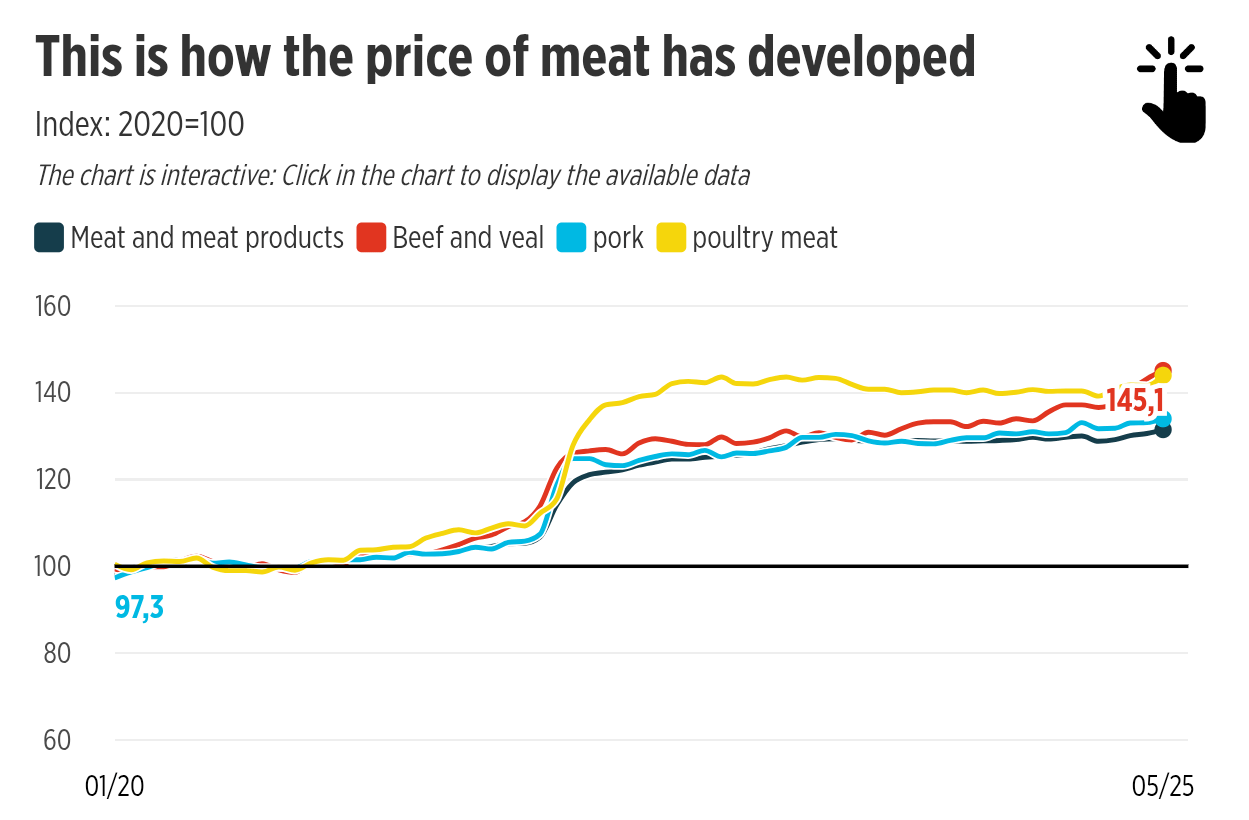
OK there's inflation, but no one's making 50% more? Data is for Germany, but this seems how be happening everywhere.
by Additional-Hour6038
30 Comments
mrmarti01
It’s painful to pay some of the prices for the smoke cuts. Short rib has gotten crazy high around the year.
crowbar032
This is US specific for beef. Multiple years of drought in cattle raising areas has shrunk the current herd to levels equal to about 1960. New World Screw worm being found in Mexican cattle has shut off any sizeable imports. Feed costs are down significantly from a few years ago so producers can hold cattle to get the highest price. All this translates to stockyards and packers paying ~$4.00 per pound live weight for ready to process cattle (for context say 5 years ago they were bringing $1.00 to $1.50 a pound). So far, demand for beef really hasn’t slowed down. Throw in corporate consolidation of meat producers and here we are at $75 steaks. As the owner of a small beef herd (20 cows), I love selling my calves right now.
SShiney
People need to understand, and it will be difficult for some, that the majority of our current debacle started back in the great recession but accelerated during covid, and it had NOTHING to do with whom was in office.
It’s from the debasement of the USD by the Fed & Treasury, which began in 1913, and then, the 1971 crux of removing the gold standard (sound money). Politicians WON’T balance the budget, not that they can’t.
“Covid” (not Trump, but Trump AND Biden), printed over 25% of the supply of currency and the USD is now heading into the top of a debt cycle where the interest on that debt consumes more than we can pay without drastic cuts to spending or an impending deflationary cycle.
There are a few tools left and we thought we were using them, but Congress will Congress, and people are greedy as fuck… so the can will be kicked at the expense of everyone who isn’t in the inner circles.
Invest in assets that keep up with Inflation + Debasement: Nasdaq (tech), Gold, Silver, BTC, Commodities, & Land. You need over 8% a year just to keep up.
And no, this isn’t just a USA thing… it’s a FIAT thing and its happened countless times throughout history… globally, across all nations, religions, ethnicities, and cultures…
displacedbitminer
Grocery stores have realized that the feds will just shrug no matter who’s in office, so they charge what they want, and increase prices how they want, disproportionate to what they’re getting charged for goods.
After all, shareholders are more important to companies than customers. The middle class is just a cash piñata, hit us harder and you get more money out of us.
There’s some other constraints, like drought and so forth, but the largest part of it is unchecked corporate greed.
Level21DungeonMaster
The hell kind of graph is this?
kalelopaka
Greed. The packers and retailers make the most profit. Most ranchers only get $1.80 to $1.87 per pound for their cattle, up from about $1.55 just a few years ago. So the math doesn’t work.
Worried-Criticism
You see, you have money. But large corporate entities that control our food supply, well they want it more. And since regulation of the meat industry is a self-policing joke, they will be taking that money now.
gerblnutz
Allowing your large meat packers to all consolidate under a couple large mega corporations with overlapping boards of directors tends to lead to price gouging and large scale market manipulation. Ask Teddy Roosevelt.
MarcusDeep
Eat the rich. It’s free meat!
georgedubaroo
Only having a start and end date should be criminal! There should be a subreddit for how bad that chart is 🤣
dewnmoutain
Well, i dont know. Germany is a whole different economy compared to america. So i would guess, covid, inflation, a national government that actively worked against farmers/meat producers.
S0M3D1CK
The war in Ukraine threw the grain market into uncertainty and jacked the price of feed.
Fair-Ad-7258
I work in the food industry., The beef cattle herd in the US is at an all time low. It takes 2-3 years to rebuild the herd, so lack of cattle higher prices. Beef packers are losing $200+ dollars for every animal they process. Packers can’t just stop processing they have labor contracts. Pricing will stay high this year and most of next year.
Three-Sheetz
Where I live in the U.S., chicken seems to be the same price as pre-COVID ($1.99 a pound boneless/skinless breast or thigh during periodic sales). Pork and beef seem to be roughly 25% higher
Tahmeed09
Not from the US- but it seems typical to blame the sitting US president for that big spike. Going on a lot now for today’s event. Looks around 2022
DAMAGEDprose
Greed.
brijamelsh
Since 2020, meat prices have increased steadily due to a combination of supply chain disruptions, rising input costs, environmental stressors, and broader economic conditions. One of the initial and most significant triggers was the COVID pandemic, which disrupted operations in meatpacking plants across the United States and globally. These shutdowns, driven by worker illnesses and safety concerns, drastically reduced processing capacity, leading to immediate supply shortages. Even after plants reopened, ongoing labor shortages continued to constrain output.
Simultaneously, farmers began reducing herd sizes. This contraction was influenced by multiple factors, including rising feed costs and prolonged droughts across key livestock regions like the American Southwest and Midwest. The lack of affordable and abundant feed, exacerbated by high prices for corn and soy, which are heavily affected by energy and fertilizer markets made it financially unfeasible for many producers to maintain large herds. As a result, the U.S. cattle inventory fell to its lowest levels since the early 1950s, reducing the future supply of beef and further driving up prices.
Feed prices themselves have been driven higher by global factors, including severe weather events (such as droughts, floods, and heatwaves) that disrupted crop production across the Americas, Europe, and parts of Asia. The Russian invasion of Ukraine added another layer of complexity, as it disrupted global exports of grain and fertilizer, making both scarcer and more expensive. These conditions affected meat production both directly and indirectly, as higher grain prices made livestock feed more costly.
Compounding the supply-side issues, the broader inflationary environment pushed up costs for fuel, labor, transportation, and packaging. Energy prices surged post-pandemic and due to geopolitical instability, raising the cost of refrigerated transport and processing operations. High interest rates also made it more expensive for farms and companies to borrow capital for expansion or reinvestment. Meanwhile, a more competitive labor market forced companies to raise wages in meatpacking and retail costs often passed on to consumers.
Technological and logistical vulnerabilities further worsened the situation. The 2021 ransomware attack on JBS, the world’s largest meat processing company, temporarily shut down a significant portion of global meat supply chains. This cyberattack underscored how dependent the meat industry is on a few centralized players. The high level of consolidation in the meatpacking sector means that any disruption has an outsized impact on pricing and availability.
On the trade front, some countries imposed tariffs or export restrictions on beef and other meats, contributing to price volatility. In the U.S., attempts to bolster domestic supply with less reliance on foreign imports sometimes resulted in higher retail prices due to more expensive local production costs.
Climate change has also emerged as a long-term driver, as frequent and severe weather disruptions have become more common. Water scarcity, heat stress on animals, and the decline of pasture quality are increasing the cost and complexity of raising livestock in many parts of the world.
In totality, meat price inflation since 2020 has not been the result of a single cause but rather a convergence of economic, environmental, logistical, and geopolitical forces. The result is a market where supply remains tight, costs remain high, and even as consumer demand softens in some areas, prices have remained elevated.
If measuring by peak prices and duration, the Biden administration has overseen the highest and most sustained increase in meat prices though largely due to inherited supply constraints, extreme weather, and global economic trends. If focusing on triggering disruptions, the Trump administration’s pandemic-era policies and trade conflicts were more responsible for initiating the supply chain instability.
Grimlite--
Now show the graph from 0
ldssggrdssgds
Greed is the only reason. Don’t know exactly who’s at fault but when the source is mostly controlled by Tyson then we can only blame them
Lopsided-Garlic1988
Massive culling due to fires in west Texas was the start of a lot of it, population sizes still haven’t recovered fully.
Top-Analysis971
I buy and sell fresh meat for a living.
The government affects inflation, thats the only real direct way they affect the cost of beef. That and grain subsidies.
Biggest actual problem is cattle supply. Corporate greed took over in 2020-2021 and the industry sold far more cattle than it should have and the supply of live animals simply hasn’t had a chance to recover since then.
Historically, the industry responds to this problem by holding back a larger % of the herd to use for breeding down the road. But cutting back the supply increases costs too so with prices being at all time inflated highs, no one had the guts to do it.
Now, we find ourselves in a bad spot. It takes 18 months for cattle to go from embryo to slaughter and it takes 3 years from embryo to breedable. So we’re constantly 18 months from having a chance at a larger herd and 3 years from an actual solution.
Worse yet is, farmers are struggling the same as everyone else to pay their bills and cant afford not to sell today, meaning there are even fewer cattle being held back for breeding down the road. As those farmers start failing, they’ll sell to corporations, further increasing the monopoly for the chance at maintaining supply.
Illustrious_Tear_529
Not exporting as much as before? Beef operating expenses rose? People might be cutting back.
DrunkGuy9million
If this is using 2020 indexed dollars, that means that this chart is ALREADY adjusted for inflation! So your meat actually rose 48% PLUS inflation. There appears to be some event near the end of 2021 that caused the vast majority of this increase. It doesn’t seem quite right timeline wise for a COVID thing. Perhaps some big policy or regulatory change?
Fit-One-6260
My beef prices are still going up 50 cents over the last month even though gas prices have dropped, wtf. As a carnivore, do I really need to buy a farm and a cow that grazes on FREE grass to save money?
CoolerCatThanYou
Honest answer? It’s a bubble. The meat industry is corrupt and has been artificially inflating prices for years.
Jimmydo6969
It has become exspensive because we keep buying it.
Yardbirdburb
It hasn’t become “more expensive”, your USD is worth LESS
RehabilitatedAsshole
The real reason? Climate change = more droughts = less grazing = buying more feed, combined with the inflation of feed cost. It’s the new normal and will continue getting worse.
Pork and chicken are still very cheap in the US if you buy on sale. Less than 3 dollars a pound. Beef had gotten quite expensive but we still got NY strip , an expensive cut, on sale last week for 6.99 a pound.
Sad-Warning-3187
6 months ago I could purchase a beef strip loin for around 130 bucks now the same strip loin cost around 230 dollars.

30 Comments
It’s painful to pay some of the prices for the smoke cuts. Short rib has gotten crazy high around the year.
This is US specific for beef. Multiple years of drought in cattle raising areas has shrunk the current herd to levels equal to about 1960. New World Screw worm being found in Mexican cattle has shut off any sizeable imports. Feed costs are down significantly from a few years ago so producers can hold cattle to get the highest price. All this translates to stockyards and packers paying ~$4.00 per pound live weight for ready to process cattle (for context say 5 years ago they were bringing $1.00 to $1.50 a pound). So far, demand for beef really hasn’t slowed down. Throw in corporate consolidation of meat producers and here we are at $75 steaks. As the owner of a small beef herd (20 cows), I love selling my calves right now.
People need to understand, and it will be difficult for some, that the majority of our current debacle started back in the great recession but accelerated during covid, and it had NOTHING to do with whom was in office.
It’s from the debasement of the USD by the Fed & Treasury, which began in 1913, and then, the 1971 crux of removing the gold standard (sound money). Politicians WON’T balance the budget, not that they can’t.
“Covid” (not Trump, but Trump AND Biden), printed over 25% of the supply of currency and the USD is now heading into the top of a debt cycle where the interest on that debt consumes more than we can pay without drastic cuts to spending or an impending deflationary cycle.
There are a few tools left and we thought we were using them, but Congress will Congress, and people are greedy as fuck… so the can will be kicked at the expense of everyone who isn’t in the inner circles.
Invest in assets that keep up with Inflation + Debasement: Nasdaq (tech), Gold, Silver, BTC, Commodities, & Land. You need over 8% a year just to keep up.
And no, this isn’t just a USA thing… it’s a FIAT thing and its happened countless times throughout history… globally, across all nations, religions, ethnicities, and cultures…
Grocery stores have realized that the feds will just shrug no matter who’s in office, so they charge what they want, and increase prices how they want, disproportionate to what they’re getting charged for goods.
After all, shareholders are more important to companies than customers. The middle class is just a cash piñata, hit us harder and you get more money out of us.
There’s some other constraints, like drought and so forth, but the largest part of it is unchecked corporate greed.
The hell kind of graph is this?
Greed. The packers and retailers make the most profit. Most ranchers only get $1.80 to $1.87 per pound for their cattle, up from about $1.55 just a few years ago. So the math doesn’t work.
You see, you have money. But large corporate entities that control our food supply, well they want it more. And since regulation of the meat industry is a self-policing joke, they will be taking that money now.
Allowing your large meat packers to all consolidate under a couple large mega corporations with overlapping boards of directors tends to lead to price gouging and large scale market manipulation. Ask Teddy Roosevelt.
Eat the rich. It’s free meat!
Only having a start and end date should be criminal! There should be a subreddit for how bad that chart is 🤣
Well, i dont know. Germany is a whole different economy compared to america. So i would guess, covid, inflation, a national government that actively worked against farmers/meat producers.
The war in Ukraine threw the grain market into uncertainty and jacked the price of feed.
I work in the food industry.,
The beef cattle herd in the US is at an all time low. It takes 2-3 years to rebuild the herd, so lack of cattle higher prices. Beef packers are losing $200+ dollars for every animal they process. Packers can’t just stop processing they have labor contracts. Pricing will stay high this year and most of next year.
Where I live in the U.S., chicken seems to be the same price as pre-COVID ($1.99 a pound boneless/skinless breast or thigh during periodic sales). Pork and beef seem to be roughly 25% higher
Not from the US- but it seems typical to blame the sitting US president for that big spike. Going on a lot now for today’s event. Looks around 2022
Greed.
Since 2020, meat prices have increased steadily due to a combination of supply chain disruptions, rising input costs, environmental stressors, and broader economic conditions. One of the initial and most significant triggers was the COVID pandemic, which disrupted operations in meatpacking plants across the United States and globally. These shutdowns, driven by worker illnesses and safety concerns, drastically reduced processing capacity, leading to immediate supply shortages. Even after plants reopened, ongoing labor shortages continued to constrain output.
Simultaneously, farmers began reducing herd sizes. This contraction was influenced by multiple factors, including rising feed costs and prolonged droughts across key livestock regions like the American Southwest and Midwest. The lack of affordable and abundant feed, exacerbated by high prices for corn and soy, which are heavily affected by energy and fertilizer markets made it financially unfeasible for many producers to maintain large herds. As a result, the U.S. cattle inventory fell to its lowest levels since the early 1950s, reducing the future supply of beef and further driving up prices.
Feed prices themselves have been driven higher by global factors, including severe weather events (such as droughts, floods, and heatwaves) that disrupted crop production across the Americas, Europe, and parts of Asia. The Russian invasion of Ukraine added another layer of complexity, as it disrupted global exports of grain and fertilizer, making both scarcer and more expensive. These conditions affected meat production both directly and indirectly, as higher grain prices made livestock feed more costly.
Compounding the supply-side issues, the broader inflationary environment pushed up costs for fuel, labor, transportation, and packaging. Energy prices surged post-pandemic and due to geopolitical instability, raising the cost of refrigerated transport and processing operations. High interest rates also made it more expensive for farms and companies to borrow capital for expansion or reinvestment. Meanwhile, a more competitive labor market forced companies to raise wages in meatpacking and retail costs often passed on to consumers.
Technological and logistical vulnerabilities further worsened the situation. The 2021 ransomware attack on JBS, the world’s largest meat processing company, temporarily shut down a significant portion of global meat supply chains. This cyberattack underscored how dependent the meat industry is on a few centralized players. The high level of consolidation in the meatpacking sector means that any disruption has an outsized impact on pricing and availability.
On the trade front, some countries imposed tariffs or export restrictions on beef and other meats, contributing to price volatility. In the U.S., attempts to bolster domestic supply with less reliance on foreign imports sometimes resulted in higher retail prices due to more expensive local production costs.
Climate change has also emerged as a long-term driver, as frequent and severe weather disruptions have become more common. Water scarcity, heat stress on animals, and the decline of pasture quality are increasing the cost and complexity of raising livestock in many parts of the world.
In totality, meat price inflation since 2020 has not been the result of a single cause but rather a convergence of economic, environmental, logistical, and geopolitical forces. The result is a market where supply remains tight, costs remain high, and even as consumer demand softens in some areas, prices have remained elevated.
If measuring by peak prices and duration, the Biden administration has overseen the highest and most sustained increase in meat prices though largely due to inherited supply constraints, extreme weather, and global economic trends. If focusing on triggering disruptions, the Trump administration’s pandemic-era policies and trade conflicts were more responsible for initiating the supply chain instability.
Now show the graph from 0
Greed is the only reason. Don’t know exactly who’s at fault but when the source is mostly controlled by Tyson then we can only blame them
Massive culling due to fires in west Texas was the start of a lot of it, population sizes still haven’t recovered fully.
I buy and sell fresh meat for a living.
The government affects inflation, thats the only real direct way they affect the cost of beef. That and grain subsidies.
Biggest actual problem is cattle supply. Corporate greed took over in 2020-2021 and the industry sold far more cattle than it should have and the supply of live animals simply hasn’t had a chance to recover since then.
Historically, the industry responds to this problem by holding back a larger % of the herd to use for breeding down the road. But cutting back the supply increases costs too so with prices being at all time inflated highs, no one had the guts to do it.
Now, we find ourselves in a bad spot. It takes 18 months for cattle to go from embryo to slaughter and it takes 3 years from embryo to breedable. So we’re constantly 18 months from having a chance at a larger herd and 3 years from an actual solution.
Worse yet is, farmers are struggling the same as everyone else to pay their bills and cant afford not to sell today, meaning there are even fewer cattle being held back for breeding down the road. As those farmers start failing, they’ll sell to corporations, further increasing the monopoly for the chance at maintaining supply.
Not exporting as much as before? Beef operating expenses rose? People might be cutting back.
If this is using 2020 indexed dollars, that means that this chart is ALREADY adjusted for inflation! So your meat actually rose 48% PLUS inflation. There appears to be some event near the end of 2021 that caused the vast majority of this increase. It doesn’t seem quite right timeline wise for a COVID thing. Perhaps some big policy or regulatory change?
My beef prices are still going up 50 cents over the last month even though gas prices have dropped, wtf. As a carnivore, do I really need to buy a farm and a cow that grazes on FREE grass to save money?
Honest answer? It’s a bubble. The meat industry is corrupt and has been artificially inflating prices for years.
It has become exspensive because we keep buying it.
It hasn’t become “more expensive”, your USD is worth LESS
The real reason? Climate change = more droughts = less grazing = buying more feed, combined with the inflation of feed cost. It’s the new normal and will continue getting worse.
https://www.cbsnews.com/news/u-s-beef-prices-record-highs-cattle-industry-struggles-to-keep-costs-down/
Pork and chicken are still very cheap in the US if you buy on sale. Less than 3 dollars a pound. Beef had gotten quite expensive but we still got NY strip , an expensive cut, on sale last week for 6.99 a pound.
6 months ago I could purchase a beef strip loin for around 130 bucks now the same strip loin cost around 230 dollars.