

Updated July 9, 2022, first published July 9, 2022
Save
You have reached your maximum number of saved items.
Remove items from your saved list to add more.
Save this article for later
Add articles to your saved list and come back to them anytime.
Got it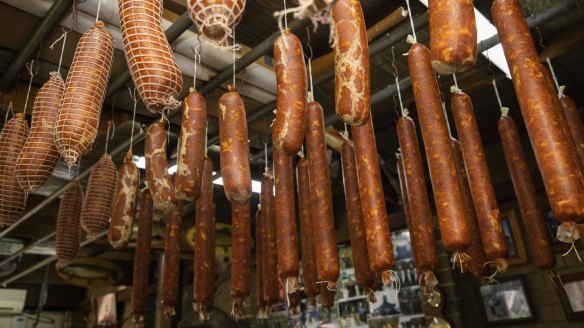 Salami is coloured deep red by pepperoni sauce made in summer.Paul Jeffers
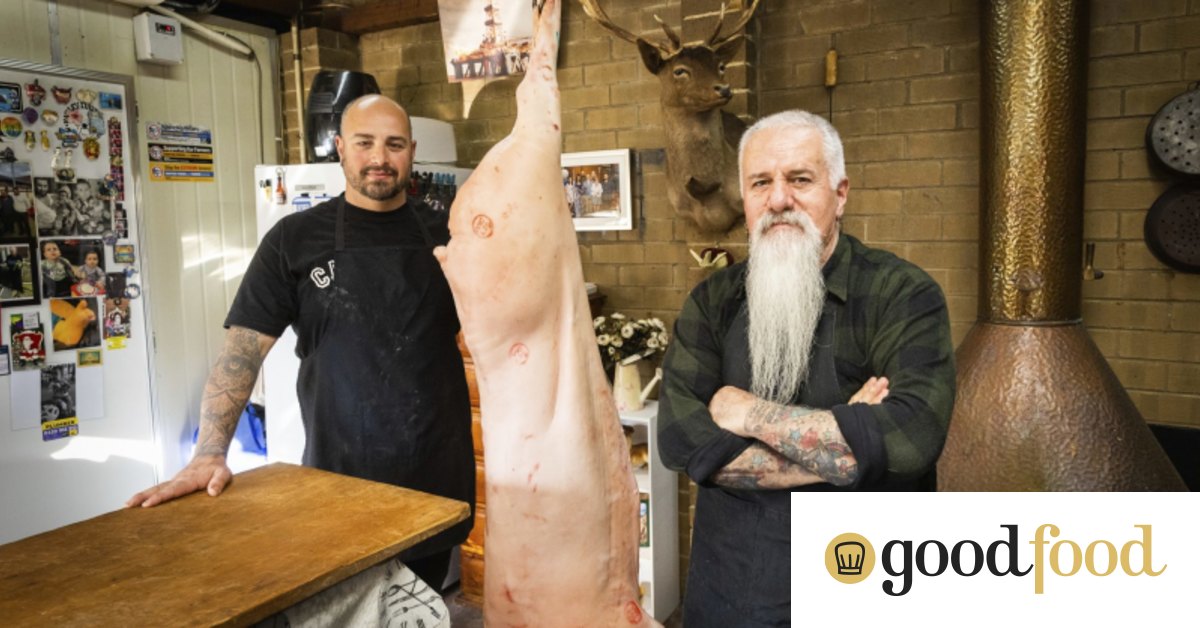
In garages and backyard sheds across Victoria, families are gathering to turn whole pigs into sausages and smallgoods.
Every year, the cold weather heralds the start of the season when immigrant families, mostly Italian, observe their culinary traditions of preparing and preserving meat for the lean winter months. “It was all we had to eat during winter back home,” says Antonio Bonacci of Lalor.
Bonacci immigrated from the Decollatura region of Calabria in 1970, aged 11. Now, from the ceiling of his backyard shed, he hangs salami coloured deep red by the pepperoni sauce his family made in summer.
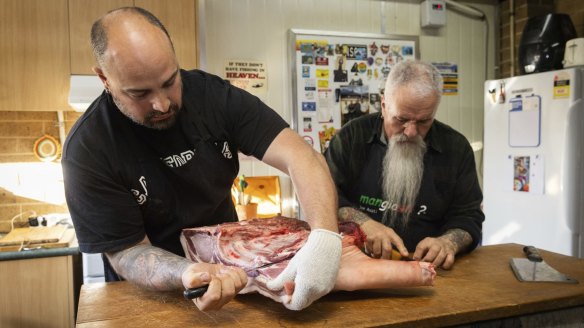 The pig is sliced, minced, salted and stuffed into casings to make fresh and cured sausages.Paul Jeffers
The shed is heated by a log fire. “You need to control the temperature and humidity as the salami begins to ferment,” he says. “On cold days I make a little fire. It also gives the salami a touch of smoke.”
Speaking to The Age, Bonacci is surrounded by his adult children and nephew. They have just spent the morning breaking down a whole free-range pig to make smallgoods.
“From the neck comes capocollo,” says Antonio. “The loin makes lombo, the belly becomes pancetta and the hind leg will be prosciutto.”
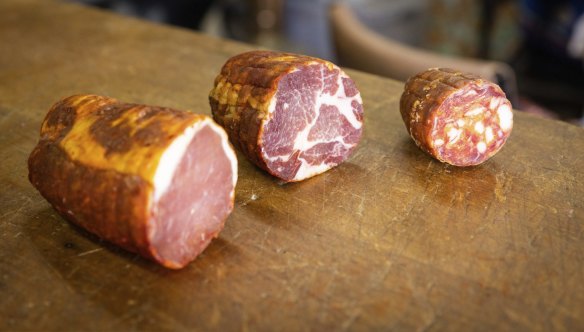 Smallgoods made in the Bonacci family back shed.Paul Jeffers
The rest of the pig is sliced, minced, salted and stuffed into casings to make fresh and cured sausages. On the stove sits a pot of bones and skin cooking in tomato sauce. This is sugo for the pasta to be served at lunchtime when Bonacci’s brothers arrive to make more sausages.
Bonacci’s nephew, Victor Bonacci, is a retail butcher. “It’s not just the wogs who are doing this,” he says. “Every year I get more and more Anglos coming in buying pigs so they can do the Italian thing in their backyard.”
His uncle replies, “In Italy tradition is not what it used to be. When we go back home we see fewer young ones who are making the [smallgoods].”
Italian restaurateur Guy Grossi says Melbourne is a bastion of traditional Italian culture.
“We have a beautiful culture that arrived in the mid 20th century with those immigrants. We call those Italians the Melbournese,” he says.
“They still collect the tomatoes in the summer to make passata [tomato sauce]. They make funghi sott’olio [mushrooms under oil] in autumn and giardiniera [pickled vegetables].
“You barely see that in the Italian cities, not like here in Melbourne where it is thriving.”
Despite staff shortages at his Bourke Street restaurants Florentino and Ombra, Grossi has ordered his own whole pig to spend a day making sausages and smallgoods with his family.
“We are practising culinary rituals that were commonplace for most families for my parents’ generation back in Italy. We are lucky to retain those skills.”
Descendants of Italian-speaking immigrants who came from the Swiss canton of Ticino during the gold rush are continuing a tradition that is 160 years old. Families have been gathering in sheds around Daylesford and Yandoit to make a spicy beef and pork sausage called The Bull Boar this winter.
“There is a heady infusion of garlic, spices and red wine as family and friend groups gather to make the sausages,” says Daylesford chef Gary Thomas, whose family descends from Swiss-Italians.
“Their original recipe evolved into a beef and pork sausage of which there are more than 35 different family recipes, many of which are still made every year to this day.
“Back in the old days, Bull Boar sausages would be air dried. Now we have refrigeration. But people come together to make the Bull Boars. We cook them, we eat them and drink wine. It’s simple fun.”
Restaurant reviews, news and the hottest openings served to your inbox.
Sign upSave
You have reached your maximum number of saved items.
Remove items from your saved list to add more.
From our partners