
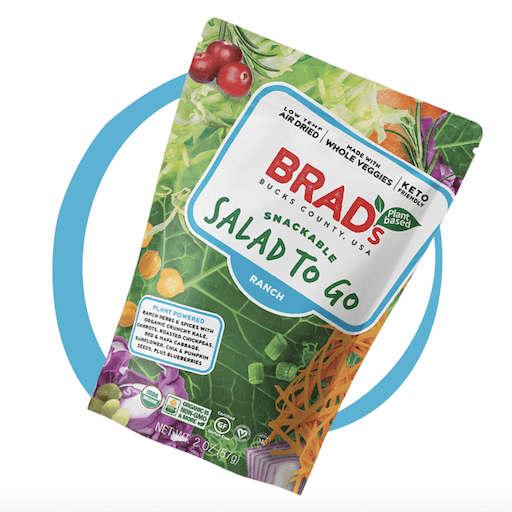
I contacted the customer service of bradsplantbased.com asking if I could see a report regarding the lead and cadmium levels in their products as per the Proposition 65 warning. They responded:
"At this time, we are unable to share the detailed report, but please rest assured that our products meet all safety standards."
So then I asked if they could just share the specific amounts in the "Salad Snack" and "Crunchy Kale" products, as those are what I eat often, to which they responded:
"The specific test results are handled by our quality and compliance team, and due to internal privacy protocols, they’re not shared outside of that department. However, please rest assured that all of our products undergo rigorous safety testing and fully comply with regulatory standards. There is no health risk from normal consumption. To give you perspective, the trace amounts potentially present are so low that you would need to consume an extremely large quantity—something like 10,000 bags per day—for there to be any concern."
Should I take their word for it? I just don't know why the report is being kept secret if it's a negligible amount. Is anyone able to find further info on the specific products I'm enquiring about?
by aryanmsh
2 Comments
Kale is a potent bioaccumulator and is well known to contain high levels of lead and cadmium-this is actually a problem with most brassica crops. A recent study found high levels of PFAS in 7/8 samples of kale as well-we’re talking Organic kale here-likely to to historic application of sewage sludge. Basically, any land that has had sewage sludge applied at any time in its history is essentially contaminated forever, and a bioaccumulator like Kale is just going to show the highest levels of contamination. You can find studies on these topics in Pubmed.
Any Proposition 65 warning is pretty much just a “cover your a**” technicality to deal with California law. I wouldn’t worry about Brad’s specifically. The law does not specify limits, so .0000000000001 ppm of lead would be a violation.
If you are really concerned about heavy metal contamination, filter your water as best as possible, don’t eat seafood, try to eat less processed versions of food; less processing = less contaminants.