
Author links open overlay panelLourdes Chávez-Alfaro a, Carmen Tenorio Jiménez b, Víctor Silveira-Sanguino a †, María José Noguera Gómez c, Concepción Fernández-Moreno c, Ana María Rodríguez Cuesta c, Antonio F. Lebrón Arana c, Óscar Segura Calvo c, Ignacio Merino De Haro d, Concepción M. Aguilera a e f, Carolina Gómez-Llorente a e f, Óscar Daniel Rangel-Huerta g, Nerys Astbury h, Aurora Pérez-Cornago i, Marta Guasch-Ferre j, Carmen Piernas a e hShow morehttps://doi.org/10.1016/j.nutres.2025.03.001Get rights and contentHighlights•
The CADIMED intervention targets red/processed meat to lower cardiovascular disease risk (CVD).
•
The trial uses metabolomics to assess dietary compliance and health outcomes.
•
CADIMED explores dietary impacts on microbiome and metabolic markers linked to CVD risk.
•
Baseline data show low Mediterranean diet adherence and high red/processed meat intakes.
•
Findings aim to guide scalable, low-cost dietary interventions for dyslipidemia.
•
Study addresses sustainable dietary practices by reducing red/processed meat intake.
Abstract
Effective interventions targeting modifiable cardiovascular disease (CVD) risk factors, such as diet, are urgently needed. The Cardiovascular Risk Prevention with a Mediterranean Dietary Pattern Reduced in Saturated Fat study hypothesizes that eliminating red and processed meat in the context of a Mediterranean diet (MD) will significantly modify circulating low-density lipoprotein cholesterol concentration and the fatty acid profile compared to general CVD prevention advice. Here we describe the intervention design and summarize baseline dietary intakes (mean ± standard deviation) related to MD adherence and red/processed meat intakes in a sample of 81 participants. The Cardiovascular Risk Prevention with a Mediterranean Dietary Pattern Reduced in Saturated Fat study is a two-arm, 8-week parallel randomized controlled intervention trial involving a final sample of 156 adults (≥18 years) with dyslipidemia (not undergoing pharmacological treatment) recruited from healthcare and community settings in Granada (Spain). The primary outcome will assess changes in circulating low-density lipoprotein cholesterol and the fatty acid profile, whilst secondary outcomes will measure changes in CVD-related metabolites/biomarkers, gut microbiome, diet/lifestyle, and intervention feasibility/acceptability. Preliminary findings indicate low MD adherence (Mediterranean Diet Adherence Screener score 7.6 ± 1.9), and high consumption of red and processed meat (1.04 ± 0.90) servings/d). These results underscore the need for targeted dietary interventions to address the growing burden of dyslipidemia and CVD. If successful, this intervention holds potential for scalability and significant impact on public health, dietary guidelines, and advancements in nutrition science by improving MD adherence and reducing CVD risk factors in adults with dyslipidemia.
Graphical abstractCADIMED tests an 8-week Mediterranean diet excluding red/processed meat for CVD prevention. The study’s primary outcome is to assess changes in circulating LDL-C and fatty acid profile, alongside improving lipid profiles and reducing CVD risk through cost-effective dietary advice. Baseline data highlight low adherence to the MD and high red/processed meat consumption. CVD, cardiovascular disease; LDL-C, low-density lipoprotein cholesterol; MD, Mediterranean diet.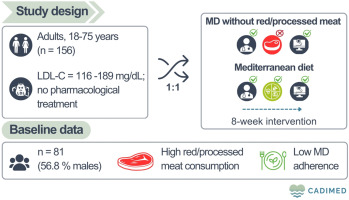 Download: Download high-res image (204KB)Download: Download full-size imageKeywords
Cardiovascular disease
Mediterranean diet
Saturated fat
LDL cholesterol
Red meat
Fatty acids
AbbreviationsCVD
cardiovascular disease
CADIMED
Cardiovascular Risk Prevention with a Mediterranean Dietary Pattern Reduced in Saturated Fat
FFQ
food frequency questionnaire
LDL-C
low-density lipoprotein cholesterol
MEDAS
Mediterranean Diet Adherence Screener
Recommended articles
© 2025 The Authors. Published by Elsevier Inc.