
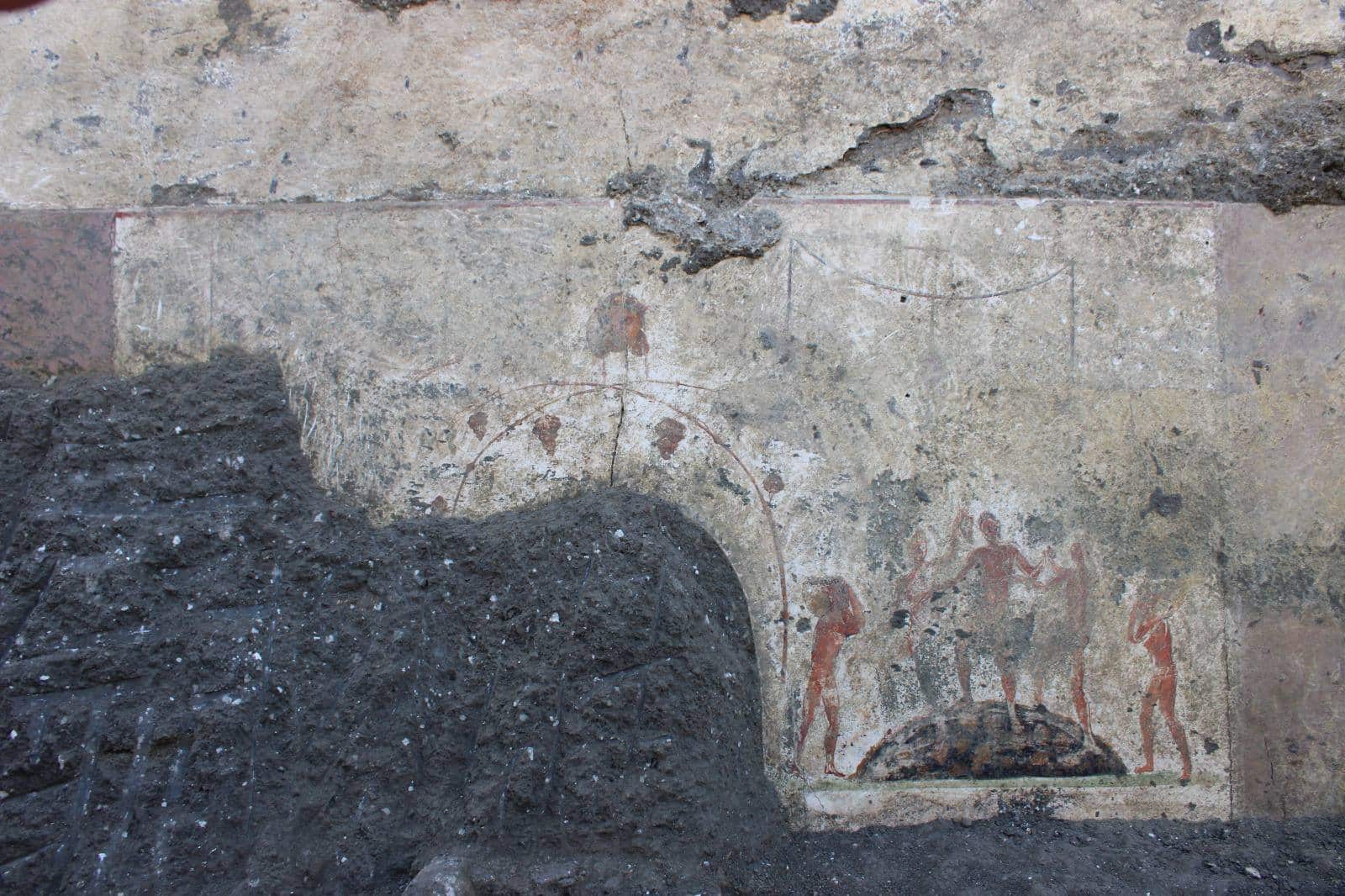
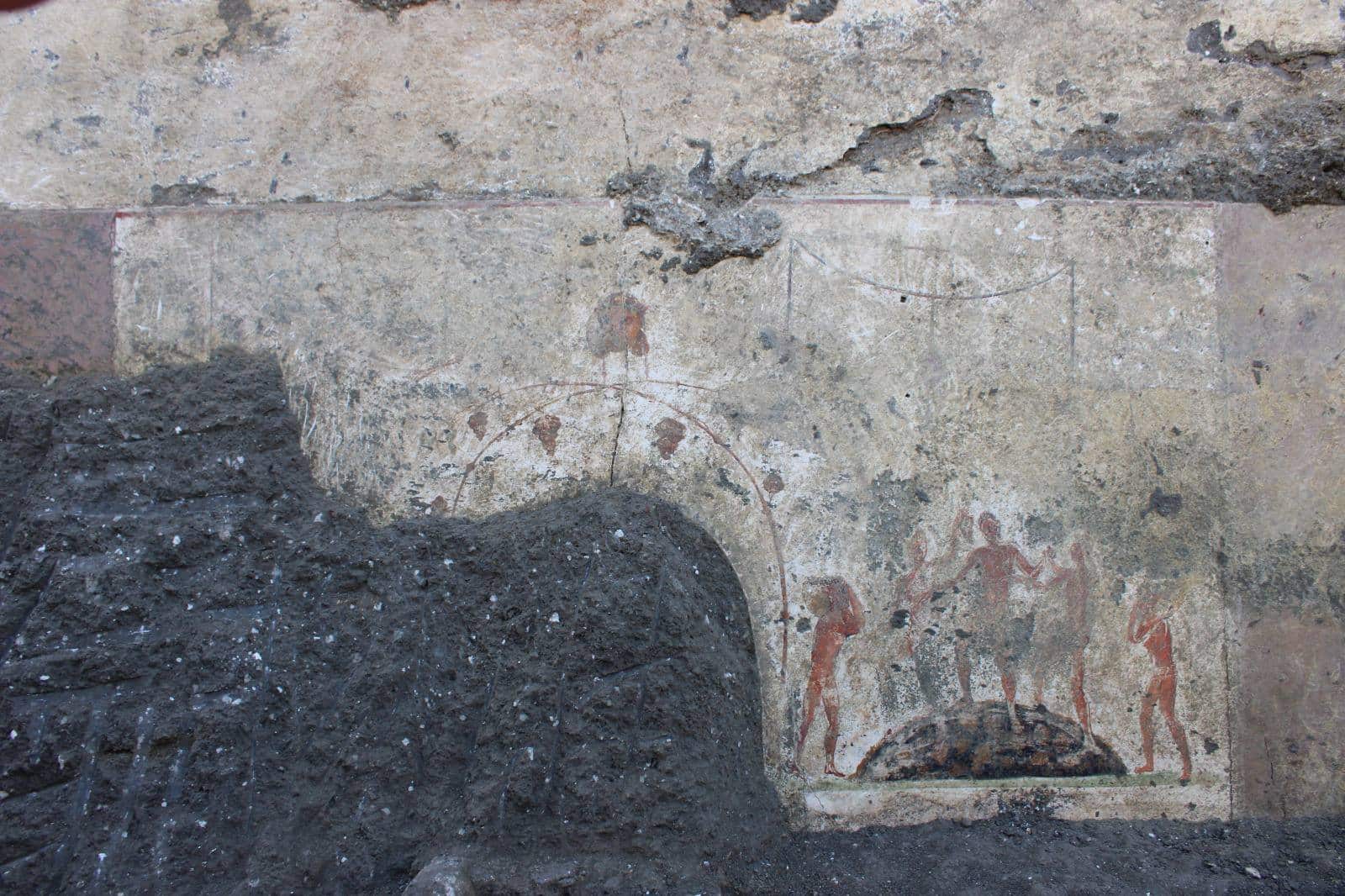
Grape harvest paintings uncovered in Villa Cuomo, southeast of Pompeii. Credit: ABAP Superintendence for the Metropolitan Area of Naples
Archaeologists continue to uncover the secrets of Villa Cuomo, an ancient rural complex located in Sant’Antonio Abate, near Naples, Italy, where remarkable paintings of wine harvesting have been discovered. Buried under three meters of lapilli during the catastrophic eruption of Mount Vesuvius in 79 A.D., this site, first excavated in 1974, offers fresh insight into Roman agricultural life.
Villa Cuomo was a working estate, unlike the lavish villas of Pompeii and Herculaneum. Its service rooms were arranged around a courtyard with unplastered brick columns. The complex played a key role in Roman agricultural production, a function reinforced by recent discoveries.
Ancient paintings depict wine harvesting rituals in Italy
Excavations have revealed striking frescoes depicting grape harvesting scenes, reinforcing the villa’s connection to wine production and the cult of Dionysus, known as Bacchus in Roman mythology.
The paintings illustrate agricultural techniques and the ritualistic nature of winemaking, a process deeply intertwined with Roman religious and social traditions.
The grape harvest was more than labor; it was a communal celebration of abundance dedicated to Bacchus.
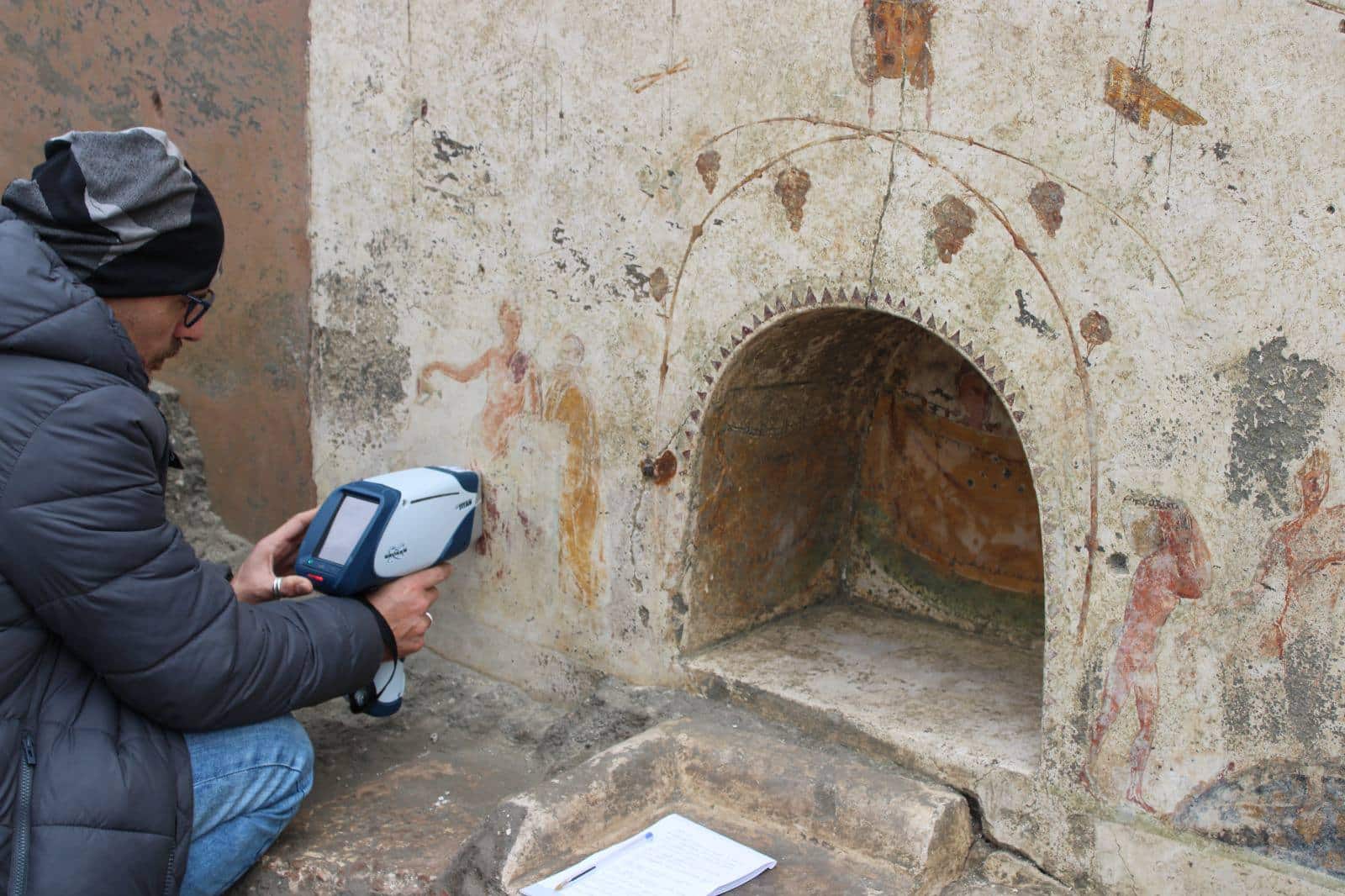
Archaeologists uncover grape harvest scenes in newly found frescoes at Villa Cuomo. Credit: ABAP Superintendence for the Metropolitan Area of Naples
To ensure the preservation of these rare murals, a team led by Dr. Davide Melica, an expert in restoration and conservation, has launched a series of diagnostic studies. The project employs non-invasive techniques and laboratory analysis to assess the frescoes’ condition and determine the best restoration approach.
Identify ancient pigments using x-ray fluorescence (XRF)
One key technique, X-ray fluorescence (XRF) spectrophotometry, has been used to identify the chemical composition of the paintings’ pigments. The results will shed light on Roman artists’ materials and techniques, aiding conservation efforts and historical understanding.
These analyses will guide the restoration and enhance our knowledge of ancient Roman artistry.
“Activities by the doctor Davide Melica from ‘Diagnostics for Restoration and Conservation’ provide for non-invasive on-site investigations and laboratory analysis of samples taken of minimum sizes.”
“The first investigation performed was XRF Spectrophotometry for the elementary analysis of the chemical elements that make up the painting film,” wrote ABAP Superintendence for the Metropolitan Area of Naples in a post on Facebook.
The restoration of Villa Cuomo represents a significant step in protecting and showcasing the region’s historical heritage. Local officials emphasize the importance of this discovery in re-evaluating the cultural identity of the Naples metropolitan area.
Authorities and experts work together to ensure that Villa Cuomo becomes an accessible cultural landmark. The site will offer visitors a glimpse into the daily lives of ancient Romans, highlighting the enduring connection between land, labor, and tradition.
With ongoing preservation efforts, Villa Cuomo is a testament to the intricate relationship between ancient agriculture, religion, and art.
Dining and Cooking