
To truly bring a restaurant’s spirit to life, sometimes it’s necessary to call upon the root of its inspiration. For designer Sherri Duvall’s latest commission — Ava June, a modern French brasserie that opened in May on Cherry Street — she drew from a trip to Paris last fall, absorbing the atmosphere of the city’s lively bistros.
Duvall, of Duvall Atelier, is the creative force behind many of Tulsa’s most distinctively stylistic restaurants, including Noche Woodfired Grill, Mr. Kim’s and Bull in the Alley. She approaches all her restaurant commissions as if the design is just as much on the menu as the food.
“Once I know what genre and style (the clients) desire, I dive into that lane and try to immerse myself in creating a space that does not look like anything else in the city. So it not only achieves the clients’ goals, but gives future customers an immersive escape,” Duvall says.

Bull in the Alley
Courtesy
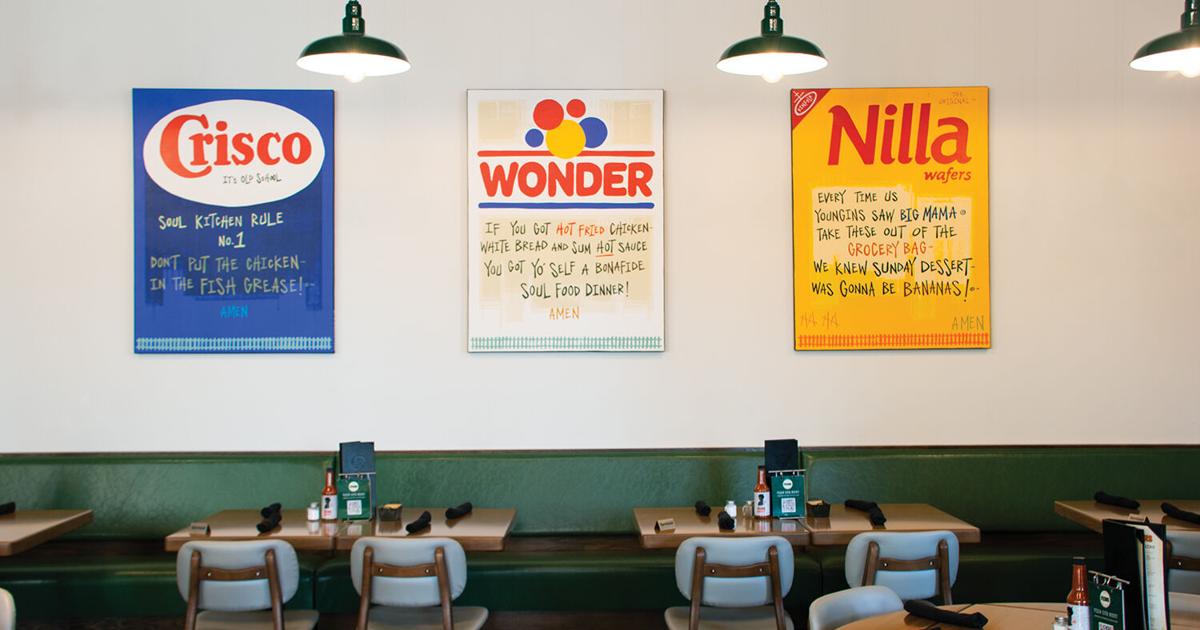
While Duvall often draws from personal experience and history, other designers start with different anchors. For Megan Chinowth, a principal and interior designer with GH2 Architects, she says the design process all starts with a story, feeling or location the restaurant would like to replicate and have the guest experience. For some restaurants, the story will be built around a focal point, like the bar. For others, it’s another aspect, such as the artwork found throughout the dining room of Fixins Soul Kitchen.
“It all starts with a really cool idea, but then you have to think about how it holds up to the end user. How will they use the furniture? Will it stand up to frequent cleaning?” she says.
The designer’s role is also to help set the owner up for success, Chinowth says. Her firm has guided out-of-town restaurateurs in adapting to the local market, like sometimes swapping communal tables for two- and four-tops to better align with smaller-market preferences.
“It can be a mindset change,” she says.
Designing a restaurant is also a labor-intensive process, typically taking six months for the design phase before the plans are ready for contractor bids. Many projects are remodels, with Duvall sharing that only about 30% start with a blank slate.
However, one recent addition to Tulsa’s dining scene, Maestro, a cocktail bar in downtown’s Santa Fe Square, did have a blank slate, as it opened in a new development. GH2 Architects worked with Tulsa-based interior designer Kate Wallace-Helm of Wallace-Helm Studio to bring the upscale, adult-only vibes to life. The space features custom lighting and layered, angled brick walls — an intricate design that, as Chinowth puts it, “appears effortless.”
Dining and Cooking