
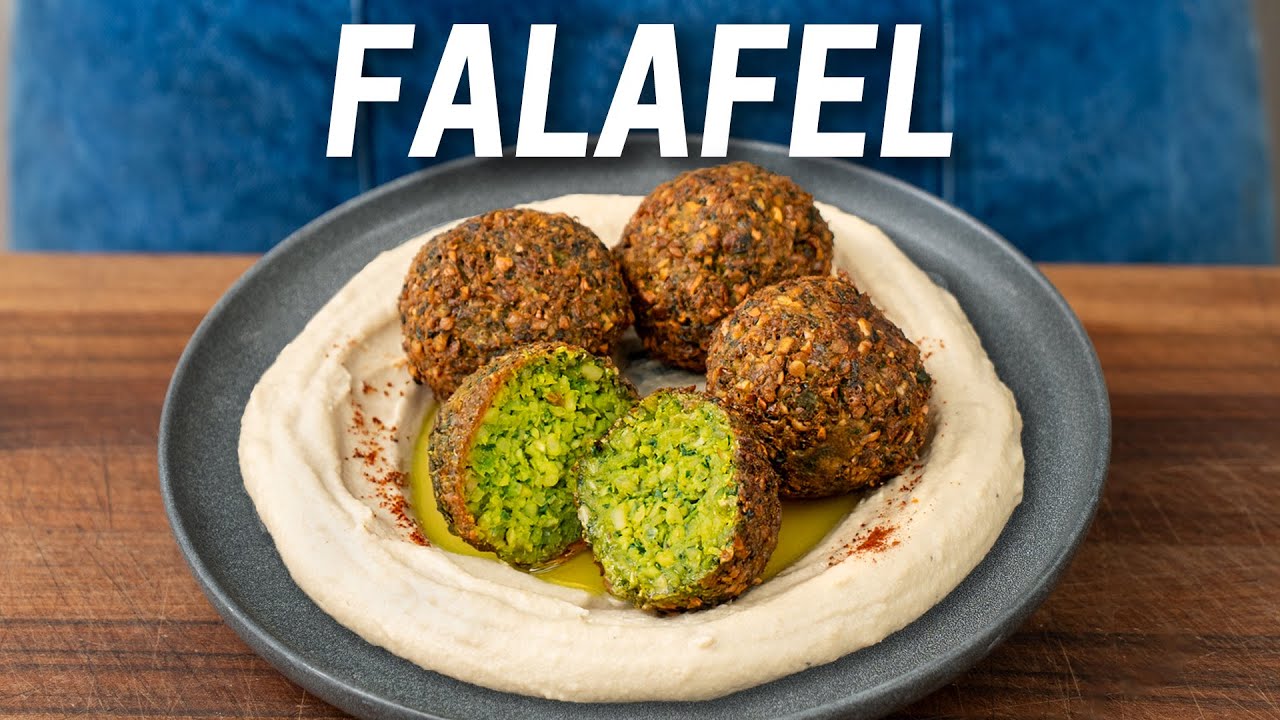
Use these techniques for my best falafel. It’s crispy outside, fluffy and flavorful inside. Use BRIAN25 at checkout for 25% off your first month of @seed’s DS-01® Daily Synbiotic at https://seed.com/daily-synbiotic?utm_source=ambassador&utm_medium=youtube&utm_campaign=brianlagerstrom&utm_term=25p&promo_code=BRIAN25
▶️WATCH NEXT:
SMOOTH HUMMUS & EASY PITA: https://youtu.be/1fiFBTW6vSc?si=CwOG3WIgbYlJ317A
☕Like this content and want to show support? Buy me a “coffee” here: https://ko-fi.com/brianlagerstrom
📸INSTAGRAM: https://www.instagram.com/brian_lagerstrom
🔪MY GEAR:
FOOD PROCESSOR: https://amzn.to/4m0YryK
CUTTING BOARD: https://amzn.to/341OgnD
HALF SHEET PAN: https://amzn.to/41SQxy1
HALF SHEET WIRE RACK: https://amzn.to/41tasDT
IMMERSION BLENDER: https://amzn.to/466T3o3
DUTCH OVEN: https://amzn.to/3SB4DAV
SPIDER SKIMMER: https://amzn.to/4p52SLE
FAVORITE STAINLESS BOWL: https://amzn.to/3pTBCTo
AMAZON STORE: https://www.amazon.com/shop/brianlagerstrom
**As an Amazon Associate I earn from qualifying purchases**
Falafel with Tahini Sauce
Falafel:
∙225g (½lb) dried chickpeas
∙1000g/mL (4–5c) water (for soaking)
∙100g (1 medium) red onion, chopped
∙10g (2 cloves) garlic
∙25g (1 small) jalapeño, chopped
∙12g (2t) salt
∙5g (2t) ground cumin
∙2g (1t) ground coriander
∙2g (1t) ground turmeric
∙25g (½c) parsley, stems removed
∙25g (½c) cilantro, stems ok
∙2–3L (2–3qt) high smoke point oil (peanut, canola, grapeseed, etc, for frying)
Tahini Sauce:
∙150g (2/3c) tahini paste (pourable style)
∙20g (1½T) lemon juice
∙3–4g (¾t) salt
∙1 small garlic clove, chopped
∙100–130g (½–⅔c) water, as needed
Instructions
1. Soak chickpeas:
Add dried chickpeas to 1000g water. Soak overnight. Drain well in a colander for 5–10 min before processing.
– Speed-soak option: Boil 1L water, add chickpeas + 10g baking soda, cover, and place in 180°F/80°C oven for 90 min. Drain well.
2. Process chickpeas:
Transfer drained beans to a food processor. Pulse 25–30 times, scraping sides halfway. Aim for a texture like finely chopped garlic.
3. Make herb paste:
In the processor, combine onion, garlic, jalapeño, salt, cumin, coriander, turmeric, parsley, and cilantro. Blend 1 min into a smooth herb paste.
4. Combine:
Stir herb paste into chickpeas. Test mixture by squeezing—should hold together. If crumbly, pulse slightly more. Chill mix 30 min.
5. Form falafel:
Scoop 40g portions (about 15–17 pieces). Press gently between palms until compact balls form.
6. Fry:
Heat 2–3L oil in a heavy pot to 350°F/175°C, about 2″ deep (never more than ½ way up your fry pot). Fry falafel in batches of 8 depending on size pot, carefully lowering into oil. Don’t disturb for 2 min, then agitate/turn gently. Fry 6–7 min total, until deep reddish-golden brown. Drain on wire rack.
7. Tahini sauce:
In a tall container, combine tahini, lemon juice, salt, and garlic. Blend with immersion blender until thick. Slowly stream in 100–130g water until smooth and pourable. Adjust with more water or lemon as needed.
Chapters:
0:00 Soaking/prepping the chickpeas
2:56 Making the falafel mix
4:04 Forming the falafel balls & prepping the oil
6:25 Making the Tahini Sauce
7:08 Frying the falafel
🎧MUSIC:
EPIDEMIC SOUND https://www.epidemicsound.com/referral/ccpjb3
#falafel
Most of the falafel that people make at home sucks. It’s dry. It’s bland. It’s crumbly. And it’s not even close to what you would get at a Middle Eastern restaurant or from a street cart. So, to help you guys avoid falafel disaster. That’s not what you’re looking for. In this video, I’m going to show you my well- tested recipe for what I think is truly great falafel. It’s shatteringly crisp on the outside, super tender and fluffy on the inside, and the whole thing is packed with fresh herbs and spices, so it’s flavorful as hell. M, it’s so green. To get started, I’ll pour 225 g of dried chickpeas into a high-sided container. Then, I’ll add in about 1,000 g of water, or one quart, and I’ll soak them for at least 12 hours, but preferably 24 hours. The next day, you can see that these are plumped up and they’re looking a little bit softer, but crucially, they’re still dry enough to grind down into a coarse mix that’s going to bind together and hold its shape when deep fried. By the way, if you’re a scrub and forgot to soak your beans, you can still play along. Here’s the speedrun version. Start by adding 225 g of dried chickpeas into boiling water with 10 g of baking soda. Then, kill the heat, slap on a lid, and toss the pot into a 180 oven for 90 minutes. In my experience, these beans work pretty well and make falafel that’s almost as good as the main character beans. The only downside is that you don’t have perfect moisture control with this process. And sometimes the chickpeas end up a little bit too soft. If this happens, you can always add a couple of tablespoons of chickpea flour to the falafel mix. Next, I’m going to pour these soaked chickpeas into a colander and then let them drain for 1 to two minutes. Once drained, I’ll move these beans over to a food processor, then pulse them about 25 to 30 times. It’s really hard to give you an exact number here because every food chopper is different, but I’m going to show you the exact texture that we’re looking for, and you can eyeball your way there. After about 12 pulses or so, I’ll come back and scrape down the sides to avoid having marblesized beans in my falafel. Next, I’ll keep pulsing until these chickpeas are chopped into a texture that closely resembles chopped garlic. This is the crux of this entire recipe. If you get the chickpea size correct, you are most likely going to have tender, moist falafel with a crispy exterior. The flavor part comes in a second, but by far the biggest predictor of textural success is particle size. If you over chop these beans, you’re going to end up with two problems. Number one, the texture is going to be pasty and the interior is going to be simultaneously dry and mushy. And number two, you lose most of the crispiness because things are so smooth and homogeneous. On the other hand, the falafel balls made with the chopped garlic- sized beans have a lot of these little craggy bits on the outside that crisp up super nicely. If you under chop your beans like this, well, sometimes you can actually get away with it, but most of the time overly coarse falafel mix just falls apart in the fryer. Just for good measure, here’s one more shot of what properly chopped garbanzos look like. If you get your beans close to this, you’ve got a good opportunity to make S tier falafel. Next, I’ll move these chopped beans over to a mixing bowl. Then, I’ll spin up the flavorful part for that. Into the same jar, I’ll add 100 g of red onion, 10 g of garlic, and 25 g of jalapeno. By the way, I chopped these down first so that they spin up a little bit easier. Then 12 g of salt, 5 g cumin, 2 g coriander, 2 g turmeric, 25 g of parsley, stems removed, and 25 g of cilantro stems. Okay. From here, I’ll just spin the food chopper for about a minute or so, or until the aromatics are well broken down. Unlike the beans, you can get away with a variety of different textures here, but I prefer a smooth herb paste because I think that makes the greenest, prettiest falafel. Now, the herb paste goes into the bowl with the chopped garbanzos. And then I’ll just stir until everything is combined. A quick litmus test that I like to do once mixed to determine if the mixture has enough moisture to stay together is squeeze it tightly in my hand. It should come together and stay together. If yours is too crumbly at this point, throw the whole thing back into the food chopper and spin it for another 10 to 15 seconds until it can hold its shape. From here, I’m going to move this falafel mix over to the fridge to sit for 30 minutes. This helps the falafel mix stay together later on even better because it soaks up some of the excess juice from the fresh herbs and aromatics. 30 minutes later, I’m going to snag this mix out of the fridge and ball it up. At this point, I know the beans have absorbed the perfect amount of liquid when it no longer looks wet in the bowl. But when I give it a firm squeeze, a lot of herby juice comes out. This means that all the flavorful juices are inside of the beans and not sitting on the outside. Next, I’ll divide this mix into 15 to 17 balls that are roughly 40 gram each. Or you can eyeball it if you’re not a nerd like me. Now, to turn this mix into balls, I’m just going to flip it into my palms and pass it back and forth while giving it a gentle but firm squeeze to compact it. And then I’ll round it off. Once these little rascals are rolled up, it’s time to fry them. But first, I’m going to thank Seed for sponsoring this vid and keeping my gastrointestinal system humming throughout this entire beanheavy process. When you cook food professionally, whether it’s in a restaurant or here on Food Tube, the thing that people don’t talk a lot about is that you end up eating all of the delicious food that you’re cooking. And over time, you kind of develop a acrimonious relationship with your gastrointestinal tract. That gut distress is what led me to taking Seeds DS1 well before they started sponsoring the channel. And I’ve stuck with it over the years because I found that it really makes a difference. Look, I’m not a science guy. Like, I do recipes and grams, but that doesn’t really mean that I’m smart. But the science stuff that I have learned from Seed has been pretty compelling. According to Seed, a lot of probiotics don’t even survive in your stomach acid. Seeds DSO1, on the other hand, is built with a capsule incapsule design that is capable of delivering 24 clinically studied strains, plus a prebiotic safely down to your colon. DSO1 is formulated to reduce bloating and make poops easier in about 2 weeks. My bathroom trips went from being D or even F tier to A or S if I’m lucky. Oh, gross. This is a food video. Don’t act like you don’t do poop, too. So, if you guys want to give DSo1 a shot right now, SE is going to give you guys 25% off your first month of DS1 with my code Brian 25. If you want to try it, I’ll leave a link down in the description. To set up my fry pot, I’m going to grab a large heavy bottom pot and drop it over medium heat. Then, I’ll add in about a quart or 2 in worth of high smoke point oil. I like peanut, but whatever oil you use, never fill your frying vessel higher than halfway up. This is a precautionary measure that leaves plenty of room for hot oil to bubble up, and it should keep it safely contained away from your body. While that heats up, I quickly want to make a super creamy tahini sauce to serve on top of these balls. First in is going to be 150 g of tahini paste. Make sure that it’s pourable. If it’s overly thick, it’s going to give you a really hard time. Then 20 g of lemon juice, 3 to 4 g of salt, and then I’ll take one little garlic clove and chop it into about four pieces so that it’s easier to spin down into a sauce. Then I’ll drop that in, grab my immersion blender, and spin this until the tahini starts to thicken, which will be almost immediately. Then I’ll stream in about 100 to 130 grams of water. And that’s it. This is one of my all-time favorite sauces because it’s simple, fast, flavorful, and extremely versatile. Aside from falafel or Middle Eastern food, I use it as salad dressing. I put it on roasted vegetables, and I love to eat it with grilled meats like steak. Okay, back at the fry pot. I’ll check my oil temperature real quick. And yeah, it’s in the ballpark of about 350, which is perfect. Next, I’m going to carefully drop in my falafel balls away from my body with a slotted spoon, one at a time. I’m being really careful and deliberate when I do this because deep frying is not zero risk. And these balls are pretty fragile. I’m also making sure to drop them into their own little areas of the oil. And I’m frying in two eightpiece batches so that the balls don’t touch. All of this should ensure that the balls stay intact and fry up really cleanly. And after 2 minutes of not touching, they’ve developed enough of a crust for me to come back and agitate them a little bit. This keeps them from being stuck to the bottom of the pot or to each other, and it keeps the parts of the ball that are facing down from getting too dark. From here, I’m going to fry this for another 3ish minutes, which makes the whole fry time about 6 to 7 in total. Then, when they’re looking nice and crusty, I’m going to move them over to a wire rack so that they can cool without steaming, and it also helps drain off any excessive oil. The final color here should be darker than you think, like almost a reddish golden brown. And there should be no visible green on the outside. That’s a sign that your balls are going to be a little bit undercooked in the middle. Now, to finish this process, I’m going to go back to the oil and carefully drop in the other half of my balls and fry them for about 6 to 7 more minutes. And once they’re deeply crisped up and dark golden brown, I’m going to move these over to a wire rack. To serve, I’m going to pile up and hit with a generous squeezer of my creamy tahini sauce. And that, my friends, is the best falafel that I’ve ever made and probably the best that I’ve ever had. [Music] My gosh, there’s this perfect crunchy shell around the outside that is shatteringly crisp. It’s so interesting. Every once in a while, you get these little tastes of caramelized onion and roasted garlic from the bits that got deep fried on the outside. And then, of course, throughout the entire experience, you’re getting this fresh, juicy herbage kind of punching you right in the face. It’s divine. If you want to check out a video where I show you my well- tested recipes for pa and hummus, I’ll link to that video right here. See you there.
50 Comments
Another rad demo, thanks, one of the best sandwiches in the world 🤜🏻⚡️🤛🏻
BUT THE BALLS HAVE TO TOUCH!!!!!!
Please taste on video
These look great- thankyou!
Any tips on how to safely deal with that oil afterwards? I.e. how do you get it out of that pan once cool, into what, and do you store it for reuse or throw it away? (If re-using, how do you know when it is “overused”?) Asking you specifically rather than doing my own research because YOU ARE THE BEST!
I wish you would address your previous falafel recipe and explain how this is an improvement. I made that before and it was good. What sets these apart?
My daughter who tried to be vegan when she was younger took me to a vegan restaurant and I had never tried falafel before and omg I fell in love.
Very anxious to try this. I'd never heard of falafel until I visited the middle east and tried it there. I really developed a liking for it and was shocked when I had some back home that was NOT made by a middle easterner. Didn't measure up at all. This stuff looks like the real deal!!
Balls.
It sucks because there is no meat involved
Looks good! In Israel, we add a little old bread for binding and seseme. Also a little baking soda, so they are light.
Other than Tahini the best sauce for falafel is called Amba.
For those of us that can't eat cilantro, is there a good substitute or is the only option to omit?
I love my falafel with amba sauce
Great video bro!
Real nice and detailed. A trick I learned from one of the best kebab shops in Berlin, is to have the falafel mixture in a container, frozen, and use a dedicated ice cream scoop tool to make the balls. Perfect size, and much better results when deep frying!
These are going to be addictive! Thanks so much for your in-depth tutorial, Bri. It's always my secret to success😘
One of my all time favorite foods. And thanks for the tahini sauce recipe, btw.
Balls
I love that your recipe is gluten free. We don’t need no bulgar wheat ruining the party.
Everywhere you use water, you should be using stock.
If I lived in NYC, I'd have thought your NY pizza video was nice but less useful because why not just go down the block to get a slice. But I don't live there, I live in a place where falafel is available just down the street, crispy balls with hummus, tehini and fresh salad inside of a soft and warm pita. Sorry, Bri, for me the juice isn't worth the squeeze on this one.
I use a 2oz ice cream scooper to shape my Fals ❤
Hands down one of the best chefs on YouTube. Thank you for all the in-depth explanations and quality recipes. I’ve made your galette recipe multiple times for my family and they love it.
I only tasted falafel once and found it tolerable but not particularly good, bland and crumbly as you described. Maybe I should try this version instead, at least it will probably taste much more. Is ok to use cannec chickpeas or do they have to be dried?
white t shirt jumpscare
A traditionally vegan recipe, the best kind! So glad to have your version with all the helpfull tips! thank you!
I don’t make falafel, but I’ve been making lemon-tahini sauce for YEARS. Every single time I make it, I can’t believe how delicious it is, and how the sum of the parts so exceed the parts themselves. HINT: a little bit of very good olive oil makes it even more complex, and gives it a silky mouth feel.
It’s easier to run the chic peas through a meat grinder attachment along with all the aromatics at the same time, then season mix w spices and baking powder to lighten the mix
Look at that, Teri – the way they glisten.
You should post "The Speedy Version" as a separate video! I Know You Know Why!
Get a falafel scoop, bro. I thought it was frivolous but it makes the process even more enjoyable.
But you used chickpeas that Israel/Lebanon/Syria etc. instead of broad beans that Egyptians use. Egyptian falafel is the best by far. Add whole coriander and fennel seeds and it takes it up a notch.
DO NOT ADD FLOUR IF YOU FIND YOUR MIXTURE IS TOO WET! You'll end up with a floury taste. Good idea to add ground chickpea flour instead. Purists will say to use the garbanzo bean flour from white chickpeas, and not the brown ones from besan that Indian food uses.
Starting with dried chickpeas is key. The texture is different than canned. Canned are best for hummus. Dried are best for falafel.
Lovely video, full of good information. Would you say that the texture is like bulgur or medium couscous? Chopped garlic is the size I chop it to, so not a real benchmark.
Don’t be such a judgmental SOB , saying all the home made falafels suck. Wait till you taste mine… hate your arrogance
"avoid awful falafel" There, I fixed it for you. Solid video, not bad recipe. Lacking in seasonings, a bit gentrified.
Mine is currently in the fridge for the 30 min. The mixture seems loose to me and the herb mixture was nowhere close to as liquid as yours. If the balls don’t hold together well can use an egg for a binder?
I was excited to start this video….but then I saw….cilantro? I hate it and have never tasted it in a restaurant falafel.
Love the white t-shirt look Bry
Impossible challange: don't laugh when Bman keeps mentioning BALLS.
"100 grams" of onion helps nobody. Onions don't come in grams. They come in onions. Measuring onions in grams might be good advice for professional cooks, but not for home cooks.
Free Palestine
your flafel sucks, it is disgusting and ugly as it is vegetable mix.
B A L L S
1000 grams or a quart OR A FREAKING LITER!?!?!? CMON!
There's poop talk on my YouTube… YouTube Poop.
he said balls lmao
How's your cultural appropriation going whitey?
The old format is back! 🙂❤️
YAY!
Made this today and I have used a gram scale for the wet ingredients and it seems the quantity is not right, I had to add water to make the mixture stick, it seems that the gram amounts are not right for the parsley and cilantro