
India is drinking up. Wine imports surged more than 50% in the first half of 2025, defying the global downturn. What’s fueling the boom — and who’s buying?
India’s wine imports surged in the first half of the year, according to the country’s official data, making one of the few bright spots in the global market weighed down by sluggish demand. The growth, industry experts say, reflects the expanding presence of imported wines in retail and hospitality, and the appetite of young consumers who are embracing wine more actively than their peers in Western markets.
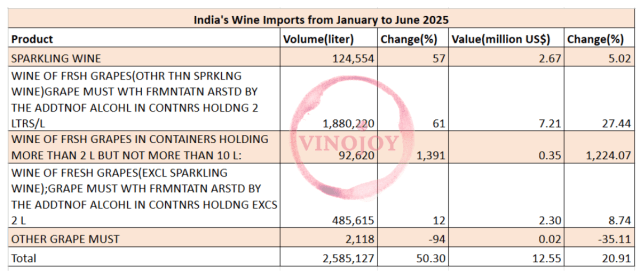
According to data released by India’s Ministry of Commerce and compiled by Vino Joy News, between January and June, India imported 2,585,127 litres of wine valued at US$12.55 million, representing year-on-year growth of 50.30% in volume and 20.91% in value.
Bottled wine in containers of two litres or less, which dominates India’s trade, drove the surge. Imports of this category rose 61% in volume to 1.88 million litres, with value up 27.44% to US$7.21 million. Sparkling wine showed a mixed trend — volume climbed 57%, but value grew only 5.02%, suggesting inflows of lower-priced bottles.
Boxed wine (2–10 litres) recorded explosive growth, with volume up 1,391% and value rising 1,224%.
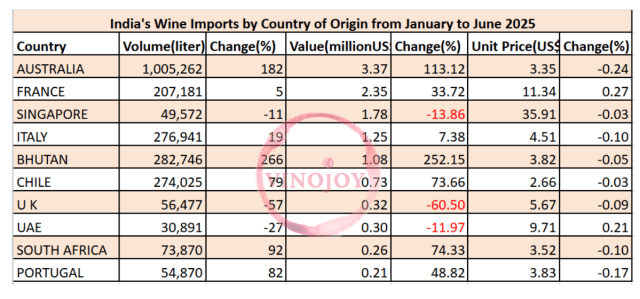
In terms of country of origin, Australia emerged as India’s top supplier, benefiting from proximity and a free-trade agreement. Imports reached 1,005,262 litres, accounting for 38.89% of total volume, but just 26.85% of value at US$3.37 million, reflecting its relatively low average price of US$3.35 per litre.
France ranked second by value thanks to its premium positioning, with an average price of US$11.34 per litre. Singapore’s even higher average price of US$35.91 per litre suggests much of its trade consists of re-exported fine wines.
Seven of India’s top ten supplier countries recorded growth, with Australia’s performance especially notable: volumes surged 182% and value climbed 113.12%, a standout amid global declines. Bhutan also entered the top five — not as a wine producer, but mainly as a re-export hub.
Market on the Ground
For those on the ground, the boom is already visible.
“We’re seeing many more imported SKUs listed with key distributors and modern retail, stronger hotel and restaurant wine lists, and much higher inbound interest from producers,” said Rajeev Naresh, Project Director of ProWine Mumbai. “Independent trackers also show India as a bright spot for beverage alcohol growth, with premiumisation and wider availability of imports as the main drivers.”
Naresh added that discovery often happens in premium venues. “For many consumers, their first experience with wine is by the glass in a hotel or restaurant. Curated wine lists and immersive experiences are what bring them in — especially in Mumbai, Delhi NCR, and Bengaluru.”
Wine in India is still overwhelmingly sold through offline channels: licensed liquor shops, supermarkets, and specialist retailers. Euromonitor and IWSR both identify off-trade as the largest segment in this young but fast-growing market.
Online channels remain fragmented. A few states, such as Maharashtra, West Bengal, and Odisha, allow limited home delivery via platforms like Swiggy or BigBasket. Other states are experimenting with pilot programs, but the lack of a national framework means alcohol e-commerce remains inconsistent and uncertain. “Because alcohol is regulated state-by-state, online access remains patchy and subject to change. In other words, it’s an evolving space, but not yet a mainstream channel,” he explained.
Who Is Drinking?
Unlike in Western markets, where younger consumers are drinking less, India’s youth are embracing wine. In big cities like Mumbai, Bengaluru, and Delhi NCR, younger legal drinkers are trading up, showing a clear preference for premium imports and international styles.
Professionals and internationally exposed groups, especially in technology, consulting, hospitality, and tourism, are also key consumers. “In Bengaluru and Mumbai, these groups have both disposable income and international exposure, making them more inclined to explore high-end imports and sparkling wines,” Naresh said.
Women are another growing demographic. “An encouraging trend is the increasing number of women choosing wine. Alongside that, we’re also seeing more first-time buyers, helped by rising awareness, education, and access,” he added.
“An encouraging trend is the increasing number of women choosing wine. Alongside that, we’re also seeing more first-time buyers, helped by rising awareness, education, and access.”
Rajeev Naresh, Project Director of ProWine Mumbai
Opportunities and Challenges


With a population of over 1.4 billion and GDP growth of 6.5% in 2024, India’s scale supports rising wine demand. Yet its per capita GDP of US$2,696.66 means consumption remains skewed toward entry- and mid-tier wines. That explains why import volumes are growing much faster than value, and why average prices remain low compared with other markets.
Taxes remain the biggest barrier. India imposes a 150% federal import duty on wine, with states levying additional local taxes. Earlier this year, the EU began negotiations with India to reduce duties to facilitate smoother trade.
Volatility is another factor. As previously reported, India’s imports of Spanish wine skyrocketed 30,017.77% in 2023, briefly making Spain its largest supplier, only to collapse 99.74% in 2024. By mid-2025, Spain had fallen to 14th place.
“By global standards, India is still a small wine market, but the growth trajectory is real,” Naresh admitted. Rising disposable income, expanding retail and hospitality, and gradual regulatory reforms are expected to propel growth in the near term.
The Role of ProWine Mumbai
For overseas wineries, the greatest challenge is finding the right partners in India’s fragmented, highly regulated market. This, Naresh said, is where ProWine Mumbai delivers value.
Mumbai remains the country’s import hub, home to the largest concentration of distributors and decision-makers. In just two days, exhibitors can reach the entire value chain — importers, wholesalers, retail buyers, hospitality procurement, duty-free channels, and even sommeliers and bartenders who shape consumer perceptions.
“We work with excise authorities to allow tastings without requiring label registration, and we provide logistics support so that samples reach the floor hassle-free,” Naresh explained. “That makes ProWine Mumbai a practical entry point for both international brands and Indian producers from outside Maharashtra.”
The fair also doubles as an education and marketing platform. Through masterclasses and competitions, it helps build consumer awareness in a market where advertising restrictions remain strict.
“What sets ProWine Mumbai apart is its breadth,” Naresh concluded. “We’re not just about wine. Spirits, beer, craft beverages, and low/no-alcohol categories are also represented. That makes the show relevant to the entire alcobev ecosystem. And being part of the global ProWein World network gives it credibility and reach while staying rooted in the realities of India’s market.”
Like this:
Like Loading…
Discover more from Vino Joy News
Subscribe to get the latest posts sent to your email.
Continue Reading
Dining and Cooking