
About 500 years ago, on September 20, 1519, five large sailboats and 270 sturdy sailors set out on a voyage that will later become historic in the southwestern Spanish port city of Sanlucar de Barrameda.
The names of each vessel were Trinidad, San Antonio, Concepcion, Victoria, and Santiago. As if he was prepared for a long voyage, he was loaded with grains and dried fish, dried fruits and meat, cheese, biscuits, and other navigational groceries at the time.
[Voiceover] Right, this is the Magellanic Fleet’s expedition that was the first human to travel around the world. The ships return to Sanlukar on September 6, 1522, about three years (2 years, 11 months and 17 days to be exact). There was only one Victoria left from five ships, and the number of 270 sailors was reduced to 18.
Even Magellan himself, the commander-in-chief of the fleet, was killed in the Mactan War in Cebu, Philippines, but their voyage marked a milestone in human history. This is because it was the first time in mankind to directly prove the claim that ‘the earth is a sphere, and if it continues in one direction, it will return to square one,’ which existed only theoretically.
What’s interesting is that according to some records written at the time, Magellan spent a large portion of his donation on wine in preparation for the expedition. Is it because there was no sobriety on the sea? Or maybe Magellan was a great drinker?
Today, Wine Frick explores why Magellan procured so much wine 506 years ago on an expedition to the unknown.
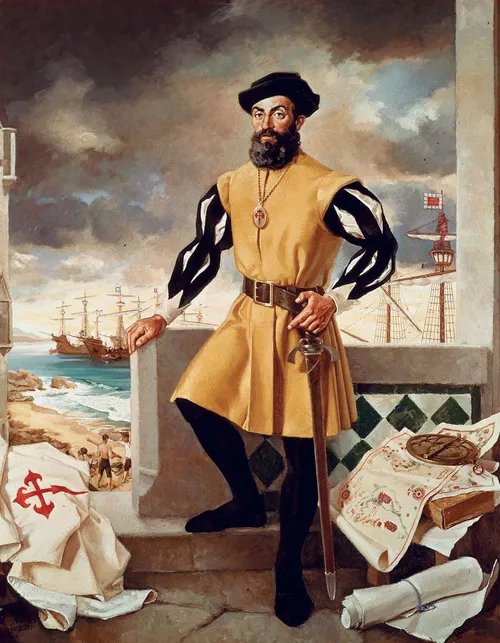 사진 확대 Portrait of Ferdinand Magellan
Twenty percent of the expedition budget was spent on wine
First, let’s see how much wine Magellan prepared? Records show Magellan bought wine at random from wineries in the Andalusia Herrez region in southwestern Spain.
It is said that the sheep was no less than 203 large oak barrels called butts and 417 leather units. Butt is about 500 liters of oak now, and the leather units made from the skins of goats and sheep ranged from as little as 20 liters to as much as 50 liters.
According to Document 17, written by Navarrete, a researcher and sailor who participated in the expedition, five ships carried a total of 233,000 liters of wine, including Pipe (another oak barrel similar to Bert) and Cask (a smaller oak barrel of around 225 liters).
Some researchers believe that Magellan’s money to buy wine at the time amounted to $475,665 (about 670 million won in won) in today’s value. And Navarette recorded that Magellan spent more than 20% of his total spending on wine.
So much wine may seem like a strange choice to take on an unexpected expedition to the unknown, but Magellan was not unusual. This is because it was natural to load large amounts of wine among adventurers navigating the sea at the time.
Christopher Columbus, who discovered the New World, is also said to have loaded his ship with sherry from Heres, the very region. The Phoenician, who was one of the leading merchants, navigators, and shipbuilding experts in the ancient Mediterranean world, also traveled through the sea with wine and sherry. So why on earth were the explorers so full of wine?
![A view of a ship in the Age of Discovery carrying cargo of wine barrels. A digital reconstruction of the shipwrecked Newport Ship off the south coast of Wales around the 15th century. [Source = Newport Museum and Cultural Heritage Service]](https://www.diningandcooking.com/wp-content/uploads/2025/09/news-p.v1.20250915.536d0c554a5f4a518df2ea058acf20a9_P1.jpg) 사진 확대 A view of a ship in the Age of Discovery carrying cargo of wine barrels. A digital reconstruction of the shipwrecked Newport Ship off the south coast of Wales around the 15th century. [Source = Newport Museum and Cultural Heritage Service]
사진 확대 A view of a ship in the Age of Discovery carrying cargo of wine barrels. A digital reconstruction of the shipwrecked Newport Ship off the south coast of Wales around the 15th century. [Source = Newport Museum and Cultural Heritage Service]
Wine, not just a favorite, but a survival necessity
The main reason is that wine was distributed to the sailors at the time, not the preference it is now. Because freshwater was easily spoiled and hygiene problems were huge, wine, which was a fermented drink for expeditions who had to prepare for long voyages, was recognized as a survival necessity.
In fact, there is a record that about a liter of wine was distributed to one sailor a day on the Magellan expedition. The tradition of distributing wine to seafarers was common in most countries, and this tradition is maintained until the 18th century.
However, the UK, where wine production was impossible, was a little different. By the late 16th century, the Royal Navy had rationed four liters of ale (a type of beer) instead of wine, an expensive import. In the second half of the 17th century, even this was replaced by rum, a liquor made by distilling sugarcane that was reduced in quantity and increased in frequency.
The researchers also focus on Magellan’s heavy presence of wine, particularly from the Herez region. This is because sherry was the main wine produced in the region, except for the geographical advantage that Sanlukar and Herez are adjacent and the most accessible wine suppliers.
![Spain's Sherry Production Area Map. The southernmost part is marked Herez and Cádiz. It is where Magellan set sail and Sherry's main producer. [출처=winefolly.com]](https://www.diningandcooking.com/wp-content/uploads/2025/09/news-p.v1.20250915.c19496976ed14111b9ae2061cf2b0e47_P1.png) 사진 확대 Spain’s Sherry Production Area Map. The southernmost part is marked Herez and Cádiz. It is where Magellan set sail and Sherry’s main producer. [출처=winefolly.com]
사진 확대 Spain’s Sherry Production Area Map. The southernmost part is marked Herez and Cádiz. It is where Magellan set sail and Sherry’s main producer. [출처=winefolly.com]
Sherry, a fortified wine, had a much lower risk of rancidity and decomposition than regular wines because of its high frequency. Furthermore, as it was rich in sugar and alcohol, it was comparable to being a short-term source of energy and energy for men who worked rough seas.
In addition to this, Sherry was also a trade item that the Spanish fleet, which was expanding around the world at the time, frequently used in exchanges with other civilizations for the first time. It’s a method that’s also used in modern times. Is there another way to get to know each other by meeting someone you don’t know well and having a drink together.
The strategy was to taste sherry first with favor and then sell it as a trade item later, but it worked pretty well. At the end of the 16th century, Francis Drake of England stormed the port of Cádiz in Spain and brought 3,000 barrels of Herez Sherry to Britain as spoils, which also led to the Sherry pandemic in England.
Indeed, as trade with Spain and the Americas began to revitalize in earnest across the Atlantic, sherry in the Herez region of Spain was exported as a major trade for a long time along the “Magellan Route” from Mexico as well as Peru to the Philippines.
![Magellan's round-the-world route was marked on the Mercador map. [Source = Encyclopedia Britannica]](https://www.diningandcooking.com/wp-content/uploads/2025/09/news-p.v1.20250915.9266e6984c554644ab388a47078c03ab_P1.jpg) 사진 확대 Magellan’s round-the-world route was marked on the Mercador map. [Source = Encyclopedia Britannica]
사진 확대 Magellan’s round-the-world route was marked on the Mercador map. [Source = Encyclopedia Britannica]
Sherry, another wine with strong liquor
In fact, the name Sherry itself is an English expression of Herez. The brand “Vino de Jerez (Herez’s Wine),” which was given by Britons who did not know Spanish well, was finally called “Her-rez,” and finally called “Sherries” after passing through Jerres and Sherries.
At this point, you’ll be curious about the taste of sherry. Sherry is a traditional Spanish wine with a similar manufacturing method to Portugal’s Port, which falls into the same liquor reinforcement category.
However, unlike pot wine, which kills yeast by adding brandy in the middle of aging, it is generally dry rather than sweet because it strengthens alcohol by adding brandy after aging. Thanks to this, drinkers who don’t like sweet drinks enjoy it.
It is divided into Fino, Oloroso, Amontilado, etc. Unlike Porth, Pinot strengthens alcohol to the point where yeast does not die, so the key is to survive and form a film called Flor. Thanks to this membrane, the wine is not oxidized and maintains its freshness.
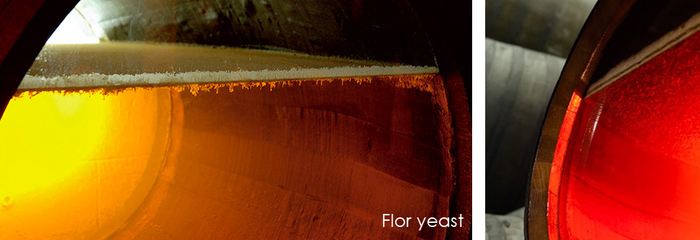 사진 확대 an example of a flor.
Oloso raises its alcohol content to 17 to 18%, which is higher than that of Fino, and the yeast is killed so that flor does not form. Thanks to this, wine and air come into direct contact, and a heavy nut-like flavor is raised through oxidation aging.
Amontiyado is a 6- to 7-year long-term aging of pinot, where flor dies naturally due to increased alcohol content and decreased sugar, and after that, oxidative aging begins, allowing for a moderate flavor between oloroso and pinot. As its name suggests, it features a nutty aroma like almonds.
In particular, Oloso uses an unusual method called the “Solare System,” and the key is to naturally dilute new and old wines by stacking small oak barrels in a trapezoidal manner, pouring new wine into the top of the barrel up to a third every year, and commercializing it by taking a third from the bottom barrel.
In the end, the trapezoidal oak barrels are never completely emptied, so some of the previous wines are always left in each oak barrel. In theory, traces of wine that first entered the ‘Solera system’ could remain after 50 or 100 years.
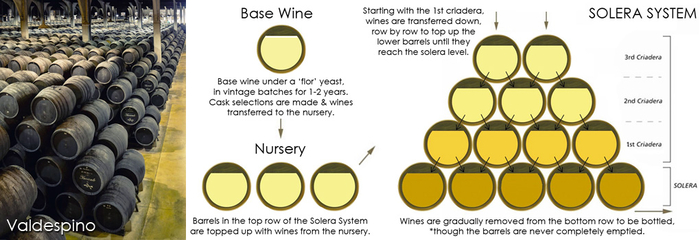 사진 확대 Solare Systems Infographic.
a drink that connects the past and the present beyond taste and survival
The reason Magellan poured more than 20% of the expedition’s budget into wine was not simply because he liked alcohol. It was a matter of survival, and the most humane way to reach out in an unfamiliar land where language did not work.
At a time hundreds of years ago when it was not even known what the Earth looked like, a glass of wine existed as a thirsting survival necessity for a navigator who was venturing around the world. It was also the best gift that could be handed over as a gesture of goodwill to strangers who met for the first time. That’s how wine became the fuel that supported the lives of explorers and the medium that connected culture and civilization.
The traces remain in the wine we pour in today’s glasses. The harsh Patagonian winter of 500 years ago, the 20-day voyage across the Pacific in three months, and the moments of greetings handed over on the islands of the Philippines in Southeast Asia.
Now we no longer have to risk our lives in search of the New World and the unknown, but still a glass of wine connects us to strangers and connects us back in time to the moment when mankind first came around the world. Maybe drinking wine is more than just a taste, but also drinking the memories of mankind’s first round-the-world trip back to where it is today.
 사진 확대
사진 확대
Wine is the wine produced by time. Along with the history of mankind, the history of wine began. It has a lot of interesting stories. A reporter with an international official level of the WSET (Wine & Spirit Education Trust) will tell you a fun and delicious wine story.
Dining and Cooking