
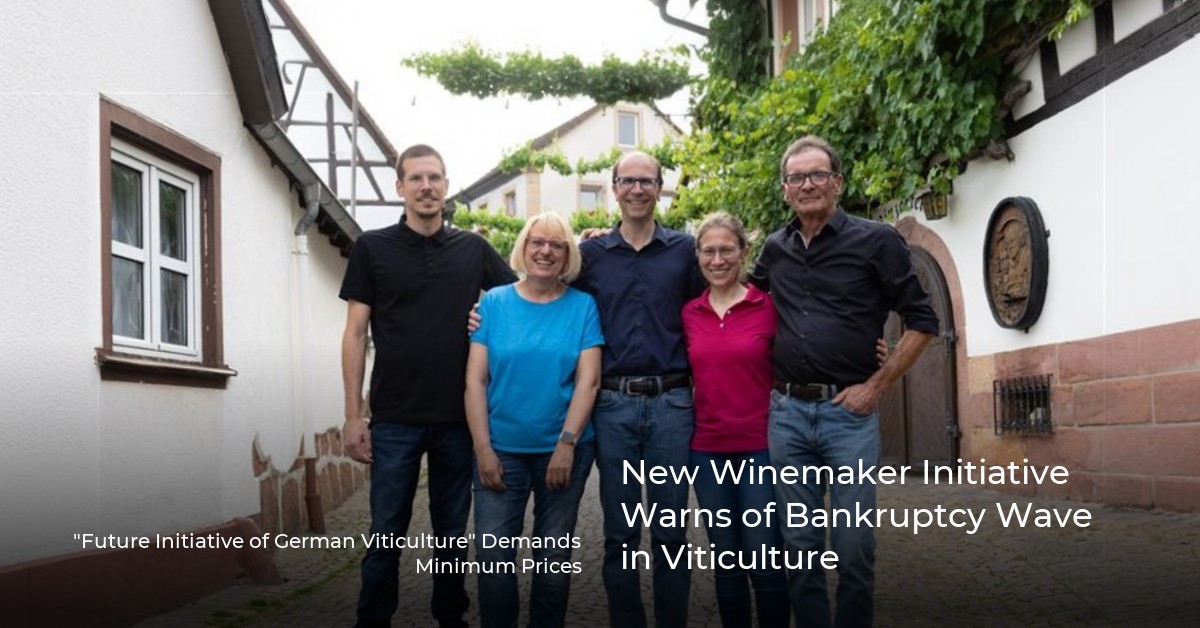
The German wine industry is facing a historic crisis, according to the newly founded association “Future Initiative German Wine e.V.” Thomas Schaurer (photo center), winemaker and founder of the association, warns in a press release: “The population must learn that in a few months, 50 to 60 percent of all winemaker families in Germany are threatened with bankruptcy.”
Reasons for the impending wave of bankruptcies, according to the association, are the lowest wholesale prices since records began. Currently, many businesses have to sell barrel wine for only 40 cents per liter, although production costs an average of 1.20 euros. “Who can afford to bear losses for years?” asks Schaurer.
“It’s not just about wine – it’s about our landscapes, our rural areas, our traditions, and last but not least, about entire life’s work and existences,” explains Schaurer. If nothing happens, Germany will lose more than just a product: “We are losing entire cultural landscapes, recreational areas – and with them family businesses that have been built up over generations with hard work.”
Winemakers without their own marketing are particularly threatened – they face “99 percent extinction.” But direct marketers are also increasingly under pressure, as many also cultivate vineyards for wholesale and are bound by long-term lease agreements.
To draw attention to the dramatic situation, the initiative has launched the nationwide campaign “Your Wine from Here.” It aims to raise awareness of regionality, quality, and fair prices in viticulture. The goal is to increase the share of domestic wines in the German market by at least five percent – and at prices that allow businesses to survive.
The central demand: A minimum producer price of 1.20 euros net per liter of barrel wine, significantly more in smaller growing areas with difficult conditions. In addition, there should be no bottle of wine in retail under 2.99 euros. “Prices below this threshold only come about through exploitation,” says the association. Low prices not only ruin winemakers but also represent a questionable approach to the cultural asset of wine.
The association makes an urgent appeal to politics and the public: “If we do not act now, we will lose a cultural asset of immeasurable value,” warns Schaurer. Wine culture in Germany is part of regional identity – whether through wine taverns, wine festivals, or viticulture itself. “What happens when our vineyards disappear? Then we lose not only a millennia-old cultural asset – but also a piece of home. What remains are overgrown, fallow areas.”
In the end, says Schaurer, the decision lies with consumers: “We accept any decision, but of course hope that they choose our culture, our landscapes, and ultimately our future.”
Members of the association based in Ingenheim (Rhineland-Palatinate) are winemakers from all growing regions of Germany.
(ru)
More on the topic
ProWein Business Report: “We need to produce less”
“We are facing a perfect storm”
Dining and Cooking