
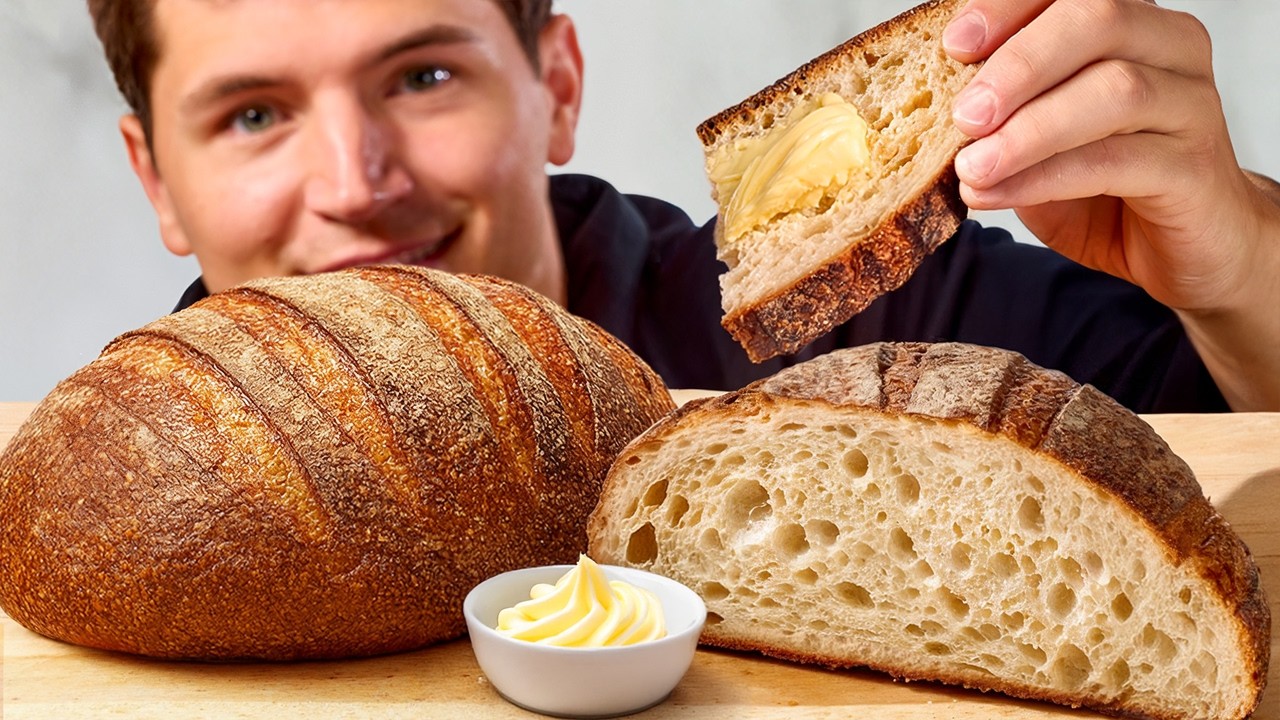
There’s nothing like slicing into a fresh loaf of sourdough: crackly outside, soft and tangy inside. It feels like a “fancy” recipe, but it’s really just flour, water, and time.
📋 COOK the full recipe on https://nickskitchen.com/sourdough-bread-recipe
🗞️ SIGN UP for my free weekly newsletter at https://www.nickskitchen.com/subscribe
🧂 SHOP salts, seasonings, oils, and more at https://www.osmokitchen.com
Follow Nick’s Kitchen:
https://www.instagram.com/nickskitchen
@nickskitchen
https://www.facebook.com/nickskitchens
https://www.youtube.com/@NickDiGiovanni
Knock knock. Who’s there? It’s bread. Am I the bread? This sourdough bread took me several weeks to make, but I’m going to show you how to do it in about 10 minutes. I’m going to pretend you’ve never baked anything in your life. You don’t know what flour does. Maybe you don’t even know what an oven is. And that’s totally fine. It doesn’t matter because I’m going to walk you through this step by step. Just like you’re learning to tie your shoes for the first time. Sourdough bread might look and sound intimidating. And it actually is. It takes time. It takes patience. It’s difficult. But if you get it down, you’ll be making the best bread on earth using just three ingredients: flour, water, and salt. Those plus a little bit of patience and sometimes just a little bit of frustration. And that’s fine. And it all starts with this little jar. The first step to sourdough is making what’s called a starter. And making one is kind of like getting a new pet, except you’ll be feeding it with a little bit of flour every single day. But just like a pet, if you treat it right and give it a good life, it’ll reward you with bread, just instead of kisses. We’re going to start off with something fun. If you’re going to make a starter, you need to give it a name. I thought of my starter’s name pretty easily. My dad’s name is Chris, and he likes to make sourdough bread, so I named my starter after him. My starter’s name is Christopher. You can name yours whatever you want. And all you need is a nice tall and sealable jar that when you add your flour and water in, which we’re about to do, it has enough room to triple in size. The first step to making our starter is to add in equal parts whole wheat flour and warm water. Now, all I’m going to do is whisk this up to remove all the clumps. When you’re working in a tight space like this, this is where a mini whisk comes in handy. And then you’ll want to scrape down the sides with a rubber spatula so no crust forms and toss on your lid. You do want there to be a little bit of air flow in there. So, if you don’t have a lid that naturally has a bit of air flow, like mine does here, make sure you just rest it in a way where air can still get in. And now, all we do is sit this in a nice warm place. It shouldn’t be in any direct sunlight. and make sure there’s no drafts or cold air coming in and this will come alive and start to grow. Let’s pretend 24 hours has just passed. That was Crustifer’s first night of sleep. Good job, Crustifer. It’s day two of our sourdough journey, and our starter is still just a baby right now. That means that if we look inside, it’s not going to be too active yet. There aren’t going to be a bunch of bubbles that you’re going to see later in the process, but Crustifer is still going to be hungry, which means we need to feed him for the first time. Pay close attention because you’ll need to do this exact same process every single day at generally the same time. I know it’s kind of annoying, but that’s how sourdough works. First, you’ll need a copy of the exact same jar you use to make your starter. And then you’ll want to grab a scale. And to this, we’re going to add 75 g of our starter. That was way more than 75. I didn’t mean to put that much. It’s very precise, but you have to do it this way. Perfect. The rest of our starter, you can make a new name tag or peel this one off and transfer it over. Or if you just know the name by heart by now, which you should, you can get rid of the name tag entirely. And what’s now left in our original jar is called our discard. We don’t need this anymore. You can use it for things like pancakes or waffles, or you can get creative online and search for things you can make with it, but we’re done with this. Every day when feeding, you’re going to leave most of your starter behind. We repeat this process every single day cuz it helps to keep our starter from growing out of control and also gives the yeast and bacteria fresh food to thrive. Now, we feed Crustifer again. First with some whole wheat flour and then with some bread flour and then with some warm water. Think of a warm bath here, not a hot tub. You have to think of your starter as a living, breathing thing. If you put water that’s too hot, he might go bye-bye. I think we all know what I mean. Now, we’re going to mix this up until it’s nice and smooth and consistent. Then, just like we did earlier, we’ll scrape down the side so that no crust forms. And then, a really nice trick is to add on a rubber band at this stage, right to the top of where the starter currently sits so that you can see day by day how much it grows and rises. It’s kind of like when you’re a kid and your parents make you stand up against the wall so they can draw lines to see how quickly you’re growing. This rubber band does the exact same thing. And now all we do is toss on our lid once again. Put it back in that same spot. And you’ll need to feed it and keep it alive tomorrow and the next day and the day after that and as long as you want to make sourdough bread. Oh, and one more note before I forget. You can’t really start making sourdough bread until day 14 or after because that’s when it becomes a mature starter and has enough flavor to create bread. So, next time you see me, it’ll be day 14. All right, we’ve trained our starter. It’s now tripled in size. It’s ready to go. And now we’re going to use it to make what’s called a leavon. It’s basically a supercharged version of our sourdough starter and one that’s going to be specifically and only used for the loaf that we’re about to make. To build our leavon, we’re going to grab a small realable glass jar. Key word, realable. It needs to be able to seal. And to this jar, I’m going to add some warm water. Then a little bit of bread flour. The bread flour’s job is to build structure in our sourdough loaf. And then some whole wheat flour. This flour’s job is to build taste. I’m going to add my jar onto my scale. And then we must make sure that we tear our scale so that it reads zero before we go to add some of our activated starter. Now, this part’s very satisfying. I’m going to scoop in here. Grab a little bit of that. Oh, yummy. I just want to eat it. And I’m going to drop it in until my scale reads 19 g. We need another scoop here. This should get us pretty close to 19. Ah, it stinks to go over. You never want to have to take the tweezers out for this. just going to pinch a little bit out until I get down to 19. This has to be so incredibly precise. Bread is such a specific thing. And if you don’t follow every step to a tea, it may not work out. So, really, really follow these instructions closely. I know it’s a little bit of a pain, but when you’re crunching later into this soft, crispy homemade piece of sourdough bread, you’re not going to regret following those directions. If my mom had just simply given me a jar of this once in a while when I was a kid, I would have been such a good kid. I would have just sat there all day long with this. Once that’s measured out, we don’t need the scale anymore for now. And the only thing left to do here is whisk until you reach a nice even consistency. This is when a mini whisk can come in handy. You want to try to get this now to a place where there are really no clumps remaining. It can be a little bit tricky, but eventually it’s going to sort itself out because we’re going to cover this and let it sit in a nice warm place for 3 hours. 1 hour before the leavon is done rising, which usually takes about 3 to 4 hours, we’re going to start on something called the otto less. Now, I know exactly what you’re thinking. We already mixed together flour and water to make the starter and the leavon. So, why are we mixing even more? Fair question. It helps to think of your starter and your leavon as the yeast. These are what are going to bring the rise in your bread. The otto lease, on the other hand, is where we start building up the majority of our dough. This is the bulk of the bread, the body of the bread. It’s going to make up most of our final sourdough loaf. To make it, all we do is add some bread flour to a bowl as well as some whole wheat flour. You see what I mean now? How it’s going to make up most of the bread. That’s a lot of flour right there. And then we’re going to cover this up with some lukewarm water. Don’t make it too hot, just warm enough. And then we simply just start mixing this all together. The goal now is to keep stirring until you don’t see any more loose flour. And just so this all makes sense, later we’re going to combine this with the leavon. But this step is giving our flour a bit of a head start to get hydrated. It’s going to form a slightly weird looking shaggy dough. And it might feel like you don’t have enough water, but just trust the process. Once in a while, it helps to flip things around as well, just to make sure you can get any of those wet spots hit with some of that dry flour. Once no more flour is stuck to the sides, I’m going to cover this up with plastic wrap and toss this in a nice warm place for an hour. And when this is done, our auto leaf should be done at the exact same time. Okay, our leavon is ready. You can see if you look at it here, it’s got all those nice bubbles. It’s tripled in volume. It’s nice and foamy and fluffy. Our flour is hydrated from the auto leaves. So now we can move on to what’s called the bulk fermentation stage. This step is very important because this is where the dough is going to develop all of its structure and flavor. This is the big slow rise where all the magic happens. All we do is add our leavon to our otto le dough. I know it sounds like I’m speaking a completely different language here, but I promise it’s still English and this is all going to make sense soon. And I’m not rushing this scooping process here. I’m going to scrape out every last bit of our leav. I can’t stress enough how precise bread making is. And even though it might sound like such a minor detail, sometimes getting that little extra last drop of dough can make all the difference. You can give yourself a pat on the back and cross something off your list because our leavon is done. The final two steps here are adding this salt sprinkled evenly over the top of our dough here. I do this because the more even we do it, the easier it is to mix everything together evenly. And then I know it doesn’t look like much, but just a little bit of warm water. And now is the fun part. This is when we get to get in there with our hands. To me, especially after you’ve spent all this time getting the components that you see here, this part is very satisfying. This is one of the moments where you become one with the bread. I’m purposely being quiet there cuz I want you to hear some of these sounds. I don’t know what you’re watching from right now. It could be a TV, a phone, a computer, but I’m hoping that these sounds sound as cool to you right now as they sound to me in person here. The goal here is to squeeze and mix it all together until it feels like one dough. Again, as you go, it’s going to get harder and harder and stickier and stickier. But I love this part of the process. It’s nice and warm. It’s a really good arm workout, and you really just get to get in there and have some fun with it. Now that I think about it, it’s actually more of a hand workout than anything. Once it comes together enough that it can hold its shape like this, I feel it’s actually easier to bring it up above your bowl. And then I’m just twisting and squeezing back and forth to get it into one uniform ball. I know just a few minutes ago when it was all shaggy and broken apart that you probably would have never thought it could turn into a nice ball like this. But now here we are. And once it looks like this, I’ll scoop as much of it as I possibly can off my hands. I find that the best way to do it is actually to rip away from it kind of quickly like that. And then we can drop it back into our bowl. Look how nice that looks. Isn’t that cool? Because of how sticky this is, you’ll still have quite a bit left on your hands. But if you pick up a piece, you can move around and almost pick everything else up with it. Just do your very best to collect all of it. We really don’t want to lose any of this dough. Now, all we’re going to do is cover this up with plastic wrap and just let it rest for 30 minutes before we move on to the folding stage. This step is important because it’s going to give the gluten that’s in this dough a chance to relax. It just worked really hard, so you need to let it rest a little bit before you work with it more. I’ve now been waiting 30 minutes for this to rest. And we’re going to do our first of three folds. This one’s a lot easier to show than tell. So, I’m going to explain why we do it while I do it. And the first step is to wet our hands. This will make it so your hands won’t stick to the dough. Then, we can remove our plastic wrap. And I’ll wiggle in my fingers and grab one corner of the dough that’s closest to me and lift until I feel tension. Then, give it a little wiggle and throw it back on top of itself. Now, we simply rotate our bowl 90°, wet our hands again, and repeat the exact same process on the second corner. Lift, wiggle, and toss. If you haven’t guessed it already, we’re going to do the same thing two more times. So, we do it once in each corner. Wet hands. Lift again until you feel tension, but not so much that you break the dough. Wiggle and throw. Last one. Doing this not only strengthens the dough, but it also gives those nice big air bubbles that you see when you cut open a beautiful loaf of sourdough bread. If you skip this step, your bread is going to bake into something that’s sad and flat. Now, all we do is cover it back up with plastic wrap. And then, we’ll bring this back to its same resting place and repeat the exact process two more times. But since the process is the same and the dough doesn’t really change, I’m just going to fast forward us to the next step. After you finish all three folds, we can move on to what’s called pre-shaping. First, grab a new bowl of water to keep your hands wet. Then, remove that plastic wrap and gently wet your hand to guide your bread out onto a clean work surface. As you’re doing this, be very gentle. The more air bubbles you keep, the better your bread will be. And if you ever need to, go ahead and redip your hands so nothing sticks. The goal now will be to create tension on the outside of our dough. We want to make a really tight skin on the outside cuz later this will lead to a really nice crust. And what you’ll do now is wet one of your hands and then in the other take a bench scraper and then you’ll lift up the dough and tuck it back under itself. You can also wet the bench scraper if you need it over and over. We’re going to tuck the bread under itself to create tension on the outside. But we need to do this without popping any of the air bubbles. It is one of those steps that’s a bit tricky to teach and explain, but as long as your dough ends up looking something like this, you can move on. Once I’m happy with it, I’m going to clean up around my dough so my work surface continues to stay nice and clean. Now, all we do is let this sit here for 30 minutes uncovered to dry out a little bit on the outside. And after that, we can start the final shaping and get baking. This has been resting now for 30 minutes. So, for the final shaping, our goal is to get as much tension onto the outside of our dough loaf as possible. First, we’ll lightly flour the top of our bread dough as well as the surface next to it. Then, I’ll use my bench scraper to flip it over onto itself. If you can move it like this, that’s a sign that you’ve formed a nice skin. Then you should probably leave yours where it is, but I’m going to move mine back to the center just so it’s easier for you all to follow along here. And I’m going to lightly flower my hands. And then grab this bottom piece. Fold it to the middle. Then grab both sides and fold those into the middle. There’s the first one. And here’s the second. Then finally, I’ll grab the last side. Give it a little stretch so it can fold a bit further than the others and fold it all the way across. Almost like you’re trying to fold it into a square. And now once again, I’ll grab the bottom and fold it all the way over itself. Now, it’s going to look almost like a burrito. Now, I’m going to lift my dough and move it for just a moment so I can scratch my work surface free from all that flour. We’re doing this because for this next step, we actually want it to stick. And finally, I’ll bring it back to the center. And as a final step, I’m going to reach my hands all the way across and drag it under itself. I’m almost kind of rolling it up into itself. Similar to before, I’m tucking the dough under itself to create that tension. And if I ever need to reset it, I can gently reposition it. But the key here is that you’ll want your hands just lightly fled the whole time. And you’ll want the dough to be sticky on the bottom so it can almost roll into itself. If you happen to get any big air bubbles like this, you can actually just tap them. But what that’ll do is spread them all apart on the bread and it’ll look really nice later. When you feel good about the shape of your dough, let it sit here for about a minute while you go to grab your proofing basket. Boom. This is my proofing basket. You may have seen one of these baskets before and had absolutely no idea what they do. And now you know. They’re for proofing bread. And this here is white rice flour. We use this to flour the inside of this basket. And there are two reasons. One, this doesn’t burn, so it’s not going to ruin the outside of your bread. And two, this makes sure that the bread doesn’t stick when we drop it in. And now, very carefully, roll your bread into your hand. It might want to stick a little bit, but you can make sure you grab it. Then, flip it over into your other hand and roll it into your proofing basket, seam side up. If you didn’t follow that, you can watch that again. But what it means is that we want the nice side of our loaf on the bottom. The reason is we’re going to flip it over one last time when we go to put it in the final baking dish. But for now, all we do is toss this in a plastic bag, then seal it up. And this goes into the fridge to proof for 16 hours. I’m so sorry. Good morning. It’s finally time to bake. And the first step is to add your Dutch oven to your oven and preheat that to 500° F. While that’s heating up for about an hour, we’re going to take some parchment paper, then fold it in half to give yourself a guide and cut that parchment right down the middle. What we’re making here is a cradle that we’re going to use to transfer our bread into our Dutch oven in just a moment. Next, we’ll grab our proof dough from the fridge. We need to move fast because we want that contrast between the cold dough and the hot Dutch oven to create steam when we put it in the oven. That steam is what’s going to help the dough rise into bread. If you’re following along, you may need to replay this part a little bit, but what we’ll do is we’ll lay one of our sheets of parchment this way and we’ll lay the other this way. We’re going to make an X shape. Then grab an inverted sheet tray and place it down over the top. This part you need to be confident. In one swift motion, I’m going to go down and then gently flip it over. Pull this off very carefully. Be gentle now. Ah, beautiful. And then we’ll grab this tool here that’s called a lom. This is basically just a very sharp razor blade. So, be careful. We’re going to use this tool to make a small slit or score the dough. You don’t want to go too deep either. Just about a/ third of an inch or a fourth of an inch thick into the bread. And you’ll come around and that’s it. This right here is basically a pressure release valve for the bread. It needs to be able to breathe when it cooks. And by making the slit right here, we control where that happens. Now, I’m going to grab my hot Dutch oven. This thing is radiating heat. I can feel and smell the heat. This is so hot right now. And then carefully, I pick up the sling. I drop it in. Don’t burn your hands. Then lid back on. And into the oven it goes. Woo. Take a breath. Now you just fingers crossed that it works. After 20 minutes of waiting, the steam stage is done. So, we’ll remove the lid from our Dutch oven to start what’s called the dry baking process. And finally, I am proud to say that we have just made our very own sourdough bread. Christopher, you did a great job today, buddy. I’m going to use my parchment cradle now to carefully lift out my sourdough. So, the best way to make sure no one hurts themselves is to set it off to the side somewhere and lay your oven mitts right over the top. In my kitchen, that’s a sign for everybody that something is hot. Be careful here. I wouldn’t touch your bread too much yet because it is still going to be very hot. But that right there is a gorgeous loaf of sourdough bread. Now, there’s just one last thing that this bread needs to be totally happy, and that’s butter. Because I’ve already spent several weeks making this bread, I’m going to make this butter at hyper speed. I just want to eat the bread, but it needs good butter. And it’s so easy. All you do is add some heavy cream to a mixing bowl. And then we crank this up until we see butter. As a little trick, I like to lay a kitchen towel over the top of my stand mixer, and that way it doesn’t splatter everywhere while it goes. There are a few quick stages that happen here. First, you’ll get whipped cream, and eventually it’ll start to turn yellow. And then once it starts splashing, you know it’s splitting into butter and buttermilk. That’s basically it. I told you it’d be quick. This is homemade butter. And all you need to do now is add it to a bowl of cold water and squeeze it around to rinse it off. And the goal is just to squeeze out all of your buttermilk to clean that butter. I’m going to sit that right here to serve with our bread. Now, it’s time for the moment I think we’ve all been waiting for. We got to check out the cross-section of this loaf. I’ll need to play some dramatic music for this. Look at that. It’s got nice air bubbles. It’s got a beautiful crust. There’s even this really cool pattern to the air bubbles. What we’re looking at now on the inside is called the crumb. That’s a fancy word for the cross-section of a loaf of bread. And we did a great job. I’m going to cut myself a nice thick slice cuz I think I’ve earned it at this point. You’ve already spent 14 days making this bread. So, the last thing I’m going to ask of you is that you take some nice butter. It can be homemade. It doesn’t have to be, though. Then toss it in a pan, maybe a little bit more, cuz who doesn’t love butter? And toast your bread this way. Nothing will ever really compare to toasting it in a pan like this. It’s going to get that beautiful golden brown crust, and it’s going to be the best bread you’ve ever had. I’m going to top off my fresh bread with one last knob of butter, tiny bit of flaky salt, and that is how you make the perfect sourdough bread. Gosh, the knife throw does not look as cool with a tiny knife. [Music]
36 Comments
did i watch the whole video? yes. am i going to make it? hell no.
@nick: do we need to keep changing christopher 😊 everyday at same time untill day 14th ? Same quantity move to other jar and add flour +warm water ?
Or just day 2 is enough and let it develop till 14th ?
I regret watching this. Because now I really want the fresh bread, but I am NOT willing to put in this much effort.
Great recipe, great explanation. And now I am certain, I dont have what it takes to bake bread 🥲
in my entire life i always question why sourdough bread is so overpriced,well now i know 😂
Dope Video!
Wow! That is a masterpiece of bread. Well done! Thank you for sharing this.
whats the point of teaching like we never have baked anything if you're going to require this many steps?
Charlie Berens brought me here.
I love sourdough, thank God there is a bakery nearby that sells delicious sourdough on the cheap because I don't think I'll ever have the patience or time to go through this regularly. Thanks for the demo though
f perfection. so annoying watching this. my mom make sourdough simple way. and it’s so good
What happens if we make a large amount of starter and bake it ?
That was cool 😃
Yeah …I'm just going get at Costco .
Sourdough is actually one of the beginner friendly things to make. Since it has a milkbactery you dont have to knead it to have the gluten develop. Just use the fold technique and you will be perfectly fine. Not sure why so many people treat it as a science.
i will go and buy a bread its so time consuming
REF HE DID IT REF HE MAKES THE BREAD
That's a lot of work to bake a freaking bread. Such a waste of time.
i come from the outdoor boys YouTube channel, and i can confidentially say that this is too long and stupid. you need three ingredients and toss in in the fire to make a good bread.
Tweezers on starter is insane. Not a bad recipe tho
JUST.IN.TIME!!!!!!!!
What are the measurements for this?
This video is the main motivation for me to not try this is out of my patience level and league 😂😅
aint no way anyone making a sourdough bread
I enjoyed every moment.
you talk too much, its annoying
So who may days / hours have this take in total?
Behind-the-scenes content humanizes creators and builds trust
This was a very informative BUT you kept saying “SOME” whole wheat flour and “SOME” bread flour and “SOME” water….. then gave a specific measurement of starter…..
Nick is being a mom here carrying a baby in her womb then nurturing it with love and care
I have no clue why I watched it but I loved it.
Great tutorial! You'll need some training to master this I guess? 😅
But one thing: why would you toast fresh bread?! Toasted bread is truly delicious, but wouldn't you enjoy a slice of fresh bread more after this elaborate bread making process? 🎉 Fresh bread is perfect as it is and commonly you toast bread when it has become older, wouldn't you?
I have a Question after you use the starter, I heard you can keep it in your fridge and feed it once a week. What would be the weight of flour to put in the starter to keep it alive
fun fact baking is more about feeling then precise measuring
That takes ages
Here and in the recipe I just can’t see any quantities of flour or water u need to use, can someone help?
Come to Bonners Ferry, Idaho, and I’ll invite you over to sample and trade sourdough loaves! It’s such a fun process! I’ve been doing it for years and love to try other people’s sourdough!