
8
Located in the heart of the Ribera del Duero in Soria, Dominio D’Echauz holds the world’s largest collection of grapevine biotypes, the result of more than two decades of collection, research, selection and recovery work driven by Vitis Navarra.
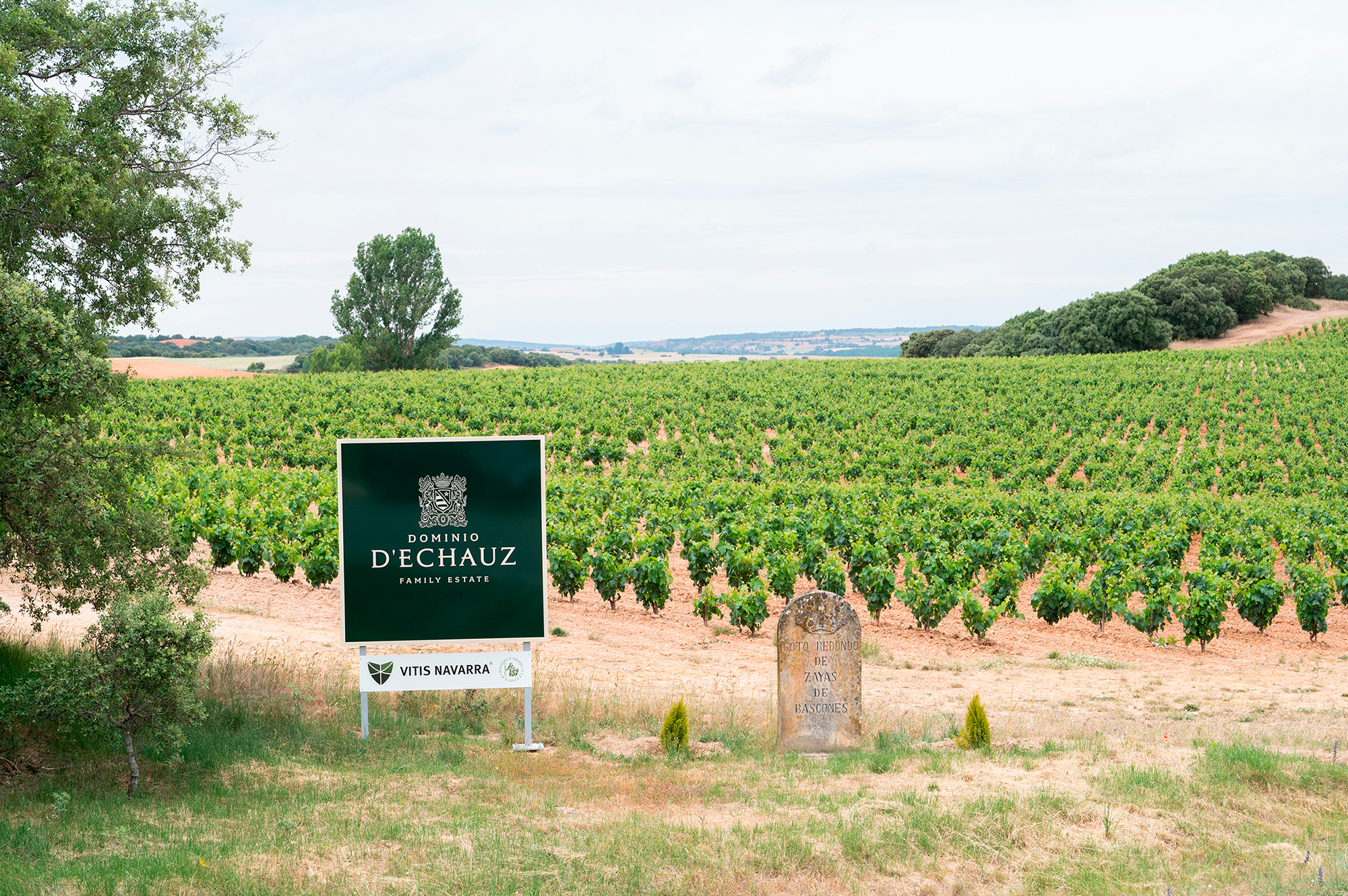
This collection, a true Noah’s Ark, is planted across 130 hectares of vineyard, where more than 16,000 different grapevine biotypes are preserved, safeguarded and studied—both from an agronomic and oenological perspective—including clones, massal selections and recovered varieties from winegrowing regions throughout Spain. In other words, the different expressions that a single variety develops as it adapts to each terroir. It therefore represents an invaluable plant heritage, essential to preserving the diversity of Spanish viticulture, which has been shaped over the centuries and is now indispensable in addressing the challenges facing Spanish vineyards, such as genetic erosion caused by monoclonal plantings, the effects of climate change, and the spread of vine diseases.
After this extensive work of collection and study, Dominio D’Echauz is now producing its first wines, where the selection of each biotype is key to expressing typicity and achieving the highest quality. The Dominio D’Echauz range includes a red wine that seeks to capture the identity of the Ribera of Soria, a white made from Albillo Mayor, and a clarete, in tribute to this traditional style of the region.
In addition to this range, Dominio D’Echauz vinifies specific biotypes to promote awareness of biotype culture and its importance for the future of the wine sector. In this way, it will be possible to taste wines made from individual biotypes—such as those of the Tempranillo variety—and to appreciate, in the glass, the differences between them.
Raise awareness of biotype culture
One of the major challenges facing the wine sector in the near future is preserving local diversity, to express the typicity of each region and prevent the erosion of genetic material, which is essential to confront new diseases and the effects of climate change.
”Hence the importance of conserving biotypes: ’After millennia of applying asexual reproduction in grapevines—their way of adapting to the environment, since no hybridization occurs—it happens through mutation, with small changes in the DNA. These changes are caused by ultraviolet radiation and stress, in a process of adaptation to climate and terroir, thus developing a series of distinctive external, morphological, and structural traits. These are spontaneous natural mutations that will be passed on to each new plant. When these variations result in significant morphological and genetic change, we speak of a specific biotype. In this way, a biotype is the set of plants that share a genotype, that is, a set of genetic characteristics,’ explains Rafael García, fourth-generation head of the Vitis Navarra nursery.
Faced with the threat of genetic material loss, Dominio D’Echauz safeguards the world’s largest collection of grapevine biotypes (more than 16,000, expected to increase to 20,000 soon thanks to ongoing prospection work), demonstrating a clear commitment to developing viticulture that preserves genetic diversity, both of Spanish varieties and their various biotypes.
’We consider ourselves guardians of a millenary biodiversity, with the duty to preserve and pass on the greatness of Spain’s wine heritage,’ explains Rafa García.
He adds, ’We cannot envision premium viticulture without recognizing local biotypes adapted to the terroir
The origin of this Noah’s Ark, which now takes shape in Dominio D’Echauz, lies in the Basajaun recovery project, launched by Rafa over 25 years ago.
Dominio D’Echauz
Echauz is a domaine—taking the French meaning of ’domaine’—located in Zayas de Báscones (Soria) and covering 787 hectares, of which 130 are planted with vineyards. It is an exceptional site where the vines share an ecosystem with other crops and a significant forested area spanning 300 hectares. This location immediately captivated Rafa García, fourth-generation head of the family business Vitis Navarra, which already has its succession secured through his children, who are fully involved in the project.
It is situated in the northeasternmost part of the Ribera del Duero, with an extreme continental climate and an altitude ranging from 940 to 1,002 meters. Additionally, the great diversity of soils and vineyard orientations allows for detailed study and characterization of the behavior of the extensive range of plant material available.
Precision viticulture is practiced in the vineyard with respect for its environment. Among the measures implemented is the design, in most vineyards, based on the Keyline system: a method that promotes soil regeneration, reduces erosion, and facilitates water capture and utilization.
Dining and Cooking