
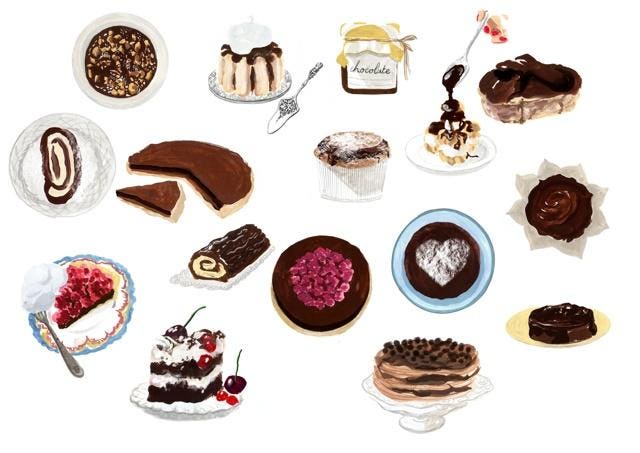
It’s not easy to weed through the numerous cookbooks released each year in search of inspiration, but Aleksandra Crapanzano’s Chocolat: Parisian Desserts and Other Delights (Scribner; 2025) caught my eye. Perhaps because I remembered the way she described, a few years ago, the chocolate meringue and mousse cake the French call Gâteau Concorde, “pure elegance in its simplicity and pure luxury in its richness”; perhaps because illustrator Cassandre Montoriol’s simple and stunning brushstrokes on the cover made me want to dive headfirst into the layered cake; or maybe because my own history involves the life-changing discovery of a thick hot chocolate at Angelina in Paris when I was eight years old.
Some of the delicious illustrations by Cassandre Montoriol
Cassandre Montoriol
At first glance (or bite), one might associate France with steak frites, boeuf bourguignon (thank you, Julia) or even tarte Tatin, but in her introduction to Chocolat Ms. Crapanzano, a journalist, cookbook author and screenwriter who lived in Paris for years, relates that many of our favorite chocolate desserts were invented in France. They include chocolate mousse, chocolate soufflé, ganache, and even pain au chocolat —also known in the United States as chocolate croissant despite looking more like a puffy, golden brick than a croissant!
The first World Cup of chocolate croissants took place in Toulouse. France, on May 27th 2019. (Photo by Alain Pitton/NurPhoto via Getty Images)
NurPhoto via Getty Images
Ms. Crapanzano gives us a concise history of chocolate in France and tells the 1615 tale of a teenage Anne of Austria bringing chocolate into the country for the first time as a wedding gift to her betrothed, Louis XIII. It appears Louis fell in love with the gift more than with his wife, but soon royals and aristocrats were savoring chocolate treats made in France.
In Chocolat, the author’s gourmandise and passion for the star ingredient oozes from the page. Gently, she prods us to get baking. “What may scare people about baking is that the end result doesn’t look like what you start with, it’s that transformation from flour, egg and butter into a cake or a madeleine.” She’s right. I loved the book because throughout its 100 or so recipes, the words that most spoke to me were: easy, simple, playful, beginner and quick.
The Moist Chocolate Yogurt Cake covered with ground pistachios and decorated with rose petals. Within the cake, one can see a few added pears.
Aleksandra Crapanzano
She deems Chocolate Cornflakes Clusters, “the easiest recipe in this book.” The simplicity of the recipe for Chocolate Pots de Crème is what sets it apart, she writes. And her Moist Chocolate Yogurt Cake is regularly made by children in kindergarten classes, she tells us. She also reveals rare generosity: recipes are often followed by “notes” or “ideas” that list as many as 16 different ways to tweak the master recipe. She even coaxes the beginner baker to unleash their own creativity, a rare trait in a French cuisine treatise.
Organic cocoa pods, cocoa beans and cocoa powder.
getty
So, which chocolate to use, one might ask. Here, again, the author simplifies things and recommends Valrhona, the French brand favored by most pastry chefs and chocolatiers. Recipes call for specific chocolates within the brand, with variable cacao ratios. “I prefer to start with a dark chocolate,” she says, “to remain true to the flavor I seek, even if I will end up adding crème fraîche on top.”
The recipes are organized into nine sections named Cookies, Cakes, Tarts, Mousses and More, The Chic, Delicious and Playful, Hot Chocolate, Truffles and Caramels, Les Bûches de Noël, and a final chapter, To Soak, To Sauce, To Coat, To Fill, To Ice, To Drizzle, To Spoon, To Glaze and Perchance to Dollop.
Speaking recently with the author, I was curious to hear how she viewed chocolate desserts in France compared to the United States.
“In France, the star of a chocolate dessert is the chocolate,” said Ms. Crapanzano, “not sugar, which is why my recipes are not overly sweet.” She goes on to explain that a classic French apple tart will not necessarily include cinnamon. The focus is the apple and its distinctive flavor.
The last pages include a list of her favorite Parisian chocolatiers. You can start planning your next trip, or you can get baking!
Dining and Cooking