
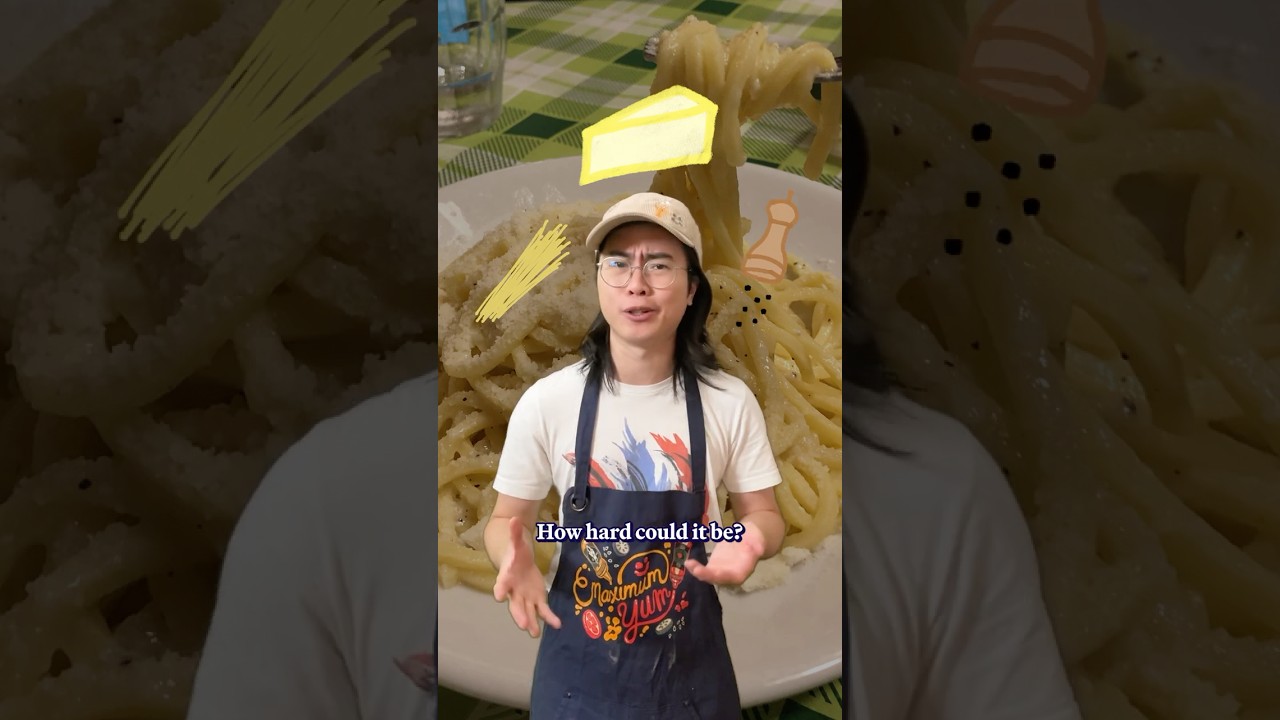
Cacio e pepe is harder to make than it seems. If the temperatures and ratios of ingredients aren’t right, the pasta can enter the dreaded “Mozzarella Phase.”
But a group of researchers tested hundreds of different conditions, measured the clumpiness of each sauce, mapped out the results and found a foolproof, award-winning scientific recipe for cacio e pepe.
Cacio e pepe for two (science edition)
Ingredients:
300g Pasta (tonnarelli preferred)
200g of Pecorino Romano
5g of Corn starch
Recipe:
1. Cook pasta, saving some extra starchy pasta water just in case.
2. Add corn starch to 50g of water in a small sauce pan, heating and stirring until it becomes gelatinized and thick.
3. Take cornstarch slurry off heat and add 100g of cold water.
4. Mix cheese in, then blend sauce. If too thick to blend, add pasta water.
5. Pour sauce over pasta and garnish with black pepper.
🎤✏️🎞️🎥 Tom Lum
So, for dinner tonight, I’m going to be making an award-winning kacho a pepe. What award was it? What What award was it? It was an ING Nobel Prize, wasn’t it? The the parody of the Nobel prizes in physics. Kacho a pepe is a deceptively difficult dish. After all, it’s just three ingredients: pasta, cheese, and pepper. How hard could it be? But it’s combining those ingredients that’s made folks like Bing with Babish almost give up on it, calling it easily one of the hardest things I’ve made. And that’s because when the starch from the pasta combines with the protein from the cheese and the heat from the pan, it can easily enter what the researchers call the dreaded mozzarella phase, where the sauce becomes a clumpy, goopy mess. But the specific ratios and temperatures causing this failure point are still a mystery. What are you going to do? Make hundreds of batches of pasta meticulously controlling each individual variable? How many times did you guys have to make 450? Yes. Now, of course, these were petri dishes, not full plates, which then let the researchers analyze and measure the clumpiness of the sauce, which resulted in this beautiful diagram. On the y-axis, we have temperature, and that dark red zone is the mozzarella phase. And on the x-axis, we have the ratio of cheese. But what’s weird is it doesn’t form a straight line. It makes this little U shape. And that’s because cheese actually has two proteins in it, quinine and whey. And the different proteins dene and interact at different rates, creating this curve and this clumpy danger zone. Now, this may seem like a lot of effort for pasta science, but studying how proteins interact and change phase could actually help us answer one of the biggest questions in science. How did proteins combine and form in the primordial soup 4 billion years ago to create life? And while we don’t have the recipe for that just yet, the researchers gave us something even better, a foolproof scientific recipe for Kacho Pepe. Because it turns out if you increase the starch level enough, you can make a sauce that almost never enters that danger zone. And the secret to getting that level of starchiness, cornstarch. Now, before the Italian grandmothers come for me, all the Asian grandmothers will know that cornstarch is a common secret ingredient to get a rich velvety sauce. And of course, the researchers acknowledge that a quote true Italian grandmother or a chef from Rome would be able to navigate this curve on their own intuition. But I am neither of those things. So, in many ways, I’m perfect to test this. But I’m not going to make a whole dinner for a video. [Music] Holy. And so with newfound admiration for the skill and science that goes into this classic Italian dish, I only had one last question for these researchers. I’m so glad you guys could make it to America. What do you think about American Italian food? Oh, we love it. It’s like it’s good. Yum. Yum. Uh-huh.
49 Comments
the stringy gloopy sauce is part of the appeal i fear
Yes!! So cool!
Nothing but a bunch of pretentious babies
"I'm not gonna make a whole dinner for a short"
*sad youtube noises😢😞*
*blender go brrrr*
*😃*
I am in love with the sauce phase diagram.
Cornstarch gel in a blender. Ethan's technique is my favorite
Ask any mother or grandmother, and they could have told you.
Using Babish as your benchmark is a stupid idea. Dudes closer to Cooking With Kay than an actual chef. Overrated like Gordon Ramsay
Primordial soup??!!!! Are you a creationist or something 😂😂😂
Wait you can't use the pasta sauce?
It's easy
Poured sauce over dry noodles nooooo
The food youtuber ethan cheblowski (?) actually did do this in a video about this exact pasta so thats super cool
wait a minute you telling me the pasta we been making as a midnight snack in my family since before i was born is difficult to make?
I always felt guilty for using corn starch to make my cacio e pepe come together, until I saw an italian chef say that he does the same thing in his restaurant during the lunch rush.
I don’t know what you’re talking about, but damn this Primordial Soup sounds delicious 😂
Primordial Pasta sounds even better 🤣
If only pepper weren't horrible
@Lionfield
Crazy
Darth Plagues was a dark Lord of the sith. So powerful and so wise that he could even use the force to combine and form the proteins in the primordial soup 4 billion years ago to create… Life.
Wondrous video, fastest sub in years
Science is beautiful 🥹
What I read from this is, just cook the noodles in less water. Less noodle water means more starch per ml of noodle water. And since you put a fixed amount of water into the sauce, the corn starch of the noodle water is preventing the danger zone. No need for corn stach.
The ending 😂
Fun fact: corn starch is used as a fire-breathing fuel
I love this
It is not that had
The secret is love.
The Primordial Soup for sure had some typa pasta in there
Ooooo. I wonder what the equation of that graph is!!!
pasta is life.. apparently literally
Graph look like tiddy haha
this is my roman empire now
That at the end was the best dub i've ever seen, i almost couldn't tell they weren't actually saying that.
That is probably the reason why we add a little bit of of the water the pasta was cooked in to make the sauce.
Primordial soup?
More like primordial mozzarella phase
Heh. I'd have assumed letting the pasta cool down a bit was gling to be the answer since it affects the starches. I wasn't too far off but maybe that's not it?
wait where do you live? there's a big difference between New York new jersey Connecticut Italian food and Kansas Italian food
No way a pasta dish is helping us figure out primordial soup 😭
Luv Luv Luv 🙌🤣🤗🤟🙏I'm a Cali kid but was taught by my Nana straight from Sicily and yes she would slap you but this is awesome!! Science for the win!!
Shouldn't it have been in chemistry instead of physics?
Damn I never had an issue with that, I feel so lucky I always thought it was easy 🙂 maybe I'm just a great cook, come at me Gordon Ramsey!
Personally, I don't think corn starch is cheating. Most other recipes will recommend buying horribly expensive pasta that is heavily dusted in its own flour, providing the necessary starch to kickstart the saucening. I've personally found great success using fresh pasta, which itself will be heavily dusted in AP flour to keep the noodles from sticking together.
EDIT: also, easy mode is starting with shorter noodles like fusili in a small sauce pot instead of a giant 4-quart pot. The noodle can cook with less water, ensuring thick pasta water even with cheap noodles.
You need the pasta water, the starch water, enough moister to stop it from clumping, I make this all the time
also, FYI another favorite cheat is adding an oil like extra virgin olive oil. It does two things:
(a) lower the overall temperature of the dish and the pan, and
(b) fulfill the role of loose starch in helping the sauce emulsify.
Drain your pot, reserve pasta water, put noodles in pan with pasta water, then add the oil and start tossing. You'll soon get a glossy coating, and that's when you know it's ready for the cheese. Dust with a handful, mix vigorously, then start tossing again.
This method is so reliable it just helped me recover from a Mozzarella'ing just a few hours ago.
A foolproof trick is to cook off your pasta in as little water as possible, once your pasta is mostly cooked through move it to a different pan, ladling in your reserve starchy pasta water and letting it evaporate leaving more and more starch behind, finishing off your pasta to al dente with these ladles of water and increasing the starch content, then add a ladle of starchy pasta water that's slightly cooled into a bowl with grated pecorino and your toasted black pepper and you shouldn't ever deal with the issue of your cheese clumping and going stringy. Taking your pasta off the direct heat, mixing in your cheese mixture and quickly tossing it through, ladling in maybe a little more starchy pasta water if needed
the mozzarella zone looks like a tiddy
Of course the plot show's a curve. A curve is the shape of science.
Forget the potential science, as a chef, I find this fascinating on face value