
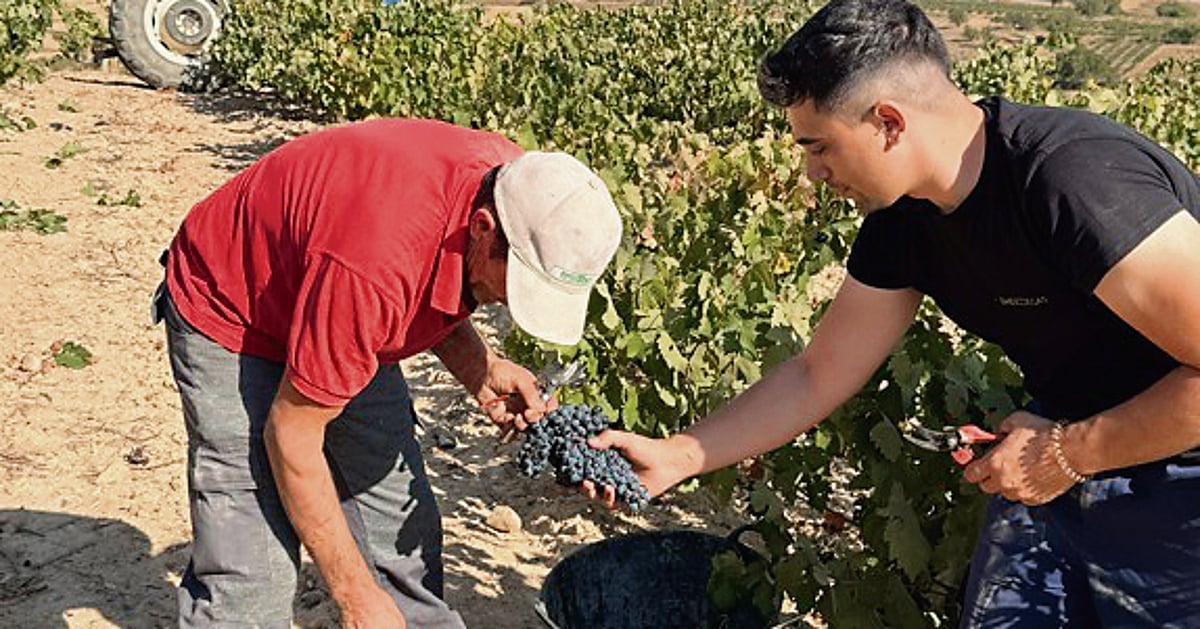
The saviors of Spanish wine making are a family, barely known outside the country, who live and work in the Fuensaldaña village, where barely two thousand souls wander the cobbled streets. They are the Crespos. One of them lifts a 1,000-kilo stone with the ease of Hercules on steroids. At EME Bodegas, the future of Spanish winemaking is a step—or rather, several centuries—behind. “This is how my father did it, and my grandfather before him,” Ricardo Crespo, third-generation winemaker, says, as you sidestep a hulking wooden contraption that looks more like a medieval torture device than a tool for vinification. Here, tradition isn’t a museum piece; it’s the pulse of the cellar. While neighbours have joined the mechanised sprint of modern wine production, EME still operates as if 1623 never ended; the results are intoxicating.
The building itself whispers of past centuries. Squat limestone walls rise unevenly, giving the winery hobbit-like charm; a pastoral nook rather than a production powerhouse. Terracotta tiles crown the roof, and a diminutive white chimney peeks like a shy sentinel. Natural flagstones pave a quiet patio, while twin brick-framed arches frame the entrance with stoic elegance. Inside, yellow walls and exposed beams cradle a cozy tasting space with small wooden rack holding a curated selection of wines. There is the ‘Cigales’ Denomination of Origin display, and two black barrels double as tables, bearing glasses of ruby liquid, a cooler bucket, and a rustic spread of bread, cheese, charcuterie, and olive oil. Descending into the cellar beneath a Roman arch, the air cools to 10–12°C. Limestone galleries, carved centuries ago with sweeping curves and precise angles, cradle the wines in silence. Ricardo, at thirty, is more than a winemaker—he is the custodian of time; a boy who started pressing grapes with his feet when he was just eight and now a man preserving a oenophilic legacy in every polished floor tile. “My grandfather revived this winery for the love of it,” he says, pride threading his words, and you can almost taste that devotion in the damp, mineral-scented air.
Yet love doesn’t pay barrels of French oak, each costing £900. Ricardo replaces 20% of his 70-barrel collection annually, investing in six thousand bottles a year when industrial methods could triple production. Across Valladolid and Cordoba, 30-to 100-year-old vines cultivate twenty grape varieties, from Tempranillo and Garnacha Gris to Albillo and Malbec. “We grow everything… every grape matters,” he says, hand-picked from 7.5 hectares.
Dining and Cooking