
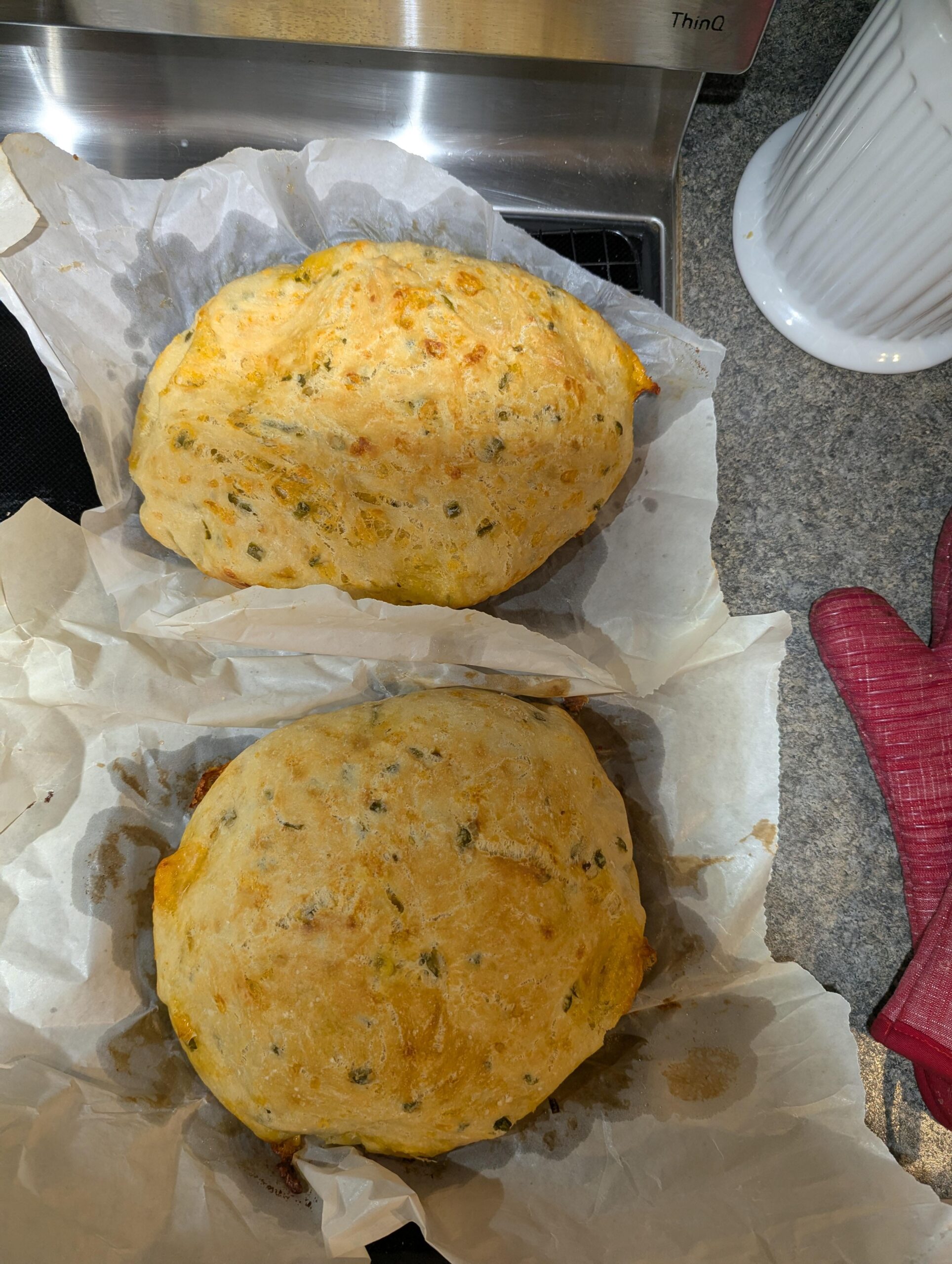
Ok so I'm using the clever carrot lahey bread recipe.
I've made this loaf probably 30 times now.
Things I've modified/tried –
Lowering hydration to 75 %
No add ins
Kneading 15 seconds after the overnight rise
2 stretch and folds in first few hours
Shaping as tight as I can with a bench scraper
Not shaping much
Reducing the salt
Shorter counter time 8-9 hrs
Longer counter time 13 hrs
Warm rest time in propped open microwave
Colder area rest time
Cold water
Warm water
Different vessels to bake in .
Oven at 500 at first then 400
Oven at 475 then 400
Final rise seam down, then baking seam up
Final rise seam up, baking seam down.
It spreads out and doesn't get much cracking and rising. The loaf in the back is actually collapsing as it cools. They taste awesome but they look flat and the crumb varies. Usually has nice holes , sometimes fluffier but still good.
The only thing I don't do is preheat the Dutch oven because mine says not to or it could damage it. It's a 7qt, I'm thinking of getting a 3 or 4 qt to see it it forces the bread up instead . The other pan I use is a oval shaped roasting pan, the crust doesn't come out as good and it still spreads two ways.
But other than .. what gives? Anyone have any tips?
by nightshade902
30 Comments
Have you tried kneading it?
Don’t know if this helps, but the first time I tried to make non-pan loaves at a hydration levels recommended, my bread spread out flat and I couldn’t score it. Now I put the risen dough in a floured banniton and refrigerate it for three hours before inverting the loaf onto parchment paper and baking it in a preheated Dutch oven. I think the colder dough temperature helps it not spread out.
My thoughts after doing the no kneed bread adventure for a number of years in my twenties, moving to “regular” bread, and now sourdough is that this recipe is awful. Light it on fire and try something else 🙂
Lower the hydration to 60%
Timing. How are you determining the timings. Are you following the recipe timings exactly or are you adjusting to your kitchen and the dough performance. There are two key things to watch in this recipe and things Lahey says that are critically important. First, this is a long overnight biga, but that doesn’t mean you can throw precision out the window. The recipe gives specific times but it also gives a specific room temperature, lastly your yeast may be in a different robustness. If you’ve got any variance you need to adjust timing. The key thing the recipe says for the bulk rise is 1.5-2x volume ([not size, volume](https://www.weekendbakery.com/posts/the-myth-of-double-in-size/)). If yours is more than doubling then you’re overproofing. If you’re going that long a bulk I usually recommend coming a bit UNDER the double volume to make sure I don’t over proof.
The second important thing that recipe says is the LONG spread in the proof. After shaping it recommends 30m – 2hrs depending on your kitchen temp. That’s huge! When you transfer your loaf to the dutch oven does it hold it’s shape? If not, you may be going too long. When you score it does it stay together or just flop out? If it flops you may be going too long. Since you’ve done this 30 times (! nice !) try varying the timings. Take a photo of the dough at the end of each stage so you can compare them later. I’d recommend tightening your timings a bit and see what happens.
you should preheat the dutch oven, else, its actually gonna “shield” the bread from heat. just think about it, you are creating a smaller oven inside the dutch one. if you put it cold, it will take a lot of time to get to temperature, meaning your bread will get cooked at a very low temperature for most of its time in the oven.
i don’t know what brand of dutch oven you use, but any dutch oven made of metal should totally be fine.
If you don’t have access to a dutch oven that can handle the big changes of temperature (again a metal one should totally handle them, a good quality ceramic one too) i would suggest doing the same thing, but without a dutch oven, over a big slab of stone/metal or a cast iron pan. needs to be thick to retain heat, with a water bath under it so it has steam.
No knead is always going to not be the best bread. You’re going out of your way to make bread, why not just put in the extra 15-20 minutes of work to get a good result?
Putting the bread into a hot vessel might be important to rapidly generating the steam you need for oven spring (puffing up in the oven). If you’re putting it in a cold Dutch oven and putting that in the oven it may be basically overproofing as it gradually warms up. It seems like this is the one point where you’re deviating from the recipe and I might investigate that. Is your oval baker covered and do you preheat it? Maybe explore other ways to steam out your oven if you’re not comfortable preheating the Dutch oven or get one that preheating won’t be an issue with.
Also maybe try a different recipe.
Could your yeast be bad/old?
No knead means little gluten, no gluten means no structure for bubbles to form, means flat.
I find no kneading dough flatter once cook too 🤔
It kneads some needing
Make normal bread.
Could opt for some side support, like if I rose my ciabatta without a lil supportive couche they’d drop flat. Maybe a banneton?
Not enough gluten formation, too low protein flour.
Over fermentation.
It’s the Wonder Bread of home baking, basic bread with little structure or air pockets. It’s fine I a pinch but even on a good day will not be AMAZING. Fortifying it with veg or cheese is not going to do anything for size or structure, in fact is going to hinder.
A score after final rise but before baking might help it lift some.
If I don’t want to knead then I bake the loaf in a pan. Free form loaves need to be kneaded, at least a little.
No knead, 75% hydration and no loaf pan don’t play well with each other. If in doubt, chuck it into a loaf pan or a dutch oven
Not a professional, but I have been baking bread for a long time. I have used several versions of no-knead throughout the years, so a couple of thoughts:
1. Preheated dutch oven really will give you better oven spring. Basically you’re making a tiny oven inside the bigger oven, where it will trap the steam and help it rise more before the crust hardens. I use both enameled and regular pots, I finally bought a non enameled 5 qt Lodge with a knob-less lid to dedicate to bread baking because having done it ALL, from preheating a tray and throwing ice cubes in to 500 to misting every 5 minutes etc, the Dutch oven is easiest and most consistent.
2. There is another version, Artisan Bread in 5 Minutes A Day. They have you mix up a large batch and rest on the counter until it’s risen but flat, then (don’t have to but recommend) refrigerate it at least a day. The cold dough can be quickly shaped and you can stretch a bit to give it a better gluten cloak, and then you let it rise covered while you preheat. They just have you bake in a hot oven on a stone, and it does get a better lift than most I have used. (But I still use it in my Dutch oven) It can be used over 2 weeks and just gets more like sourdough as it ages.
So you took a food that has kneading as basically its only preparation step and skipped it and you’re surprised it didn’t work. Hmm, have you tried kneading it?
“Use the force Luke!”
The force of the nature by doing first Autolyse:
Autolyse is a bread-making technique where flour and water are mixed and left to rest before adding anything else,
just do that for 1 hour minimum, then add yeast, wait some time, then the rest of ingredients, salt included.
This resting period is key to flour to develop gluten just by having only water, and flour takes time to absorb it, don’t force it to swallow all.
Make sure your starter is really healthy, triple feed it before you start
It looks like an awful long ferment for yeast. I make a “no knead” yeast loaf every couple of days and borrowed shaping techniques from sourdough to get a big rise and belly. You’ll need a banneton for this (or use a bowl with a linen tea towel).
This was the more involved version. Instead of doing multiple s&f sets, I just do a preshape. https://www.reddit.com/r/Breadit/s/wEHaHORBg6
– 400g bread flour
– 300g water (75% hydration)
– 6g yeast (1.5%)
– 8g salt (2%)
Combine all ingredients until you see no more dry bits. The dough will be shaggy. Rest covered for 30mins. This will allow the flour to hydrate and start building gluten networks.
Do 8 stretch and folds with wet hands (or more) until you feel the dough getting tight. Flip it over in the bowl so the smooth side is up. Slide your hand under the ball and “rotate” and tuck continuously in a circular motion. The idea is to make the ball as smooth and round as as possible. The dough should look smooth, round and tight. This means it has a lot of tension. Leave to rise covered at room temp for an hour or until double.
Pre-shape. Tip out dough onto floured surface. Rice flour is ideal from this point on. Flatten dough into a rectangle. Fold into thirds then roll it up. Use a a “pull and twist” motion to round up the dough into a tight ball. Leave to rest 30mins covered on the counter. What this step does is remove large bubbles that have formed during the first rise and build up tension in the dough. The rest is to allow the gluten to relax and for more small bubbles to form.
Shape. Perform the exact same pre-shape step. This is the final round of building tension in the dough. Place in floured banetton, pinch seams tight and let rise again covered for 45mins while you preheat the Dutch oven to 230C.
Score and bake. Place baking paper over the banneton then something flat and firm like a cutting board. Invert the banneton over and you should get a loaf that holds its shape. Score and bake for 30mins covered at 230C. Remove lid and continue to bake for 15mins and 210C. Remove from oven and cool on wire rack at least an hour before slicing.
The NYT no knead bread recipe was the first maybe 10 loaves I baked in my life. Not all flawless, but all were delicious.
> The only thing I don’t do is preheat the Dutch oven because mine says not to or it could damage it
I hate to sound snarky, but.. This basically means the one thing you haven’t tried is actually following the recipe.
I’m not a.. I dunno.. metalurgist, but I’m not sure how preheating the dutch oven could damage it. It’s a vessel made to be heated. 🤷
Have you tried stretch and folds until you get a good window? Stretch and fold every 15-30 minutes until you see no improvement with the window.
It’s amazing how the slightest addition flattens the loaf and a close crumb. Get it right plain then work on adding other flavors.
Have you tried pre shaping the dough? This has made quite a difference in my loaves.
Have you tried proofing overnight? You can move loaf into cold dutch oven and start with cold oven as well.
Bread falling as it cools? Use a thermometer to make sure it’s done before removing from oven. 205F for plain bread, forget what is best for a bread with inclusions.
No knead need knead
Switch to a no knead focaccia and you’ll be much much happier.
https://youtu.be/Fki0cXoi73U?
This is basically my go to recipe.
What you’ll do is during the second set of folds you’ll add your incorporations into the folds then, that way it receives 2 full rounds of stretch and folds.
Since you’re making focaccia your bread will only be 3-4 inches tall, but you’ll get more of that lighter airier structure you’re not getting from your no knead recipe because your bread lacks the gluten structure and strength to help the rise with your inclusions.
Sometimes I’ll prep my focaccia at night, and after the third set of stretch and folds i put it in the fridge overnight to cold ferment until tomorrow after I get home from work, then I take it out, and drop it in my focaccia tin and let it rise.
Others have said it here, you e probably reached your own limit in the no knead world and it’s time to graduate to either straight sourdough loaves or something like the focaccia, but both will require a bit more work than what you’re used to, but you’re ready for it
For the no-knead method, all your other tweaks won’t help you if you don’t pre-heat the pan. Use a seasoned cast iron dutch oven (not enameled) so you can pre-heat properly with no danger of damaging the pot. I use a 5qt Lodge double dutch oven and it works perfectly for the no-knead method, though I would like it even better if it was a bit smaller. If you prefer to avoid pre-heating, then you should take the other advice here to use a recipe with more manual manipulation of the dough to develop the structure.
If you tried this recipe 30 times to no avail it’s time to use something else
https://www.kingarthurbaking.com/recipes/no-knead-crusty-white-bread-recipe