
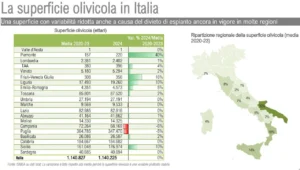
The Sicilia olive oil, decreases the Puglia, while remaining by far the most olive-rich in Italy. It is easy to imagine that Xylella had an influence in this last case, considering that we are talking about the comparison between hectares present in 2024 compared to those of average 2020-2023.
The photograph of the Italian olive oil heritage was taken Ismea, the Institute for Services to the Agricultural and Food Market In its timely annual report on the olive oil sector, the report—based on ISTAT data and based on the premise that many regions still ban tree removal—provides some interesting insights.
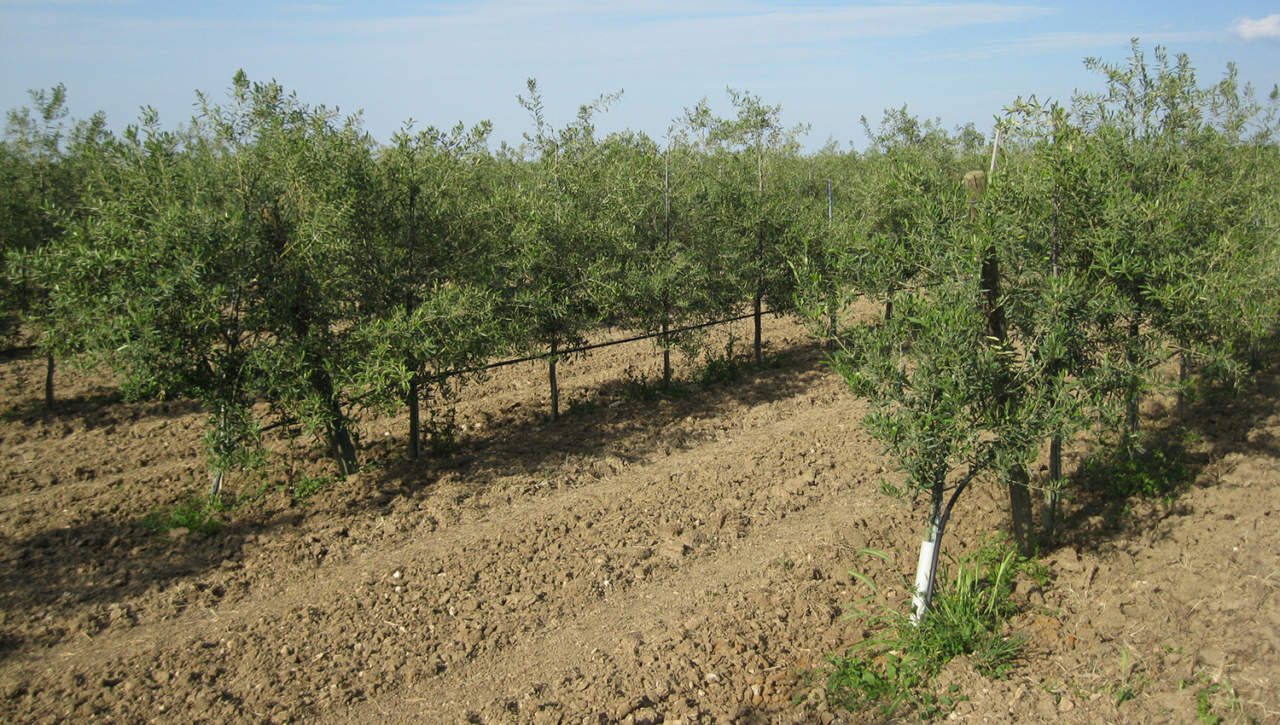
 New olive trees planted
Among the positive ones, in addition to the Sicilian data – that goes from 161.048 to 176.974 hectares, approaching second place in the Calabria (with 184.682 hectares, 15 more than the average of previous years) – those from the northern regions of Italy stand out, confirming the fact that olive growing – due to climate change – is no longer an exclusive prerogative of central and southern Italy.
The olive groves to the north
And so the Piemonte passes from 157 to 220 hectares, certainly a few, but still a +40%. The same goes for the Friuli Venezia Giulia which sees its regional olive grove grow by 16%, that is to say from 308 to 356 hectares. Very good the Liguria which records an increase of almost 2 thousand hectares of olive groves, passing by 17.493 to 19.260 with an increase of 10%. And also in Trentino something is moving, with another 16 hectares carrying the regional account at 396 (+ 4%).
The olive groves in the center
In central Italy the number is growing somewhat Toscana (by 85.801 to 87.520 for a +2%) and theEmilia Romagna which comes to 4.573 hectares (+ 5%). Buildings in Umbria, Lazio, Abruzzo, and Molise, with an imperceptible regression of the Marche (-36 hectares for a total of 9.533).
And those from the south
In the south it weighs dry loss of over 17 thousand hectares of Puglia which falls below the threshold of 350 thousand (a 5% drop). In percentage terms, the Campania which yields 6% of the olive-growing area, passing by 72.264 to 68.169. Stable there Sardinia with 9 more hectares.
These data, added together, lead to the national olive oil heritage at 1.140.225 hectares, about 600 less compared to the 2020-2023 average.
Dining and Cooking