
August 27, 2025
3 min read
Add topic to email alerts
Receive an email when new articles are posted on
Please provide your email address to receive an email when new articles are posted on .
“
data-action=”subscribe”>
Subscribe
We were unable to process your request. Please try again later. If you continue to have this issue please contact customerservice@slackinc.com.
Back to Healio
Key takeaways:
An energy-reduced Mediterranean diet combined with exercise advice reduced diabetes risk over 6 years.
The intervention “represents a practical and sustainability strategy,” a researcher told Healio.
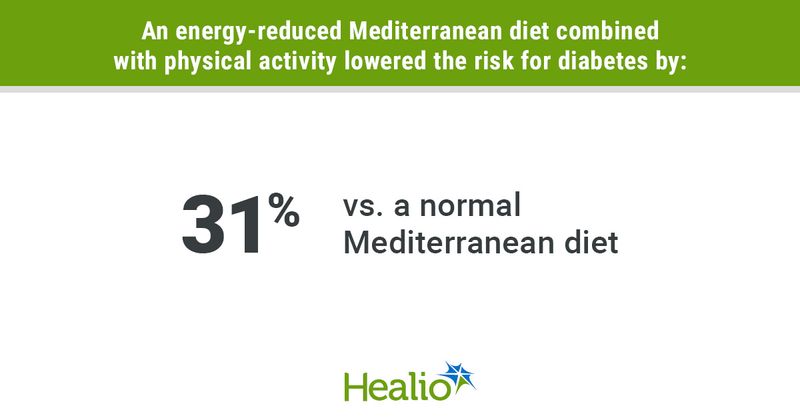
An energy-reduced Mediterranean diet combined with physical activity greatly lowered the risk for diabetes in adults with overweight or obesity vs. a normal Mediterranean diet, a study showed.
“Clinicians should consider recommending this multidomain intervention approach for patients with overweight or obesity, particularly when conventional Mediterranean dietary advice alone has proven insufficient,” Jordi Salas-Salvadó, MD, PhD, a professor of nutrition at the University of Rovira i Virgili in Spain, told Healio. “We think that this multicomponent lifestyle modification represents a practical and sustainable strategy that could be incorporated into routine clinical practice for diabetes prevention.”
Data derived from: Ruiz-Canela M, et al. Ann Intern Med. 2025;doi:10.7326/ANNALS-25-00388
Several prior studies have shown the influential role nutrition plays in diabetes risk, as poor diet resulted in 73% of diabetes cases in 2018.
Salas-Salvadó and colleagues performed a secondary outcome analysis of the randomized, single-blind, controlled PREDIMED-Plus trial.
In the trial, 4,746 adults aged 55 to 75 years with metabolic syndrome, overweight or obesity and no prior diabetes or CVD were assigned 1:1 to either a control group given educational advice on the traditional Mediterranean diet or an intervention group consisting of:
physical activity advice;
a Mediterranean diet with a planned caloric intake reduction of 600 calories daily; and
behavioral support for weight loss.
Diabetes incidence among the cohort was based on American Diabetes Association criteria, while both groups were given 1 L of extra-virgin olive oil monthly “to support adherence and retention,” the researchers wrote.
Salas-Salvadó and colleagues reported the absolute risk for diabetes over 6 years follow-up was 12% (95% CI, 11.9%-12.1%) in the control group and 9.5% (95% CI, 9.4%-9.5%) in the intervention group, equaling a 31% (95% CI, 18%-41%) lower RR in the intervention group vs. control group.
The researchers noted the reduction in diabetes incidence “was consistent across subgroups of age, education and baseline metabolic status” while a greater effect was seen among men vs. women.
“The potential effect modification by sex may be explained by greater weight losses in men (3.4 kg) than in women (2.3 kg),” they suggested. “However, these subgroup findings should be interpreted cautiously considering the number of comparisons performed.”
Salas-Salvadó and colleagues acknowledged several study limitations. For example, dietary adherence was self-reported, while the findings may have limited generalizability to younger populations or those with different ethnicities or dietary traditions.
“In the future it is important to identify subgroups of participants/patients who might benefit most in terms of diabetes prevention and CVD,” Salas-Salvadó told Healio. “Future research should also delimitate which of the PREDIMED-Plus intervention components (diet, physical activity or weight loss) are most crucial for diabetes prevention.”
Salas-Salvadó added the diet’s “higher palatability and cultural acceptance could make it a highly sustainable, long-term, weight loss option when combined with moderately reduced energy intake.”
In a related editorial, Sharon J. Herring, MD, MPH, a professor of medicine at Temple University’s Lewis Katz School of Medicine, and Gina L. Tripicchio, PhD, MSEd, an associate professor at Temple University College of Public Health, explained the intake of the energy-reduced Mediterranean diet may be difficult in the U.S. “where prevalence of CVD events, prediabetes and type 2 diabetes remain critically high among adult populations, especially for those patients living in under-resourced neighborhoods where healthy food options are limited.”
“Furthermore, the large number of dietician contacts during the study may prove difficult to scale broadly in the United States given challenges with health care access and reimbursement for prevention services,” they wrote. “More studies will be needed to replicate these results using a lower-intensity intervention to ensure adequate reach among the populations that need it most.”
Reference:
For more information:
Jordi Salas-Salvadó, MD, PhD, can be reached at primarycare@healio.com.
Perspective
Back to Top
This study really drives home how powerful lifestyle changes can be when implemented in a whole-patient plan of care. What stood out to me most was that even on top of a strong, heart-healthy Mediterranean diet, adding calorie reduction and regular physical activity was a force multiplier. It makes a huge impact in cutting the risk for type 2 diabetes by 31% over 6 years. That is impressive, especially in a group already eating well to begin with.
As a physician, this study’s impact reinforces that simply telling patients to “eat better” is not enough, even when they already eat good food. We have to give patients structure and support, and make them part of a team to help them. I also appreciate how realistic the approach was. It combined different suggestions we should already be making and integrated them. The empowering message to patients is that it is not about perfection, it is about consistent, doable changes that can be lasting. The Mediterranean diet is a great foundation because it is enjoyable, adaptable and sustainable over the long term. This study demonstrates that when paired with accountability and regular, specific follow-up, we can help people truly change the trajectory of their health. It is a reminder that prevention is not just possible, it is practical, and we should be doing much more of it.
Michael Antolini, DO
Osteopathic physician specializing in family medicineMember, American Osteopathic Association
Disclosures: Antolini reports no relevant financial disclosures.
Sources/Disclosures
Source:
Ruiz-Canela M, et al. Ann Intern Med. 2025;doi:10.7326/ANNALS-25-00388.
Disclosures:
Instituto de Salud Carlos III served as the study’s primary funding source. Please see the study for all authors’ relevant financial disclosures. Herring reports grants from NIH and Patient Centered Outcomes Research Institute. Tripicchio reports grants from National Heart, Lung and Blood Institute.
Add topic to email alerts
Receive an email when new articles are posted on
Please provide your email address to receive an email when new articles are posted on .
“
data-action=”subscribe”>
Subscribe
We were unable to process your request. Please try again later. If you continue to have this issue please contact customerservice@slackinc.com.
Back to Healio
Dining and Cooking