
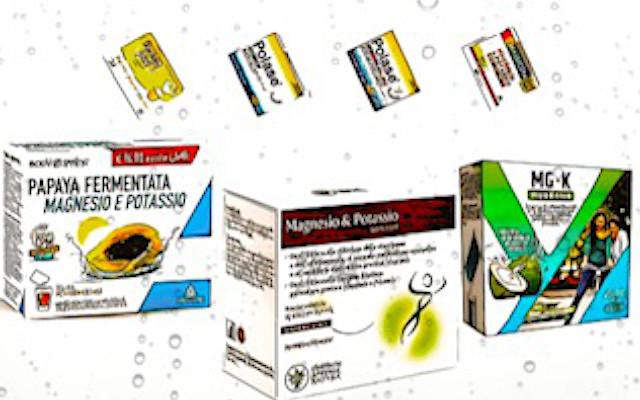
The extreme heat of the long summer 2022 increases the demand for food supplements based on magnesium and potassium. A category of products that are only apparently the same, since the list of ingredients can vary significantly.
Attention focuses on the presence of problematic food additives – as well as unnecessary – and on the cost of food supplementation. Our market survey on 7 of the most famous products available in Italian pharmacies.
1) Introduction. The value of a varied and balanced diet
It is useful to remember that a varied and balanced diet, with adequate quantities of fruit and vegetables, can satisfy in principle all nutritional needs of healthy individuals. And it is important to maintain good hydration, as explained by Paola Palestini, professor of Biochemistry and coordinator of the Master in Advanced Nutrition (ADA) at the University of Milan Bicocca.
1.1) Plenty of water
‘With temperatures very high, sweating increases and there is a greater loss of mineral salts. To counteract its effects, you must first drink more water than usual, even more than two liters a day, depending on how much you move.. ‘
1.2) Risk of dehydration in the elderly
‘The recommendation it concerns in particular the elderly. In addition to having less water in the body, they lose the feeling of thirst, therefore they are at risk of dehydration. They should be forced to drink by handing them a glass of water from time to time’.
2) The role of magnesium and potassium
‘Magnesium and potassium, like other salts, they are important. Both are cofactor ions of enzymes useful in energy metabolism, that is, in the production of energy. What we miss when we feel tired, weak’explains Paola Palestini.
2.1) What foods contain it
Our body needs adequate amounts of magnesium and potassium, at least 2,4 g / day and 4 g / day respectively for a healthy adult. Their contribution is guaranteed by some foods in particular:
– magnesium is present in appreciable quantities in various foods, such as hulled millet, Brazilian nuts, prickly pears, cannellini beans, pine nuts, shrimps, raw spinach,
– potassium abounds in some fruits of the summer season such as ripe tomatoes, bananas and melon. (1)
2.2) Dietary supplements of magnesium and potassium, when?
Resort to supplements food is still useful in some circumstances.
‘If they don’t wear out enough foods rich in these salts – for various reasons – or if this is not enough, it is useful to resort to food supplements. With the foresight to choose those less ‘enriched’ with other unwelcome ingredients’, warns prof. Paola Palestini.
3) Market survey, the analysis criteria
The market survey considers some essential criteria for choosing the food supplements in question:
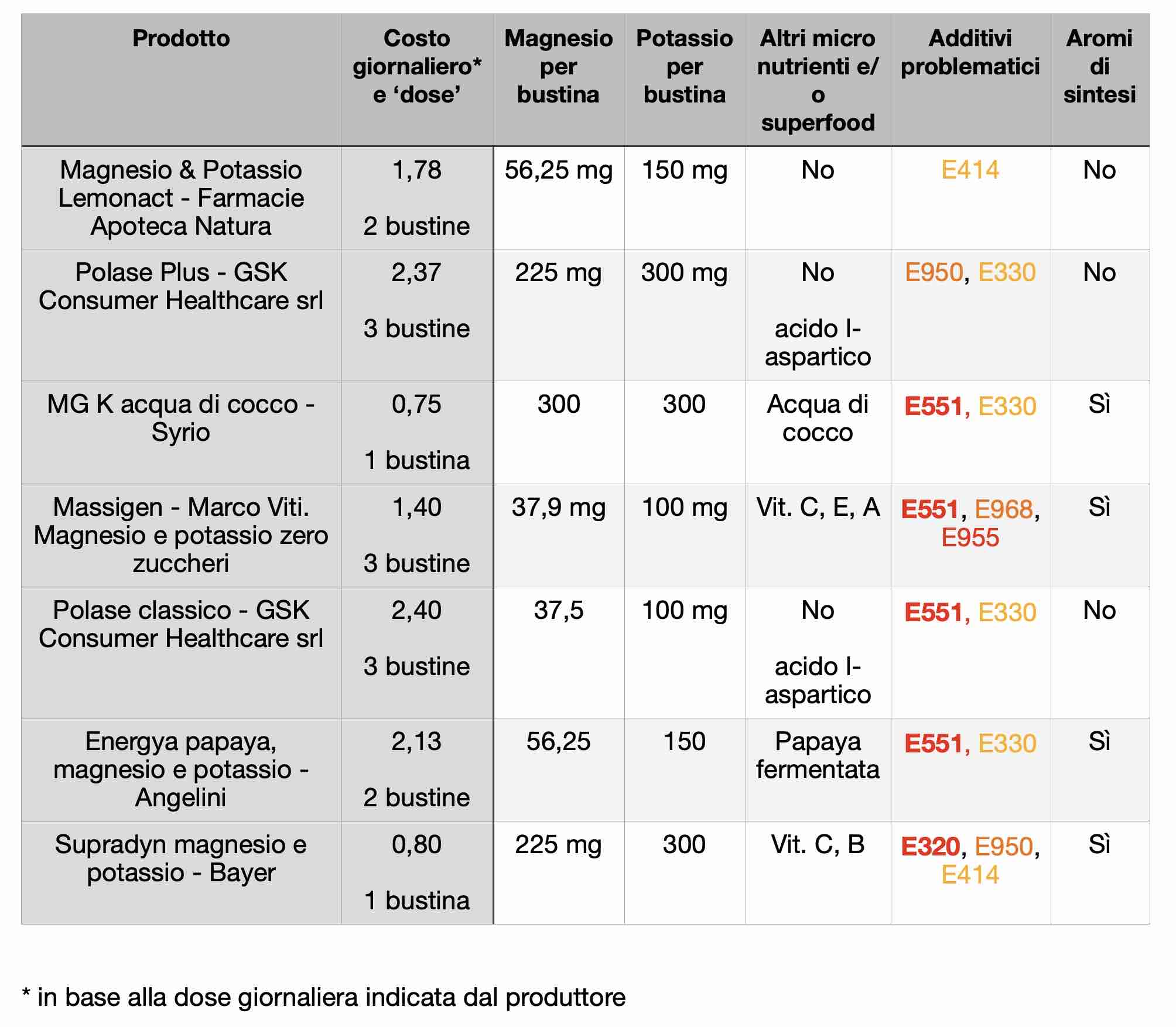
– the presence of problematic additives (which are never lacking, unfortunately), the use of synthetic aromas and the addition of other micronutrients,
– the daily expense calculated on the basis of the price found in the pharmacy and the daily dose indicated by the manufacturer,
– the quantity of the two mineral salts contained in each sachet.
3.1) Problematic additives
The problematic ingredients in fact there is no shortage.
Among the additives, stands the silicon dioxide (E551). This anti-caking agent is a nanomaterial, just like the titanium dioxide dye (E171), banned by EFSA since 7.2.22 in food and supplements, but not even in drugs.
Oral consumption of silicon dioxide is associated with gastrotoxicity, hepatotoxicity and alterations in the intestinal microbiota. Yet it is present in 4 of the 7 supplements examined. (2)
3.2) Flavors and other additions
To transform the integration of mineral salts in a pleasant pseudo drink, moreover, all the recipes pursue the sweet taste (with sweeteners or sugar), the ‘orange’ color (always harmless, in the 7 products) and the ‘orange’ taste, in 4 cases with the use of synthetic aromas.
In two products vitamins are added, in others the addition of so-called superfoods. The products under the GIFT magnifying glass, in brief review.
Massigen, two sweeteners discussed
The Massigen supplement of Marco Viti chooses the version ‘zero sugars’ using the two sweeteners discussed. Erythritol can cause abdominal discomfort such as diarrhea and flatulence. Products containing more than 10% must carry the warning on the label ‘excessive consumption can have laxative effects’. An undesirable effect that paradoxically causes further loss of fluids and mineral salts.
The second sweetener, sucralose E955, is not only useless in weight control, but it promotes its increase. It also alters the intestinal microbiota.
Polase, the highly advertised classic
The most famous classic Polase is proposed on the label as useful ‘to combat tiredness and physical fatigue’. The manufacturer states that the product contains’organic salts, high absorption’ And ‘real orange juice'(in powder, 9%). It also contains L-aspartic acid, a non-essential amino acid (which can be synthesized by the body) used together with potassium and magnesium to prevent cramps.
Two additives they deserve attention. The aforementioned silicon dioxide E551 and citric acid E330, naturally present in fruit but which in the industrial version can pose risks of allergy, exposure to mycotoxins and damage to the teeth, especially among heavy consumers of carbonated drinks.
Polase Plus with sweeteners
Polase Plus arises as a concentrated formula of magnesium and potassium, with ‘organic salts’, like the classic version. Instead of sugar, however, he uses the sweetener acesulfame k (E 950), paradoxically considered responsible for causing weight gain combined with a low-calorie diet and resulting in a studio on guinea pigs that are a source of damage to cognitive memory. In addition to citric acid E330, the Plus version also contains palm oil.
Supradyn, Bayer adds possible carcinogen
The Supradyn by Bayer appears on the label as’formulated with high quality standards’. The claim is vague. It lacks reference to any shared standard, thus implying that competing products are made with low-level standards. And what’s more, it adds three very problematic additives:
– BHA, a synthetic antioxidant, is classified as a possible carcinogen (group 2B) by the International Agency for Research on Cancer (IARC). It is also strongly suspected of being an endocrine disruptor,
– acesulfame potassium (i.e. acesulfame K), as seen, useless and suspect,
– gum arabic, E414, finally, which in the face of heavy consumption or combination with other gums causes swelling, flatulence, laxative effect. Finding them in industrial foods is not uncommon, as we have seen for the milk snacks for children and non-alcoholic aperitifs.
Lemonact, (almost) perfect recipe
Recipe out of the box so far seen in pharmacies is that of the Magnesium & Potassium Lemonact supplement by Farmacie Apoteca Natura.
Sugar (cane) present in a sachet is specified in 3,4g. The aromas are from citrus essential oils, which also give the product the flavonoids typical of citrus fruits The contribution of magnesium and potassium is entrusted to a mixture – Lemonact – composed of concentrated lemon juice, potassium chloride, magnesium, acacia gum (the only additive present).
The formulation combines natural sources of the two mineral salts in a blend ‘natural inorganic and organic salts, in particular magnesium citrate, highly soluble and readily assimilable by the body, and eliminates the need to use anti-caking agents (such as silicon dioxide, ed) and other synthetic excipients’.
Mineral salts e super fruit
Angelini focus on fermented papaya, antioxidant. The supplement, presented on the label as ‘dye-free and gluten-free’, contains a sweetener (sucralose, already commented on).
MG K coconut waterInstead, it also draws potassium from a delicious one super fruit with dehydrated coconut water (titrated 6% in potassium). Sweetens with fructose and sucralose.
Footnotes
(1) SmartFood IEO,
– MAGNESIUM: the 10 richest SMART foods, https://smartfood.ieo.it/nutrizione-e-salute/nutrienti/magnesio-alimenti/
– POTASSIUM: the 10 richest SMART foods https://smartfood.ieo.it/nutrizione-e-salute/nutrienti/potassio-alimenti/
(2) Marta Strinati, Silicon dioxide, additive at risk still in use. GIFT (Great Italian Food Trade), 20.5.21

A professional journalist since January 1995, she has worked for newspapers (Il Messaggero, Paese Sera, La Stampa) and periodicals (NumeroUno, Il Salvagente). She is the author of journalistic studies on food and has published the book “Reading labels to know what we eat”.
Dining and Cooking