
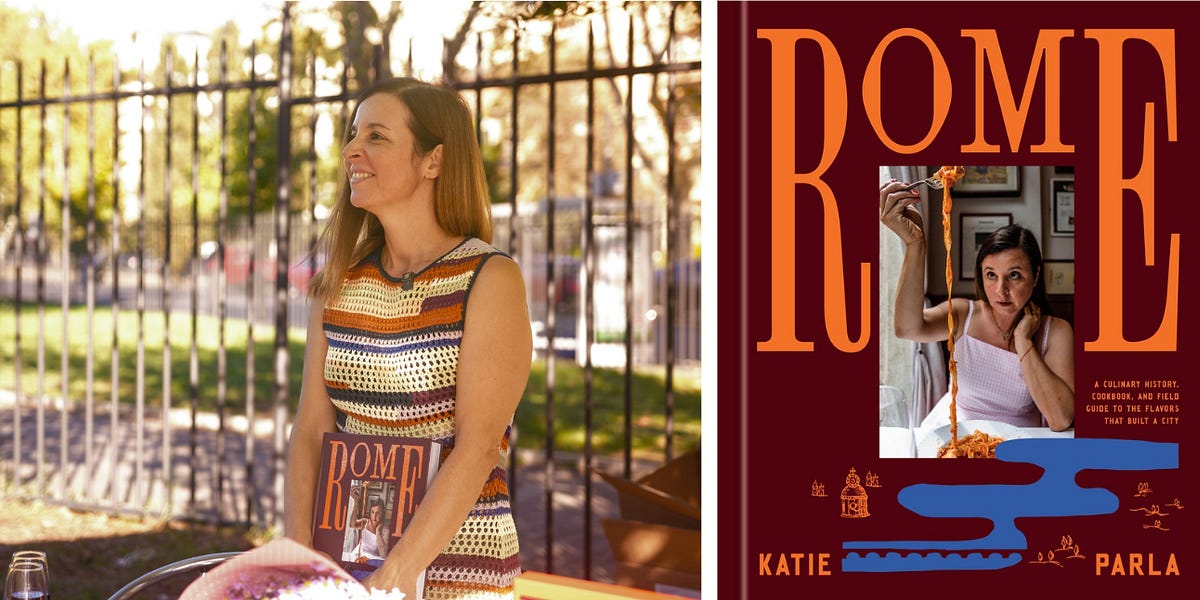

When I was first researching my novel, Feast of Sorrow about the ancient Roman gourmand, Apicius (more years ago now than I want to admit!), I ran across a little-known Roman food blogger and archaeologist, Katie Parla. Since then, her trajectory has been nothing short of stunning in the food world, with several cookbooks under her belt, writing for acclaimed news outlets such as Conde Nast, The New York Times, Eater, and Saveur, and even hanging out on TV with food icons Stanley Tucci and Andrew Zimmern. Over the years, I avidly read Katie’s work and was thrilled when we were able to connect in both Boston and Rome, where she graciously did a reading with me for The Chef’s Secret at Rome’s excellent English bookstore, Otherwise Books.
Katie’s latest cookbook is more than just a bunch of recipes; it’s also a readable homage to the city of my heart (and hers), Rome. I had a million questions for her, but narrowed them down to just a few. Read on for your chance to win a copy!
Rome feels like your biggest and boldest book yet. How does it stand apart from your earlier ones, like Tasting Rome or Food of the Italian South?
This book feels like the project I have been circling for years. Tasting Rome was my first shot at distilling the city’s food, but it had constraints that shaped what could make the final cut. Food of the Italian South was a love letter to a swath of Italy that deserves more attention, yet it still wasn’t the Rome book I had in me. This new one brings together everything I have learned from decades of research, guiding, and eating here. It is deeper, broader, and more opinionated. I let myself write the Rome I live in, not the one filtered through nostalgia or marketing.
You’ve called this book part cookbook, part culinary history, and part field guide. What made you want to blend all those elements into one project?
Rome’s food is too layered to fit neatly into a single category. If you try to write about it strictly as a cookbook, you miss the long arc of how dishes came to be. If you focus only on history, you risk losing the sensory experiences that keep these traditions alive. And if you write just a field guide, you limit yourself to the present tense. I wanted all of it. Rome is a city shaped by continuity and chaos. The format had to match that energy.

You’re tackling almost 3,000 years of Roman food history. How did you even begin to organize that, and how did you keep it from feeling overwhelming?
I approached it the way archaeologists peel back layers of a site. You start with the broad eras, then you dig until the patterns begin to speak for themselves. Rome’s food story is long, but it has a rhythm. Power shifts, trade routes expand or collapse, migration reshapes neighborhoods, and cooks respond. Once I framed the book around those forces, the material organized itself. The key was resisting the urge to cram in everything. I wanted to assemble a comprehensive book, not an encyclopedic one.
You’ve been researching and eating your way through Rome for decades. How did you approach the research for this book, and how did you decide what stories or dishes truly define the city?
I returned to primary sources and revisited sites I thought I already knew. I combed through ancient texts, medieval accounts, early modern treatises, and twentieth-century archives. Then I spent time with cooks, farmers, bakers, butchers, and historians. I kept a simple rule. A dish or story earned a place only if it revealed something essential about how Romans have fed themselves across time. Carbonara is in the book. So is the humble fava and pecorino pairing. Both say something real about how Romans eat and why.
You’re originally from New Jersey but have lived in Rome for years. How does that mix of outsider and insider perspectives shape the way you tell Rome’s culinary story?
Living here for so long has taught me to see the city from the inside. Being from somewhere else gives me the distance to question the stories Romans sometimes take for granted. I can celebrate tradition while also interrogating the narratives that get repeated without evidence. That combination keeps my work grounded and makes the research sharper.

The book includes recipes from chefs, artisans, and home cooks. How did you connect with them and decide whose voices to feature?
These are people I have known for years through my work as a guide, journalist, and obsessive eater. I chose collaborators who understand the city’s food culture at a cellular level. Some are chefs pushing Rome forward, while others are bakers and cooks who carry traditions that stretch back generations. They are all, in their own way, the ambassadors of Roman identity and I wanted readers to hear from the people who keep that identity alive.
I love that you highlight both the classics and the lesser-known dishes. How did you choose which recipes earned a place in the book?
The same rule applied. A recipe had to teach something about Rome. It could be an iconic pasta or a dish known mostly in a single neighborhood. If it helped illuminate the city’s past or present, it stayed. If it felt redundant, it went. I wanted readers to taste the depth of Roman cooking without turning the book into a catalog.
You’ve often challenged the romantic myths around cucina povera. How do you walk the line between honoring tradition and dispelling the misconceptions that surround it?
Honoring tradition demands that you actively dispel the misconceptions around it.
We did an event together in Rome many years ago, and you had just published your first cookbook, Tasting Rome. I remember that you were frustrated that you couldn’t fully tell the stories you wanted because of certain editorial decisions. Your subsequent books have been published independently, which is a big move. What kind of creative freedom did it give you?
Independent publishing let me build the book I had wanted all along. I could shape the narrative without softening the history or omitting the uncomfortable parts. I could ramble about history in a way that traditional publishers might consider too niche. I could give my designer free rein to create a book as vibrant and kinetic as Rome itself.

You worked with your own team on the visuals. What were you hoping readers would feel when they opened the book and saw those images and illustrations?
I wanted readers to feel like they were inside the city rather than looking at a polished postcard version of it. Rome lives in markets, workshops, bakeries, bars, and kitchens. The visuals reflect that lived reality. They are intimate without being precious. They show the grit, the beauty, and the humor that define everyday life here. Critically, all food photography was shot in situ.
Roman cuisine has evolved so much over time, even in just the last fifteen years since I began my annual trek. What do you think it reveals about the city and its people?
Rome adapts slowly on the surface, but underneath it is always shifting. The last decade and a half has brought new chefs, new influences, new approaches to technique, and a growing willingness to challenge rigid ideas of what Roman food should be. The evolution reveals a city in motion. Romans have strong opinions, but they also know how to absorb change and make it feel local. The cuisine mirrors that mix of stubbornness and flexibility.
Rome can live both in the kitchen and on the coffee table. How do you hope people will use it as they explore and cook from its pages?
I hope they cook from it or read it cover to cover without ever turning on the stove. I think the book can appeal to cooks, history enthusiasts, and armchair travelers alike.
When someone finishes the book or cooks from it for the first time, what do you hope stays with them about Rome’s food and the spirit behind it?
I hope they understand that Rome’s food is not static. It is the product of centuries of invention, misfortune, power, migration, borrowing, and joy. It reflects a city that has survived everything and still finds pleasure in the everyday act of eating. If readers walk away with a richer understanding of that complexity, and maybe a craving for rigatoni con la pajata or a slice of pizza rossa, then I have done my job.

To sign up for the giveaway, you can fill out this form. Your name will be thrown into the hat for a shot at a paperback copy. This giveaway closes at midnight ET on Thursday, 11/27/25. Winners will be notified within a week of the giveaway closing and announced in a future newsletter/post.
Important to Note: You must be 18+ and a United States resident (pesky international laws make it tricky to do giveaways worldwide). If you are someone who loves to read the rules, you can find the obligatory info here.

I’ll be at a number of events in the coming months, starting with these fantastic venues. I would make me extraordinarily happy to see you there!
Lovestruck Books, Cambridge, MA, December 2, 7PM in conversation with Julie Carrick Dalton. There will be cake!
Newtonville Books, Newton, MA December 3, 7PM in conversation with Greer McAllister.
Rozzie Bound Co-Op December 6, 1-2:30 PM Book Signing
Book Ends, Winchester, MA January 15, 7PM in conversation with Marjan Kamali.
If you love food and love Italy, and haven’t read IN THE GARDEN OF MONSTERS, THE CHEF’S SECRET or FEAST OF SORROW, click the links to learn where to buy your copy! And now you can pre-order my latest, THE HAPPINESS COLLECTOR out on December 2!

Follow me here: Website | Instagram | Facebook | Threads | Bluesky | TikTok
Crystal King is a participant in the BookShop.org and Amazon Services LLC Associates affiliate advertising programs, designed to provide a means for individuals and sites to earn advertising fees by advertising and linking to Bookshop.org and amazon.com
Dining and Cooking