
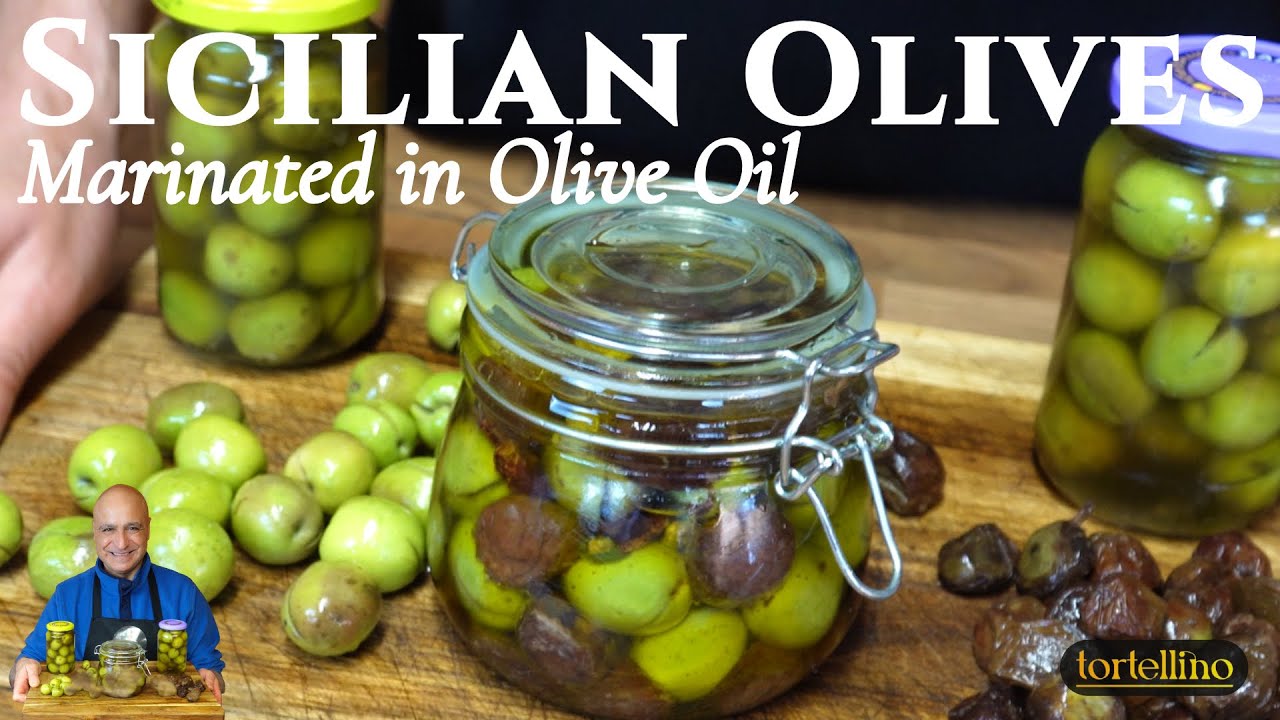
Marinated Olives in Olive Oil – A Sicilian Method from My Sicilian Mum
How to Cure Any Olives at Home using traditional Sicilian methods for both black and green olives.
In this video I show the full process step by step, from preparing fresh olives all the way to tasting and marinating them. These are the same methods I learned in Sicily from people who still make olives in the traditional way, using salt, patience and simple techniques that have been passed down for generations. I prepare black olives by making tiny holes to help the salt enter and to let the moisture escape. They soften gently under pressure and develop their natural sweetness. This is how Passuluna are made in Sicily. I prepare green olives by cracking them and placing them in a simple brine with ten percent salt. They ferment slowly and lose their bitterness over several days. I follow the guidance of my friend Massimo, who produces olives professionally in Sicily.
I also talk about safe ways to marinate olives at home with garlic, chilli, capers and sun dried tomatoes, and I explain why certain ingredients need to be dried or warmed before being placed in oil. This helps to keep everything safe and avoid the risk of botulism when preserving food in jars.
In the video I mention two printable lists that you may find helpful.
The first list contains different marinade ideas from Sicily, Southern Italy and from around the world.
The second list contains guidance on how to treat ingredients safely before using them in oil based marinades.
You can download both lists using the links below.
At the end of the video I taste both batches, show their progress, and prepare a jar with Sicilian olive oil. I keep the rest to continue fermenting until they reach the flavour I grew up with in Sicily.
Thank you for watching and for spending this time with me in the gentle rhythm of Sicilian home cooking.
Download the two printable lists here
Marinade Variations List: https://drive.google.com/file/d/1Tu89QNKGe0QFrhAVIVPdS5_sLPZUgSvm/view
Safe Preparation Guide: https://drive.google.com/file/d/1F3VdzmS2RcrAJlofUTkfBtdE-MNq5F9Z/view
Ingredients
For Black Olives
• Fresh black olives
• Salt
• Optional marinade ingredients
• Olive oil
• Garlic
• Chilli
• Capers
• Sun dried tomatoes
For Green Olives
• Fresh green olives
• Water
• Salt at ten percent
• Optional marinade ingredients
• Olive oil
• Garlic
• Chilli
• Capers
• Sun dried tomatoes
Method Steps
Black Olives
Make four tiny holes in each olive.
Place olives in a drainer.
Add salt and mix gently.
Place a weight on top to help the moisture drain.
Leave for seven days.
Taste, adjust salt if needed, and continue for a few more days.
Store in the fridge or marinate.
Green Olives
Crack each olive gently using a stone, meat tenderiser or knife.
Place in a pot.
Prepare a brine with ten percent salt.
Pour the brine over the olives and keep them submerged.
Leave for seven days.
Taste and adjust salt if needed.
Store in brine or marinate safely.
00:00 Introduction
00:45 Preparing black olives
04:14 Preparing green olives
14:12 Seven day update and tasting
24:55 Safe marinating with garlic and chilli
33:41 Final tasting and storage
#howtocureolives
#cureanyolives
#marinatedolives
#sicilianolives
#blackolives
#greenolives
#tortellinotime
#tortellino
We are just back from Sicily, and my
sister-in-law, Mariolina, donated me some black olives. They are about four or five days old. They
were black when they were removed from the tree, and these are a type of olive called Nocellara
del Velicia. And some of you, when I made some marinated eggplants, asked me, how do you marinate
olives? So I will be doing two kinds today, black olives and green olives. I will do the black
olives first, and this is really, really simple, by the way. And this is ideal, as they have been
in this bag for a few days, but it has been open. We travelled back from Sicily, so I did not have a
choice in the matter. And I am going to show you. So the reason why they are black, as I mentioned,
is because they are more mature. Very simply, get a toothpick, and they are a little bit softer
already as they are a little bit more mature. And I am going to do one hole at the bottom, one at
the top, one on the side, and one on the other side, and I will start collecting them inside a
pasta drainer. So bottom, top, side, and side, pasta drainer. So I will do all of this. Julie
is going to put the camera down. She is going to help me, and then I will show you what to do next.
No, I think I am busy now. I need to go off and do something else. The purpose of these little holes,
by the way, is dual. One is to allow the salt, I will be putting some salt in a little while, to
penetrate the olive and cook it. That is the word they use in Sicily. And the second one is to allow
the moisture to come out. So four little holes is enough. Julie was asking me when the camera was
off, are you sure they are okay? Because they looked to me like, she used the word rotten. That
is not the case, by the way. They are not rotten. That is very much how they make these olives.
They are called Passuluna in Italian, by the way, or in Sicilian, I should say. And I have got
a couple here, one which is well advanced, actually almost ready to eat because they have
been in the bag for a little while. And I will show you this one inside. Obviously, it is not
kind of ready, but if I cut with a little knife, you can see that inside the pulp is already
more of a brown colour. When this will be ready, they will be totally black. This can go in. I
will get another one which is quite hard still, and I will cut into this one, and I will show you
that the inside will be green. Look, can you see? This is still green. I will keep it. They are too
precious to throw away. Okay, so having completed step one, I will show you what step two is, and
this is very much done to individual choices. The quantity of salt you put in is entirely up to
you, but obviously you will need some because they need to cook. So here I have got some normal
salt, and I will sprinkle some on top first. Then I will go in with my hands, and I will give
everything a good mix together. And I will go in again. More salt and more mixing. And I will stop.
Here I have got a pot. I will put that underneath, and this one goes on top. And this is quite an
important step, by the way, especially if you want your black olives to be nice and soft. So
a little plate goes on top. Make sure that the plate is smaller than your container, whatever you
are using. And here I am armed with my weights, which I tend to only use. I am going to change
that. Not his weights. They are his son’s weights. I only use them these days to do jobs like this,
and I have got altogether about 12 kilos. And I will apply them on top of my plate, and they
will be applying a lot of pressure on my olives, and I will leave them. And I will check them in
seven days’ time. And then at that point, I might have to put a little bit more salt, maybe, but
we will check what they look like. There may be a little bit of, not mould, what looks like mould.
Do not panic. It is not going to be a problem. That is very much a feature of this job. So I will
put this aside, and I will go on with the green olives next. With the green olives, I have been
keeping them in water for a few hours so that they are washed and rinsed from any dust or any dirt.
In the old days, they used to keep them in water for two or three days, but I spent some time with
an expert when I was in Sicily, and he said to me, pretty much, do not bother, no need to. Just give
them a good wash and leave them in water for a couple of hours, and that is plenty enough. So we
do not need to keep them in water for two or three days. But of course, we will not tell your mum
or your sister or anybody that, because they all still do it in water, leave them in water. Yeah, I
think it is one of those things that they do, most probably because of traditions more than the real
value added. But that is fine. You do what you wish. I have kept them in water for two or three
hours. And also, when we were in Sicily, we tested some of the olives that this gentleman produced.
He is obviously a business, and I am following very much his method of doing this, which is very
traditional now in Sicily. And nothing here, by the way, is rocket science. Everything is really,
really easy and all based on old traditions on how they do these things still today in Sicily.
With the black olives, I pierced them, and they were fine, very easy. In this particular case, we
need to make sure that I crack them open, and that will also allow the salt to go in and cook them.
So you have got different ways on how you can do that. And I have got here a meat bash, which is
mostly what I will be using today. And ensure that you have got a nice and smooth surface. You can
also use, here, I have got one here, a stone. And I have got here a flint. Again, I washed it and
ensured that it has got a nice, smooth surface. Or indeed, if you like, you can use a little knife
or a little paring knife. So I will try different methods today, and I will let you know which one
is best. I will start with my meat bash first, and I will go very gently though, enough to just
gently crack it open. You do not need to go mad; otherwise it will explode. Just a little crack,
enough for the salt to go in and carry on. So I will do another one. That is good. My mum, for
years and years and years, always used to use one of those flints. And I do not know what… it does
not work. There you go. I think as you do more and more, obviously, you understand how strong
to go. You can also use a hammer, but remember, you are not hammering a nail. You are trying to
break the surface of an olive. Another option, and this is what my friend Massimo suggests, is
to also use a knife. So again, you can go in, do that, and that is good enough. Enough for
the salt to go in. And actually, most probably, this is the more modern and quicker way of doing
it, I guess. Let us try with this one. I think I like the meat bash one very… Meat bash, yes. The
meat bash actually gives more of a rustic look because it actually does split open, whereas with
a little knife it gives only a little cut. But we will do some and some, and then we can compare.
So once again, I am going to add Julie. It is the only reason he has brought me out here today.
I said, can you come and help me do this really, not the video? And I have got quite a lot to do,
so we will see you once Julie has put the camera down, and we will carry on. See you in a little
while. I am going to spread them out. This is the way forward. I think Julie is enjoying herself.
So what do you say, Julie? What is the best way? I do quite like the stone, funnily enough.
More than the cutting with a knife. I think cutting with a knife is a bit too pretty.
I mean, you want them to look a bit gnarly, do you not? Gnarly. Gnarly, yeah. Look, lovely.
I quite like the stone. Nice, clean, soft, flat, smooth stone. Let us have another little go with
this. Hang on. I am a little bit heavy-handed with this. Yes, I can vouch for that. But it is very
hard to get it just perfect, like old Tortellino over there. Oh dear, I have two popped in there by
mistake. I have gone for the elegant little cut, whereas Julie has absolutely massacred the olive,
made a mess here. It is not science involved. If you look, some are harder, some are softer.
You should have seen her. They were flying everywhere. They were on the floor. But look how
many I have managed, everybody. Yes. As opposed to Francesco’s little pile. Yeah, of course. That is
quite a difference. Look. Yeah, but mine… there, look. So these are Julie’s, and here are mine.
All right, you have done a little bit more than mine. Never mind. Okay, so it does not really
matter. It should not make any difference. But we will be interested to test if there is a
difference or not by the time they are ready. I should point out that when I spoke to my friend
Massimo, he did say to me, ensure that your olives are as fresh as possible, so only within
a few days of being picked from the tree. These olives were donated to me by my friend Enzo, and
we made a little video when we were in Sicily on how they make olive oil. And there will be a
little link up here if you want to see that. But Enzo, who grows olives for olive oil purposes,
he very kindly donated me these olives so that I could marinate them in the UK. One thing I should
say is that they also need to be quite firm, and if they are too soft, unlike the black ones,
no good really. You want to start with a nice firm olive. And also, ideally, this is not good because
they do stipulate that they need to be green, mostly for aesthetics, I suppose, as well. But
I did actually carry mine in my hand luggage and some in my case. And the black ones are the
ones in my hand luggage. And if I was in Sicily, most probably, they would not use this for
marinated green olives. They might make Pazzoluna or throw them away. But they travelled 2,335 miles
with me, and I am not going to throw them away, so I am going to stick to the original plan.
And this is a different process, of course, to the black ones. So I go here, a litre of
water. I might have to do this twice, as I’ve got two containers. And I’m going to tear this off
so that I start from zero. And I’m now applying 10 % of salt to a litre of water. So 63, I won’t
end up at 100. There you go. That’ll be fine. 100, perfect. And I’ll mix it together so that all of
the salt is dissolved in the water. I’ll pour it inside my bowl with the olives, making sure that
all of my olives are totally covered by water and salt. I just had a little bit more water as I
was slightly short, so a little bit more salt, in it goes. So what is important is that if you
place your hand on top of your olives, you can press them down and they are totally submerged
in water. Here I’ve got one of Julie’s 20,000’s put-away containers. She’s got a thing about
them. I have. I love them when they come in a set. There’s a certain supermarket in the UK, they’ve
even got some new ones this year with new colours and I’m… desperate to buy them, but never mind. A
bit like your Christmas spatulas. Absolutely. So I’m using the lid of another Tupperware container
that fits inside so that I can apply some pressure and I’ll go a little weight here and I’ll put it
here and this will ensure that air will still get in and out, but also they will stay under water.
So I’ll repeat exactly the same process with this one and then I’ll show you what happens next. The
advice from my friend Massimo was not to be mean with salt. You can add more but do not add less
and I’ll explain that in a moment why that is the case. So I’m now doing the second lot and that
should be more because this is my lot and it’s a bit smaller than Julie’s and this is also ready.
So 10 % salt. I will leave this for seven days. I will not touch it and within a few days you
will see that a little frothy foam will develop, do not panic. It’s very normal because everything
is beginning to ferment and the olives will be cooking inside. That’s what the salt does. In
seven days’ time I will check the salt level, and what Massimo did say to me is that when
they make these olives industrially they’ve got equipment that measures the grading of
salt to ensure that it stays broadly at 10 %. In a kitchen at home you don’t have such
equipment. So the best thing to do is to check it by testing it. But I’ll do that in seven days’
time and then I will be likely to top it up to ensure that the salt stays roughly at 10 % because
that is what ensures that you get a nice and solid olive at the end. So do not worry about the froth,
it’s not mould, it’s perfectly normal. And I’ll see you in seven days’ time. By then I will also
check the black olives, which will have dried and they will be well on the way. So, cha-cha for now
and see you then. Just a question though. Just a question, my love. Why don’t you pop your finger
in now and try and sort of gauge the saltiness of the water now? Because otherwise, how are you
going to gauge whether it is less salty? Do you see what I mean? In seven days’ time. I knew there
was a reason why I married her. I was going to say, are you just going to chuck some more salt
in? Okay. Salty, be like a sea-water salty, but I think I will be able to remember it in seven
days’ time, but we’ll see then. Thank you. See you later. Let’s see what difference seven days
make. One hundred and sixty-eight little hours. There you go. I think Julie’s more impressed about
the fact that I can carry 12 kilos of weights more than anything else. Absolutely. He needs to get
on that, make that a daily occurrence. Okay, let’s start with the one marinated in salt. And here
are the ones that I have very elegantly cut with a knife. And here are Julie’s. Oh, so that makes
them mine. Thank you, Julie. Now, if you look, as I mentioned before, you can see that there is
a little bit of mould or whatever, as I mentioned before, it’s not a problem. It’s very much a
feature of the fermentation, so do not panic. Okay, I have opted to go for a more scientific
method to test the saltiness in the water rather than just try to remember what the salt level
was before. So here I’ve got 100 millilitres of water and I’ve added 10 grams of salt. So
what I will do, I’ll just dip my finger here and I’ll taste it first. Salty, not as salty as
before. Let’s try here. Oh, definitely saltier. So Massimo is absolutely right. The level of salt
content in the water has gradually reduced because it’s been absorbed by the olives. So I need to
add a little salt. So if it says play by here, and that is what I will do. I’m an accountant,
so I can play by here very well. So I will follow his advice. Just say fill up a spoon-full of salt
and add it in. And I got a little bit more water here and I will just top it up only slightly and
I’ll mix it. And I’ll split it 50-50 over here and some over here. And I’ll give everything
a good mix, like this and like so. And also, before I leave them, I’ll just test them. So
I’ll try one of my elegant ones and test it. It’s well on the way. Actually, it has lost its
bitterness, is strong and most probably needs a little longer, but they are getting there very
nicely. Let’s try one of Julie’s to see what they are like in comparative terms. They are identical.
It goes to show really, it doesn’t matter if you crush them or if you cut them with a knife. So
I will leave this now back in place as before, and they will need another three or four days.
So today is Saturday, so I will see them again on Wednesday, Tuesday or Wednesday next week. And
I’ll move on to the black olives over here. So let’s remove the weights. Let’s get rid of this.
Okay, you can see there is a little bit of rust developed to the bottom because of the weights,
of course. And here they are. And likewise, you can see that the old olive has got the odd
trace of what one could call maybe a gentle mould or maybe the salt, I don’t know, but it doesn’t
really matter. And before I proceed, I want to taste one because this looks more advanced. You
can see that some of them are greener than others, so for example this one here, but some of them
are well on the way, so I’ll just pick a black one. Before I taste it, I’ll slice it open to see
the colour inside. So let’s have a look. You can see that they are on the way, they’re browner than
they were before, but they should be a little bit darker. But I’ll taste it anyway and see what
it’s like. Oh, they’re lovely. They’re really, really sweet and they’ve gone soft, which is
typical of Pasta Guna. And they most probably would be ready now. However, in line with the
instructions I was given, I am going to deviate too much. I’ll add a little bit more salt, not
a lot this time. And I’ll give them a little mix once again. And I will also leave them for a few
more days. Shall we see what’s underneath? Yes, of course. Very good point. Oh, look at all of the
liquid which has been drained. Quite remarkable, actually. Can we do anything without? I don’t
know. Is that something you’ll have to look into? I’ll look into it. I’ll let you know next
time when we look at them again on Wednesday. By the way, I have also documented myself a little
bit further. And by the time I see you again on Wednesday, Tuesday, Wednesday, a few days, I will
also give you some ideas on what you can do with them. And you can eat them straight away, as they
are, of course. But I have produced a little list here where I have got some recipes on how you
can marinate them further. So I’ve got a classic combination, which will be a number about eight
or nine, such as lemon slices, chilli and garlic, which is very, very typical Sicilian. Or the
Southern-Italian inspiration, such as Calabrian spicy chilli with garlic and bay leaf. But also
I have got some other variations from all over the world. So, for example, I have got aromatic
variations, which have got coriander seeds, orange zest and thyme, and others also sweet and rich in
tones, and international spices and twists. So, for example, I will be giving you the Spanish
model, or the Greek or Moroccan. I will not be doing them all next week, but I will tell you how
you can safely do it, especially if you are using garlic so that you avoid botulism. And then I will
make this, not this one, it is dirty now, I will make this available online so you can download
it and you can do whichever version you like. So that is the lot for now. You have got my 168 hours
update, and I will see you on Wednesday. Cha-cha for now. I will start with the black ones because
they are ready. So I will just remove the weights. So here we go. So this is exactly 11 days since
the very beginning when they were put in salt, and they are ready actually, pretty much done.
Some of them are greener than others, but that is fine. I am sure that they will be perfectly okay.
And very simply, to start with, I will move them into a little plastic bowl over here. And I will
marinate some in a little while alongside some of the green ones, but I will not marinate all
of them. And they will live here in the fridge, and as and when I want them, I can then marinate
them or just eat them as they are. I will just try one more. Be rude not to. I just had my breakfast,
but… you never turn down all the way down, especially from Sicily. The other day, Julie asked
me what to do with this, and I said I would find out. I read about it, and it is not good for
consumption in terms of human consumption, but generally in Sicily they just throw it away
because it is the water content from the olives, but also it has got a high degree of salt and
minerals. So it is very, very, very… not nasty, but very strong. But one thing that we are going
to be doing, having read about it, is to dilute it with water, one part of this and ten parts
water. So most probably we will fill it up and we will put it in our compost bin. And because
of the high degree of salt and minerals, it will accelerate the composting process. So it does not
go to waste. Oh, that has made me very happy. That is how sad I am. I have not told Julie that. She
has only just found out. So literally you do not have to put anything else on top of them, just
like that, and they will be okay in the fridge? They are just good as they are in the fridge, and
they will be delicious any time you want to eat them. But I will marinate them also, as I said. So
let us move on to the other batch, and I will pick the green one because I was told that Julie wants…
no, I picked the red one. I was told, Julie, that she wants the red one back. So I will use this. So
let us take a look to see what they look like now. Oh, these are the elegant ones, Julie, not yours.
I will just taste one again. I can hear they are more crunchy, are they not? Well, they would be,
yeah. They are lovely. They are strong, yeah? But as a Sicilian, I love them. But most probably,
if you are used to eat olives from supermarkets and so on, you might find them a little bit
too strong. But they are perfect as they are, so I will marinate some, but I will show you
what to do to continue the process. First thing I will do is to remove some of the surface water
where there is a little bit of this foamy stuff, which I can easily remove now. I said the other
day that I will talk to you about safekeeping of olives and how you can preserve any food in a
safe way, so I want to make sure that anything I tell you is absolutely safe. But the first thing I
will do is to remove the olives from my water, my brine, and I am using a ladle here with the holes
underneath so that I transport as little water as possible. And this is a little salad drainer. I
think it is ideal for this job. So I am going to scoop about maybe three. That will be fine. And
I will give them a quick spin to ensure that I remove as much of the surface water as possible.
I am taking a very safe approach to this because, although very rare, botulism is very dangerous.
And I will explain a little bit more in a little while, but it can be lethal if not dealt with
properly. I do not want to scare you, but you need to be aware of it. And if you look, can you see?
That is a little bit of brine which I have already removed. And using some kitchen paper, I am now
patting them dry so that I can remove as much of the surface water as possible. So they are
dry enough, and I will move them in a separate container for the time being. Today I am going
to be marinating my olives with some garlic, even if Julie is not very keen, because some of you
actually have asked in the past. To be fair, it is just that I do not like olives with garlic. I
love garlic with everything else, but it is just, for me personally, it is just something about it I
am not that keen on. However, today I am going to show you a way to do it which is really safe. And
as I mentioned before, it makes botulism also a thing of the past. So I am going to quickly apply
a little oil on a frying pan, and I am going to be fairly generous because I am not going to fry the
garlic. I am going to gently warm it up. Likewise, I am going to use some chilli peppers also. These
are chilli peppers which I keep in the freezer. So another extra reason to take this step. So what
is botulism and why am I always banging on about it? It is actually quite rare and it is a little
bit like a poison if you are not careful. And it is the ideal condition that gets created when you
are placing raw products such as garlic or indeed even chilli peppers or other vegetables like
broccoli and cauliflowers in raw olive oil. And what happens is that it matures—no, develops—kind
of a mould, if you like. And the olive oil has not got any air, and it is a perfect condition for
this botulism to come up, and it can be lethal and poisoning. And what is worse is that you will not
know it is there because actually you will not see mould, you will not taste it. And it is actually
something that I have seen and spoken about a lot. But unfortunately, a lot of content creators tend
to somehow ignore it sometimes. And I have seen viewers asking very responsible questions on the
subject, and the response from the creator can be very defensive and often fuelled by a degree
of ignorance and sometimes arrogance. Because actually it is something that exists, and their
response is that the mums or the grandmothers have done it for generations and nothing has
ever happened. You can take the same view with crossing the road without looking. You can cross
the road 100 times without looking and never get run over. But all it takes is one time for the car
to come and hit you. So why take the risk? So what I am doing here, I am removing the moisture
element from the garlic and from the chilli, which is what helps develop botulism. It is a
bit like when I make my breadcrumbs. I have got my little container over here. I will give you
a very good and clear analogy. I have made these breadcrumbs about three months ago, and here they
are. They look perfectly okay. There is no mould, they are dry, and they are beautiful. And what I
do, I pretty much buy the bread when it is fresh. I leave it out to dry in a room for about four or
five days. Then I put it in the food processor and I place it in here. I drill some holes on my lid
and I leave it to continue doing so. And what happens, because there is air circulation and
the breadcrumbs have dried, there is no mould. However, if I was to place my fresh bread inside
my container and I placed the lid on, no holes, within a day or two you would have some mould
developing. So effectively the container is the equivalent of the oil, and me drilling the holes
and drying the bread is the equivalent of what I am doing now with the garlic and the chilli.
Effectively, I am removing the moisture to make it safe. I have got a second list here which I
will be sharing with you guys because what is close to my heart is also your safety, and this is
not an area that really can be ignored. And it is very rare, as I said, I do not want to scare you,
but it is there. So I have got a list here of many ingredients’ guide, where you can treat certain
things for preservation starting from garlic and fresh chilli, even basil and parsley. They can
actually hold moisture. So the general rule is that if it is wet, dry it. If it is juicy, make
sure that you cook it. Or if it is dry, you can use it. So I will make this available also with
the video alongside the other list of different ways on how you can marinate your olives, and
hopefully you will find it useful and be safe. So while I have been talking, my garlic and my chilli
have been very gently warming up. You can see that it is very, very low in temperature, and I will
leave it for another minute so that it dries up, and then it will be ready. And that is it. It
is enough. I can turn this off. I have sliced my garlic thinly, so it will not take very long. So
I can safely remove it from the heat. I will place it here, and I will leave it to gently cool down
until it has reached a good temperature so that I can mix it with the olives. In the meantime,
I will show you other ingredients I am going to be using for this marinade. And I have got
a combination of sun-dried tomatoes and also capers. Now, sun-dried tomatoes, I do not need to
do with them what I have just done with the garlic and the chilli pepper because they are sun-dried
and they are already dry, and that would be in my list. So I will get, again, something Julie is
not too keen on, so I will make sure that I do not go excessively mad. That is okay. I pick them
out and give them to you. I know you do. And here are some capers. And the one thing I need to do is
to remove them from the salty water. And just like olives, these are already treated, so I am
comfortable that there is no real water left here because they are in a fairly acidic solution, and
acidity is what you also need to ensure that you can fight botulism. And being that the capers are
salty, I am not going to add any salt whatsoever to this. And also, the sun-dried tomatoes tend
to be quite salty, so this is perfect. Oh, look, there is a piece of garlic. I am glad it goes in
the bin as this is untreated. And I will make a start, and this is really simple. So I have got
some of my black olives, and they can go and form a little base. I will add some of my green olives
next, a few capers, sun-dried tomatoes, and I will scoop some of my oil and some of the garlic and
the chilli pepper and place it inside. And I will start again and I will carry on until I reach the
top. So, layer of olives once again. And this time I am going to go and put all of my remaining oil
inside, all of my remaining sun-dried tomatoes and capers. And I will finish with a layer of green
and black olives. Looks lovely. Here I have got some of the green gold of Castelvetrano. This is
olive oil which was donated to me by my friend Filippo when I visited Sicily last time around.
I made a little video on how this is made. I will make it available on this video, of course. And I
will go very gently to ensure that the oil finds its way all the way to the top, and I will stop
once it reaches the top. And that is perfect. You will have noticed that I have not added any
dry basil or any dry rosemary or anything like that because it is not necessary. The best thing
to do is to add those additional herbs when you get them out, and they will be fresh and also they
will release a lot more flavour. And these are ready to eat, of course, because they are already
ready to eat. But I will give them a couple of days, and then Julie and I will tuck in, and I am
lucky to get the garlic. Now the remainder of my olives will continue fermenting, and the longer
you leave them to ferment, the milder they will become in taste. So what I will do is exactly
what my mum used to do but more on a larger scale, and I will show you also what my mum used to do.
So I will mix them together in one container as I should have enough now so that everything fits
in. And I have put the lid on properly this time, and they will go in a dark room, room temperature
is fine, and they will continue doing their own thing. And they will take between now and February
to get to that optimal position in terms of taste. But any time in between now and then, you
can eat them. And what my mum used to do, she would just pick some and then she would either
marinate them in olive oil or eat them just as they are. Entirely up to you on how you choose
to do them. But there will be a point eventually in time, and that is likely to be February next
year, where the olive will stop absorbing salt, and it does not matter how long you leave them
in there for. They can stay in there for a year if you like, but obviously they will no longer go
through that process. Also, something else which is very, very common is to put them in jars.
So it is the same as that, but again, get some olives and put them in, go to the top, but leave
a little bit so that there is room for your water. Then go back to your salted water and add it to
the jar. So here again, put the lid on, but as Massimo, my friend, said, do not do it too tight.
Make sure that it is a little bit loose so that you get that circulation of air still going on.
And again, my mum used to leave it like that also, and then the jar is ready for you to empty. You
can rinse it under the water if you want to remove the saltiness from the olives, dry them, and off
you go. And that is it. That is pretty much all you need to do. Just hope that you remember that
the lid is a little bit loose when you go to pick them off the shelf because that is the sort of
thing I would do, is end up with them on the floor. But there you are. She has actually got a
history of breaking a lot of things. Yeah, I am a bit clumsy. And as you can see, I am armed with
lots of other jars. My job today is going to be to make little jars and fill them up just like
this and donate them to my children and family so they can also enjoy these lovely olives from
Castelvetrano. So it is a very simple process, just a little bit of patience, a little bit of
care and attention if you choose to marinate them with garlic or anything else. Otherwise,
just eat them as they are. They are just as delicious. Thank you for watching. Hopefully you
enjoyed the video, and see you later. Bye bye.
11 Comments
Ciao. If you would like to try this at home, the full method is in the description and you can choose either the black olives or the green olives. Please let me know how your olives turn out and if you try a marinade of your own. In the video I mention two printable lists, you can find the links here as well for easy access:
Marinade Variations List: https://drive.google.com/file/d/1Tu89QNKGe0QFrhAVIVPdS5_sLPZUgSvm/view
Safe Preparation Guide: https://drive.google.com/file/d/1F3VdzmS2RcrAJlofUTkfBtdE-MNq5F9Z/view
Olive harvest time in Italy and everyone is doing preparing their olives. As I didn’t have an Italian mother, I didn’t know what to do but now have found out from you. Many thanks
This is very interesting. So glad Julie asked about the brine as that was my Q. Composting is a great way to recycle. I m not sure 🇺🇸 would allow loose olives through customs, but I have no fear of having to cross that bridge! Thank you so much for your time and effort. ❤❤
Very intersting, thank you. May I give you a tip about pouring the oil without making a mess….hold the can with the spout on top, not on the bottom. You wont have the oil glugging out because all the oil under the spout.
Love your videos
My grandmother always put olives up here in America. We loved them. I can’t find her recipe, but remember garlic, salt, oregano oil. She used green olives. Miss her and my Mother who did it together. We were blessed by the care they gave these olives. ♥️♥️🙏🙏🇺🇸🇺🇸
Very good video. Thank you
Thanks for sharing the olive production secrets 🤩
How did you manage to smuggle them through the customs? As an Italian professional cook, also living abroad, answered them: "It's for the preservation of the Italian cucine!" 😅 ❤🇮🇹
I love how you explain everything in detail. I have always wondered how olives were made.
"Botulism" is the condition caused by "Botulinum" which itself is the toxin produced by the bacterium Clostridium botulinum. The organism requires anaerobic conditions in order to survive (i.e. no oxygen); one reason why preserved foods can be susceptible to contamination (for those who remember the tinned salmon outbreak in the 1970's). It tends to enjoy low acidic conditions.
Always something to learn, thank you for being honest and explaining everything.
My family has never prepared them as they’ve always been freshly prepared and sold in Italian Supermarkets here in Canada.
Will give it a go in future.
Thanks for sharing