
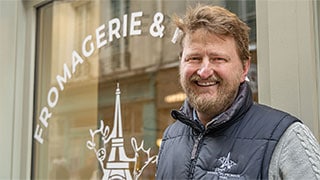
Diversity. The word “diversity” just hints at the huge array of cheeses French producers create. Brisson points out that France’s varied landscapes, climates, livestock, and flora are reflected in more than 3,000 cheeses.
In populated areas, soft cheeses like Brie could be purchased, young and fresh, every day by hungry customers. In the mountains, cheeses had to be aged until they were dry and hard enough to resist spoilage, then brought down to market a few times a year.
Where cows would starve on sparse pasture, hardy breeds of sheep or goats provided the milk that sustained farmers and cheesemakers for generations.
Then there’s the microbial bounty. The orange bacteria of Saint-Paulin, the blue mold of Roquefort’s caves, and other unique biota shape the look, texture, and flavor of local cheeses.
Brisson notes that when the building that houses the museum was constructed, most cheeses were consumed just a few miles from where they were made. Until transportation got faster and mechanical refrigeration was developed in the 19th century, most consumers in France had never even seen most French cheese.
State-of-the-art. Brisson, who saved for 10 years to fund his dream of a cheese museum, highlights diversity in the main display hall. Visitors can not only choose whether to experience the interactive displays in French or English, they can decide to explore hard, soft, or blue cheese. (Of course, the best answer is to go through the process three times.) The building—and the techniques many cheesemakers still use—may be old, but the technology behind the innovative, hands-on displays is state-of-the-art. Guests wave a hand across a beam of light to pump imaginary milk or pour rennet into a glowing vat. Captions describe the manufacturing and biological processes in play.
A few yards away is an active cheesemaking station where Brisson demonstrates cheese production. And, artistically lit in the center of the room, are pedestals with a range of cheeses selected for tasting. Brisson says cheese tasting is a huge hit not just for foreign visitors, but for the museum’s many French guests, too. He attracts an after-work crowd for cheese-and-music events with a global focus, like an Irish cheese and whiskey tasting last St. Patrick’s Day. And the gift shop is a cheese shop.
Brisson hopes to extend his offerings by bringing guests to the countryside for cheese tours.
He is also eager to inspire the next generation of cheesemakers. Brisson says many mid-career enthusiasts are studying cheesemaking, but alarmingly few teenagers are entering the industry. Through visits and internships at the museum, he hopes young people will—like he did—find that spark of passion that fuels a love of the cheesemaker’s art. ‡
Dining and Cooking