
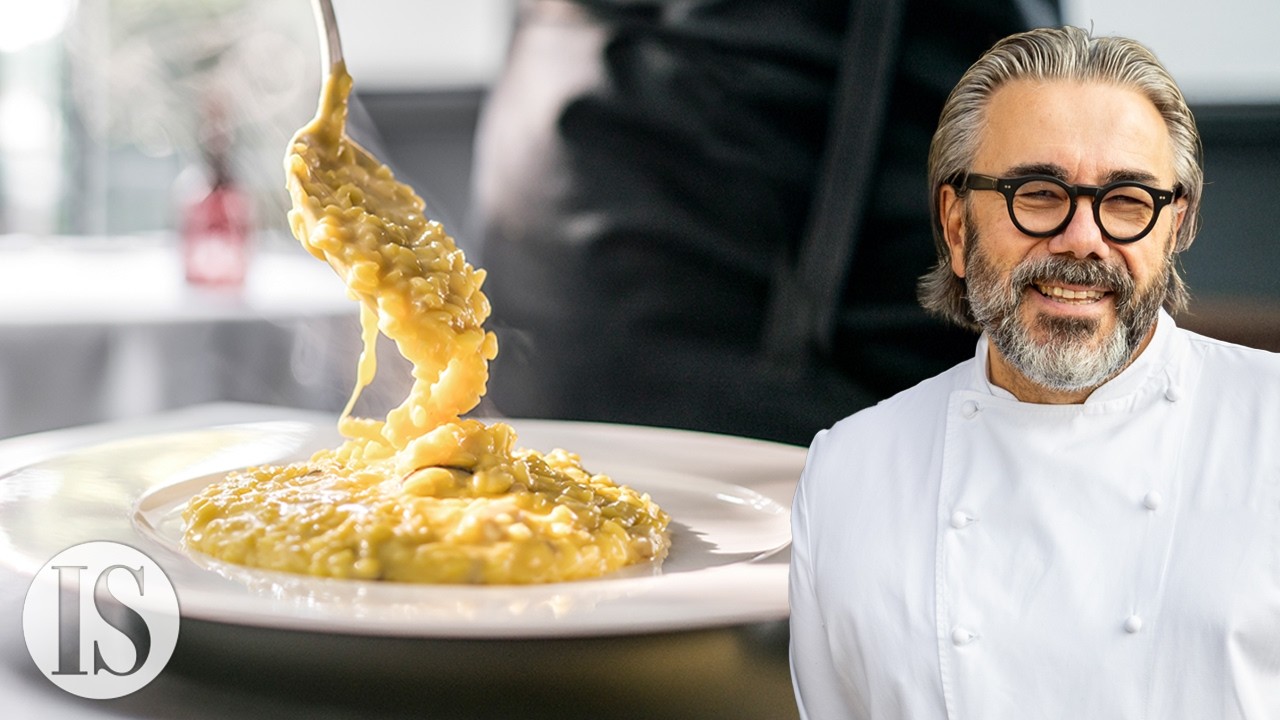
La grande cultura del riso e dei formaggi italiani si incontrano in un piatto simbolo di un ristorante e di un territorio intero, il risotto del Miramonti l’altro. Philippe Léveillé presenta la ricetta in carta dal 1957 e nel farlo ci porta per mano attraverso uno dei carrelli dei formaggi più ricchi e premiati d’Italia.
Scopri “Riso all’italiana”, il primo libro dedicato alla cultura del riso in Italia in tutte le sue forme: https://shop.vertical.it/collections/books/products/riso-allitaliana
Siamo riusciti ad avere una ricetta INDICATIVA del risotto del Miramonti l’altro da Philippe Leveille, un traccia per consentirvi di sperimentare anche a casa:
Riso Vialone Nano 280 g
Burro 200 g
Funghi Porcini 120 g
Formaggella di Collio 80 g
Parmigiano Reggiano 36 mesi 80 g
Robiola 60 g
Taleggio 60 g
Zafferano 2 stimmi
Brodo vegetale qb
Vino Bianco qb
Sale qb
Guarda la Zuppa di Pesce: Originale (Bouillabaisse) vs Gourmet (Pasta) dello chef Philippe Léveillé https://www.youtube.com/watch?v=OT_HUWZHT2c&t
Scopri tutti i video dedicati al Riso da ItaliaSquisita: https://www.youtube.com/watch?v=8v-o4IngMM4&list=PLWKLqE-7K4-bTGxXkLGL0MinF6fJmDB-s
Visita:
http://italiasquisita.net/
Shop:
https://shop.vertical.it/
Seguici su:
https://www.facebook.com/pages/ItaliaSquisita/147031685608
Tweets by italiasquisita
https://www.instagram.com/italiasquisita/
Contattaci:
info@italiasquisita.net
Welcome back, I’m Philippe Léveillé, I’m still the chef at Miramonti L’Altro. We are in Val Trompia. My cuisine, like all cuisines in Italy and around the world had its evolution, but there are some dishes that have really remained pillars of Miramonti L’Altro. One of these pillars is the famous risotto
by Miramonti L’Altro. We are talking about a risotto that – I wasn’t even born and it already began to exist and we’re talking about 1957. 70 years later and more, it still exists. It is predominant in my restaurant, it’s the one which triumphs among
the first courses still in 2025. We are in an area where cheese is very important. Even at that time, around 1957, perhaps they worked more with ‘Malghe’, they used to go look for the cheese where it was manufactured. It is also a pleasure to have taken up recipe like this that doesn’t belong to me, but which is part of the pillars of our restaurant. Our luck is being in a valley very rich in these Malghe, because there are some left, there were a lot more a few years ago, but there’s still
this sense of abundance of cheese. You can see two carts
of cheeses coming and Lombardy and especially the valleys that are all around us are well represented and this is the pride of this place. So, these two carts are
composed of three types of cheese. On one we have all the mature cheeses, on the others we have all the soft cheeses and all the blue cheeses. The selection was made by Daniela, my wife Daniela Piscini who has a great experience that is made of all these years of research and these are available on two carts of cheeses. The part of the valleys that are around us and part of Lombardy are rightly privileged. And then, well, you can see the king of cheeses. We have Bagoss. This miracle of nature that takes this saffron flavor from the milk, mixing it and letting it age in the Malghe, but we’re also touching on other areas of all of Italy, a direction
that goes from the South, to the center, to the Piedmont areas. The only French thing here is me. On the cheese cart there is not a single one. I’m always happy with people coming from my land and showing them that it’s not just France that has so many cheeses, but one could also say that Italy has much more, more variety.
French cheeses are well classified, meaning it’s like this, it’s like a painter’s palette. There’s red, there’s blue, there’s yellow, there’s green, there are the main colors. They don’t have pastel. The beautiful thing about
Italian cheese is this, the fact of diversify cheese from different areas, perhaps starting from the same region, but there is a multiplication of products that France certainly doesn’t have and this just pleases me because I have much more raw material. So, this risotto contains four cheeses: robiola, formaggella, parmigiano and taleggio. The synthesis of these cheeses gives you
the creaminess we want. So, the peculiarity of formaggella
from Coglio, as its name says, formaggella, therefore it is new, it is fresh, its creaminess is genuine, it is simple, it is the cheese that even a child can eat, but inside my risotto
it’s a completely different thing. Robiola. You consider robiola in this sense – when one sees a robiola, I reprimand
the supermarket because it offends me. Robiola from the supermarket doesn’t make any sense when eating it, in my opinion. But that’s not a criticism. When you see a robiola made in our valley and
industrial robiola – why do you have to eat stuff like this? When you cut it and you have the impression of seeing milk drip down, you taste robiola and you might say that it doesn’t have much flavor, but that’s not true, because we’re used to eating tasteless things. This is what is beautiful about farmers’ cheese,
and you can find this farmer effect on the cheese trolley. Speaking of parmigiano, an important thing, we always use a 36 month old Parmigiano Reggiano, always. For taleggio, we always find
very creamy taleggio. Now we’ll enter the kitchen. Now Pierre will show exactly all the steps, from toasting to the final creaminess, how
we get to combine this risotto. Let’s start toasting the rice by adding some butter in the pan. Let’s melt the butter, let it heat well, then we will take the rice
and add it to the hot butter. We have always used, always from the original recipe,
Vialone Nano rice. Always – I have never used another rice. When the rice is nice and hot and the butter is sizzling well, we’ll simmer it with white wine. We’ll evaporate all the wine. When the wine has completely evaporated, we will add some vegetable broth. I’ll also add some butter. For each ladle of broth, a generous
spoonful of butter should be added. butter. The first stability is to have the right amount of butter being added correctly along with the boiling broth. The butter component that comes in
this risotto is key, it already gives a starting point of fat, it gives greasiness, but the particularity of that butter is that just like all risotto, it is usually creamed with butter and a little cheeses or whatever needs
to be added in. Not in this case. Because this way while creaming we won’t risk the risotto getting cold excessively while still adding a high quantity of cheese. Now I add some saffron. I’m adding the saffron not so much for a matter of taste, but more for a chromatic matter, to give a brighter
color to the final preparation. Let’s start with the mushrooms by adding some butter in a nice and hot pan. When the butter is completely melted, it starts to sizzle,
we’ll add the porcini mushrooms. Something very important
is that the protagonist is definitely not the mushroom. Not at all. This is an addition, in fact, it’s the season of porcini mushrooms,
so those should be given priority. We have the opportunity to use other mushrooms that can be any mushrooms. That is to say, what is important, is that the main character is not the mushrooms. Mushrooms being a sponge, you need to add a generous amount of butter, so we will also be able to obtain a light sauce to season the risotto on top. Meanwhile, we continue cooking the rice by adding more broth and another piece of butter. The rice will continue cooking for about 12-14 minutes. About halfway through cooking the mushrooms we will start adding them to the rice. Two ways of cooking mushrooms, the mushroom that is added inside the rice and the mushroom that is crispy and crunchy, which we add on top at the end. As of now, we didn’t add salt yet because we will only add it during creaming after the cheeses will have been added to the rice to balance, because the cheeses are however very salty and perhaps the rice would be too salty. The rice is done. We begin the creaming by adding formaggella from Coglio, taleggio and robiola and parmigiano. During creaming, we’re trying to add air to the rice to make it as creamy as possible. If the rice becomes too hard, we’re going to add a drizzle of broth. You have to live risotto,
you have to feel the risotto. That is the thing Pierre has. He lives in the moment, he understands, he doesn’t need timings, he knows. I cream it ‘all’onda’ to try to make it as creamy as possible. I taste it to see if it needs salt. I still add some robiola and I finish the creaming. I call them living cheeses, meaning that when one asks me for the recipe of risotto Miramonti L’Altro, I say there is no Miramonti recipe, there is rice, there’s some butter, there’s some cheese and the quantities, I would say, are almost based on feeling. So, in this book: ‘Rice, the Italian
Way’ by Italia Squisita, there are all the recipes from my colleagues, all the most famous ones, and I think
I also had my place in there. My risotto is not there because there is no recipe, there isn’t a real recipe that could be transcribed and explained. I am not there, but I am on a beautiful video that you can
now watch, above all it’s not as if the chef doesn’t want to tell his secrets. I explained them to you and they were filmed. When you have the total maîtrise of a dish, especially of a dish of this kind, in the sense that it is made of generosity, of goodness, of elegance, of savoir faire, because it is very important, because here we are at the limit of splitting, it has a fat content that is so important, and my colleagues know it – we are always at the limit, it’s very risky. It can completely split, like a sauce. The risotto is done. We are going to pour the rice
into the baking dish and then place it in the oven. We place it in the oven for about 30 seconds to let it come back to its proper temperature and then serve it at the table. Meanwhile, the mushrooms
have become crunchy and they are almost finished cooking. The risotto in Miramonti L’Altro in September is not the same as those in July, or June, or August, because the butter is different, because full-fat cheeses are different. So it’s simple, but complicated in execution because you need to have a feeling for making a dish like this. The rice is ready, we take it from the oven. We will complete our risotto with crunchy mushrooms and a bit of sauce. Serving the risotto half-way is a stab because I ask myself how will they finish the other four or five courses afterward? They succeed, it’s incredible, I repeat one more French thing, the gourmandise, that gluttony, gluttony is something that I hope people will never miss, to say “I’m not hungry anymore, I can’t eat anything anymore, but I’ll eat a spoonful of risotto Miramonti anyway”. and this is something that truly fills your heart. In all these years that I have seen this risotto, I think I eat one spoonful every day. And it feels
like the first time. It’s like gelato in Miramonti, it’s the same. These are those pillars – when you eat them, it’s no longer eating it
to check how it’s done, but it has become a ritual, in the sense of a spoonful, so as to say: “It’s there, and I am happy.” So, you see how we told you
about this rice, eventually this risotto can be replicated at home. To everyone watching Italia Squisita, I wanted to thank you, say hello and see you next time and Miramonti is here and I’m waiting for you.
22 Comments
Il burro non vi spaventa? Siamo riusciti ad avere una ricetta INDICATIVA del risotto del Miramonti l'altro da Philippe Leveille, un traccia per consentirvi di sperimentare anche a casa//Does butter NOT scare you? We managed to get an INDICATIVE recipe from Philippe Leveille, a guide to allow you to experiment at home:
Riso Vialone Nano/Vialone Nano Rice 280 g
Burro/Butter 200 g
Funghi Porcini/Porcini Mushrooms 120 g
Formaggella di Collio 80 g
Parmigiano Reggiano 36 mesi/36-month Parmigiano Reggiano 80 g
Robiola 60 g
Taleggio 60 g
Zafferano 2 stimmi/Saffron 2 pistils
Brodo vegetale/Vegetable broth qb/to taste
Vino Bianco/White wine qb/to taste
Sale/Salt qb
Per scoprire di più sul libro "Riso all'italiana", con le ricette di 100 grandi chef dedicate al riso in tutte le sue forme, visita lo shop//To find out more about the book 'Rice the Italian Way,' which features rice recipes from 100 top chefs, visit the shop: https://shop.vertical.it/collections/books/products/riso-allitaliana
a quattro formaggi without a blue cheese? hmm
Quante c a zz a te inutili
Complimenti, un risotto da favola che cercherò di replicare a casa.
Grandissimo chef, ha tutta la mia umile stima!
Aspettiamo il video risposta di Cracco.
Un disastro totale, una zuppa unta e un insulto al risotto.
Grazie
Chi schernisce o ironizza su questo risotto non l'ha mai mangiato o magari cucina con il bimby😂😂😂
Right, just put triple the amount of (good) cheese and butter into it. Gotcha.
Chapeau, chef ,anche per l’obbiettivita’👏👏👏
Nuovamente chapeau, chef, penso che anche l’ormone della felicità, dopo questa goduria sia impazzito.
"va giá a grassare e dare untuosità" 'A facc roncazz fraté c'haj mis nu kil'e burr!!!
This was the most sympatic cook ever in this serie. Plus the dish looks so delious that we must visit this restaurant next year … even it is almost 1000 km ro drive … until then I will exercise myself to cook this recipe. Thank you so much for this video.
c'è del risotto in questo colesterolo
Purtroppo non posso fare la ricetta nel cofano dela mia auto non ci entra la quantita di burro esatta
Grazie Chef x aver condiviso con noi un piatto speciale e spettacolare. 🙏❤️🔝
Chi qui dopo il video di chef Larossa?
Grazie x come ha spiegato tutto perfettamente ma un risotto così almeno una volta va mangiato …………….amo mangiare i risotti e soprattutto prepararli 🎉🎉🎉
Il burro fuso alla fine è il tocco in più!
Butterotto
Genio assoluto, ho fatto tanti risotti, ed è giusto andare a sentimento, stare vicino alla pentola, assaggiare, correggere il sale, trovare la giusta consistenza. Comunque giù il cappello di fronte a questo chef.