

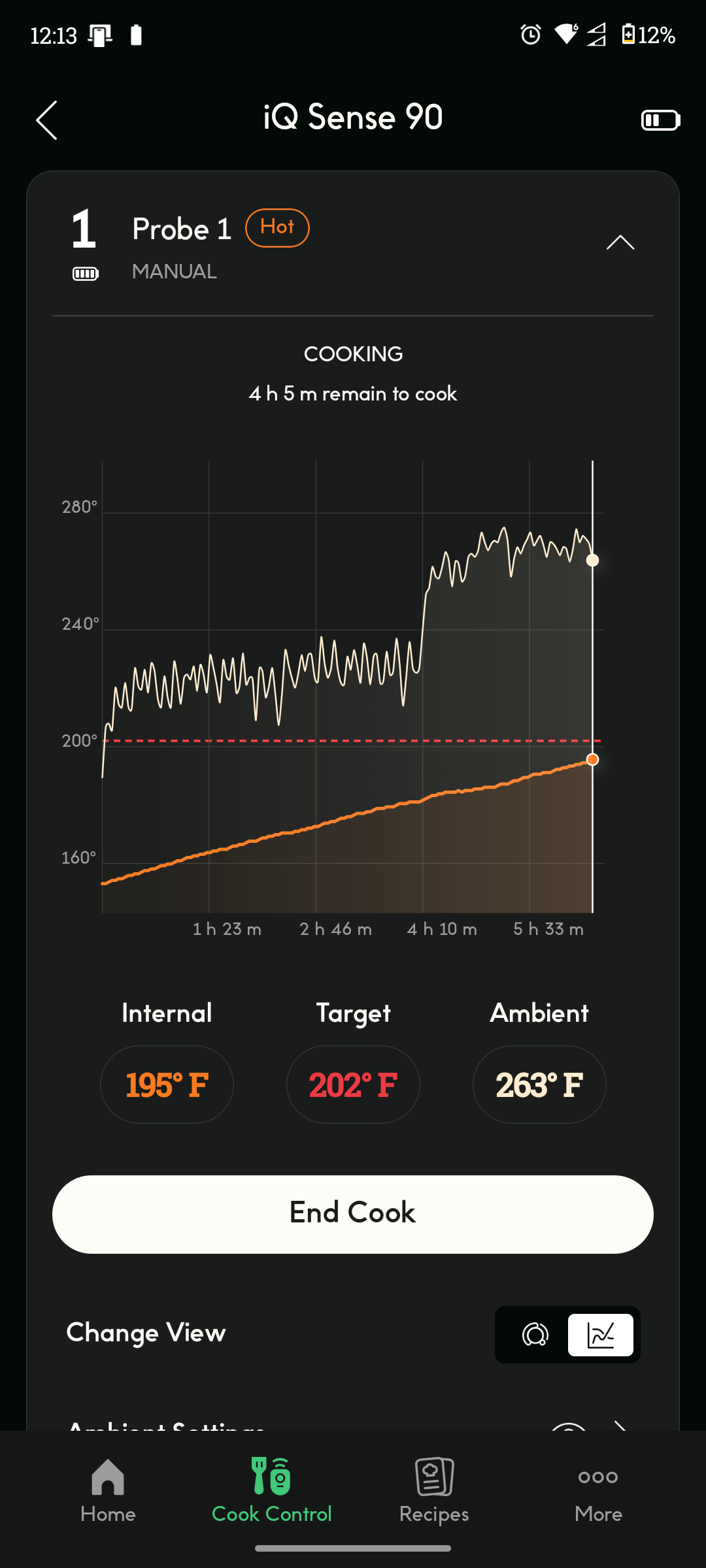
Setpoint on the grill was 225F. First picture is a shorter duration of the cook. The upper grey line is for ambient temperature. The red line is desired temp of 202F and the orange line is internal temperature. I was making a pork picnic shoulder cut into three pieces.
The second picture shows a much longer period if the cook. Each large ambient valley was due to me opening the grill for a spritz or to tend to the ribs I was also making. What I find interesting is the difference in ambient temperature after I turned the meat. The first picture and first 60% of the cook time in the second picture were when I had the probes facing upwards. The last 40% of the cook the probe was facing downwards.
It really does illustrate the difference in temperature between what the top of the food sees and what the bottom of the food sees in my grill. I would love to know how other grills do with temperature when charter this way.
Grill is a 6 year old GMG Daniel Boone Prime and temperature probes are ChefIQ sense wifi thermometers.
by TheDamus647
2 Comments
I don’t think there is anything crazy for a 6 year old pit. If the valleys your talking about are those lows in the first few hours as it’s set at 225, you might be opening up your pit to often. You are going to see bigger swings as the pit stabilizes temp each time you open it. I don’t think there is anything wrong with 215 to 235 swings.
Nothing here is outside of the ordinary.
I don’t know your grill, but the interior temperature is usually dictated by a thermocoupler. Depending on where that is located, it will impact temperature at the cooking location. Additionally, buildup (soot etc…) on the thermocoupler can interfere with the temperature readings so its worth giving that a scrub down on a regular basis.
Might be worth doing a toast/biscuit test to find additional hot spots.