
Summary 
Oleificio Dell’Orto, located in Oliveto Citra overlooking the Upper Sele River Valley, has been producing olive oil since the 1870s, with the fourth generation of the family now leading the company. The mill has embraced innovation over the years, introducing modern extraction technologies and conducting research on olive processing by-products, while also focusing on sustainability, education, and oleotourism to preserve the land and create opportunities for the community.
Perched on a hilltop overlooking the Upper Sele River Valley in Campania’s Salerno province, Oliveto Citra has been home to Oleificio Dell’Orto since the 1870s. The scenic village takes its name from the Italian word for “olive grove” and a reference to its thirteenth-century origins, reflecting its deep olive-growing vocation and historic legacy.
One of our oldest trees is a Carpellese, a symbol of our company’s history with its beautiful and imposing presence. Knowing how to preserve the territory and share its story has great value today.- Polidoro Dell’Orto, Oleificio Dell’Orto
“The company was founded by my great-grandfather Vito, then passed to my grandfather, after whom I was named, my father Fiore, and eventually my brother Sergio and I,” co-owner Polidoro Dell’Orto told Olive Oil Times. He represents the fourth generation of a family of millers who have guided the evolution of extraction technologies for more than a century and a half.
 The Dell’Orto family and their co-workers during the harvest
In the mill’s earliest years, oil was extracted using two presses with hand-operated winches, then collected in a tank from which it was ladled out with a bowl. Hydraulic power later transformed the machinery, and the arrival of centrifuges significantly improved efficiency and quality.
The modern continuous-cycle cold-extraction system was introduced by the two brothers, who grew up in the mill and embraced innovation at every opportunity.
“In 1998, we invested in upgrading our milling technology, leading the way in the area,” Dell’Orto said. “Since then, we have never stopped. We have replaced three plants, always striving for the highest quality.”
The company’s facilities sit at the heart of an orchard of 1,500 olive trees spanning the valley, where Campania’s second-largest river flows. Centuries-old trees grow alongside newer plantings.
The orchards consist primarily of Carpellese and Rotondella, native varieties from which Dell’Orto crafted two premium extra virgin olive oils — a monovarietal and a blend — each awarded the highest honor at the 2025 NYIOOC World Olive Oil Competition.
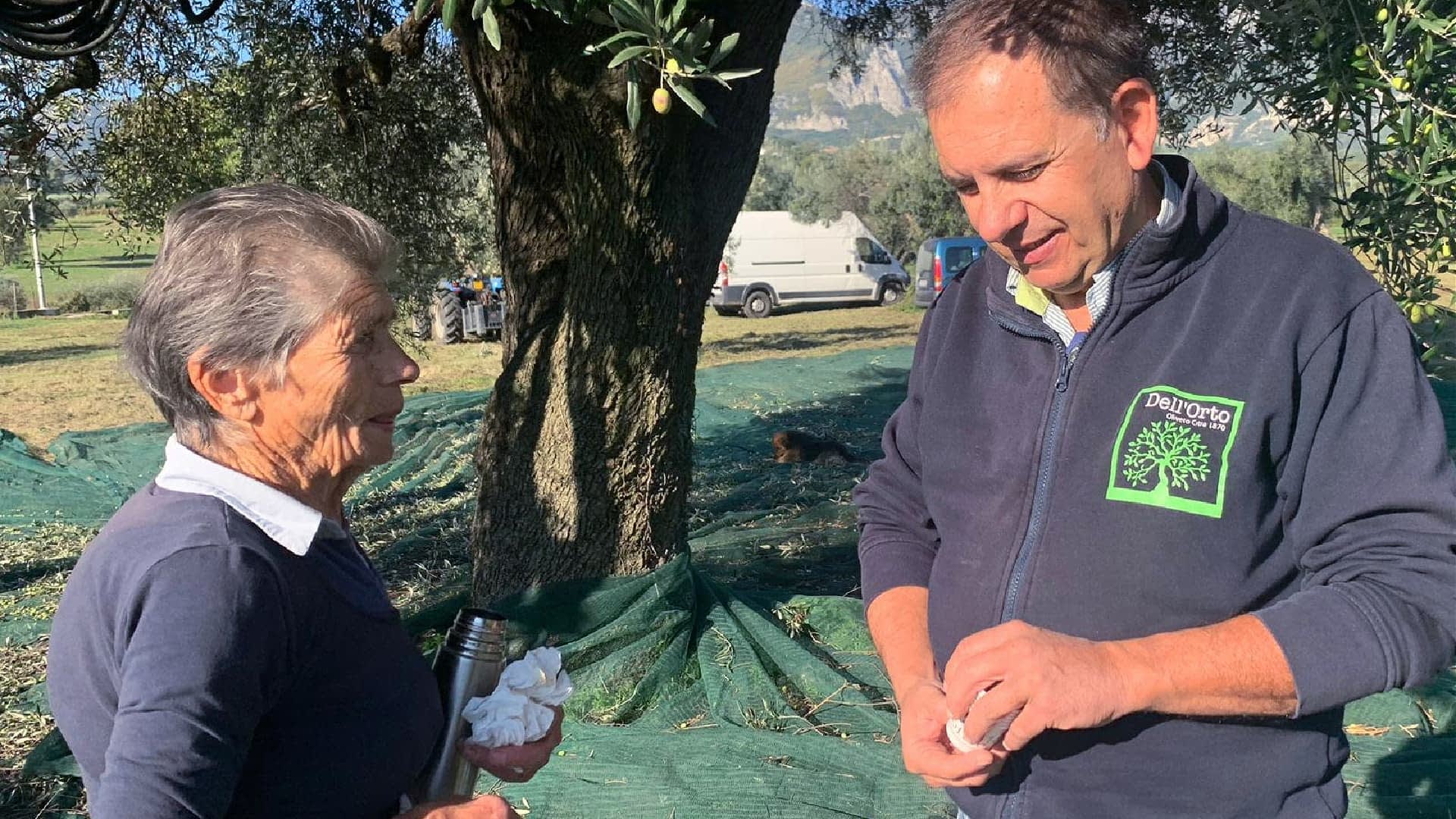 Polidoro Dell’Orto and his mother Lucia at their family farm in Oliveto Citra
“One of our oldest trees is a Carpellese, a symbol of our company’s history with its beautiful and imposing presence,” Dell’Orto said. “I often invite friends and visitors to touch it as a gesture of good luck.”
He noted that Greeks and Phoenicians likely introduced olive cultivation in the region. “Because of this long history, our groves include not only classic varieties such as Leccino and Frantoio but also others that remain unidentified. We are beginning a research project with the agricultural research council, CREA, to study their genotypes.”
Research plays a central role at the company, which also collaborates with the National Research Council (CNR) in Naples. The mill has joined a study on wastewater and olive pomace, exploring innovative applications, including potential uses in medicine.
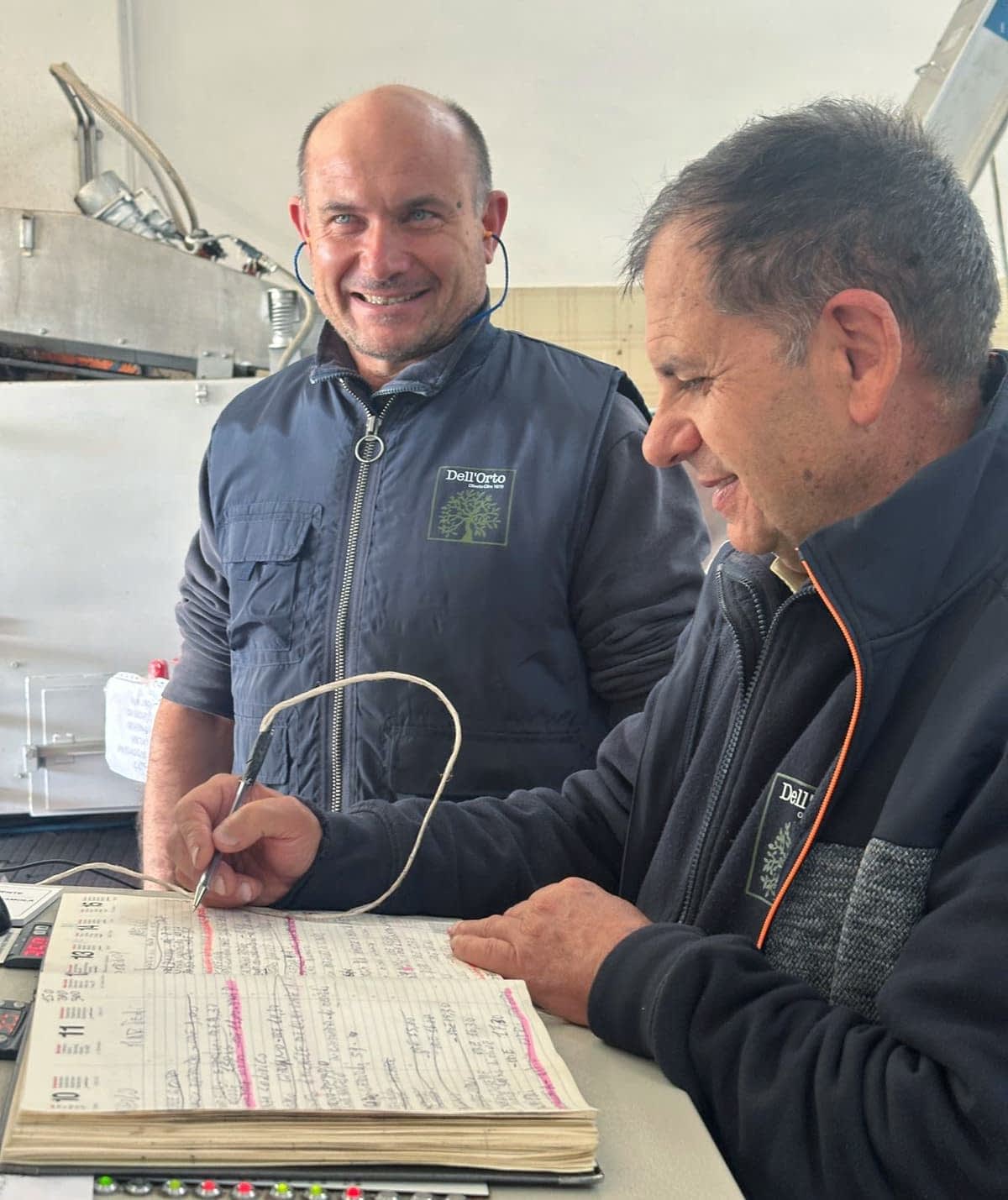 Polidoro (right) and Sergio Dell’Orto working at the family mill
“We are interested in studying processing by-products because we believe nothing from the olive tree should be wasted,” Dell’Orto said. The company valorizes olive pits as a biomass source and allows olive leaves to mature and ferment. “After a year and a half, they become rich peat we use to fertilize the soil.”
“We conduct research both in the field and in the mill, where we continuously experiment with our Alfa Laval machines,” he added. “Each year, we make improvements to maximize performance.”
Beyond third-party milling, the company works closely with local farmers. Technicians monitor the groves year-round and provide agronomic advice. The mill then purchases top-grade olives from these growers to produce a dedicated line, currently sourced from about 2,000 trees.
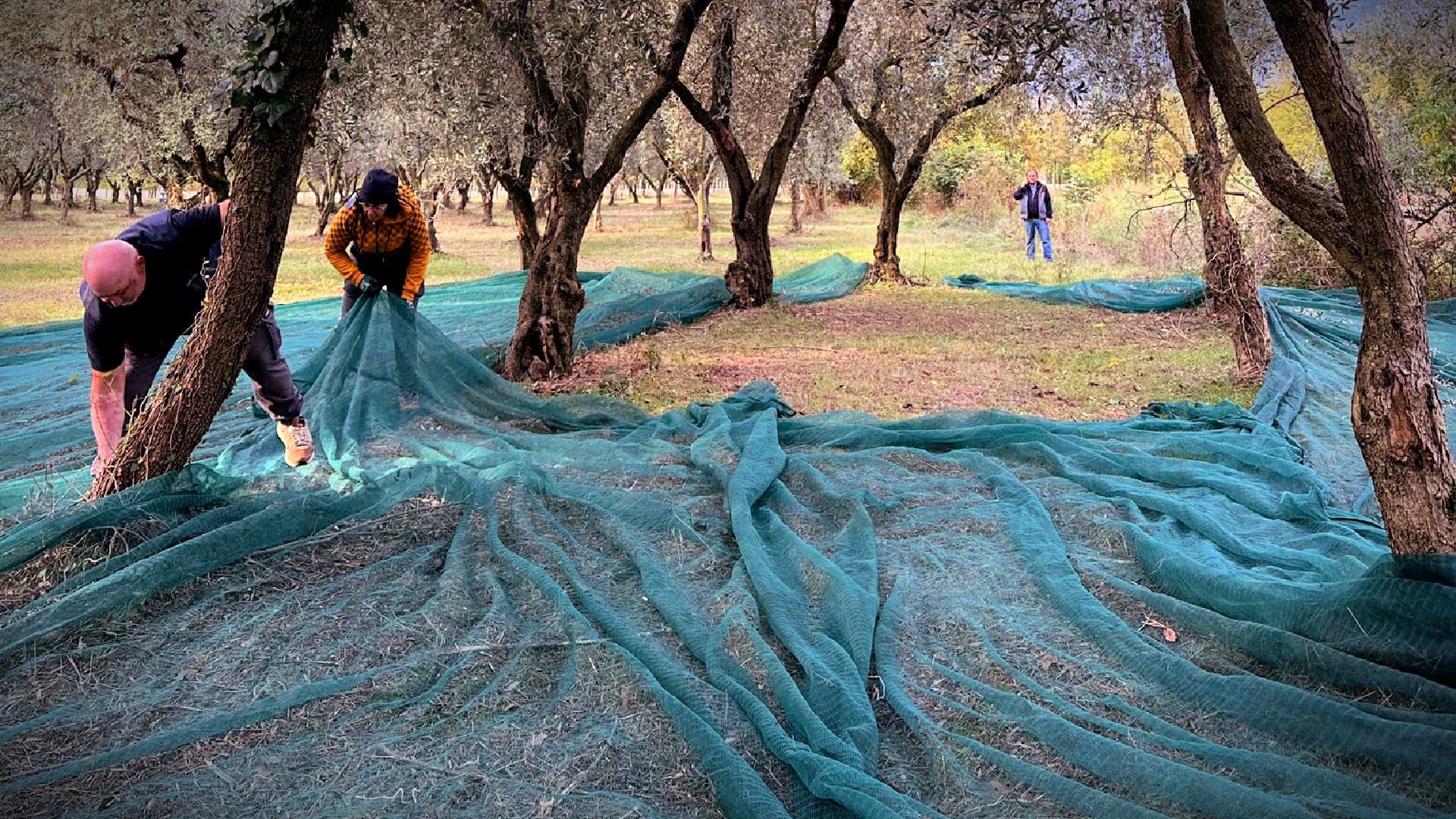
 Workers spread nets beneath the olive trees during the harvest at the Dell’Orto farm.
“We have seen many growers in the area switch to organic farming, which is very positive,” Dell’Orto said. “Farmers are increasingly aware of sustainability, a principle that guides our work.” The company also installed photovoltaic panels to power its facilities.
“Our oils are distinguished by two guarantee labels, the DOP Colline Salernitane and organic certification,” he added. “They represent our bond with this land and our commitment to protect it.”
The company exports 50 percent of its output through importers specializing in premium products, with Japan, the United States, Sweden, Switzerland, and Australia among its main markets. International buyers, he said, value the farm’s environmental dedication.
“We often host visits from our buyers so they can see how carefully we manage our groves,” Dell’Orto said. “Above all, I care for this land because I was born here and deeply cherish it. Respecting it comes naturally.”
 Polidoro Dell’Orto and his wife Eliana Calabrese
“Our quality vision includes not only the products but the entire territory,” he continued. “Oliveto Citra is untouched by pollution or heavy industry. The land is pristine, and the landscape is beautiful, especially in spring and fall when the valley’s colors shine. Knowing how to preserve the territory and share its story has great value today.”
In recent years, Dell’Orto has dedicated himself to educational initiatives for the public and for students, aiming to raise awareness of quality olive oil and create new opportunities for local employment.
“Depopulation has long been a major issue for Italian villages, reducing the available labor force,” he said. “For this reason, we organize events, conferences, and tastings to involve people — especially young people — and keep them connected to the land.”
Students are invited to tour the groves and mill. Tasting courses are offered to future chefs, while younger children learn about healthy eating and habits.
“I believe in the power of education to stimulate an appreciation for quality and care for the land,” Dell’Orto said. He noted that new B&Bs, agritourism properties, and vacation homes have sprung up in recent years, bringing in more visitors. “Olive growing shapes the landscape and creates opportunities for oleotourism that benefit the community.”
The company’s groves are open to everyone. The property has no fencing, and Dell’Orto encourages neighboring farmers to let their animals roam freely.
“Our groves are covered with grass, so we allow our chickens to scratch under the trees and a local shepherd to bring his sheep to graze. Another neighbor’s horses roam through the rows,” he said. “Sometimes a new dog or cat shows up, and we care for them all. There is a natural synergy between the animals and the thriving groves, where foxes and other wildlife find habitat. This is further proof of a healthy environment, and we believe safeguarding the land is the only way to produce truly high-quality extra virgin olive oils.”
Dining and Cooking